Tag: International Federations

  • Ingmar De Vos sole candidate to run for ASOIF Presidency

    Ingmar De Vos sole candidate to run for ASOIF Presidency

    The Belgian, Ingmar De Vos, Council member of the Association of Summer Olympic International Federations (ASOIF), member of the International Olympic Committee (IOC) and President of the International Equestrian Federation (FEI), will stand for election as the next ASOIF President at the 48th General Assembly on 9 April in Birmingham, United Kingdom. The third term of incumbent President Francesco Ricci Bitti will come to an end on 31 December 2024.
    The President is elected by secret ballot for a term of four years in the year of the Summer Olympic Games and takes up the position on 1 January of the following year.
    The nomination of Mr De Vos was the sole candidature received by the official deadline of 25 March. In line with the ASOIF Statutes, Full Members may nominate one of their executive body members for the position of ASOIF President.
    Ingmar De Vos has served as FEI President since 2014 and as ASOIF Council member since 2019. An IOC Member since 2017, he is part of the IOC Coordination Commission for LA28, the Legal Affairs Commission, and the Gender Equality, Diversity and Inclusion Commission. He is also a SportAccord Executive Committee member, ASOIF representative on the WADA Executive Committee, member of the Board of Directors of the Belgium Olympic Committee, and a UN International Gender Champion.
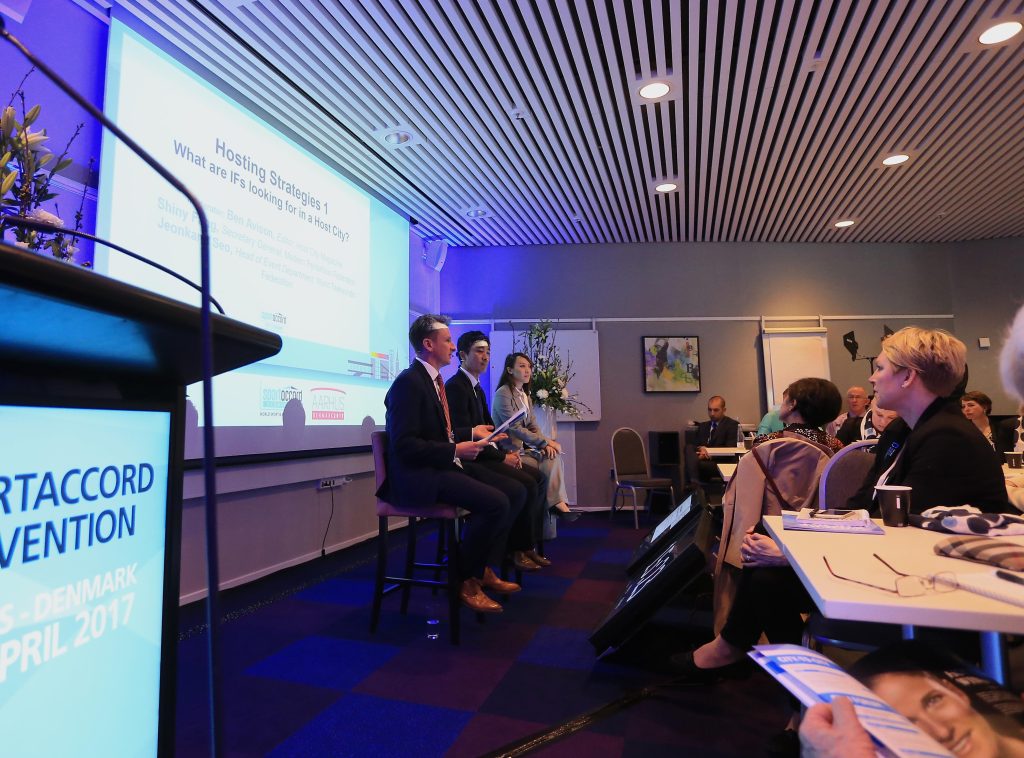
    The 48th General Assembly will be organised during the SportAccord World Sport & Business Summit, which takes place from 7 to 11 April in Birmingham, United Kingdom. It will be fully livestreamed on YouTube. Click here to learn more about the agenda.

  • Shooting and football federations sign good governance partnership

    Shooting and football federations sign good governance partnership

    [Source: IFAF] The International Federation of American Football (IFAF) and International Shooting Sport Federation (ISSF) have signed a Memorandum of Understanding (MoU), formalising a partnership under which the two International Federations (IFs) will collaborate with the primary aim of optimising costs and environmental impacts associated with key areas of governance.
    The wide-ranging agreement, which is thought to be a first of its kind between IFs, reflects a shared commitment to progressive sports governance in line with the priorities of the International Olympic Committee’s (IOC’s) Agenda 2020 + 5.
    Cooperation in the framework of the MoU is already under way, with the two organisations agreeing to co-finance the attendance of legal delegates to the IOC Medical Conference and Prevention of Competition Manipulation Workshop in 2025.
    These areas – medical, safeguarding and integrity – represent a core focus for collaboration under the agreement, which is structured around three pillars:

    Shared Resources, exploring opportunities for co-funding and mutualisation;
    Knowledge transfer, via regular exchange of experience and best practices; and
    Cross-promotion initiatives, seeking to enhance the visibility of both sports and their respective athletes in the build-up to the Olympic Games LA28.

    The two International Federations are respectively among the youngest and most established in the Olympic movement, presenting considerable value in exchange.
    IFAF achieved full IOC recognition in 2023 and was awarded associate membership of the Association of Summer Olympic International Federations (ASOIF) at the organisation’s General Assembly in 2024, following the inclusion of flag football on the sports programme of the Olympic Games LA28. The fast-growing, high-speed version of America’s favourite sport is set to be among the most high-profile attractions at the Games in Los Angeles, where it will enjoy a prime downtown venue and with leading NFL stars recently cleared to compete.
    Shooting sport featured on the programme of the first modern Olympic Games and has been governed internationally by ISSF since its establishment in 1907. The ISSF has ambitious plans to further build on the sport’s popularity in north America, leveraging two competition venues at LA Clays and the Long Beach Convention Center that puts the sport at the centre of the Games plan.
    Pierre Trochet, President of IFAF, said: “We are pleased to strengthen our cooperation with the ISSF – a federation that shares our commitment to exemplary and progressive governance, and is open to innovative approaches to optimising costs and impacts.
    “Pioneering new, smart models of collaboration is a cornerstone of IFAF’s growth strategy, as we have demonstrated through our transformative partnerships with professional leagues. With this MoU, we are extending the same approach to institutional governance, allowing us to drive mutual benefits and efficiencies, and for IFAF – as a young and ambitious federation, determined to implement best practices – to benefit from the wealth of experience held by our established peers.”
    ISSF President, Luciano Rossi, said: “As one of the founder members of the modern Olympic Games in 1896, it is a pleasure to join forces with IFAF, who after many years of dedicated effort has become one of the newest members of the Olympic family. We are looking forward to working together in areas of mutual interest and I am confident that through creative collaboration we can become more efficient individually but also contribute new ideas in support of the Olympic movement.”

  • IOC President-Elect calls on Olympic Family to challenge existing models

    IOC President-Elect calls on Olympic Family to challenge existing models

    “We are in a period of transition in the Olympic Movement,” ASOIF President Ingmar de Vos said in his speech welcoming IOC President-Elect Kirsty Coventry and paying tribute to IOC President Thomas Bach, at the ASOIF General Assembly.
    Also addressing President-Elect Kirsty Coventry, World Athletics President Lord Coe said: “There is a huge opportunity with the new leadership to create the reset around the relationship between the IOC and the IFs, and particularly the review of the revenue generation model. 
    “We all want the pinnacle of Olympic sport being the pinnacle of the four year summer sporting cycle and we look forward to working with you. You will have the support all the IFs; we stand ready to support you. 
    IOC President-Elect Kirsty Coventry said: “We would all love to say we hope the next few years are going to be smooth but I’m not sure that’s quite going to be the case.”
    Listing the challenges ahead, she referred to “all the geopolitics we are going to need to navigate, the more and more conflicts that our world is facing, revenue models.”
    “We won’t always agree. We hope we can be respectful enough to disagree… but that’s what a family is about. It’s how we are going to come together to make sure we have the best Olympic Games and the best platform for generations to come.”
    Bravely challenge models
    With reference to recent “tough discussions” with ASOIF about “event delivery”, she said “International federations need to play a greater role.”
    “It’s important to take some time to engage with all of you to fully understand not just want your expectations are, but how we are going to deliver extraordinary Games in LA and Brisbane, and into the future. 
    “We have to be brave enough to challenge some of the models that we’ve been doing.
    “It’s very clear there are two priorities, two pillars: the Olympic Games, and ensuring the Olympic Games is the biggest success for our athletes; and the second one is then building a better world through sport. The first one has to be extremely successful in order to have the second one. 
    “So we really need to focus on how we are going to ensure together we are going to have incredible Games that will inspire generations and more people across the world.”

  • IFSC rebrands as World Climbing

    IFSC rebrands as World Climbing

    The International Federation of Sport Climbing (IFSC) has officially become World Climbing, unveiling a refreshed global identity that reflects the sport’s rapid rise and its diverse global community. The rebrand highlights the evolution of climbing, nearly 19 years after the organisation’s founding. 
    Built around the guiding philosophy “We get the World Climbing,” the new identity reinforces the federation’s values and commitment to openness, inclusivity, culture, and inspiration. 
    “Since climbing began its Olympic and Paralympic journey in 2007, our community has evolved rapidly,” said World Climbing President Marco Scolaris. “This transformation into World Climbing is another important step in the journey. It reflects our heritage while embracing the future. This new brand represents every part of our sport, from Athletes to National Federations, to global partners and more.”
    As climbing continues to grow in mainstream society, particularly with younger, digitally connected audiences, the new visual identity aims to strengthen the sport’s visibility and accessibility worldwide. World Climbing’s modernised brand will help connect new participants with the sport’s history, culture and values, while also enabling a more cohesive presence across events and digital platforms. 
    At the heart of the rebrand is a distinctive new logo: a ‘world’ formed from climbing holds, with interwoven routes symbolising global climbing. Each colour in the new palette represents one of the sport’s three disciplines, Lead, Boulder and Speed, all in harmony with a written font that will be seen to be ascending in selected visuals.
    “Climbing started from humble beginnings and has developed into the sport we always believed it could be,” Scolaris added. “With World Climbing, we are not simply adopting a new name, we are promoting a global identity that reflects our principles of inclusivity, adaptability, responsibility and adventure. We are becoming a bigger part of many more people’s lives, and this brand is built for that future.”
    The transition to the name World Climbing was formally approved by national federations in October 2023 and written into the federation’s statutes, after which work began on developing the new identity.
    The visual identity will be rolled out throughout the 2026 season, anchored by the launch of the new World Climbing Series, which will succeed the IFSC World Cup. The federation’s five continental bodies, World Climbing Africa, World Climbing Asia, World Climbing Europe, World Climbing Oceania, and World Climbing Pan America, will adopt the updated identity as part of the global implementation. A phased digital transition will accompany the rollout, including new broadcast graphics, event branding and online platforms designed to bring the sport to life for audiences across the world. 
    “We’re setting the holds on the wall of life, building the routes that we will climb together, into the future. Higher, stronger, faster; Together”, president Scolaris concluded.

  • ASOIF raises voices of IFs in new strategy

    ASOIF raises voices of IFs in new strategy

    The Association of Summer Olympic International Federations (ASOIF) has outlined a new long-term strategy aimed at strengthening the collective voice and influence of International Federations (IFs) within the Olympic and wider sports movement.
    Unveiled at the start of 2026, the ASOIF Strategy 2026–2032 follows a year of consultation with member federations under the leadership of ASOIF’s new President, Ingmar De Vos. The strategy sets out a shared mission “to represent, strengthen and grow the collective influence of the Summer Olympic International Federations within the Olympic and Sports Movement”.
    Developed through a comprehensive membership survey and consultation process, the six-year framework is designed to guide ASOIF’s priorities through the next two Olympic cycles, up to and including Brisbane 2032.
    Three strategic pillars
    The strategy is built around three core pillars intended to support IFs during a period of significant change for the Olympic Movement.
    The first pillar, Advocacy, Influence and Representation, focuses on advancing the collective voice and autonomy of IFs, promoting high governance standards and strengthening their standing within sport and society.
    The second, Olympic Games Excellence, seeks to secure more meaningful and structured involvement of IFs in International Olympic Committee (IOC) and Olympic Games Organising Committee (OCOG) decision-making, while maintaining a constructive and aligned partnership with the IOC.
    The third pillar, Collaboration and Knowledge Sharing, aims to coordinate collective responses to shared challenges, encouraging structured cooperation, information exchange and member-driven initiatives.
    According to De Vos, the strategy is designed to move beyond high-level principles and deliver practical outcomes.
    “Our new Strategy translates three clear strategic pillars into actionable, achievable and measurable initiatives,” he said. “With a roadmap extending to 2032, aligned with the Olympic cycle, we are anticipating an evolving governance and operational landscape while remaining firmly guided by our core principles of member focus, collective value, clarity, transparency and future readiness.”
    Implementation and governance focus
    As ASOIF moves into the implementation phase, the role of its Olympic Games Committee has been elevated and more closely aligned with the Olympic Games Excellence pillar. The intention is to strengthen support for IFs across Games planning, delivery and operational coordination.
    Good governance remains a central theme. The Sixth Review of IF Governance has already been launched, continuing ASOIF’s benchmarking work in this area, with results due to be published in summer 2026.
    Progress on the new strategy will be reviewed by the ASOIF Council at its next meeting on 3 March 2026, with a more extensive discussion planned for the organisation’s 50th General Assembly, scheduled for 25 May 2026 in Baku, Azerbaijan.
    Key milestones in 2026
    Beyond internal governance, ASOIF and its members will be closely involved in several major Olympic milestones during the year ahead.
    These include continued support for the Dakar 2026 Youth Olympic Games in October, which will mark the first Olympic event hosted on the African continent. Preparations for the Los Angeles 2028 Olympic Games are also expected to intensify, while confirmation of the sport programme for the Brisbane 2032 Olympic Games is anticipated.
    Throughout 2026, ASOIF plans to maintain structured dialogue with the IOC, positioning its new strategy as a foundation for closer collaboration and a more coordinated, future-focused Olympic Movement.

  • ASOIF General Assembly focuses on strategy, governance and Olympic Games preparations

    ASOIF General Assembly focuses on strategy, governance and Olympic Games preparations

    [Source: ASOIF] The 36 Full and Associate member federations of the Association of Summer Olympic International Federations (ASOIF) gathered today in Lausanne, Switzerland, for the organisation’s 50th General Assembly, with discussions centred on the implementation of the new ASOIF Strategy 2026-2032, the Sixth Review of International Federation (IF) Governance, and preparations for upcoming Olympic Games and Youth Olympic Games.
    The General Assembly was officially opened by ASOIF President Ingmar De Vos before International Olympic Committee (IOC) President Kirsty Coventry addressed the member federations.
    The IOC President highlighted the power of sport and emphasised that all stakeholders within the Olympic Movement must work closely together to fully unlock its potential. She also underlined the vital role played by the IFs and the importance of their continued development and ambition, stating: “If you are not strong and striving, neither are we.”
     
    Implementing the ASOIF Strategy 2026–2032
    ASOIF presented the implementation roadmap for its new Strategy 2026–2032, which is built around three strategic pillars: Advocacy, Influence and Representation; Olympic Games Excellence; and Collaboration and Knowledge Sharing.
    During the meeting, ASOIF also highlighted its refreshed brand identity which was launched in April and is aligned closely with the organisation’s strategic direction and future ambitions. The new visual identity reflects ASOIF’s commitment to innovation, collaboration and a strong partnership with the IOC.
    Reflecting on the new strategy during his opening remarks, ASOIF President Ingmar De Vos said: “Importantly, the strategy recognises that collective action matters more than ever. No single IF can navigate every challenge alone. The strength of ASOIF ultimately comes from the willingness of IFs to collaborate, to share expertise and to act collectively where it matters.”
     
    Governance remains a priority
    Governance continues to be a central focus for ASOIF and its members. The General Assembly received an update on the Sixth Review of International Federation Governance, the outcomes of which will be published in June.
    All 36 Full and Associate Members participated in the review process, which is overseen by ASOIF’s Governance Task Force and supported by an independent governance consultancy. The review is based on a comprehensive framework of governance principles and indicators tailored specifically to the needs of international sport federations.
     
    Olympic Games and Youth Olympic Games preparations
    The General Assembly also received in-person updates from the Organising Committees of LA28, Brisbane 2032 and the Dakar 2026 Youth Olympic Games.
    Representatives from LA28 presented how they are planning to deliver the largest sports programme in Olympic history and outlined planned testing and readiness activities. They also highlighted accelerated recruitment across key operational areas as preparations move increasingly toward Games delivery and test event planning.
    The Organising Committee reported strong public interest following the launch of the ticket draw, with more than four million tickets sold across 85 countries and all 50 states in the first drop.
    The seventh LA28 Coordination Commission meeting with ASOIF representation will take place in Los Angeles from 2-4 June 2026.
    Preparations for Brisbane 2032 continue to progress, with the Queensland Government’s Delivery Plan now in place and venue development and procurement processes under way.
    The Organising Committee confirmed ongoing engagement with the IOC and IFs regarding the development of the sports programme, with the initial programme expected to be finalised in late 2026 or early 2027. Additional milestones foreseen in 2026 include further venue delivery developments, sustainability strategy confirmation, commercial announcements and the unveiling of the Games emblems. Brisbane 2032 has also set up an Athlete and Sport Advisory Group to ensure structured athlete engagement and input.
    Taking place from 31 October to 13 November 2026, the Dakar 2026 Youth Olympic Games will be the next Olympic sports event and the first one on African soil. The Organising Committee presented progress updates across key operational areas, while highlighting continued collaboration with IFs to support sport planning and delivery.
    The eighth Coordination Commission meeting with ASOIF participation took place in Dakar in March 2026 and marked the transition from planning to operational readiness.
     
    Updates from the IOC, WADA and ITA
    The General Assembly also received updates from the IOC on matters relating to IFs and the Olympic Games, especially in the context of the IOC’s “Fit for the Future” process and the related Working Group discussions. Meanwhile, the World Anti-Doping Agency (WADA) and the International Testing Agency (ITA) delivered reports on their anti-doping efforts and collaboration with IFs.