Tag: Russia

  • Moscow ready to host the World Cup, says Mayor

    Moscow ready to host the World Cup, says Mayor

    Moscow’s urban systems could cope with hosting an event on the scale of the FIFA World Cup “tomorrow”,  Sergei Sobyanin, Mayor of Moscow said on Saturday in an interview with TV channel Moscow 24. He also said that football infrastructure will need to be fully modernised before the city is ready to host.
    The Mayor’s comments come just a few days after the revelation from his office, City Hall, that Moscow will spend US$8.1bn on preparing for the 2018 FIFA World Cup. This figure was four times as much as the US$2bn that the city’s top sports official Alexey Vorobyov said earlier in April would be spent on sporting and transport infrastructure.
    The largest proportion of City Hall’s revised budget will be allocated to urban infrastructure indirectly associated with the event. Two thirds of the budget will go towards transport upgrades in Moscow, which currently experiences some of the heaviest traffic in the world. 
    Eleven per cent of the spending will be spent on sports facilities, including the major task of redeveloping Luzhniki Stadium, which is Moscow’s biggest sporting infrastructure project. 
    “The works are fully under way,” said Sobyanin. “At the same time, training fields are being built and football infrastructure will become modern by then.”
    Sobyanin confirmed that the new Otkrytie, or Spartak stadium will open this year, along with a new Spartak metro station. He also said the number of hotel rooms in Moscow is growing by 1,000 each year.
    The successful hosting of the IAAF World Athletics Championships in 2013 is evidence of Moscow’s capacity to host mega events, he said. “In terms of number of teams this is the second most spectacular event after the Olympics.”

  • HOST CITY partners with Casa da Russia for Brazil 2014 World Cup

    HOST CITY partners with Casa da Russia for Brazil 2014 World Cup

    Visitors to Casa da Russia – or House of Russia –  will be able to enjoy reading HOST CITY magazine, which is renowned for its insights into the business of hosting major sporting events. 
    Casa da Russia will hosted in Rio de Janeiro’s Museum of Modern Art and operated by Eventica Communications.
    “With facilities for media, government offices, hospitality lounges and a programme of events for Russian and international guests, the Casa da Russia will be Russia’s home from home at Brazil 2014, and will provide a perfect opportunity for Russia – the next host country of the FIFA World Cup – to showcase preparations and the host cities of Russia 2018,” Eventica said.
    As part of the partnership, HOST CITY will also preview activities at Casa da Russia as part of its online news coverage of the 2014 Brazil World Cup. 
    During the World Cup, matches will be broadcast live on big screens. Casa da Russia also promises to host a Russian cultural extravaganza, with guest musicians, bands, DJs and artists participating in a month-long celebration of Russia.
    Baltika has signed as the exclusive Beer Partner for Casa da Russia, following successful partnerships with Eventica over many years, including at the Russian Winter Festival in London’s Trafalgar Square from 2005 to 2008 and at Russia.Sochi.Park – the official Russian hospitality venues in London during the 2012 Olympic Games.
    The accreditation process for the press centre at Casa da Russia is already open. In the first week of opening, the organisers Eventica Communications registered 160 Russian and British journalists from media including O Globo, TV Record Brasília, Sky Sports, Sportbox, Russia Today, Sport FM and many more. 
    For more information visit http://www.eventica.co.uk/?p=5817#more-5817

  • Blatter warns against discrimination at Russia handover

    Blatter warns against discrimination at Russia handover

    The 2014 FIFA World Cup in Brazil was successful on many fronts, but president Sepp Blatter chose to highlight a “message of togetherness” after handing the tournament over to the next hosts, while president Vladimir Putin of Russia chose to praise the social impact of the World Cup.
    “FIFA’s World Cup in Brazil had a very special message to give – a message of togetherness and of connecting people, a message of peace and of anti-discrimination,” said Blatter after the ceremony at the Maracana Stadium on Sunday.
    “We have enjoyed a successful World Cup and we will have a legacy in this country. At the same time there is a responsibility for the next host country and I’m confident that Russia will take on this responsibility and also give us a wonderful World Cup to remember in 2018.” 
    During the ceremony inside the Maracana Stadium Putin said, “I want to congratulate President Rousseff on how the World Cup was organised. Football helps to solve social problems.”
    Putin’s decision to focus on the social benefits of hosting the World Cup is notable, given the major protests within Brazilian society that dogged the country as it prepared to host the tournament. Whether hosting the World Cup will act as a catalyst for change in attitudes towards sexuality in Russia remains to be seen.
    “Our task is to create the best possible conditions for the coaches, players, experts and fans,” said Putin. 
    “I am grateful to President Blatter and his colleagues from FIFA for the honour to organise the World Cup. We will do all we can to organise the event on the highest level”.
    Russia has its work cut out over the next four years. Seven new venues need to be built but construction is being held up by an auditing process, according to the Moscow Times. 
    Over the course of 2014 around US$ 23bn is supposed to be spent on large scale infrastructure projects, including the World Cup venues, but only 6 per cent of this had been spent by the start of June. 
    Russia will be able to take heart from Brazil’s broad hosting successes, despite the scramble to finish venues on time.
    ”Brazil is very proud for once again having staged the biggest football celebration in the world,” said Brazilian president Dilma Rousseff.
    “In the last 30 days the world has been connected to Brazil, celebrating goals with a lot of emotion in the 12 host cities and making this the World Cup of World Cups. I am sure that everyone who came to Brazil, like tourists and delegations, will take back memories of our hospitality and joy, and we Brazilians also have unforgettable memories. 
    “I wish the Russian people great success in the organisation of the 2018 FIFA World Cup.”
    The first major milestone event for Russia 2018 will take place in July 2015 in Saint Petersburg when the qualifying pathway for FIFA’s member associations will be defined at the Preliminary Draw, FIFA said in a statment.

  • Time a concern as work starts on World Cup stadium

    Time a concern as work starts on World Cup stadium

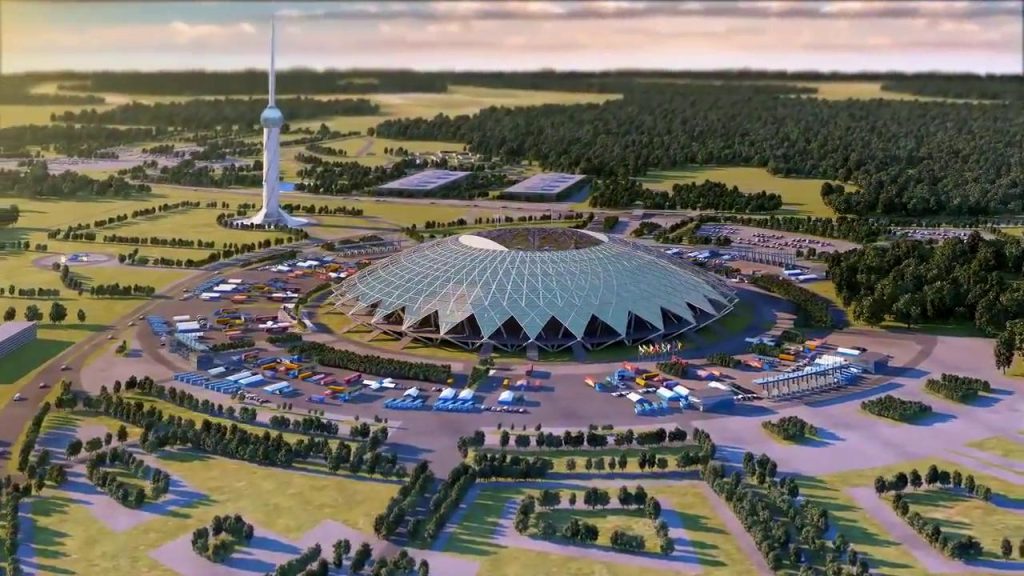
    The new stadium in Samara is set to have a capacity of 45,000 and will become the home of local club side Krylia Sovetov following the 2018 World Cup. Construction work on the stadium is expected to be completed in summer 2017 and will be linked to the city and wider region with new local infrastructure development. 
    Also in attendance at the ceremony was sports minister Vitaly Mutko. “All technical and administrative issues have been resolved and today we are starting to build the stadium” he said. “There are still key questions concerning the city’s development… but first and foremost is the sporting infrastructure that will be built here. Samara is football’s capital on the Volga. We are looking forward to all the necessary conditions being created for footballers and teams, as well as for fans to be welcomed.”
    Three of the planned 12 World Cup stadiums are currently completed, with two of them requiring reconfiguration in order to host football games. Whilst the Russian Government is insisting that all the stadiums will be completed on time, previous delays have raised alarm.
    Organizing committee head Alexei Sorokin told the Associated Press: ”That is a normal working concern. That does not mean we are lying down calmly and waiting for things to happen. It suggests that we are … attentive to it.”
    Whilst some of Russia’s World Cup plans appear to be on time and on budget, delays and rising building material costs are a cause for concern. The St. Petersburg stadium, for example, was due for completion in 2008 but is now unlikely to open before 2016 and at a hugely inflated cost of $1.1 billion.
    There have also been a number of concerns over infrastructure spending and logistical challenges associated with holding the World Cup in Russia but officials have maintained that these issues can be resolved on time.
    FIFA have said the design work for all the other stadiums is now completed and construction work is expected to begin this autumn. 
     

  • FIFA asks Russia to drop two World Cup cities

    FIFA asks Russia to drop two World Cup cities

    FIFA President Sepp Blatter recently visited Russia and met with President Vladimir Putin as well as Vitaly Mutko and Alexet Sorokin, the Chairman and the CEO of the 2018 FIFA World Cup Local Organising Committee respectively, to discuss the plans.
    The Interfax news agency quoted Mutko as saying: “The existing conception of the 2018 World Cup provides the staging of the event at 12 stadiums in 11 cities. FIFA recommended staging the World Cup at 10 venues in nine cities.”
    “We will once again tour the 11 cities, and then a decision will most likely be made. Everything will depend on how things move along and how the cities view the post-tournament program.”
    “We’ll finalise our decision taking into consideration the progress of the host cities in their World Cup preparations.”
    Blatter first revealed the reduction plans at the final press conference of the 2014 Brazil World Cup in July. He said: “We are not going to be in a situation, as is the case of one, two or even three stadiums in South Africa, where it is a problem of what you do with these stadiums.”
    Issues with stadium construction and underdeveloped infrastructure have also been cited as the reasoning behind FIFA’s demands, with several sites facing huge delays. Russian daily newspaper Kommersant recently suggested the cities of Volgograd, Kaliningrad and Yekaterinburg were the most likely to be excluded from the World Cup.
    However, other cities also face uncertainty. The construction of the 45,000 seated Rostov-on-Don Stadium is still yet to commence whilst in Saint Petersburg, the $1.1 billion New Zenit Stadium has faced massive delays. Construction work on the new home of Zenit Saint Petersburg began in 2006 but by 2012 was only half built and facing a complete redesign of the stands. The stadium may now not open until 2017, nine years past the original deadline.
    On the other hand, some Russian cities have fared much better with their World Cup developments. For example, the new Kazan Arena recently hosted its first football match after being completed in record breaking time last year. 


  • Brazil 2014 and Chelsea FC CEOs to address World Football Forum

    Brazil 2014 and Chelsea FC CEOs to address World Football Forum

    Two of football’s most influential figures are to speak at the World Football Forum in Moscow on 13th November 2014, with successful event hosting and financial fair play on the agenda
    Ricardo Trade, CEO of the local organising committee of Brazil 2014 will tell the World Football Forum audience about his experience of organising the world’s biggest single-sport event. 
    After playing as goalkeeper of the Brazilian handball team, Ricardo Trade became team trainer and supervisor for the Brazilian Volleyball Federation, participating in the 1988 Olympic Games in Seoul. Trade was operations director of the 2007 Rio de Janeiro Pan-American Games and participated in the Rio 2016 Olympic Games’ victorious bid campaign.
    Ron Gourlay, Chief Executive of Chelsea Football Club will lead a discussion of UEFA financial fair play (FFP) regulations. Since the introduction of FFP in 2011, clubs that have qualified for UEFA competitions have to prove they do not have overdue payments towards other clubs, their players and social/tax authorities from throughout the season. 
    Through this initiative, UEFA aims to prevent clubs going into debt, even applying sanctions that include exclusion from European competitions between 2014 and 2015. The World Football Forum 2014 provides the platform for one of the world’s most successful football clubs, Chelsea FC, to explain how they are tackling this current and fundamental issue in European club football, from the commercialisation of the stadium assets to grass root youth development.
    The World Football Forum in Moscow, which takes place on 13th November 2014, is a partner event of HOST CITY
     

  • Wrong conclusions on bid report, says FIFA investigator

    Wrong conclusions on bid report, says FIFA investigator

    The findings of FIFA’s long awaited ethics report into the bidding process for the 2018 and 2022 World Cups were announced today (Thursday), with the judge’s summary saying there was limited evidence of improper conduct. However, the investigator who produced the report says the summary misrepresented his facts and made erroneous conclusions. 
    In his summary, Judge Hans-Joachim Eckert concluded that there was not enough evidence to remove Russia or Qatar’s rights to host the World Cup or reopen the process, saying that any breaches of rules by bidding nations had only a “limited scope”. 
    Michael Garcia was hired by FIFA 18 months ago to find out the truth about widespread allegations of collusion and bribery in the bidding process that saw Russia and Qatar win the hosting rights to the 2018 and 2022 World Cups respectively. 
    “Today’s decision by the Chairman of the Adjudicatory Chamber contains numerous materially incomplete and erroneous representations of the facts and conclusions detailed in the Investigatory Chamber’s report,” he said on Thursday. He is now expected to appeal to FIFA’s ethics committee.
    In his 42-page summary of Garcia’s 430-page report, Eckert said that concerns over the activities of bidding nations were “limited” and not sufficient cause to question the outcome of the election.
    “The effects of these occurrences on the bidding process as a whole were far from reaching any threshold that would require returning to the bidding process, let alone reopening it,” said Eckert.
    Contraventions identified in the summary included improprieties in England’s bid campaign, namely incentives to executive committee member Jack Warner.
    “England’s response to Mr Warner’s – improper – demands, in, at a minimum, always seeking to satisfy them in some way, damaged the integrity of the ongoing bidding process. Yet, such damage was again of rather limited extent,” said Eckert.
    “We cooperated fully with the Ethics Committee’s investigation and continue to believe that a fair and appropriate review will demonstrate the integrity and quality of our bid,” said the Qatar 2022 Supreme Committee for Delivery and Legacy said in a statement. 
    “FIFA welcomes the fact that a degree of closure has been reached with the chairman of the adjudicatory chamber stating today that ‘the evaluation of the 2018/2022 FIFA World Cup bidding process is closed for the FIFA ethics committee. As such, FIFA looks forward to continuing the preparations for Russia 2018 and Qatar 2022 which are already well underway,” said FIFA’s statement.
     

  • Russia World Cup can change perceptions – Sorokin

    Russia World Cup can change perceptions – Sorokin

     
    HOST CITY: How are preparations going in terms of the stadiums?
    Alexei Sorokin: We’re had two ready for some time, Kazan and Sochi, and of course now we have Moscow Spartak which opened officially and the end of August and then staged its first game shortly afterwards. In the beginning of 2016 the St Petersburg stadium will also be ready. The rest are in different phases of construction.
     
    HOST CITY: Can you tell us about opportunities for international contractors?
    Alexei Sorokin: Foreign expertise was used in the design preparations. In some instances there has been a lot of consultancy from companies like Populous (England) and gmp (Germany). There is not a single stadium without some kind of foreign element. 
    The way we went about choosing was by public tender put out by the specific region. Different companies are being used for different aspects of design, so maybe one company for security, another for usability and so on.
     
    HOST CITY: What about venue sustainability? How will you ensure legacy use for such large venues?
    Alexei Sorokin: We don’t think the stadiums are that large. If you consider the population of the country, they are not overwhelmingly large. In some cases they will have demountable tribunes, in others they will stay at 45,000 seats, but the level of interest in football is enough to fill them to 80 per cent if not 100 per cent all the time. 
    We have strong assurances from the regional authorities that the need for such stadiums is there. The interest in football is of course not equal everywhere you go but that’s normal. There will be no white elephants for sure. 
    We’ve taken a lot of advice and the stadiums will all be designed in such a way that they are marketable for events other than football. If you look at Kazan, for instance, it will host aquatics in 2016. Every design has taken this concept into account. But we deliberately picked cities where clubs are playing in our Premier League, or at least are close to doing so. Several clubs in Russia jump back and forth. We have picked cities where people really go to watch football.
     
    HOST CITY: But are they cities that can also attract the kind of non-footballing commercial entities?
    Alexei Sorokin: The short answer is absolutely. Why do I say that? Because all but two of our cities have a population in excess of one million. There is a major need for a certain level of social life. They need a venue where people can get together.
     
    HOST CITY: What will make 2018 stand out from other World Cups?
    Alexei Sorokin: We hope to show a new country and the transition we have made in the last two decades; and to show how diverse Russia really is. We may be united by the same language but the regions are very different. 
    We certainly hope we can attract people to other regions than just the host cities because they are no less interesting. Some regions are dominated by religious culture or very historic. It will certainly be a discovery.
     
    HOST CITY: Russia’s latest mega event was Sochi, but there was a lot of negative media surrounding so-called “anti-gay” laws. How do plan to avoid such adverse publicity?
    Alexei Sorokin:  I wouldn’t call it an anti-gay law. It’s a law against propaganda over homosexuality amongst children. I recommend to everyone to read the contents of the law and try to understand it before twisting its nature which is what many have largely done.
     
    HOST CITY: Ever since you launched the bid, Russian football has been unable to eradicate racism. How harmful is this?
    Alexei Sorokin:  I would acknowledge that we have certain incidents and outbreaks of racism but not a dominating tendency. Many other countries also have incidents. I’m not saying that as a justification because it’s bad wherever it happens. 
    Our position is very strong. It’s part of our communication strategy, but it is not an overwhelming part of what we are doing in terms of organising the World Cup. But don’t get me wrong: it’s a very important subject to us and we are in constant discussions with the Russian Football Union, coming up with certain measures. We must make it unpopular and indecent to be involved in something like this.
     
    HOST CITY: What are the most important observations you took away from Brazil?
    Alexei Sorokin: It mostly lies in the field of atmosphere. The biggest impression for me was the atmosphere they managed to generate. You can’t just manufacture that as an organiser. It has to be natural. 
    The passion for the game was one of the true sentiments we brought back. We’ll struggle to match that, but every World Cup is different. We’d be wrong to try and copy them. Sometimes copying can be valid in terms of certain organisational patterns but in terms of overall climate, it has to be very distinct from all others.
     
    HOST CITY: Is travelling an issue for you like it was in Brazil?
    Alexei Sorokin: I truly don’t think so. You only spend a maximum two hours travelling from Moscow to the farthest venue away. I don’t think it’s that bad.
     
    HOST CITY: What about the scale of the budget which caused such a backlash in Brazil?
    Alexei Sorokin: We need to discern between what is spent on development of the various regions and the budget that is spent towards the event itself. In terms of the World Cup, the event budget is within appropriate limits. All the rest of it is about infrastructural development programmes which would have been spent anyway. 
    I won’t comment on what happened in Brazil but maybe it wasn’t explained enough, which we will try to do. These are investments into the lives of people including things like bringing hospitals that are close to stadiums up to certain standard. The World Cup will use them for a month but the people will use them for years thereafter.
     
    HOST CITY: Everybody knows how tense the relationship is between Russia and the rest of the world right now. What impact could this have on your security plans and the perception of 2018?
    Alexei Sorokin: Political situations tend to change. I don’t think it has any impact on our security because it’s always been a priority anyway. The World Cup is perhaps one of the ways of changing certain perceptions. That’s partly why our country decided to go for this. We are occasionally victims of old perceptions. Remember Euro 2012? There were some pretty negative perceptions beforehand but it went off well. The same applied to the Sochi winter Olympics. I wouldn’t spend much time thinking about perceptions.
     
    HOST CITY: Finally, you currently have politicians everywhere calling for sanctions – and even a World Cup boycott – because of the situation in Ukraine. What’s your reaction?
    Alexei Sorokin: Honestly the last thing I would do is comment on private opinions. It does not impact our work. Various people may have their opinions about where the World Cup should take place but it’s their opinion. If we paid too much attention to this it would be hard to organise the tournament.
    Our focus is the World Cup. It will remain that way for another four years. We don’t feel any threat. We are organising the tournament together with FIFA. We need to keep the principle that was declared many years ago, that sport should be beyond politics.
    This article first appeared in the Autumn issue of HOST CITY magazine. Register here.

  • 2018 World Cup breaks new ground with SIS Pitches reinforced turf

    2018 World Cup breaks new ground with SIS Pitches reinforced turf

    The FIFA World Cup final will be played on a surface incorporating artificial grass for the first time ever, after Russia 2018 organisers selected an innovative surface called SISGRASS from SIS Pitches.
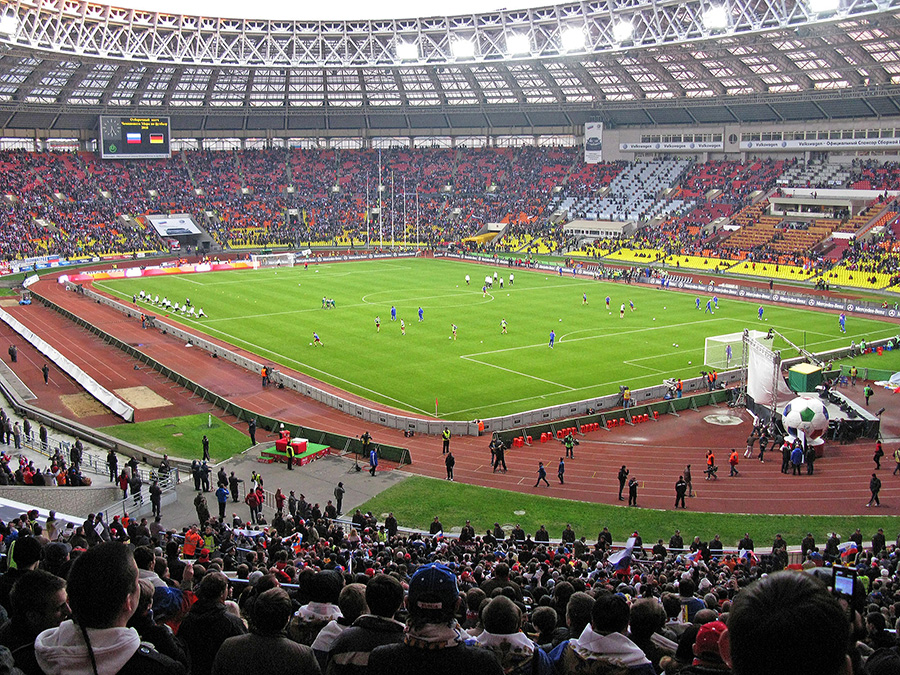
    A surface of 95 per cent natural grass impregnated with more than 150 miles of specially developed synthetic yarn will be installed at Moscow’s historic Luzhniki Stadium. 
    The pitch is scheduled to be ready in time for the Confederations Cup in May 2017.
    SIS Pitches said its SISGRASS surface offers a safer, softer surface that protects players from injury, but with three times the playing time of natural grass alone. 
    “It’s the first time a World Cup final has been played on anything but all-natural grass and it’s like a dream for us as a company and a community,” said SIS CEO George Mullan. 
    “We have come so far to get this system to the pinnacle of world sport.”
    The patented system was created after SIS Pitches approached Dutch engineers to design a ‘giant sewing machine on tracks’. This machine crawls across a pitch, implanting, or ‘stitching’, more than 240 million precise lengths of two-tone green synthetic yarn 180mm deep into the sub-surface.
    “We didn’t want to simply improve on existing machinery. We chose a challenge to create the perfect hybrid pitch of natural and synthetic grass and start from scratch,” said Mr Mullan.
    “It strengthens the structure of the natural grass, making it stronger and more resistant to damage which means more games can be played on a pitch. It also drains more effectively. For a busy tournament like the World Cup it is perfect.
    “At the same time it is player-friendly. Our polyethylene construction actually gives it a softer feel, with more consistency and greater traction than natural grass alone. That reduces injury risk and the bounce and roll is always even, so the players love all these features,” adds Mr Mullan.
    SIS Pitches says the durable surface is also visually indistinguishable from natural grass. 
    “TV Companies also love it because the surface stays looking beautiful at all times,” said Ilyas Kobal, SIS division managing director.
    “It was a long tender process but in the end our advantages meant even the local Russian companies could not match us.”
    SIS Pitches had to convince the FA, FIFA and a host of international testing bodies that its new system worked better than alternatives. This involved stringent accelerated wear trials by rigorous independent testing consultants STRI. 
    In these trials the new surface beat unreinforced grass for damage resistance, traction, grass cover and sheer strength, SIS said, claiming that the surface can be used three times longer in all weathers without damage and can be laid in just one week.
    Construction work to transform Luzhniki Stadium is underway, due for completion in early 2017. A system of undersoil aeration, drainage, irrigation and heating is being installed to allow the pitch to be used all year.  A custom designed rootzone will be laid, stitched with yarn and then seeded to be ready in time for the Confederations Cup.
    During the 2018 World Cup the stadium will host the opening and final matches. SIS Pitches has also signed a two-year deal to maintain the pitch after the World Cup, when Luzhniki will be the home of the Russian national team.
    Since its launch in summer 2015, SISGRASS has also been selected for Chelsea, Besiktas, Hull City FC and the English FA’s centre of excellence at St. George’s Park.
     

  • IOC asks sports federations to take events out of Russia
    IOC asks sports federations to take events out of Russia

    The IOC Executive Board on Tuesday said it will no longer back the 2019 European Games, set to take place in Russia, and has asked all Winter Olympic Sports Federations to find alternative host nations for any upcoming events. 
    These immediate decisions are part of a number of IOC responses to the World Anti-Doping Association (WADA)’s “Independent Person” report into doping in Russia. 
    “The IOC will not organise or give patronage to any sports event or meeting in Russia. This includes plans for the European Games 2019 organised by the European Olympic Committees (EOC),” the IOC Executive Board said in a statement. 
    “Because of the detailed references to the manipulation of samples during the Olympic Winter Games Sochi 2014 the IOC asks all International Olympic Winter Sports Federations to freeze their preparations for major events in Russia, such as World Championships, World Cups or other major international competitions under their responsibility, and to actively look for alternative organisers,” it added.
    “The findings of the report show a shocking and unprecedented attack on the integrity of sports and on the Olympic Games,” said IOC President Thomas Bach. “Therefore, the IOC will not hesitate to take the toughest sanctions available against any individual or organisation implicated.”
    The report, by “independent person” Richard McLaren was instigated after Grigory Rodchenkov, former director of Russia’s Moscow and Sochi antidoping laboratories, blew the whistle on cover-ups.
    “WADA is grateful to Richard McLaren, his team, and other contributors that, together, helped provide us with a fact-based path forward today as it relates to allegations and other information provided by Dr. Rodchenkov,” said Sir Craig Reedie, President of WADA said in a statement.
    “Shamefully, the McLaren Report corroborates the allegations, exposing a modus operandi of serious manipulation of the doping control process in the satellite laboratory set up in Sochi for the 2014 Games; and, the Moscow laboratory since 2011 and after the Sochi Games.
    “Not only does the evidence implicate the Russian Ministry of Sport in running a doping system that’s sole aim was to subvert the doping control process, it also states that there was active participation and assistance of the Federal Security Service and the Center of Sports Preparation of National Teams of Russia.”
    The IOC has now started “disciplinary actions related to the involvement of officials within the Russian Ministry of Sports and other persons mentioned in the report because of violations of the Olympic Charter and the World Anti-Doping Code”.
    The Report could result in a complete ban on Russian athletes participating in the 2016 Olympic Games, due to start in Rio de Janeiro on 5 August. 
    In the statement, the IOC said it will “carefully evaluate the IP Report. It will explore the legal options with regard to a collective ban of all Russian athletes for the Olympic Games 2016 versus the right to individual justice. In this respect, the IOC will have to take the CAS decision on 21 July 2016 concerning the IAAF rules into consideration, as well as the World Anti-Doping Code and the Olympic Charter.”
    For the full IOC Executive Board statement click here.