Blog

  • Cooperation in staging major events: why is compromise becoming so tricky?

    Cooperation in staging major events: why is compromise becoming so tricky?

    This November in Glasgow leading executives from the global major events industry met at the first in-person ‘Host City’ conference since the pandemic. The theme of the conference was exploring the new realities for major events in the post-COVID era. As a consultant and prior panellist, I was asked to chair a panel looking at “Partnership paradigms of event hosting and delivery”. Our panel included representatives of a major host city, a global sporting rights-holder and two event organisers – one traditional and one disruptive. In discussion with the panellists, we agreed to explore why it feels that cooperation between stakeholders in running major events is becoming ever more challenging.
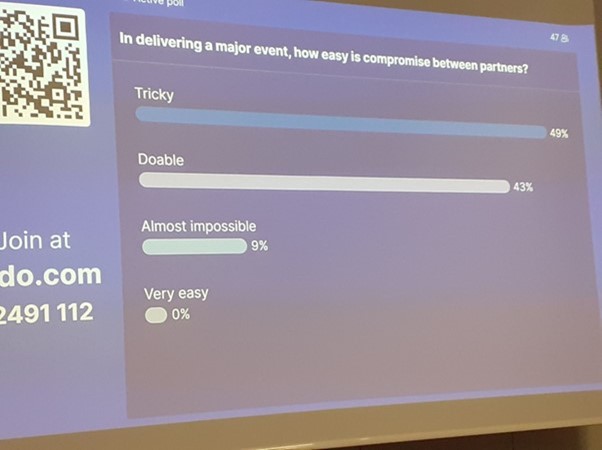
    At the start of the session, we polled the audience to test our theory. The question was simple: was this indeed the case? The results surprised me and are shown in the picture. Nearly half the delegates felt that compromise was ‘tricky’ while a worrying 9% felt it is ‘almost impossible’. 43% did feel that compromise is ’doable’ but no one, yes 0%, thought it was ‘easy’. This cannot be a good sign and these on-screen results certainly created an energy in the panel discussion.
    As I write, we are watching an 11th hour dispute between Budweiser, a FIFA Partner, and the 2022 FIFA World Cup (FWC) Host Nation around who can drink a Bud Light, where and when [1]. Such a public dispute two days before a global event that was awarded in 2010 seems avoidable; was compromise not possible much earlier? In our discussions at Host City, we learnt that the Edinburgh Festivals need more visitors in 2023 for the operators to return to profit. Yet the City Council has moved to significantly reduce supply in the temporary accommodation stock [2]. This new supply and demand imbalance has also driven up rental prices for visitors, performers and their crews. It seems the festivals are set to be even further away from profit in 2023. Without some form of compromise Edinburgh City council seem set to kill their ‘golden goose’. One festival, the Edinburgh Film Festival, has already seemingly collapsed, the organisers citing “the perfect storm of sharply rising costs, in particular energy costs, alongside reduced trade due to the ongoing impacts of the pandemic and the cost-of-living crisis” [3]. 
    But if the Edinburgh Festivals can recover to viability, does attracting hundreds of thousands of visitors to travel to Edinburgh sit comfortably with ESG considerations? Indeed, one can say the same of any large-scale event, such as a football world cup. ESG is becoming a major area of contention in sport. Just in the last few weeks we have seen the collapse of a lucrative sponsorship deal between a mining company and Australian Women’s Netball [4] and also one between British Cycling and Shell which cost the cycling CEO his job [5].
    Likewise, FWC22 clearly shows that Diversity, Equality, and Inclusion (D&EI) will only grow as a consideration in sport and other major events. FWC22 again is in the spotlight, following the collapse of plans by European captains to promote inclusion through a “One Love” armband. It appeared that purely financial penalties would not deter national teams from showing their support for the LGBTQ+ community. However, amidst threats of sporting sanctions, the teams chose to prioritise competition and performance although this might be overruled by the Court of Arbitration for Sport (CAS) [6].
    So, finding a way through the competing agendas of Host Cities, Organizers, Rights Holders, Athletes and participants, sponsors, broadcasters, the media and the wider public is indeed becoming ‘tricky’. But from my own experience, I can say that it is far from ‘almost impossible’. When I was CEO of the International Tennis Integrity Agency (ITIA) and Chair of the “Tennis Rules Committee” we needed to find a common, global position in the sport on the issue of betting sponsorship of both tournaments and broadcast coverage but also of the tennis players themselves. With different attitudes and dynamics in-play either side of the Atlantic and trade-offs required between commercial and integrity considerations, this seemed a gordian knot. But achieved it was; and tennis now has a very coherent and sustainable global position in this respect which is supported by the players.
    My sense from this and other relevant experience dating back to working with the London 2012 ODA in the mid-noughties is that finding compromise in sport going forward will take three key ingredients.

    Evidence Based Decisions. Returning to Edinburgh’s short-term lettings decision, it would seem that the veracity and completeness of the data which informed the council’s decision has been called into question [7]. Likewise, assertions on possible revenues to be made, or lost, in a decision must be verified by a trusted and neural body. This takes time, effort and resources but decisions based on incorrect or incomplete data sets will unravel, perhaps spectacularly.
    Discussion and Debate. The panel at Host City all agreed that the quality of debate and discussion during COVID had decreased. Online meetings are fine for the passage of information. But there is no substitute for in-person meetings to discuss matters of common interest and to tease out any areas of possible concern. Working through these areas, taking evidence, and listening to differing points of view should only reduce areas of conflict. Footballer, Kylian Mbappe, recently refused to take part in sponsorship activations as part of his membership of the French national team [8]. He raised concerns about fast food and betting companies being associated with the team. The team have asked to be consulted on sponsorships going forward. This will be a growing requirement. One can only wonder if Australian netball took this step with its players before agreeing to the mining sponsorship? As ever, neutral consultants can more easily put themselves in the middle of these discussions to work through issues and concerns.
    Arbitration and Compromise. The above process should reduce the number of areas of contention. But there will likely remain some. Lawyers may now be involved. But I remain firm in my view and experience that brokered arbitration and a willingness to compromise for the greater good can often be achieved if the evidence is sound and differing points of view are aired and understood.

    The above arrangements should be underpinned by robust scenario planning. Host City delegate IPSEM Squared made a very valid point on the need for an effective and proactive crisis management approach to be in place should issues arise. Sponsors should also have a response plan that can be put in place quickly to change (or at least manage) the arising conversations better than is currently the case. We have already seen the almost complete removal of cigarette and nicotine sponsors from sport and the failure of other industries- such as alcoholic drinks, energy, extractives and fast food – to engage more effectively may see them go the same way.
    Achieving consensus in how best to stage major events is going to only get harder as wider societal issues play into what was always a complex process of creating national or world class events, be those cultural festivals or major sporting occasions. However, Ankura would posit that with careful stakeholder management, agreed evidence on which to base dialogue and active listening most areas of dispute can be worked through to find compromises that create positive outcomes to the overall benefit of the event itself and indeed the wider community.
    Jonny Gray is a Senior Managing Director in the Ankura sport practice and the former founding CEO of the ITIA. 
    Copyright 2022. The views expressed herein are those of the author(s) and not necessarily the views of Ankura Consulting Group, LLC., its management, its subsidiaries, its affiliates, or its other professionals. Ankura is not a law firm and cannot provide legal advice.
    References
    [1] https://www.reuters.com/lifestyle/sports/budweiser-world-cup-campaign-curbed-not-crashed-by-qatar-beer-ban-2022-11-19/
    [2] https://www.thetimes.co.uk/article/holiday-let-changes-will-mean-shortage-of-beds-for-festivals-7pvdssmzf  
    [3] https://deadline.com/2022/11/edinburgh-film-festival-new-campaign-launched-to-save-festival-filmhouse-cinemas-1235160292/
    [4] https://www.abc.net.au/news/2022-10-24/netball-australia-hancock-prospecting-explainer/101569486
    [5] https://www.theguardian.com/sport/2022/oct/31/british-cycling-chief-brian-facer-steps-down-three-weeks-after-controversial-shell-deal
    [6] https://www.skysports.com/football/news/12098/12753559/world-cup-german-fa-taking-fifa-to-court-of-arbitration-for-sport-over-one-love-armband-ban
    [7] https://www.scottishdailyexpress.co.uk/news/politics/new-edinburgh-restrictions-short-term-27631993
    [8] https://talksport.com/football/1198477/kylian-mbappe-france-paris-saint-germain-sponsorship-deal/
  • SportAccord structural changes on track

    SportAccord structural changes on track

    [Source: SportAccord] SportAccord is pressing ahead with vital structural changes, after Martin Gibbs was confirmed as the organisation’s new permanent Managing Director.
    This appointment is one of several concrete steps taken by SportAccord since the dissolution of the Global Association of International Sports Federations (GAISF) was voted by its members in late November.
    With professional services provider Ernst & Young handling GAISF’s liquidation, the ongoing integration of various activities, responsibilities, and staff members into SportAccord is firmly on track, ensuring continuity for International Federations and the broader sports movement.
    Statutes are being revised to fulfil commitments given to the global sporting community, and SportAccord is working on terms of reference for a new Membership Commission, which will oversee the application process for International Federations to join the Alliance of Independent recognised Members of Sport (AIMS).
    Under SportAccord’s revised governance structure, the Association of IOC Recognised International Sports Federations (ARISF) and Alliance of Independent recognised Members of Sport (AIMS) will become Members. They will join the Association of Summer Olympic International Federations (ASOIF) and the Association of International Olympic Winter Sports Federations (AIOWF).

  • Cube appointed Master Licensee for 2023 UCI Cycling World Championships – Glasgow & Scotland

    Cube appointed Master Licensee for 2023 UCI Cycling World Championships – Glasgow & Scotland

    [Source: Cube] Cube Partnership has been appointed Master Licensee of the 2023 UCI Cycling World Championships – Glasgow and across Scotland.
    The Championships, to be held 3-13 August 2023, will be the biggest cycling event in history, with 13 UCI World Championships taking place across seven disciplines in Glasgow and across Scotland.
    As Master Licensee, Cube Partnership will be responsible for designing, sourcing, delivering, and retailing licensed products at the Championships’ official venue shops, other local and national retail outlets and via a dedicated online store. The online store, to be designed and operated by Cube, will include a comprehensive range of exciting merchandise products, and will bring a world class ecommerce service to fans across the globe. The official online store is due to be launched early spring next year.
    In line with Cube and the Championships’ social value commitments, the official range of products and merchandise will have a strong commitment to sustainability, with a focus on limiting single use plastics, responsibly managing waste materials, and reducing carbon emissions.
    Trudy Lindblade, CEO of the 2023 UCI Cycling World Championships said: “We are so very pleased to welcome Cube Partnership as the Master Licensee for the 2023 UCI Cycling World Championships.
    Having a bespoke range of inspiring memorabilia to commemorate this truly extraordinary event is one we welcome.  The inaugural event is a celebration, and a take home piece of history will be a trusted gift to give and or receive.
    Andy Bough, Cube’s CRO said: “We are delighted to have been appointed Master Licensee for the 2023 UCI Cycling World Championships. Through this partnership, and the Championships’ An Event For Everyone ethos, Cube will leverage its extensive global event experience and unrivalled merch design expertise to bring to life an exciting and sustainable retail and merchandise programme for cycling fans across the globe.”

  • Exclusive: Prospect of moving Olympics to winter for Qatar “pure speculation at this point” – IOC

    Exclusive: Prospect of moving Olympics to winter for Qatar “pure speculation at this point” – IOC

    Qatar is in formal talks with the International Olympic Committee about the possibility of hosting a future Summer Olympic Games, but the question of moving the event to a different time of year is “pure speculation”, the IOC told Host City.
    Qatar is one of eleven prospective hosts in talks with the IOC about future Summer Olympic Games. 
    Following an IOC Executive Board Meeting in which climate-driven changes to future Winter Games host city selection were discussed, Host City asked the IOC if it would consider allowing a Summer Olympic Games in the winter months to enable a bid from the Middle East.
    “This would be pure speculation at this point in time,” the IOC Media Relation office said in an email.
    The rules regarding the months in which the Games can take place have not changed in nearly 20 years.
    “As per an IOC Executive Board decision in 2003, and as clearly stated in the Future Host Questionnaire for the Olympic Games, the duration of the competitions of the Olympic Games shall not exceed sixteen days and the dates of the Olympic Summer Games shall be chosen within the period: 15 July to 31 August,” the IOC explained.
    “The final dates for the holding of the Games, including the number of days of competition and the scheduling of the Opening and Closing Ceremonies of the Games, is decided by the IOC in consultation with the Organising Committee for the Olympic Games (OCOG).”
    The National Olympic Committee (NOC) of Qatar is one of 11 NOCs from four continents interested in hosting the Olympic Games, either in Continuous Dialogue or informal exchange with the IOC.
    The NOC of Qatar are taking part in Continuous Dialogue with the IOC. “These discussions are not linked to a particular year or edition of the Games and there is no longer a fixed election cycle, as in the past,” the IOC said.
    The next Summer Games for which a host has not yet been confirmed is 2036, following Paris 2024, LA 2028 and Brisbane 2032.
    The Qatari capital of Doha previously bid for the 2016 Games, under the slogan “Celebrating Change.” This bid did not make it to the Candidature phase, and Qatar turned its attention to a successful bid for the FIFA World Cup, which was moved to take place outside summer months for the first time – although organisers claimed it could have taken place any time of year.
    Although the bidding procedure for the Olympic Games has changed significantly since then, further changes would be required to enable the Games to be hosted at a different time of year.
    “Since Olympic Agenda 2020 and the subsequent reforms of the New Norm, the IOC has adopted a new, flexible approach to electing Olympic Hosts, which considers carefully the local context and future plans for the region. All potential hosts must demonstrate sustainability and legacy at the heart of their Games proposal, which should align with long term socio-economic development plans for their region or country,” the IOC told Host City.

  • Tour de France report shows impact of hosting events in Copenhagen, Denmark

    Tour de France report shows impact of hosting events in Copenhagen, Denmark

    [Source: Sport Event Denmark / Wonderful Copenhagen] This year’s Tour de France started in Tivoli Gardens in Copenhagen, when the teams were presented in front of 10,000 cheering fans, and ended with Jonas Vingegaard returning triumphantly dressed in yellow.
    Vingegaard however, is not the only Dane thinking back at Tour de France with fond memories. A new report shows how the Danish Grand Départ had great impact both in terms of tourism income, exposure, and not least in engaging the whole nation.
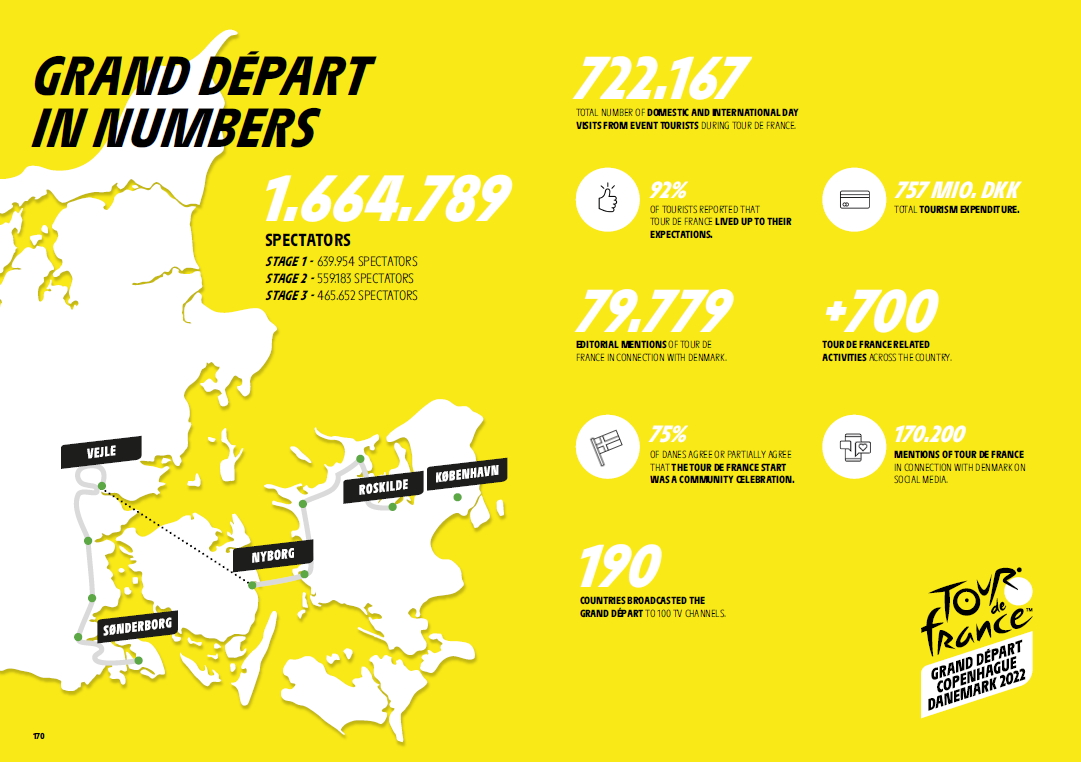
    Of the 1,665,789 spectators for the three Tour de France stages in Denmark, 722,167 were tourists, both domestic and international, spending more than EUR 100m.
    The event also generated massive media attention, with Denmark and Tour de France mentioned together in 80,000 editorial articles from June 2021 to July 2022.
    “For us, Tour de France was an engine boosting our focus on promoting everyday cycling and showcasing the infrastructure solutions we have in Copenhagen. And these numbers just show what a powerful platform a major event can be. We have hosted major medias from all over the world, including The Guardian, Le Monde, and The Times returning home sharing stories showing what the transformation bike infrastructure can do for a city and how it helps Copenhagen to become a healthier, cleaner, and less congested city, says Lars Vallentin, senior manager at Wonderful Copenhagen, the Official Destination Management Organisation of Copenhagen.
    However, the biggest success of the Danish tour start was probably the enormous local engagement and the many projects, carried out in relation to Copenhagen and Denmark hosting the Tour de France – Grand Départ. In the last 100 days before the event, a total of 744 Tour de France related events were carried out all over Denmark engaging everything from schools to shops and even a hospice, where the visitors helped knit an enormous yellow jersey.
    Sport Event Denmark are very happy for the huge impact of Tour de France in Denmark and believe this is the perfect platform for attracting big events for the future.
    “We must take advantage of the fact that we have created such a strong image of our unique cycling DNA and hosting role in Denmark. We at Sport Event Denmark dream of Denmark hosting even more big cycling events. The UCI Road World Championships could be an option. Denmark successfully staged the event in 2011 so why not repeat it with the insights we have now from the staging of the Grand Départ Tour de France?” says Lars Lundov, CEO, Sport Event Denmark.
    Lundov and Vallentin both point to the close collaboration with the rights holders, ASO, as an important part of the Danish success bringing the event to life all over Denmark, with everything from bike shops and bakers to events using the official city dressing.
    A design developed in collaboration with the French organization. A partnership which helped create an unprecedented celebration of everyday cycling and Denmark as a cycling nation and destination.

  • Bach highlights esports in New Year’s Message of hope

    Bach highlights esports in New Year’s Message of hope

    From delivering Beijing 2022 during the pandemic to the ramifications of Russia’s invasion of Ukraine, 2022 was a challenging year for the Olympic Movement – but according to President Bach, the IOC can nonetheless look ahead with “hope and optimism” in a year that includes qualifiers for Paris 2024, and the first Olympic Esports Week.
    “The power of sport as a force for good in the world is widely acknowledged – and it is needed more than ever. Especially in a time when division and conflict is gaining ground over dialogue and cooperation – in a time, when, tragically, it is not people but the guns of war that are doing the talking,” said Bach in his New Year’s Message.
    This year will highlight the achievements of athletes on the road to Paris 2024. “The Olympic Qualifier Season is ongoing and already now has generated over 100 million additional engagements across Olympic social media platforms – thereby promoting the athletes and their sports in new and exciting ways.
    “Another highlight of how we are opening new horizons and reaching new audiences with our values will be the inaugural Olympic Esports Week in 2023. Held in Singapore next June, the Olympic Esports Week will be the next major step for us to engage even deeper with the young generation.”
    Singapore also hosted the inaugural Global Esports Games in 2021 – an independent initiative of the Global Esports Federation.  
    “Thanks to the great preparation by the Paris 2024 Organising Committee, we can look forward to Olympic Games of a new era: inspired by Olympic Agenda from start to finish. The Olympic Games Paris 2024 will be more inclusive, more youthful, more urban, more sustainable – and they will be the very first Olympic Games with full gender parity. And all of this in one of the most beautiful cities in the world,” said Bach.
    “This positive momentum is something that we can carry into the new year. Our values, our solidarity, our unity, our peace-mission – all this makes our beloved Olympic Movement so unique. This is the solid foundation on which we can build our future – on which we can build a better and more peaceful world through sport.”

  • Coventry, Milton Keynes and Bristol to host Arnold Clark Cup matches

    Coventry, Milton Keynes and Bristol to host Arnold Clark Cup matches

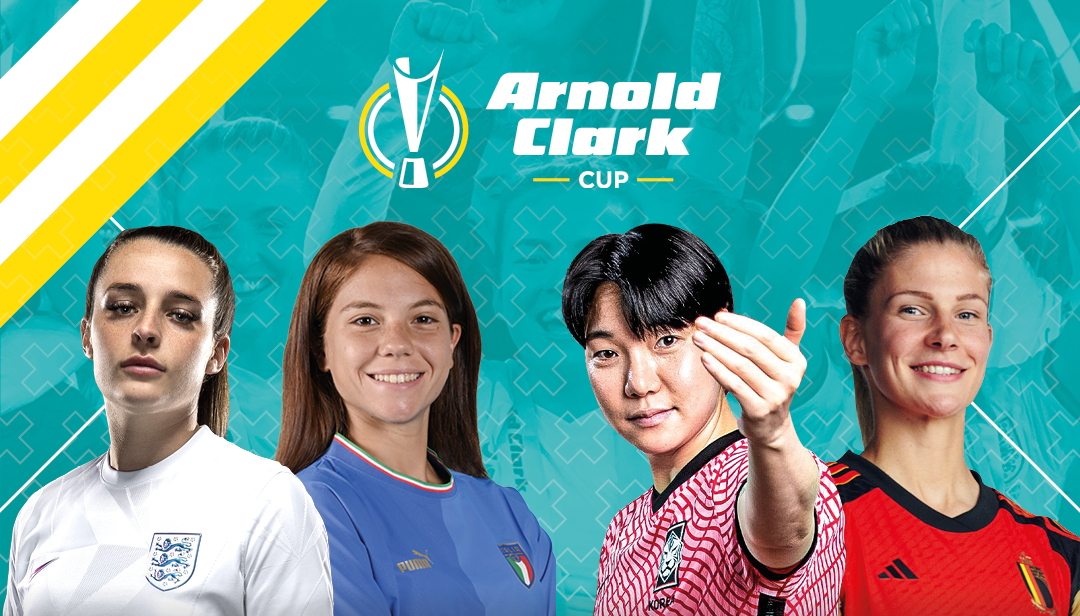
    [Source: West Midlands Growth Company] Coventry Building Society Arena (CBS Arena) will host the second double-header of the Arnold Clark Cup on February 19, headlined by defending champions England taking on Italy. 
    Belgium will take on South Korea in the second match of the double-header, with fans able to see both matches on the same ticket. Tickets can be purchased here and start from just £10 for adults and £5 for concessions.
    The double-header at CBS Arena will take place between match days at Stadium MK (Milton Keynes) on 16 February and Ashton Gate Stadium (Bristol) on 22 February, with more than 30,000 tickets already sold across the two venues. 
    As one of the last opportunities to see England ahead of the 2023 FIFA Women’s World Cup, tickets for CBS Arena are also expected to be snapped up quickly. 
    Paul Michael, Commercial Director at CBS Arena, said:
    “We are thrilled to be hosting this major international tournament at a time when women’s football continues to go from strength to strength – as the impact of the Lionesses’ triumph last summer continues to be felt far and wide.
    “Attracting the Arnold Clark Cup underlines CBS Arena’s credentials as one of the UK’s leading sporting venues, and we can’t wait to welcome players and fans for two great matches.”
    England fans will be able to watch every match live across ITV, and can follow tournament updates at: @arnoldclarkcup / #arnoldclarkcup

  • Florida’s sports industry provides $146.5bn in economic impact

    Florida’s sports industry provides $146.5bn in economic impact

    [Source: Florida Sports Foundation] The Florida Sports Foundation announced its recently commissioned study found the total economic impact of the sports industry on Florida’s economy amounted to $146.5 billion in Fiscal Years 2019-20 and 2020-21.
    CLICK HERE for the direct link to the full $146.5 Billion Economic Impact Study.
    The report, conducted by the independent research firm Tourism Economics, also showed that the billions injected into the economy by sports supported 978,200 part-time and full-time jobs on an annual basis and generated $13.9 billion in state and local taxes.
    “We applaud the Governor for the extensive steps he has taken to ensure Florida has remained open for sports throughout his administration,” said Angela Suggs, President and CEO of the Florida Sports Foundation. “The findings of this report show the wisdom of the Governor’s strategy to prioritize access to golf courses, beaches, hiking trails and other recreational venues.”
    Amateur and leisure activities were the largest contributors to Florida’s sports economy over the course of the study. This category, which includes golf, hunting, fishing, and other recreational activities, accounted for $113.6 billion in total economic impact. Within the amateur and leisure activities category, golf was the largest contributor, generating $44.2 billion in impact.
    Other highlights of the report include:
    • Florida’s sports industry accounted for nearly 28.1 million non-resident visitors to the state, representing 14 percent of all Florida tourism.
    • Professional sports accounted for $10.2 billion in economic impact, while college athletics contributed $5.5 billion in impact.
    • The efforts of the state’s 36 sports commissions, supported by the Florida Sports Foundation, generated $24.9 billion in total economic impact.
     
    About the Florida Sports Foundation
    The Florida Sports Foundation, a 501(C) 3 non-profit corporation, is the official sports promotion and development organization for the State of Florida. It is charged with the promotion and development of professional, amateur, recreational sports, and physical fitness opportunities that produce a thriving Florida sports industry and environment. With a seemingly endless list of sporting ventures and venues, the Florida Sports Foundation strives to promote Florida’s unique sports industry. The Foundation’s staff is dedicated to serving the needs and interests of Florida’s sports community and assists with all questions concerning Florida sporting activities and issues.
    To create the thriving sports industry and environment, the Florida Sports Foundation:
    • Provides grants to support sporting events that bring out-of-state visitors to Florida;
    • Produces and distributes annual golf, fishing and boating, and baseball spring training guides for both in-state and out-of-state tourists; and
    • Organizes the annual Sunshine State Games, an Olympic-style festival for Floridians of all ages, and the Florida Senior Games State Championships for senior athletes, age 50 and over.
     
    About Tourism Economics
    Tourism Economics is an Oxford Economics company with a singular objective: combine an understanding of the travel sector with proven economic tools to answer the most important questions facing our clients. More than 500 companies, associations, and destination work with Tourism Economics every year as a research partner. We bring decades of experience to every engagement to help our clients make better marketing, investment, and policy decisions. Our team of highly-specialized economists deliver:
    • Global travel data-sets with the broadest set of country, city, and state coverage available.
    • Travel forecasts that are directly linked to the economic and demographic outlook for origins and destinations
    • Policy analysis that informs critical funding, taxation, and travel facilitation decisions
    • Market assessments that define market allocation and investment decisions.

  • The future of streaming: the opportunities and challenges for live sport

    The future of streaming: the opportunities and challenges for live sport

    Such is the draw of high-action, high-energy sports content that in 2023, Deloitte predicts that streamers will spend more than $6 billion on exclusive major sports rights in the largest global markets. For context, in 2021, streaming providers spent a combined $50 billion on all content: they are investing a significant proportion of their entire content budget on sports. 
    For sports organisations, this presents four key opportunities: 
    1. Monetising rights further: For premium sports competitions, streamers’ interest provides added competition for rights and/or distribution to reach a broader audience. For smaller and newer sports and leagues, streaming platforms can offer the benefits of coverage for the first time to increase awareness, and alternative commercialisation models (e.g. advertising-supported) beyond the traditional rights fee.
    2. Appealing to younger consumers: While younger generations are less likely to watch full matches, their overall content consumption continues to increase, and that consumption takes place increasingly on digital platforms. In 2022, we witnessed a rush among clubs, leagues and governing bodies to respond to fans’ growing demand for sports content by partnering with streaming platforms to produce additional content taking fans beyond the live match. 
    3. Making it personal: Streaming services could provide new innovations around personalisation, interaction and real-time data analysis. In the future, we expect to see further experimentation from streaming providers looking to offer more tailored experiences, such as offering multiple live feeds in-game. 
    4. Growing global audiences: Giving viewers in different countries easier access to sports they might not be as familiar with and providing sports organisations with greater transparency of the popularity of their content. 
     
    The challenges to overcome 
    Streaming platforms may provide fans with access to even more content related to their favourite sports – such as original documentaries, behind-the-scenes content and associated secondary competitions. However, the fragmentation of rights across even more platforms could make it more difficult, and costly, for fans to access what they want to watch when they want to watch it. Rightsholders and streamers must work closely together to ensure that they aren’t creating artificial barriers to fan engagement.  
    What’s more, there are technical challenges when streaming live sport. Sports content is often fast-paced and therefore necessitates a higher frame rate than other media genres. In addition, live sporting events are more sensitive to latency issues and, when streamed, delays can be a minute or more. This could be a real issue for many, particularly with premium-priced subscriptions, as sports fans will demand high picture quality and superb reliability.  
    Meanwhile, rights holders may not want to risk a critical revenue stream when current linear broadcasts are already high-quality, low-latency, and have significant pre-existing production and distribution infrastructure already in place.  
     
    What’s to come 
    It will take at least a couple of rights cycles before the future of watching live sports is realised.  For some major sports, the next opportunity for streaming providers to bid for rights and grow their share will not be until the early 2030s, by which time underlying industry economics may have evolved, possibly markedly.  
    For sports streaming to go the distance, sports organisations and entertainment companies should consider several things: 
    • Put the fan first: Skilfully used, first-party data can provide insight into fans’ needs and preferences. As a result, careful analysis of audience engagement will help organisations to deliver the right amount of quality content, easy access, an engaging user experience and exclusive perks, all at a reasonable cost. 
    • Expand the streaming service’s influence: The next generation of fans will consume sport across several platforms. Brands should consider how best to integrate social media, online games, fantasy sports and other digital engagement channels into the overall offer. 
    • Improve streaming’s technical aspects: In order to enhance broadcast quality – eventually moving from 4k to 8k resolution, reducing latency and eliminating service interruptions. This will help ensure live sport remains truly ‘live’ when streamed. 
    Ultimately, the question for sports organisations is whether media deals are both meeting their current fans’ needs and helping to build a future fan base. For many, streaming platforms, as part of a broader media strategy, may provide an opportunity to do both. 
     
    About Deloitte’s Sports Business Group 
    Deloitte is a leading advisor to the sports business market, with more than 1,000 experts advising clients across sport. 
    We equip our clients with knowledge and insight that will resolve challenges, grasp opportunities and deliver transformational change.
    Drawing on Deloitte’s global network of expertise and capabilities, we work with some of the world’s largest sports organisations, governments and investors.?
    Our global sport capability hubs lead industry innovation in areas such as: data and analytics; digital services; major event capabilities; sports and transformation advisory, M&A advisory and transaction support; cyber security, risk management and ESG; tax and legal.?
    Find out more here.

  • Copenhagen will host the FIBA 3×3 Europe Cup 2025

    Copenhagen will host the FIBA 3×3 Europe Cup 2025

    Copenhagen is preparing for an urban festival with street activities in the heart of the Danish capital when the FIBA 3×3 Europe Cup Qualifier and 3×3 Europe Cup 2025 take place.
    “We are really happy and proud of bringing the 3×3 Europe Cup to Denmark for the first time”, Kamil Novak, FIBA Europe Executive Director said. “Copenhagen and Denmark are perfect matches to 3×3 as one of the missions of this discipline is to bring basketball to the people and show that everyone can be successful in 3×3.”
    “We are proud to host the Euro Cup 2025 and the qualifier on Danish soil in collaboration with Wonderful Copenhagen and Sport Event Denmark,” said Mads Young Christensen chairman of the board of Danish Basketball Federation (DBBF). I am thrilled that for the first time in Danish basketball history we will host a European Championship. We get the opportunity to showcase our fantastic sport to the Danes and show our international basketball family why Denmark is unique as a host nation for major sporting events.”
    The 3×3 Europe Cup will be staged in September 2025 in a public square in central Copenhagen with a venue large enough to accommodate 1,200 spectators. In 2024, the Copenhageners can warm up with the 3×3 Europe Cup 2024 Qualifier.
    Other activities and side events also include school programs, exercise, and competitions enabling the children to try the urban and Olympic discipline.
    Denmark’s Basketball Federation expects between 7,000 and 8,400 paying spectators for the Europe Cup 2025 and up to 90,000 spontaneous spectators.
    The Danish Basketball Federation, in collaboration with Wonderful Copenhagen and Sport Event Denmark, bid for and won the two events.
    “I am absolutely thrilled that Copenhagen will be hosting the European Championship in 3×3 basketball,” said Lord Mayor Sophie Hæstorp Andersen. “It offers a unique opportunity for us to host a big international sport tournament in urban surroundings and combine it with street sport activities that everyone can participate in. I hope the event will encourage more people to try street sports, and I look forward to the celebrations in the streets of Copenhagen.”
    “3×3 is one of the new Olympic disciplines with high entertainment value and great street credit,” said Lars Lundov, director of Sport Event Denmark. “Therefore, the Europe Cup 2025, the qualifier in 2024, and Copenhagen are a perfect match. Together with the Danish Basketball Federation, and Copenhagen, we are planning a vast program of side activities during the urban festival embracing the tournaments.”
    “We are really excited to welcome the 3×3 Europe Cup to Copenhagen,” said Kit Lykketoft, Director of Convention at Wonderful Copenhagen. “In Copenhagen, we have a focus on creating events with broad and lasting legacies and the 3×3 Europe Cup is not only a testament to Copenhagen’s position as a leading sport event host city but also a great example of how a strong collaboration between organisations can create elite events that are closely tied to local life and leave a positive lasting legacy in the city.”