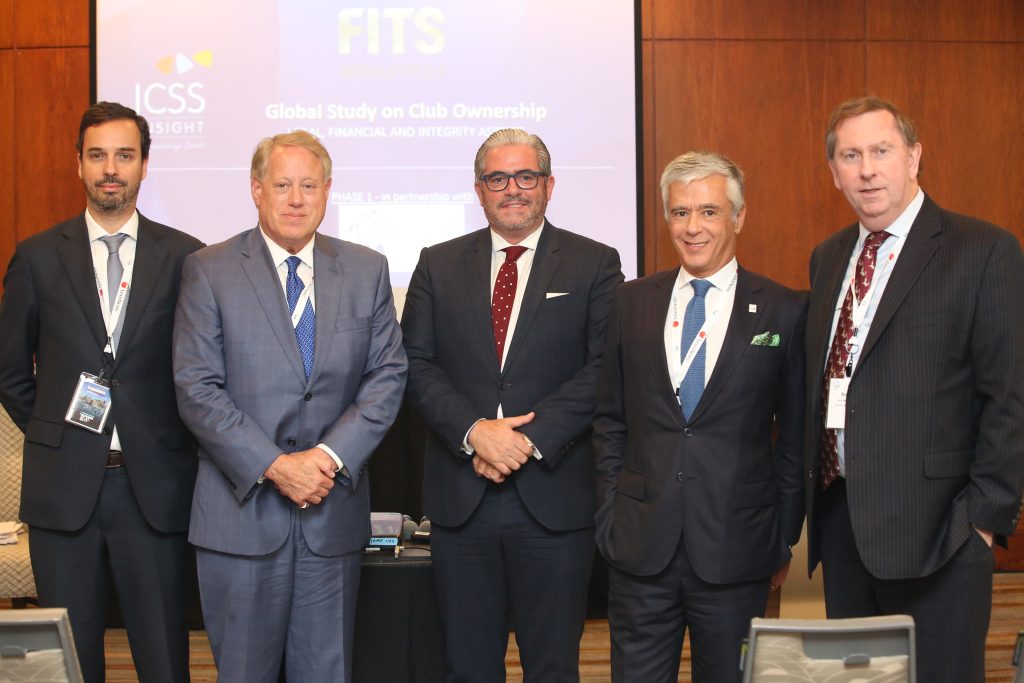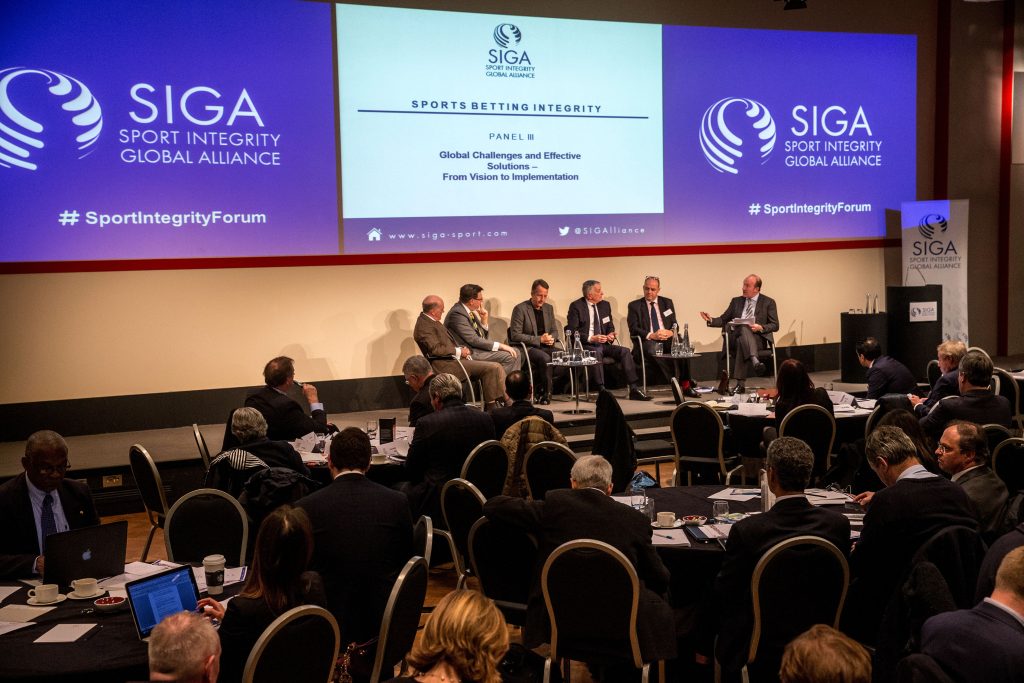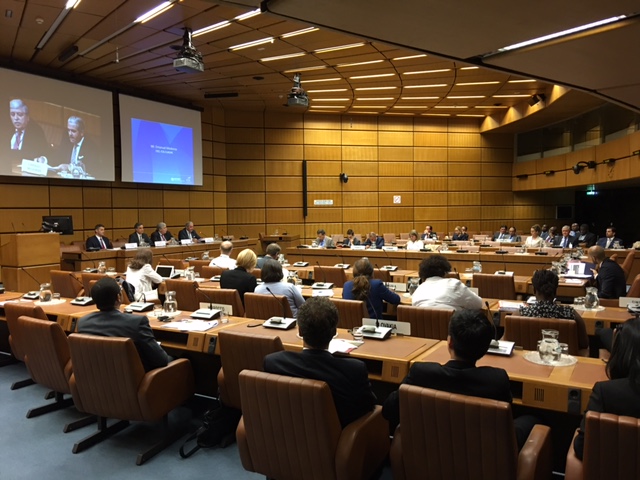
At Securing Sport 2014 on Monday, the International Centre for Sports Security (ICSS) hosted a special closed doors meeting attended by sports ministers and leaders of international organisations, who agreed to take steps to prevent the growing threat of corruption in sports.
The ICSS also announced a partnership with UNESCO the United Nations Educational, Scientific and Cultural Organization (UNESCO) to safeguard sport against the “unprecedented threat” from corruption, match-fixing and sport betting fraud.
Ministers at the private meeting came from Portugal, Singapore, Cape Verde and Angola, joined by representatives of UNESCO, the Council of Europe, WADA, Commonwealth Secretariat and OECD.
The participants agreed on the importance of following up on and implementing international conventions and instruments such as the Declaration of Berlin and the Council of Europe’s Convention on the Manipulation of Sports Competitions.
“Sport is now under threat in a way unprecedented in its history and the response to these threats must be united, international, and bold,” said ICSS president Mohammed Hanzab.
“This special ministerial forum was another important step in engaging key countries and regions, international experts and sport ministers and ensuring that protecting the integrity of sport continues to stay high on the agenda.
“Securing Sport 2014 has today gathered individuals with the power, will, and determination to see that international sport moves in the right direction in the future.”
According to the ICSS, the ministerial meeting highlighted a desire to implement education programs and capacity building initiatives, to support countries and regions to assist them in creating national integrity platforms, and to work together to create programmes to preserve the integrity of sport.
Under the agreement with UNESCO, ICSS will host around around 100 government officials, technical experts and leaders in sport at a “special technical meeting” in Doha in the first half of 2015. This will be the first time international experts have met to implement the detailed recommendations on the manipulation of sport competitions outlined within the ‘Declaration of Berlin’.
“This meeting of international experts will play an important part in the ICSS’s drive to mobilise international efforts and enhance the integrity and credibility of sport,” said Hanzab.
Hailed as a ‘beacon for future national and international sports policy’, the Declaration of Berlin was adopted by 600 participants from 121 countries at the 5th UNESCO World Sport Ministers Conference (MINEPS V) in May 2013. It seeks to improve and enhance international cooperation between governments and all other sport stakeholders on issues of access, investment and integrity of sport.
In particular, the Declaration of Berlin calls for better sports governance and a zero-tolerance policy against doping and the manipulation of sports competitions, as well as greater collaboration to detect, prevent and monitor such manipulation.
“We are all custodians of sport and we owe it to every athlete and sport fan to protect its integrity and credibility so we can nurture the next generation of sports leaders,” said Hanzab.
Security and good governance are key themes of HOST CITY Bid to Win conference. To find out more about best practice in major events, register for HOST CITY Bid to Win and join ICSS director general Helmut Spahn and many more experts on 28th October.
Tag: Integrity
-

World sports ministers tackle unprecedented corruption threat
-

Governments pledge US$6.45m to anti-doping fund
Twelve world governments have pledged US$6.45m towards an anti-doping fund set up by the International Olympic Committee (IOC), which is matching funds with the aim of creating a joint fund of US$20m.
The fund was set in motion by the IOC’s Olympic Agenda 2020 and will be administered by the World Anti-Doping Agency.
The world governments that responded to a call to match the IOC funding are China, France, Ivory Coast, Japan, New Zealand, Peru, Qatar, Saudi Arabia, South Korea, Turkey, the US and Sweden.
The donations mean that the fund will have a starting budget of almost US$13 million.
“WADA is very pleased with the financial commitments that this partnership has generated for the fight against doping in sport”, said WADA president and IOC vice president Sir Craig Reedie.
“The fund allocated by the IOC has received the commitment of governments of the world to contribute a total of US$ 6,452,296. The funds will provide a tremendous boost to WADA in their efforts to carry out innovative, anti-doping research focussed on protecting the clean athletes.”
The 12 governments have committed to pay WADA in full by 31 March 2016.
As a separate fund for research in the fight against doping, the IOC will also administer the balance of US$3.55m remaining from the full US$10m it approved as part of Olympic Agenda 2020.
These funds will be allocated to researchers involved in athlete-centred projects in science and society. Four applications from researchers in Spain and Australia have already been selected.
“With Olympic Agenda 2020, we are changing the philosophy with regard to the credibility of sports competitions and of athletes,” said IOC president Thomas Bach.
“We must consider every cent in the fight against doping as an investment in the future of Olympic sport, not as an expense. This fund clearly shows that we support innovative anti-doping research that will lead to better protection of the clean athletes.”
Sir Craig Reedie was a keynote speaker at HOST CITY Bid to Win in October 2014, where Agenda 2020 was discussed before its unanimous adoption by the IOC.
Integrity in events will be a key theme of HOST CITY 2015. -

Blatter resigns as corruption claims escalate
With charges of corruption within FIFA escalating, president Sepp Blatter announced on Tuesday that he will resign to make way for “deep-rooted structural change”.
At a press conference in Zurich called at extremely short notice, Blatter announced he will resign “at the earliest opportunity”.
The announcement came shortly after reports that FIFA administered an alleged $10m bribe from the South African government to CONCACAF president Jack Warner in 2008, and an ABC News report claiming that Blatter was himself under investigation by FBI and US prosecutors.
Two days before Blatter’s re-election, several officials were arrested in a dawn raid on the Baur au Lac Hotel. The US Department of Justice has since charged 14 officials employed by FIFA and associated agencies with 47 charges of corruption including racketeering, fraud and money laundering.
“While I have a mandate from the membership of FIFA, I do not feel that I have a mandate from the entire world of football,” Blatter said.
“Therefore, I have decided to lay down my mandate at an extraordinary elective Congress.”
The extraordinary Congress is likely to be convened between September 2015 and March 2016.
“This will need to be done in line with FIFA’s statutes and we must allow enough time for the best candidates to present themselves and to campaign,” said Blatter.
Waiting until the next ordinary FIFA Congress on 13 May 2016 would “cause unnecessary delay”, he said.
Blatter said by stepping down he would be able to focus on reforming FIFA. “Since I shall not be a candidate, and am therefore now free from the constraints that elections inevitably impose, I shall be able to focus on driving far-reaching, fundamental reforms that transcend our previous efforts.
“For years, we have worked hard to put in place administrative reforms, but it is plain to me that while these must continue, they are not enough.”
He also said the structure of FIFA’s Executive Committee and its relations with the continental confederations must be overhauled.
“The Executive Committee includes representatives of confederations over whom we have no control, but for whose actions FIFA is held responsible. We need deep-rooted structural change.
“The size of the Executive Committee must be reduced and its members should be elected through the FIFA Congress. The integrity checks for all Executive Committee members must be organised centrally through FIFA and not through the confederations.”
Blatter, who has presided over FIFA for 17 years, also called for term limits, “not only for the president but for all members of the Executive Committee.”
“I have fought for these changes before and, as everyone knows, my efforts have been blocked. This time, I will succeed.”
Blatter has asked Domenico Scala, Independent Chairman of FIFA’s Audit and Compliance Committee to oversee the transition over the coming months.
“Mr. Scala enjoys the confidence of a wide range of constituents within and outside of FIFA and has all the knowledge and experience necessary to help tackle these major reforms.”
Blatter thanked all his supporters, saying “What matters to me more than anything is that when all of this is over, football is the winner.”
Prince Ali bin al Hussein of Jordan denied Blatter a majority in the first round of voting in Friday’s election and he has not ruled out standing again.
Prince Ali told CNN “I think this is the right move from Sepp Blatter and I think we have to look to the future.
“I am always there to serve football and I think that’s the most important thing and to do so much work to fix this organisation in a proper way.
“I am at the disposal of our national associations. I don’t want to be somebody who kicks somebody in the knees. At the end of the day I will do my part to help the national associations.”
Other possible candidates include Michel Platini, Luis Figo, Jerome Champagne and Michel van Praag.
His resignation was welcomed by IOC president Thomas Bach, who said “We highly respect this decision of President Blatter to step down and to initiate the necessary reforms – and to make way for a new leadership of FIFA to drive these changes.”
Sepp Blatter remains an IOC member until his 80th birthday on 10 March 2016.
-

Sepp Blatter: we welcome investigations
This is a difficult time for football, the fans and for FIFA as an organisation. We understand the disappointment that many have expressed and I know that the events of today will impact the way in which many people view us.
As unfortunate as these events are, it should be clear that we welcome the actions and the investigations by the US and Swiss authorities and believe that it will help to reinforce measures that FIFA has already taken to root out any wrongdoing in football.
While there will be many who are frustrated with the pace of change, I would like to stress the actions that we have taken and will continue to take. In fact, today’s action by the Swiss Office of the Attorney General was set in motion when we submitted a dossier to the Swiss authorities late last year.
Let me be clear: such misconduct has no place in football and we will ensure that those who engage in it are put out of the game. Following the events of today, the independent Ethics Committee – which is in the midst of its own proceedings regarding the awarding of the 2018 and 2022 FIFA World Cups — took swift action to provisionally ban those individuals named by the authorities from any football-related activities at the national and international level. These actions are on top of similar steps that FIFA has taken over the past year to exclude any members who violate our own Code of Ethics.
We will continue to work with the relevant authorities and we will work vigorously within FIFA in order to root out any misconduct, to regain your trust and ensure that football worldwide is free from wrongdoing. -

FIFA can’t go on like this, says Prince Ali
With several FIFA officials charged with corruption just two days before the presidential election, HRH Prince Ali Bin Al Hussein of Jordan has called for an end to FIFA’s ongoing crisis.
“We cannot continue with the crisis in FIFA, a crisis that has been ongoing and is not just relevant to the events of today,” he said in a statement to the press.
“FIFA needs leadership that governs, guides and protects our national associations. Leadership that accepts responsibility for its actions and does not pass blame. Leadership that restores confidence in the hundreds of millions of football fans around the world.”
After a raid at Baur au Lac hotel in Zurich on Wednesday morning, ten FIFA Executive Committee members will be questioned by Swiss authorities “on suspicion of the acceptance of bribes and kick-backs” in relation to 2018/22 World Cup bids. The arrests were instigated by US Department of Justice.
Prince Ali is the only challenger to FIFA president Sepp Blatter, who was widely predicted to be reelected on Friday. FIFA has faced calls from the English Football Association and Transparency International to postpone the election.
Sepp Blatter has not been charged. FIFA spokesman Walter de Gregorio told press that Blatter was “relaxed” about the day’s events because he was “not involved in them at all”, going on to explain: “Well he is not dancing in his office. He is very calm; he is fully co-operative with everything. That’s what I meant. He’s not a happy man, saying ‘wow wow’.”
De Gregorio also said the presidential election would go on ahead on Friday as planned and that a revote on the 2018 and 2012 World Cup hosts was out of the question.
“This for FIFA is good. It is not good in terms of image or reputation, but in terms of cleaning up, this is good,” he said.
“It is not a nice day, but it is also a good day. The process goes on and we are looking forward.”
-

The democratisation of FIFA
Joseph “Sepp” Blatter’s surprise announcement on June 2 that he was resigning as president of FIFA was sensational, not least because it happened just four days after his re-election for a historic fifth term.
Blatter’s rivals for the presidency – Jerome Champagne, Luis Figo, Michel Van Praag and of course Prince Ali, who was the only challenger left standing at the FIFA Congress – all based their campaigns on a common message: the organisation was tainted with allegations of corruption and needed to clean its image.
Blatter, on the other hand, barely uttered a word to the press during the run up to the election – even when investigators raided the Baur au Lac Hotel in Zurich to arrest a number of officials on corruption charges.
In the election, Blatter emerged victorious but storms continued to gather, including allegations that FIFA administered a $10m bribe from South Africa to CONCACAF president Jack Warner. As media reports emerged that Blatter was himself under investigation by FBI and US prosecutors, he announced to the world – at just a couple of hours’ notice – that he was to step aside.
What was perhaps most extraordinary about Blatter’s resignation speech was that he used it as an opportunity to position himself as a reformer at heart, shackled by circumstances. His resignation, he said, was necessary to make way for “structural changes” that he had himself been advocating for many years.
These changes including loosening the grip of the continental confederations through which FIFA’s members are aligned, a reduction in size of the Executive Committee – presumably to give non-ExCo FIFA members greater influence – and capping terms of office.
Whatever you may think of Blatter’s claims to be a democratiser, a process of reform is now inevitable. While it might have taken external events to drive FIFA to the brink, at last it can contemplate the reform it needs.
Football remains the world’s most popular sport and the FIFA World Cup its biggest single sport event. And if democratisation may not be Blatter’s true legacy, FIFA has undeniably embraced all regions of the world under his presidency.
Anything can happen now, depending on the outcome of further investigations, which are by no means focused exclusively on the hosts of the future World Cups. The world waits.
-

FIFA to bring in new president and reforms in 2016
FIFA’s executive committee met today to take the first steps towards transforming the organisation, discussing key areas of reform and setting the date for the presidential election and Extraordinary Congress at 26th February 2016 in Zurich.
This is significantly later than expected, with most observers predicting a December election.
The meeting was chaired by outgoing FIFA President Blatter, who will not be standing for president again as “a new FIFA President will be elected”, according to a FIFA statement.
Candidates can now declare their interest in running for the office of FIFA President, with a deadline of 26 October. The Ad-hoc Electoral Committee will hold its first meeting on Tuesday, 21 July.
Domenico Scala, chairman of the Audit and Compliance Committee delivered presentations on the proposed topics for reform. These include “enhanced centralized integrity checks for Executive Committee members, the introduction of term limits, higher standards of governance at all levels of football structures including confederations and member associations as well as individual disclosure of compensation.”
FIFA is to set up a “Reforms” Task Force with a “neutral chairman”.
The “concrete and comprehensive reform proposals” will be presented at the next ordinary FIFA Executive Committee meeting in Zurich on 24 and 25 September and submitted for approval at the extraordinary Congress in February.
FIFA said its bidding procedure is being reformed in line with the guidance of the United Nations’ strategy for “Safeguarding against Corruption in Major Public Events”. Future World Cup bids will have to recognise the provisions of the UN Guiding Principles on Business and Human Rights, with which suppliers must comply.
The Executive Committee also stated its firm commitment to reform and “its full cooperation with the on-going US and Swiss investigations”.
Djimrabaye Bourngar from Chad has been appointed as the deputy chairman of the investigatory chamber of the FIFA Ethics Committee.
The themes of sports governance and bidding procedures will be discussed at HOST CITY 2015 in Glasgow on 9th and 10th November. -

Former IOC DG to lead FIFA reform
FIFA has appointed Dr François Carrard, former IOC director general and coordinator of the IOC 2000 Reform Commission to chair its 2016 Reform Committee.
As an independent chairman, Carrard will oversee FIFA’s process of reform that has been initiated in response to investigations into corruption.
As Director General of the International Olympic Committee, Dr Carrard guided the IOC through its own governance reforms in the wake of the bidding process for the Salt Lake City Winter Olympics in 2002. An internationally renowned Swiss lawyer, Dr Carrard brings specific experience of the challenges faced by global sports organisations such as FIFA.
“It is vital for the future of global football to restore the integrity and reputation of its governing body,” Carrard said.
“As the independent chairman, I am committed to delivering the necessary package of credible reforms, working with representatives from within football and wider society. To that end, I will establish an independent advisory board, made up of representatives from outside football, to support the work of the committee and provide an additional layer of independent expertise.”
Carrard was appointed after consultation with the six football confederations, each of which have appointed two representatives to the 2016 FIFA Reform Committee.
FIFA President Blatter said: “We believe Dr Carrard is the right person to drive this reform process forward as an independent chairman with a proven track record in governance reforms. We are confident that he can help FIFA to strengthen its governance structures in a credible and meaningful way. FIFA’s commercial partners will also play a key role in the reforms, and we will be discussing with them the most productive way to include their views.”
The 2016 Reform Committee will present its comprehensive proposals to the FIFA Congress in February.
-

David Grevemberg shares thoughts pre-CGF General Assembly
Around one third of the world’s population live in the Commonwealth. Many of these people live in some of the world’s biggest cities, which include emerging mega cities such as Delhi and Lagos, as well as established host cities like London, Sydney, Toronto and Glasgow.
The Commonwealth also encompasses two thirds of the world’s small states and island states, embracing the widest range of cultures of any international association of nations.
The Commonwealth is, in short, incredibly diverse. “Each city, each location is different; it has different strengths and it has different challenges,” David Grevemberg, CEO of the Commonwealth Games Federation (CGF) tells HOST CITY.
Attainable Games
The CGF’s aim, declared on its website, is “uniting the world through sport”, which it achieves through the Commonwealth Games. While all 71 Commonwealth nations take part, the majority do not have the scale or technical capability to host the Commonwealth Games.
The smaller Commonwealth Youth Games presents a more attainable proposition for cities that want to benefit from hosting a CGF event.
“The structure and approach that the Federation is taking can appeal to emerging markets, to more regenerative markets and sustained markets. We have different cities, all within different phases of their development,” says Grevemberg.
“I think the Games, whether it’s the Youth Games, a Commonwealth Championship event or a multi-sport event, can play a part in contributing to that journey for cities when approached right.
“The Commonwealth Youth Games have great agility for local hosts to make of them what they will. Events like this are fantastic opportunities to create opportunities for those smaller states to showcase what’s on offer, and what their challenges, ambitions and aspirations are.”
The small island states of Samoa and St. Lucia are hosting the Youth Commonwealth Games in 2015 and 2017 respectively.
“For Samoa and St. Lucia, these are accessible and inclusive events; they will be taking in the local context. They are taking a very agile approach, in terms of providing not only a great competitive experience for the athletes and citizens, but also using the event to have a cultural immersion experience.”
While sports events do present fantastic opportunities for hosts to showcase their qualities to the world, the question of to what extent they can bring wider benefits to society is becoming ever more pertinent – particularly when it comes to mega events like the Commonwealth Games, which require major investment to deliver.
“These events, when used with the right time and place and purpose, have the power to be transformational – not just in terms of infrastructure, but also can have economic and social benefits and changes that can build more peaceful, sustainable and prosperous communities,” says Grevemberg.
“I think there’s demand now that sport delivers on that proposition and that it claims an order as part of a justification of running these events.”
“It’s as much about the journey as it is about the destination of hosting these events. It’s about – what are your ambitions, what are your anxieties and how does this event match up with that – and ultimately is it a good business and social proposition?”
Transformation 2022
Earlier in 2015, the Commonwealth Games Federation suffered from the loss of Edmonton as a candidate city for the 2022 Commonwealth Games during the height of the oil price crisis in February 2015. The CGF, with Grevemberg appointed as CEO following his leadership of Glasgow 2014, embarked on its “Transformation 2022” programme of reform.
Central to Transformation 2022 is a review of the sports programme.
“Are we being inspiring and innovative in our decisions on the sports we have on the programme? Are we driving efficiency and effectiveness to the delivery of this event? Are we looking at affordability and appeal in getting those balances right?
“Those are the three elements we’re looking at in terms of driving our overall Games proposition to have more inspiring and innovative Games, so the sports on the programme are starting to reflect that,” says Grevemberg.
In making the Games more appealing to potential hosts, the CGF is setting out to communicate more widely and deeply with its network of cities.
“It’s quite important that we remain agile and listen to what our cities and countries are looking for. We have a responsibility now to work with people and the various partners in cities to ensure that we are accountable, that our events are delivering the benefits that they claim they do.”
The goal is not ultimately to stage sports events, but to use them as a means to improve quality of life.
“Part of this notion, in terms of the proposition to deliver inspirational Games, is to engage and embrace with the cities; and how to work with cities and use major sports events within the Commonwealth to share and exchange best practice for using sports as a tool to drive prosperity.
“That is what drives sustainability, and obviously that nurtures future hosts and the power of sport within the Commonwealth.”
Commonwealth Cities Exchange
When it comes to best practice, the Commonwealth is blessed with a large number of some of the world’s most successful host cities.
“If you look at the cities of the Commonwealth that have hosted major sporting events – not just the Commonwealth Games – and the way that they’ve used sport to hold themselves to account, but also to drive some of those sustainable development agendas, there’s no question that the Commonwealth has a strong pedigree of cities that have lived and learned how to do it: the Manchesters, the Glasgows, the Londons, the Sydneys, the Vancouvers, the Edmontons, the Torontos, the Jo’burgs, the Durbans, Kuala Lumpur, Singapore… the list goes on.
“You’ve got a lot of really powerful examples of cities – so how do we create Commonwealth exchange with common purpose, not just to celebrate legacy but also to celebrate ambition?
“The concept is ultimately to share best practice and to help people recognise the power of sport to develop their societies.”
Fully engaging the CGF’s 71 members, the Commonwealth Games Associations – 54 of which perform a dual role as National Olympic Committees – will be crucial to communicate the benefits of hosting CGF events.
“There’s a really strong emphasis on working with the CGAs to build their relationships with private, public and third sector – because you really can’t do anything without that alliance. We need to work with them and their local communities to showcase and drive the value of the events. You also have to look at cities as partners.”
Partnerships with sport’s international federations (IFs) will also be essential for developing sport within the Commonwealth.
“With each of the IFs we are looking at the technical relationship, the developmental relationship; where can we be innovative and have enhancement on our promotional opportunities; promote that sport and its values within the Commonwealth; and finally other opportunities for us as a trailblazing movement to enhance the reputational prominence of that sport.”
Grevemberg cites the Glasgow 2014 athletics track at Hampden Park for as a good example of working in partnership with the IAAF. By raising the ground level, the field of play was widened and the existing national stadium was able to house an athletics track for the Commonwealth Games.
“That created a sustainable solution for athletics in an existing stadium. It minimised cost but created an appealing world class event that wouldn’t leave a white elephant. That was an innovative solution that had enormous reputational benefit.”
Good Governance
Reputation is crucial for rights holders and the popularity of sports should not be taken for granted.
“We, as sports managers and sports administrators and our leadership, need to be conscious that there are lots of competing forces out there and we do live in turbulent times.
“We need to be agile and respectful, conscious and definitive in the approaches that we are taking to really uphold the values that we promote. That’s ultimately, without being overly evangelical, what we have to lead with.
“Otherwise we get overtaken – something else will fill the gap. We need to certainly take the necessary steps to ensure our success in the future.”
The values of the CGF are “Humanity, Equality and Destiny”, which Grevemberg describes as referring to “people, how we treat people and how we give people the opportunity to realise their full potential.”
The CGF uses the “medium” of sport to achieve this.
“The Transformation 2022 starts to put a narrative around those values, which people can really own and understand how we can put those words on the ground. They line up very effectively with the Commonwealth Charter and the principles of peace, prosperity and human rights.
“I believe that sport and the work that we do can play a part in building awareness, advocating or taking tangible action to address those pieces. We are exploring ways with the Commonwealth Secretariat and many sport development bodies to see how we can play a big part.
“So it’s just having those bold, frank, idealistic, but not naïve, conversations about what can we do with the power of sport to be a force for good.”
HOST CITY 2015
David Grevemberg spoke at HOST CITY’s first conference in October 2014, on the subject of “Beyond the Bid: Winning for the Future” and HOST CITY is very pleased to welcome him back in November 2015 speaking on the subject of “How Cities and Events Innovate to Thrive”.
On HOST CITY’s launch event last year, Grevemberg says: “Enlightening. I think the calibre of people that attended and spoke was excellent; it was excellent to meet so many experts with a shared perspective and shared passion and belief that the hosting of major events is a force for good.
“I think it’s a great forum to discuss the fact that we are at this crossroads where the integrity of sport, in terms of how sport is managed and run, and what it delivers, is in question right now – that’s the reality.
“I think forums like that are important for us as the industry and those that may be interested in becoming part of the industry, to be able to come and exchange views, to debate, deliberate and ultimately design some innovative thoughts about where to we go from here.
“Every city, every event is different with different opportunities. At the same time, there is best practice out there that can be transferrable.”
-

Seb Coe: presidency gives IAAF chance to renew itself
Sebastian Coe said the IAAF presidential election campaign, through which he received 115 (56 per cent) of the votes of 207 member federations, has created an opportunity for the organisation to renew itself.
Lord Coe will take up the presidency of the International Association of Athletics Federations (IAAF) at the close of the IAAF World Championships in Beijing on 31st August.
The second candidate, Sergey Bubka received 92 votes and was elected as vice president.
“I’m very flattered, very, very honoured to have been elected president,” Coe said at a press conference after the election on Wednesday.
“You have a president that will devote himself full-time to the IAAF. It has been a long and hard campaign but it has given us the chance to pause for breath, the chance to review and renew itself,” added Coe.
The presidential election comes at a time of great pressure for the organisation as it faces allegations of widespread doping within the sport.
On 2 August, the Sunday Times and German broadcaster ARD reported that IAAF data leaked by a whistleblower showed that a third of medals won in endurance events from 2001 to 2012 were awarded to athletes who had recorded “suspicious” blood tests.
The IAAF dismissed the reports as “sensationalist and confusing”, pointing out that the results did not refer to positive tests, but the questions are still being raised of the federation, with the Sunday Times alleging on 16th August that the IAAF blocked publication of the data.
As an Olympic medallist and former chairman of London 2012 and vice president of the IAAF, Sebastian Coe brings a wealth of experience to the organisation’s leadership.
“We have a man who has devoted his life to the sport,” said outgoing president Lamine Diack, who has held the presidency since 1999.
Coe paid tribute to Diack, saying “Lamine has left us with an extraordinarily strong foundation and one aspect of that foundation is that we are a truly global sport. I will do my best to continue from those firm foundations
“In 2001 and 2002, I sought the advice of Lamine Diack about playing a greater role in the sport and in 2003 I became a Council member. In 2007 I sought his advice again before I became a Vice President.
“It has been an apprenticeship that has helped me understand greater the balances and nuances within the sport.
“I want to thank the (member) federations but I also want to thank those that cover and broadcast our sport. We tend to forget that the media is most potent sponsor of our sport; and I will maintain my chairmanship of the media committee.”
A number of new members were elected to the IAAF Council, including European representatives Jose Maria Odriozola (ESP), Bernard Amsalem (FRA), Sylvia Barlag (NED), Mikhail Butov (RUS), Antti Pihlakoski (FIN), and Anna Riccardi (ITA).
“This has been a good day for European athletics,” said Svein Arne Hansen, president of European Athletics.
“I am very pleased for all the European representatives elected to the IAAF Council. I call on them to work hard and cooperate with the members from the rest of the world for the good of our sport.
“There are a lot of urgent issues to address over the coming years, including the integrity of the sport, our competition programme and development.”