Tag: Integrity

  • FIFA Reform Committee discussions “intense and fruitful”

    FIFA Reform Committee discussions “intense and fruitful”

    The 2016 FIFA Reform Committee finished its first meeting today in Bern and announced that it has made good progress towards putting forward a new “framework” for football’s worldwide governing body.
    “The 2016 FIFA Reform Committee has enjoyed intense and fruitful discussions over the last two days. Overall, we have made important steps towards delivering meaningful and lasting reform,” said François Carrard, the committee’s independent chairman.
    “During the meeting we also heard from Domenico Scala, the Chairman of the FIFA Audit and Compliance Committee. The Reform Committee discussed a number of areas of importance including overall governance, financial mechanisms and the responsibilities and scope of FIFA’s various bodies. 
    “I would like to thank my Committee colleagues for their dedication and look forward to working closely with them over the coming months. I will be giving a preliminary update to the FIFA Executive Committee at the end of this month, and following a number of consultations with various stakeholders, including FIFA’s commercial partners, I will announce the make-up of an independent advisory board.”
    The next meeting of the 2016 FIFA Reform Committee is scheduled to be held from 16-18 October again in the Swiss capital of Bern, which is one of HOST CITY 2015’s valued sponsors.
    “At the next meeting of the Reform Committee we will consolidate these discussions into a tangible framework for future consideration by the relevant bodies,” Carrard said.
    HOST CITY spoke with Alex Koch, head of corporate communications at FIFA who was unable to comment further but confirmed that he will be speaking at HOST CITY 2015, the leading EU-based meeting of cities and cross-sector rights holders, on 9th and 10th November in Glasgow.
     

  • EU conference addresses child trafficking through sport

    EU conference addresses child trafficking through sport

    At a conference hosted by ICSS Europe and the European Commission, international experts and leading policy-makers gathered in Brussels on Tuesday to call for sports bodies and governments to act against the trafficking of young people through sport. 
    The international movement of young athletes has risen dramatically in recent years. 
    “According to the United Nations, human trafficking is the third largest criminal enterprise in the world. However, trafficking of young athletes through sport, particularly football, is still a taboo in the industry,” said Emanuel Macedo de Medeiros, CEO of ICSS EUROPE.
    “As an international organisation working to protect sport, the ICSS is committed to protecting young athletes and raising awareness about the growing issue of child trafficking in sport. Young athletes are not commodities. They are human beings and must be treated as such.
    “As a week-long initiative of the European Commission that celebrates sport and physical activity and the positive role it can play in society, the EU Week of Sport was an important platform to raise awareness of the issue and place the topic in the minds of influential decision-makers.”
     “Today also reinforces the ICSS’s commitment to safeguarding young people and I would like to encourage governments, law enforcement agencies and other experts in child protection to ensure that clear, practical and effective standards on recruitment, training, education and protection of children and young people are applied across all sports.”
    The conference, which took place during the EU Week of Sport, brought together leading figures from sport, child protection and youth development and education.
    “There is definitely a link between mobility of young athletes and trafficking. It is important that we put the issue of the child trafficking through sport, particularly from Africa to sports clubs in Europe, on the agenda of leading organisations in government and sport,” said Pascal Reyntjens, Chief of Mission, International Organisation for Migration (IOM) – Belgium & Luxembourg.
    “Despite the clear progress made in the protection of minors and young athletes recently, further discussion between sports organisations and other bodies working in this area must take place.”
    The conference also highlighted several themes underling the role of sport in education and how it can enhance economic and social development.
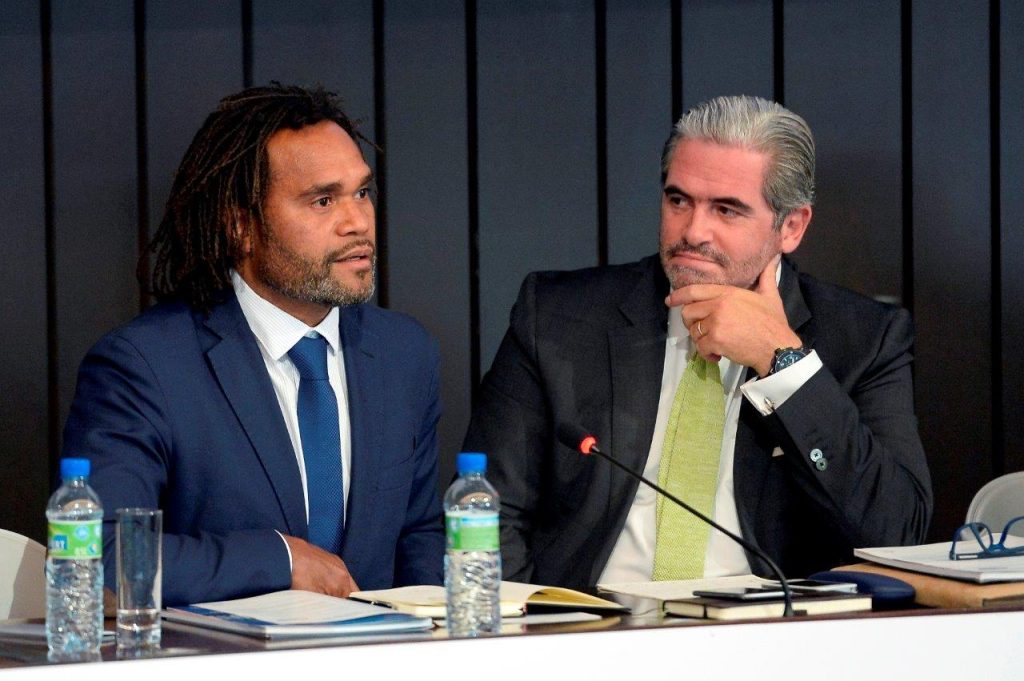
    “Sport has the aim to bring people together. It is has the power to change the world and to unite people beyond regions, beyond colours. Sport has no borders and is universal,” said football superstar and UEFA Global Ambassador, Christian Karembeu.
    “Through sport, we speak the same language. In sport, we have the same rules, the same life and have the same opportunities. Sport is also a powerful tool for integration and inclusion in wider society.
    “I am very proud to be here today and have a strong interest in the topics discussed. Education through sport is very important and through it, we can have balance.”
    International organisations attending the conference included: the European Commission, the Council of Europe, UNESCO, United Nations, International Labour Organisation, government organisations, UEFA and other representatives from the sport and Olympic movement, as well leading NGOs.
     

  • New round of FIFA corruption charges anticipated

    New round of FIFA corruption charges anticipated

    The investigation into corruption and misconduct in and around FIFA is expanding, with further arrests on the cards, the US and Swiss Attorney Generals handling the case indicated today. 
    Speaking to press in Zurich, US Attorney General Loretta Lynch said “individuals and entities” could be set to be charged simultaneously in a new phase of investigation. 
    “We tend to proceed against individuals brought under one indictment together,” she said. 
    The investigation, which has so far been conducted as a coordinated effort between US and Swiss authorities, is likely to expand into other nations. 
    “If some ExCo members are not living in Switzerland this could make other jurisdictions think about how they could help,” said Swiss Attorney General Michael Lauber.
    “We feel that we have received cooperation and collaboration from many parties… There is always the possibility that people have more information to provide,” said Lynch. 
    Lauber and Lynch did not reveal the subject of new enquiries.
    “I’m not going to comment on which individuals or entities will be the subject of the next round of charges… and I am not able to give you information about Mr Blatter’s travel plans,” said Lynch.  
    She added that FIFA and its members face a choice between corruption and integrity as it seeks to reform. 
    “FIFA are considering issues of reform and improving the sport,” she said. 
    “They have a lot to consider… Individuals have a choice between the old way of corruption or moving towards integrity of the sport.” 
     

  • IOC suspends former IAAF president Lamine Diack

    IOC suspends former IAAF president Lamine Diack

    The IOC Executive Board on Tuesday suspended the honorary IOC membership of Lamine Diack, former president of the International Association of Athletics Federations (IAAF) following the publication of a World Anti-Doping Report on Monday.
    “The Independent Commission’s Report contains a series of findings that will shock and appal athletes and sports fans worldwide, and indeed many issues that highlight very current deficiencies with the anti-doping system in Russia,” said WADA President and IOC Vice President Sir Craig Reedie on Monday, during Host City 2015 conference in Glasgow.
    Following the publication of the report, the International Olympic Committee (IOC) said it was “closely monitoring the situation” and expects the IAAF and WADA to “consider all necessary action to be taken to protect the clean athletes and rebuild trust”.
    The IOC’s Executive Board on Tuesday confirmed the proposal of the IOC Ethics Commission to provisionally suspend Mr. Lamine Diack, the former President of IAAF, from his honorary membership of the IOC.
    In a statement, the IOC said it has asked the IAAF to initiate disciplinary procedures against all athletes, coaches and officials who have participated in the Olympic Games and are accused of doping in the report of the Independent Commission. 
    “With its zero-tolerance policy against doping, following the conclusion of this procedure, the IOC will take all the necessary measures and sanctions with regard to the withdrawal and reallocation of medals and as the case may be exclusion of coaches and officials from future Olympic Games,” the statement said. 
    The news follows WADA’s suspension of its accreditation of the Moscow Antidoping Center. The laboratory is now restricted from carrying out any WADA-related anti-doping activities including all analyses of urine and blood samples. 
    The IOC said it has no reason to question the credibility of the results of the anti-doping tests carried out at the Sochi 2014 Olympic Winter Games, but will retain all the doping samples for ten years and retest samples “in an appropriate way should substantial doubts arise. In any case, the IOC may retest samples once new scientific techniques become available”.
    “While the contents of the Report are deeply disturbing, the investigation is hugely positive for the clean athlete as it contains significant recommendations for how WADA and its partners in the anti-doping community can, and must, take swift corrective action to ensure anti-doping programs of the highest order are in place across the board,” said Sir Craig Reedie.
    “WADA is fully committed in its role of leading the charge to protect the rights of clean athletes worldwide.”
     

  • WADA president takes tough action on doping

    WADA president takes tough action on doping

    WADA president and IOC Vice President Sir Craig Reedie CBE on Wednesday asserted he is taking quick and strong action in response to evidence of widespread doping in athletics.
    In an editorial published in the Independent, he said “There have been critics of the World Anti-Doping Agency, and critics of me, and first and foremost I don’t want people to think I’m too political or too soft.
    “I can categorically state I have not been soft on Russia. It was me as president of WADA that agreed with several national anti-doping organisations to create an independent commission to look into the subject of doping in Russia, the results of which we saw in all its damning detail in Geneva on Monday.”
    Speaking to press at Host City 2015 on Monday, Reedie said WADA was responding to calls to be tougher.
    “I think the world will want us to be much stricter and aggressive in saying whether people are compliant or not.”
    The independent report revealed that officials at a WADA accredited drug testing laboratory in Moscow destroyed 1,417 samples and accepted bribes to cover up positive tests. 
    “It’s quite clear that that was organised between a laboratory, a national anti-doping association, almost certainly a national athletics association – three different organisations combining to beat the system.”
    WADA reacted immediately by provisionally suspending the laboratory’s accreditation.
    “We have responsibility for the Russian anti-doping agency and its state of compliance – quite clearly it is not compliant at the moment – we can deal with that.
    “As far as the national athletics federation in Russia is concerned, that is the responsibility of the IAAF and their responsibility under the code is to make sure that the national federations are code-compliant. We will clearly work with the IAAF as closely as they want us to and as we are able to resolve this issue.”
    Asked by press at Host City 2015 whether the IAAF leadership was able to handle the crisis, he said “I think the allegations of people at the top end of the IAAF are intensely regrettable. They have done the sport in my view great damage. 
    “This is a newly elected council, a new president. And yes I think the new leadership can do it. It’s not going to be easy and it’s going to involve a great deal of effort, but we will help them as best we can.”
    Responding to a question from Host City magazine about whether athletes are in some cases victims, he said: “My experience is that very few drug cheats do it themselves; they almost always have somebody else. So I am very happy with the principle that we deal with the athlete’s entourage; the rules also say that we deal with the athlete. 
    “But I agree with you; if you coaches and people who are administering drugs to athletes then they are in many ways more guilty than the athletes themselves.” 
    Reedie told Host City how WADA has become stronger under his leadership. 
    “We greatly strengthened the new 2015 code by specifically targeting the athletes’ entourage. Secondly we created an offence called ‘prohibited association’, so if an athlete is associating with a known member of the entourage who has been convicted of a doping offence then the athlete shouldn’t be there. 
    “We have produced a list and that’s now current. If any of the officials mentioned in the Pound report are sanctioned they will immediately be put on that list.”
    The next phase of the WADA-commissioned report will investigate allegations beyond Russia. 
    “Is there a sense that things could get worse before they get better? Quite possibly. We still await further revelations from the commission and, because of its independence, I genuinely have no idea what those revelations will be,” Reedie wrote in the Independent. 
    “At the end of the day, I think good will come out of evil,” he told press at Host City 2015.
     

  • Renewing the trust in sport

    Renewing the trust in sport

    As an Olympic medallist, recent developments in some sports are particularly upsetting. What saddens me most as a former athlete is that they erode the trust in the clean athlete. Clean athletes who push themselves day in day out pursuing their dreams see the finger of suspicion pointing at them. This is the very worst ‘side-effect’ of doping. 
    We must do everything we can to protect these millions of clean athletes around the world. For their sake and for the credibility of sports competition, they have to be protected from doping and corrupting influences. We also have to protect the credibility of sports competition from match-fixing and manipulation. The IOC has created a specific 20-million US dollar fund for the protection of clean athletes. This comes on top of overall international investments of an estimated 500-million US dollars for around 250,000 anti-doping tests a year, among other initiatives. The IOC has a zero-tolerance policy against doping and any kind of manipulation and corruption. 
    Doped athletes already face a four-year ban from any kind of sports competition for their first infringement. This means an effective ban from the next edition of the Olympic Games. As a young man, I called for life bans even for the first infringement. Unfortunately, such a sanction would not be upheld by any judicial court. But what we can do is making the anti-doping system more independent from sports organisations. In this respect, the IOC took the initiative to ask the World Anti-Doping Agency (WADA), the international authority in the fight against drugs in sport, to consider taking over testing programmes from the international sports federations. The IOC also proposed that the Court of Arbitration of Sports (CAS), the highest judicial body for the sports world, take over all sanctioning of doped athletes. 
    Zero-tolerance also means all nations and all sports have to be compliant with WADA’s rules. On this front, sport requires the support of governments. Let us not forget that governments have a 50% stake in WADA. Governments need to make sure that their national anti-doping authorities are WADA-compliant. Governments also have to ensure dealers, corrupt doctors and coaches are punished with the full force of the law. 
    Protecting the clean athlete goes hand in hand with ensuring that the environment in which the athletes operate is safe from corrupting influences. To fight manipulation in sport and specifically match-fixing and illegal betting, the IOC and the International Sport Federations are already working closely with police, betting operators and regulators around the world. Recognizing the international nature of organized crime, the IOC is also engaged with Interpol to safeguard the integrity of sport. 
    Fighting corruption also means that good governance for sporting organisations is essential. The IOC has put the necessary measures in place since a long time. More recently, the reforms passed in Olympic Agenda 2020 exactly one year ago, ensure internationally recognized standards of governance. As a result, all our accounts are audited at a higher international financial reporting standard (IFRS) and we are publishing everything in our annual report, as is common practise in the corporate world; we have term and age limits for all IOC Members; we have a chief ethics and compliance officer, an audit committee and an independent ethics commission. We have called on and we expect all sports organisations to follow this route. All these measures and others, which are publically available, allow the IOC to distribute over 90% of our revenue – that is $3.25 million each and every day – back to athletes and world sport. 
    The recent discussions on these issues show the huge significance sport has in our society. Sport has the power to make the world a better place. If these good governance measures are adopted and the zero-tolerance policies are followed by all sport organisations, there is a very bright future for sport. As Nelson Mandela said: “Sport has the power to change the world.” Yes, these are difficult times for sport. But yes, it is also an opportunity to renew the trust in this power of sport to change the world for the better.
    This opinion piece by IOC President Thomas Bach is also published on www.olympic.org
     

  • Blatter and Platini banned from football world

    Blatter and Platini banned from football world

    The adjudicatory chamber of the Ethics Committee chaired by Mr Hans Joachim Eckert has banned Mr Joseph S. Blatter, President of FIFA, for eight years and Mr Michel Platini, Vice-President and member of the Executive Committee of FIFA and President of UEFA, for eight years from all football-related activities (administrative, sports or any other) on a national and international level. The bans come into force immediately.
    The proceedings against Mr Blatter primarily related to a payment of CHF 2,000,000 transferred in February 2011 from FIFA to Mr Platini. Mr Blatter, in his position as President of FIFA, authorised the payment to Mr Platini which had no legal basis in the written agreement signed between both officials on 25 August 1999. Neither in his written statement nor in his personal hearing was Mr Blatter able to demonstrate another legal basis for this payment. His assertion of an oral agreement was determined as not convincing and was rejected by the chamber.
    The evidence available to the adjudicatory chamber in the present case was not sufficient to establish, to the extent required, that Mr Blatter sought the execution or omission of an official act from Mr Platini within the meaning of article 21 paragraph 1 of the FIFA Code of Ethics (FCE) (Bribery and corruption). However, the conduct of Mr Blatter towards Mr Platini without a legal basis constituted a breach of article 20 paragraph 1 of the FCE (Offering and accepting gifts and other benefits). Furthermore, Mr Blatter found himself in a situation of conflict of interest, despite which he continued to perform his related duties, failing to disclose said situation and the existence of personal interests linked to his prospective activities, thus violating article 19 paragraphs 1, 2 and 3 of the FCE (Conflicts of interest). By failing to place FIFA’s interests first and abstain from doing anything which could be contrary to FIFA’s interests, Mr Blatter violated his fiduciary duty to FIFA and breached article 15 of the FCE (Loyalty). Mr Blatter’s actions did not show commitment to an ethical attitude, failing to respect all applicable laws and regulations as well as FIFA’s regulatory framework to the extent applicable to him and demonstrating an abusive execution of his position as President of FIFA, hence violating article 13 of the FCE (General rules of conduct).
    In consequence, Mr Blatter has been banned for eight years from all football related activities and fined CHF 50,000.
    The investigation into the case of Mr Blatter was conducted by Mr Robert Torres, member of the investigatory chamber of the Ethics Committee. The investigation resulted in a final report which was submitted to the adjudicatory chamber on 20 November 2015. The adjudicatory chamber opened formal proceedings on 23 November 2015, and the hearing of Mr Blatter took place in Zurich on 17 December 2015.
    The proceedings against Mr Platini primarily related to a payment of CHF 2,000,000 that he received in February 2011 from FIFA. The payment to Mr Platini had no legal basis in the written agreement signed between both officials on 25 August 1999. Mr Platini’s assertion of an oral agreement was determined as not convincing and was rejected by the chamber.
    The evidence available to the adjudicatory chamber in the present case was not sufficient to establish, to the extent required, that Mr Platini obtained the payment for the execution or omission of an official act within the meaning of article 21 paragraph 1 of the FCE (Bribery and corruption). Nevertheless, the conduct of Mr Platini without a legal basis constituted a breach of article 20 paragraph 1 of the FCE (Offering and accepting gifts and other benefits). Furthermore, Mr Platini found himself in a situation of conflict of interest, despite which he continued to perform his related duties, failing to disclose said situation and the existence of personal interests linked to his prospective activities in violation of article 19 paragraphs 1, 2 and 3 of the FCE (Conflicts of interest). By failing to place FIFA’s interests first and abstain from doing anything which could be contrary to FIFA’s interests, Mr Platini also violated his fiduciary duty to FIFA and breached article 15 of the FCE (Loyalty). In addition, Mr Platini failed to act with complete credibility and integrity, showing unawareness of the importance of his duties and concomitant obligations and responsibilities. His actions did not show commitment to an ethical attitude, failing to respect all applicable laws and regulations as well as FIFA’s regulatory framework to the extent applicable to him and demonstrating an abusive execution of his position as Vice-President of FIFA and member of the FIFA Executive Committee, hence violating article 13 of the FCE (General rules of conduct).
    In consequence, Mr Platini has been banned for eight years from all football related activities and fined CHF 80,000.
    The investigation into the case of Mr Platini was conducted by Ms Vanessa Allard, member of the investigatory chamber of the Ethics Committee. The investigation resulted in a final report which was submitted to the adjudicatory chamber on 20 November 2015. The adjudicatory chamber opened formal proceedings on 23 November 2015, and the hearing took place in Zurich on 18 December 2015 in the presence of Mr Platini’s lawyers.
    Source: FIFA
     

  • FIFA acting leaders look to the future
    FIFA acting leaders look to the future

    Dear friends of football, 
    FIFA has faced unprecedented difficulties this year in a crisis that has shaken global football governance to its core. We are now moving through a period of necessary change to protect the future of our organisation. 
    We maintain that the majority of those working in football governance do so in the right way and for the right reasons, but it has become clear that root-and-branch reform is the only way to deter future wrongdoing and to restore faith in FIFA. For these reasons, this year and the immediate years to come will be among the most important for FIFA since it was founded in 1904. 
    A new FIFA President will be elected at the Congress in February, offering the opportunity to start a new chapter. It is vital to recognise that this will be only the beginning. We will need to work hard together over the coming years to win back the trust and respect of fans, players, commercial affiliates and all the many millions of participants who make football the world’s most popular sport. 
    We are confident that the new reform measures approved by the FIFA Executive Committee in December, alongside the separate actions of the Swiss and US authorities, will lay the foundations for a stronger, more transparent and more accountable and more ethical governing body of football. 
    We call on all of FIFA’s member associations to fully support, implement and abide by the new reforms. The future of FIFA and the global development of football depend on our full commitment to embracing a change in culture from top to bottom, through the following key reform points: 
    • A clear separation of powers between the political side of global football and the day-to-day financial and business operations of FIFA, such as organising competitions and football development investments, will help to protect our integrity and avoid conflicts of interest. All financial transactions will be monitored by a fully independent body. 
    • Member associations must mirror the above structure and comply with principles of good governance, such as establishing independent judicial bodies. They will also be accountable for the conduct of their entire team and any third parties that they work with. 
    • Strict term limits for senior positions within FIFA of three four-year terms will ensure that no single person can wield too much power or influence. 
    • An explicit commitment in the FIFA Statutes to develop women’s football and to promote the full participation of women at all levels of football governance, including a minimum of one female representative from each region in the new FIFA Council. 
    • Central integrity checks by an independent body for all appointments to FIFA bodies and senior management. 
    • Members of the new FIFA Council must be elected by the member associations from each respective region under new FIFA governance regulations and monitored by the new, independent FIFA Review Committee. 
    • More independent and properly qualified members of key committees such as finance, development, governance and compliance to provide a stronger layer of neutrality and scrutiny. 
    • More involvement from the football community (players, clubs, leagues, member associations, etc.) in decision making. 
    • A statutory commitment by FIFA to uphold and protect internationally recognised human rights in all its activities. 
    There may be further challenges ahead, and it will take time for these reforms to take effect, but our resolve to rebuild FIFA for the better remains steadfast. Our aim is to establish a secure, professional and fully accountable sports organisation by the time of the 2018 FIFA World Cup™ in Russia. 
    We are confident that this is a realistic target, and we look forward to returning our full focus to FIFA’s primary mission of promoting and developing football everywhere, and for all. 
    The hundreds of millions of fans, players, coaches and others dedicated to football around the world deserve nothing less from those of us with the incredible responsibility and privilege of governing and guiding global football. 
    Yours faithfully, 
    Issa Hayatou Acting FIFA President
    Markus Kattner Acting FIFA Secretary General 
     

  • European Athletics backs UK call for review of world records

    European Athletics backs UK call for review of world records

    European Athletics President Svein Arne Hansen has announced a number of measures to bring about a “cultural revolution” in athletics.
    These initiatives include a review of European records, in line with the UK Athletics proposal that world records should be reset in light of ongoing doping revelations. 
    “Rebuilding the reputation of athletics is likely to be the biggest job we have ever undertaken,” Hansen wrote in a statement issued to stakeholders.
    “Symbolic gestures and cosmetic measures will not be sufficient, this grave and unprecedented situation calls for fundamental reform.”
    “We believe a cultural revolution will be required for athletics to rebuild its reputation and bring the sport’s governance to where it needs to be.”
    The reform programme includes further development of good governance structures; investing in a new mandatory anti-doping education programme, pushing IAAF and WADA to implement tougher penalties for doping offenses, developing a national anti-doping system of assessment and monitoring, and reviewing the European records, in line with the British Athletics proposal for world records.
    “The recent scandals have reopened the discussion about the legitimacy of certain records in our sport. These link us to a past in which neither we nor the public can have full confidence,” said Hansen.
    “Over the years different approaches for addressing this question have been proposed but the issue is very complex and so far nothing has happened. It is clear that now the situation is different.
    “We will set up a special project team in the coming months to look again at what is best for the sport and possibly a new approach to records in Europe that could be an example for the IAAF and our Member Federations. 
    “We will also review the lists of all past award winners, like our European Athlete of the Year or our Coaching Awards, to see if action needs to be taken. Whatever changes we make will be clearly explained so that the public can see how European Athletics is coming to terms with the realities of our sport’s past.”
    An independent WADA-commissioned report, published during HOST CITY 2015 on 9 November, revealed that officials at a WADA-accredited drug testing laboratory in Moscow destroyed samples and accepted bribes to cover up positive tests. 
    “Like everyone in athletics, I am gravely concerned and saddened by the recent WADA report on systemic doping in Russia, the serious corruption allegations against some former IAAF officials and the other scandals that seem to surface on a daily basis,” said Hansen.
    “Although European Athletics has not been implicated in any way and these issues are not unique to athletics, the public image and reputation of our sport have been tarnished and this, of course, touches all of us.”
    Hansen said European Athletics would take work with IAAF to “help Russia come back into the sport on the right terms.”
    “Our philosophy will be one of “tough love” – firm, fair and respectful – but our tolerance for doping and any form of corruption must remain at zero. 
    “We will also support our Member Federations that have ideas to contribute to the discussion about our sport’s future now taking place, for example the ‘Manifesto for Clean Athletics’ published by UK Athletics.”
    WADA is due to release another report later this week. 
    “When the second WADA report is released, we will carefully study it and any recommendations it contains. If immediate comments are called for, we will make them. Then, in light of the report, we will take our time to review the projects and proposals we have put forward and make any adjustments or additions required,” said Hansen.
    Hansen endorsed the current leadership of the IAAF. “We have full confidence that IAAF President Sebastian Coe is the right man for the current challenges, and European Athletics will give him the backing and support he needs.”
     

  • FIFA explains ban for Qatar and Russia bid inspector

    FIFA explains ban for Qatar and Russia bid inspector

    Harold Mayne-Nicholls, who chaired the FIFA Bid Evaluation Group for World Cups in 2018 and 2022, was on Thursday notified by the adjudicatory chamber of FIFA’s independent Ethics Committee of the reasons for his seven-year ban. 
    The adjudicatory chamber, chaired by Mr Hans-Joachim Eckert, had banned Mayne-Nicholls from taking part in any kind of national and international football-related activity (administrative, sports or any other) for a period of seven years.
    The FIFA-led investigation found Mayne-Nicholls guilty of infringing article 13 (General rules of conduct), article 15 (Loyalty), article 19 (Conflicts of interest) and article 20 (Offering and accepting gifts and other benefits) of the FIFA Code of Ethics (FCE). 
    The adjudicatory chamber described the violation of article 20 as “the most serious breach committed by the official”, contravening a provision that aims at “guaranteeing that the requirement for FIFA – and its bodies and officials – to behave with integrity and neutrality is upheld at all times”.
    “Mr Mayne-Nicholls, in his capacity as chairman of the FIFA Bid Evaluation Group for the World Cups in 2018 and 2022, had a special obligation with regard to the integrity and neutrality of his work,” the adjudicatory chamber said.
    “Confidence in the work of the Bid Evaluation Group was especially crucial in order for it to properly exercise its powers and duties. After having taken part in an inspection visit to one of the Bid Committees in September 2010, Mr Mayne-Nicholls, at his own initiative, repeatedly asked for personal favours related to the hosting and training of his relatives (a son, nephew and brother-in-law) at an institution linked with that Bid Committee. 
    “Not only were these requests of a private nature, but they were made only a few days after the visit to the Bid Committee, during the time the Bid Evaluation Group of which Mr Mayne-Nicholls was the chairman was still exercising its duties and prior to the election of the hosts for the 2018 and 2022 FIFA World Cups. 
    “By making the requests, Mr Mayne-Nicholls did not act in FIFA’s interests and ignored his responsibility as a high-ranking FIFA official, someone who was expected to act with utmost neutrality and integrity, in order to pursue his own personal interests.”
    Mayne-Nicholls now has the option to lodge an appeal with the FIFA Appeal Committee.