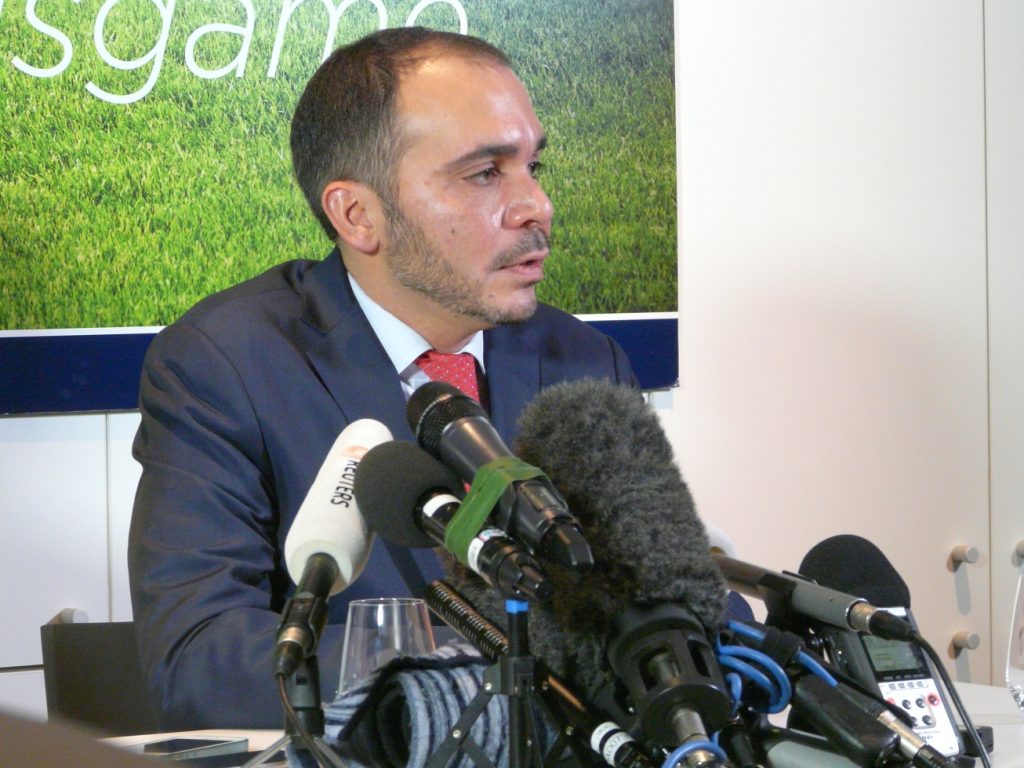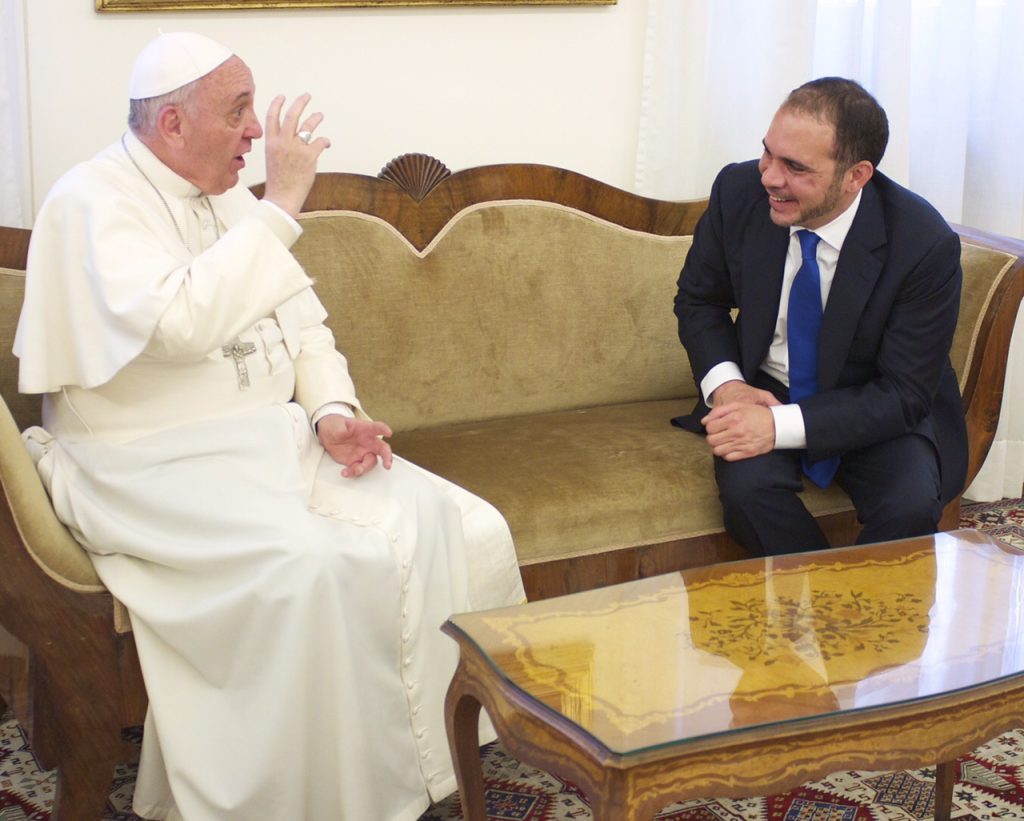
Prince Ali Bin Al Hussein of Jordan has kicked off his bid for the FIFA presidency by telling media that the organisation must become more transparent.
In his first interview since announcing his candidacy, Prince Ali Bin Al Hussein also announced plans to begin a ten year programme of reform, while stating he would not necessarily want to hold the position of president “long term”.
Speaking to the BBC, Prince Ali pointed to weaknesses within the current framework without directly attacking the other candidates Sepp Blatter and Jerome Champagne, in line with his promise to run a positive campaign.
“Fifa as an organisation tends to be a bit secretive, but we should be confident and happy to be open and engaged with everyone,” Prince Ali said on Saturday.
Prince Ali was a key figure in the push for FIFA to publish its report into alleged corruption.
“I was the first to ask for the Garcia report to come out. We should have nothing to hide.
“I don’t see a reason to be guarded. We have to bring the administration of sport into the current time we live in. I want to bring back that confidence.
“I believe we should be totally transparent.”
The move to making FIFA more transparent is part of a wider campaign to transform FIFA.
“Reform is crucial,” he said.
This emphasis on reform has echoes of the recently approved Agenda 2020 programme at the IOC, of which Prince Ali’s older brother Prince Feisal is a member.
“I will look to a 10-year programme for the organisation where everyone is a part of it, and ourselves as the executive committee will implement it.”
In contrast to the lengthy terms served by current president Sepp Blatter and his predecessor Joao Havelange, Prince Ali told the BBC the role is “not something I want to do long term,” adding “A lot of things can happen and I’m confident we can [reform] in quick time.”
He plans to build his manifesto through discussions with FIFA members.
“In the coming months, I will be looking to sit down and talk to all our member associations and listen to them.
“I’m not coming in to dictate. I have my ideas and progress I want to implement, but I have to hear back from my colleagues.”
Prince Ali’s campaign has been undermined by the assertion on Friday by Shaikh Salman bin Ebrahim Al Khalifa, president of the Asian Football Confederation that all 46 AFC member associations will vote for Blatter.
His ability to run FIFA has also been called into question by his competitor Jerome Champagne, who told the BBC “Last year he lost the election in Asia, so if you don’t have a base in your own region and own continent, how can you be expected to be elected at the world level?”
FIFA’s longstanding president Sepp Blatter on Friday welcomed Prince Ali entering the election race, telling Swiss newspaper Le Matin: “I can only rejoice in this nomination. We are a democracy, and this can only be beneficial for debate.
“And do not they say that win without peril is to triumph without glory?”
The president will be elected on 29th May at the FIFA Congress.
According to the FIFA website, “In the spirit of true democracy, each national association has one vote, regardless of its size or footballing strength.”
Tag: Presidential Election
-

FIFA must end secrecy, says presidential candidate Prince Ali
-

Luis Figo runs for presidency of “deteriorating” FIFA
Luis Figo on Wednesday put himself forward as a candidate for the presidency of FIFA, promising to improve the organisation “deteriorating” image and remove its association with “scandal”.
Announcing his bid with just one day to go before the deadline, Figo joins Prince Ali of Jordan, Jerome Champagne and David Ginola as a challenger to FIFA president Sepp Blatter.
“I look at the reputation of Fifa right now and I don’t like it. Football deserves better.
“In recent weeks, months, and even years, I have seen the image of Fifa deteriorate,” Figo told journalists.
“If you search FIFA on the internet, you see the first word that comes out: ‘scandal.’ Not positive words. It’s that we have to change first and try to improve the image of FIFA. Football deserves much better than this.
“I’ve been talking with so many important people in football – players, managers, president of federations – and they all think that something has to be done.
The brand image of FIFA’s most valuable product, the World Cup, is at risk, Figo said.
“Last year was the World Cup, I was in Brazil and I saw the reaction of all the fans regarding the image of FIFA and I think something has to be changed.
“Change in leadership, governance, transparency and solidarity, so I think it’s the moment for that.”
All candidates will need to show the support of at least five nominating member associations in order to validate their presidential campaigns.
FIFA’s Harold Mayne-Nicholls, who led the evaluation commission for, and questioned the outcome of, the controversial 2018 and 2022 World Cup bidding procedure has said he may also enter the race.
The 42-year old footballing legend played for Barcelona, Real Madrid and Inter Milan, winning FIFA World Player of the Year award in 2001 and the Ballon d’Or in 2000.
FIFA requires presidential candidates to demonstrate that they have worked as “a board member, committee member, referee, assistant referee, coach, trainer [or] any other person responsible for technical, medical or administrative matters in FIFA, a Confederation, Association, League or Club”.
The president will be elected on 29th by FIFA members. Support for incumbent President Blatter is said to be very strong.
-

FIFA Election: how Blatter’s challengers compare
The presidents of the world’s 209 Football Associations will elect the president of FIFA at the FIFA Congress on 29 May.
With FIFA’s continental “confederations” holding great sway over voting intentions, and with all of these confederations bar UEFA said to be supporting Sepp Blatter, the incumbent president looks set to secure a historic fifth term.
Candidates must state their intention to run for president on 29 January, with the support of five nominating member associations. Are there any serious challengers in the mix?
Sepp Blatter
Nationality: Swiss
Age: 78
Announced campaign: 26 September, 2014
Core message: Says he is on a mission to complete the reform process initiated in 2011
Strengths: FIFA President since 1998, seeking a fifth term. Retains strong support of the majority of FAs outside Europe. Five of FIFA’s six continental Confederations are said to be backing Blatter: AFC (Asia), CAF (Africa), CONCACAF (North and Central America and Carribean), CONMEBOL (South America) and OFC (Oceania).
Challenges: FIFA enduring external pressures and the emergence of Prince Ali of Jordan as a challenger demonstrates that internal discontent is not limited to Europe.
Jerome Champagne
Nationality: French
Age: 56
Announced campaign: 26 September, 2014
Core message: To remove elitism and global imbalance from the administration of football.
Strengths: Says he is close to gaining the five required nominations.
Challenges: Time is running out and a host of other, more outspoken candidates have emerged.
Prince Ali Bin Al Hussein
Nationality: Jordanian
Age: 39
Announced campaign: 6 January 2015
Core message: Reform of FIFA, increasing transparency.
Strengths: Experience as vice president of FIFA, president of Jordanian Football Association and president of West Asian Football Federation. Has backing of the English FA. The only challenger to Sepp Blatter from outside Europe.
Challenges: Has yet to confirm whether he has the number of nominations required. His message of reform is echoed by those of other candidates who have since entered the race.
David Ginola
Nationality: French
Age: 48
Announced campaign: 16 January 2015
Core message: To restore democracy, transparency and equality to FIFA
Strengths: Has the support of pressure group ChangeFifa but has yet to declare the support of any FAs.
Challenges: Ginola’s campaign is financially supported by bookmaker Paddy Power, yet FIFA rules prohibit candidates “being associated with betting, gambling, lotteries and similar events”.
Michael van Praag
Nationality: Dutch
Age: 67
Announced campaign: 26 January 2015
Core message: To normalise, modernise FIFA and regain public trust. Presenting himself as the only credible opponent to Blatter.
Support: Has the required five nominations, including support from Scotland.
Challenges: Other European candidates offering a message of reform and transparency could split the vote, if they gain the required nominations. Support outside Europe is limited.
Luis Figo
Age: 42
Nationality: Portuguese
Announced campaign: 28 September 2015
Core message: To repair FIFA’s public image.
Support: Has the required 5 nominations.
Challenges: A recently retired footballer, he lacks experience in football administration. -

Prince Ali tackles FIFA’s “culture of intimidation”
Presidential candidate HRH Prince Ali Bin Al Hussein of Jordan produced his most vocal attack on the leadership of FIFA on Tuesday, setting out his stall to fix the tarnished reputation of football’s global governing body.
He spoke of a “culture of intimidation” within FIFA, where people can be punished for standing up for principles.
Challenging Sepp Blatter and the other two candidates, Michael van Praag and Luis Figo, to a public debate in the run up to the election, he said he hopes the presidential election will be conducted fairly.
Prince Ali plans to meet soon with van Praag, who he says he admires, and his friend Figo, to discuss strategy and said he would welcome the opportunity to work with them as a team.
He also said he will forsake his seat on FIFA’s Executive Committee if he does not win the election, as he is not prepared to work any longer under the current leadership.
Continental support
Speaking in London to a select group of media including HOST CITY, he revealed the names of the five national football associations from three continents that have nominated him to stand.
“The countries are Belarus, Malta, England, Jordan, USA – and so I’ve very happy with that – and of course Georgia,” he said.
“These nominations are from three different confederations, which I am very happy with.”
It has been widely reported that FIFA’s continental confederations tend to vote as blocs, and that incumbent FIFA president Sepp Blatter has the support of five out of the six confederations.
However, Prince Ali downplayed the power of confederations in the election process. “This is not a question of confederations – this is a national association vote for the presidency of FIFA and I don’t think that any confederation is necessarily united in that respect.
“I don’t think anyone has a ‘stranglehold’ on any confederation; I think it’s up to member associations to decide.”
He also said the calls for reform are widespread. “I don’t think that it’s just in Europe that there are concerns about FIFA. I see that, having been in South America, in Asia and in Africa and I think it’s time now to make that change.”
A “culture of intimidation”
Addressing speculation that the leadership of the Asian Football Confederation, of which Jordan is a member, has not backed his bid, Prince Ali said “There is a culture of intimidation within FIFA but, having said that, this is a candidacy for the whole world.
“This is a world issue and not just about confederations.”
Pressed on what he meant by “intimidation”, he said “In the past if people take a principled stand, they end up being possibly punished for it.”
Observers have suggested that a strategy is underway to challenge Blatter via an early multi-pronged attack that could switch to supporting a single challenger.
However, Prince Ali welcomed the other candidates.
“It’s very good that there is more than one candidate and it’s also emblematic of people’s desire to have a positive future. I look forward to meeting with them as soon as possible.
“Luis Figo is a friend of mine, I know him very well. Michael can Praag is also somebody who I admire and respect a lot, so I would like to sit them down and have a good and honest discussion about how they see things.”
Asked about whether a joint candidacy might even be a possibility, he said: “That does not fall within our statutes, but I would be very welcome to have support and work as a team and with everybody for the future of football.
“We need to be centralised a bit and we need to give everybody a role and we need to come up with a new way of conducting the sport, from the bottom up.”
Building on a his core message of transparency, he said “I would like to see before the election a public debate, including the incumbent, so that everybody knows across the world what our positions are. I’m ready to do it.”
Rebuilding trust
Widespread concern over allegations of corruption in the bidding process for the 2018 and 2022 World Cups has had a negative impact on FIFA, with a number of sponsors having dropped their support in recent months.
“There are many complaints obviously, in particular the reputation of FIFA and where it’s at right now,” he said.
“I am there to rebuild trust in our organisation and that doesn’t include only in our national associations but all stakeholders.”
Asked about how this could be achieved, he said “FIFA needs to include everyone – including yourselves, members of the press.
“You need to have a long-term plan that does not change based on the whims of a president, and based on real decisions that are conducted with all stakeholders in the game – and fix our reputation. That’s the way I’ve always worked.”
Central to the challenges facing FIFA is the controversial way in which Qatar was awarded the 2022 World Cup. Asked if he would consider stripping a country of its hosting rights, he said “First of all I believe that every single association has the right to host the World Cup, regardless of their size and so on.
“Having said that, I was one of the first to ask for the Garcia report to be made public. Because this is a world game and everyone needs to understand what is going on – that is transparency in its essence.
“The problem really lies in how things took place: for example the double bid. We need to know why that happened. If Qatar had another four years to prepare their bid in a proper way, we wouldn’t be in this situation.”
Prince Ali was also drawn into pointing the finger directly at Sepp Blatter for the crisis of trust in FIFA.
“Blatter has been president and definitely the president needs to be held personally responsible for what happens; and if I am president I certainly will take responsibility for all actions at FIFA.
“I have a lot of respect for what he’s done in the past, but if we talk about proper reform I am not confident that I’ve seen it.
“He’s had the chance to do so; we’ve had Mark Peith’s report, which was never in my opinion shown. We’ve also had promises from him that he would not run again – but obviously that was not the case.
“In full honesty and integrity, he should give the chance to others such as myself.”
Presidency or out
Prince Ali also announced his plans to leave the FIFA Executive Committee if he does not become president of FIFA.
“I have been on the Executive Committee for the last four years and I understand what has been going on,” he said.
“I have always tried to reform FIFA as best I can from the inside, but having said that I do believe the way to go ahead is to run for the presidency itself.”
“My total commitment is running for the presidency of FIFA. I’m not going to sit through another four years of what’s been going on and the only way to change it is from the top.”
Despite his core message of a lack of transparency within FIFA’s administration, he remains hopeful that the election process can be conducted fairly and that he can win the election.
“I think I have my reputation, I am where I am and I just hope that things work out in that way, that it’s fair and it’s honest.”
The presidents of FIFA’s member associations will elect their president on May 29th.
“It’s long campaign, so I don’t think anyone should be written off. Globally there is a desire for change and I am committed to that.
“If things are played fair and rightly, things will grow in the appropriate way.”
-

Luis Figo strikes to break up FIFA’s power
Luis Figo was the first of the candidates for the FIFA presidency to launch his manifesto today, proposing radical changes to an organisation that he says has deteriorated under the current leadership and suffers from a “negative reaction”.
The retired Portuguese footballer pledged to redistribute at least half of FIFA’s funds equally around the world to develop football at the grass roots level.
With the aim of establishing good governance, Figo wants to establish a FIFA Football Council to advise the president and Executive Committee, as well as an independent governance, audit and compliance committee with powers to “control the actions of the president”.
He also announced a proposal to increase the number of members on the Executive Committee, with equal representation from each of the continental confederations.
In a bid to boost the global appeal of his candidacy, he also announced plans to increase the number of non-European teams competing in the World Cup.
Figo’s and FIFA’s funding
Drawing on his own life story, Figo revealed that his campaign is entirely self-funded. “I grew up in working class of Lisbon, playing on streets,” said Figo. “My life changed through the power of football and I am lucky to be an independent man. I don’t owe anyone anything; this means I can serve FIFA in the interest of football, for football.
“Thank God I’ve had a long and successful career. When you retire, you need to have a balance – it’s on a smaller scale than FIFA’s budget but the way I’ve managed my finances shows that I can stand on my own two feet. I have enough money to pay for my candidature.”
Figo plans to redistribute FIFA’s revenues to enable children all over the world to get a chance to become professional footballers.
“I was very lucky and fortunate to play and get training from an early age but I know this opportunity does not exist for many children across the world,” he said.
“This is why I propose radical changes to the way FIFA redistributes its membership payments.
“I want to see at least 50 per cent of FIFA funds spent on grass roots football and to increase the size of the funds available.”
This amounts to US$ 2.5 bn. He also wants to distribute an additional US$1bn directly to the member associations over a four year period.
Currently, the member associations receive less than US$ 4m per four years.
He questioned FIFA’s current approach of setting aside a US$1.5bn reserve pool to cover the possibility of the World Cup being cancelled. “This money is not FIFA money – it is the member associations’,” he said.
“US $5m is enough to cover the operational cost of FIFA.”
This offer of cash may help Figo to gain backing for his campaign from the 205 member associations around the world that elect FIFA’s president on 29th May.
In another bid to boost the appeal of his campaign outside Europe, Figo also said he would like to increase the number of teams competing in the World Cup, without increasing Europe’s participation.
“I believe we should consider proposals to expand the competition to a 40 or even 48-team World Cup,” he said. “Both these options are feasible with an extra three to four days of tournament play.”
Structural changes to restore trust
Central to his campaign is rebuilding trust in FIFA.
“In the last few months and years we’ve come to realise that the FIFA image has deteriorated.
In Brazil, during the most important sport competition the World Cup, I could see protests against the organisation – and this was in a country that loves football deeply.
“I could see the reaction to the president of the organisation – I could see quite a negative reaction. This is not an appropriate image.
“When I started to look at all the news about scandals I decided that something needed to change.”
The changes that Figo proposes are major and structural.
“There must be transparency. My proposal is to change structures, so there will be a wider consultation with members.
“In the different confederations, we will organise meetings between 10 and 15 member associations… and the summaries of those strategic meetings will be distributed and passed on to the board.”
He also announced plans to establish a new FIFA Football Council to advise the FIFA president and the Executive Committee on issues including the calendar and format of events as well as the laws of the game and football development.
This council would have a moderating role over hosting decisions.
“It is also important to maintain decisions within the council in terms of which countries go on to organise the World Cup,” he said.
On the issue of the controversy and investigations surrounding the 2018 and 2022 World Cups, he acknowledged that there are reports of “irregularities that have taken place, reports not made public.”
But indicative of his aim to achieve global appeal, he did not support any of these claims, saying “If there are no irregularities, I don’t think Qatar should be prejudiced [against].”
He also proposes to merge the existing ethics and disciplinary committees to create a new governance, audit and compliance committee.
“For there to be transparency, the governance committee would have to be a fully independent committee from the council and also from the executive committee, and therefore that they could control the actions of the president.
“With these measures defining the different responsibilities and powers of each body, I think we would have the right measures for transparency within the organisation.”
The composition of the Executive Committee would also become a more level playing field with equal representation internationally. Each continental confederation would have one seat per ten member associations, with an additional seat for member associations that have won the World Cup, with a limit of eight seats per confederation.
With six confederations each bringing up to eight members, this would represents a major increase on the current Executive Committee membership of just 27.
Can he win it?
Figo chose to launch his bid in London, with the venue for the press conference switched from Stamford Bridge to Wembley Stadium at 24 hours’ notice.
“London is a global city and Wembley is an emblematic football space. There is no better place to present my ideas to the world,” he said.
Figo’s candidacy was nominated by six European associations. Whether he will be able to gain support from the 205 member associations, the vast majority of whom are said to have unwavering support for the incumbent president Sepp Blatter, remains to be seen.
“Mr Blatter, well I respect him, he has been leading the organisation for many years. He has had many positive achievements for football and for the organisation but a point has reached where change has needed.”
Figo’s other competitors in the presidential race are Prince Ali Bin Al Hussein of Jordan and Michael Van Praag of the Netherlands.
“Looking at the other candidates, we have some good ideas, someone who is in the Executive Committee and who knows how the organisation works internally. Also the Dutch FA president I know and respect very much; he has a lot of experience.”
He denied suggestions that he might step aside to support a single challenger to Blatter.
“My idea is right now is to run to the end, to see as many people as possible regarding the presidency and to convince them with my ideas.
The president of FIFA will be elected at the FIFA Congress on 29th May.
-

Luis Figo welcomes winter World Cup in Qatar
Luis Figo, the retired Portuguese footballer who is running for the presidency of FIFA, has said that the organisation is right to recommend hosting the World Cup in late November and December 2022 – despite the disruption this would cause to the European football leagues.
“The FIFA Task Force recommendation is the right decision for the World Cup,” he said in a statement.
After a six month consultation process, the FIFA task force recommended earlier today that the 2022 World Cup should take place at the end of the year, to avoid clashing with the Olympic Games, Ramadan and the hottest months of the year.
“It has to be played in the best possible conditions for the fans and players who will enjoy a great World Cup atmosphere, and for Qatar who deserve to be put in the position to organise a great event,” Figo said.
“With good will and a sense of solidarity it is always possible to find the right solutions.”
Figo’s endorsement is in contrast to the reaction of other leading European football administrators. The European Professional Football Leagues and the European Clubs Association had been pressing for the World Cup to take place from 5 May to 4 June and will continue to oppose the proposed date change.
Richard Scudamore, the chief executive of the English Premier League, said “It’s the European leagues and European clubs that are going to suffer the most, so it’s very disappointing.”
While Figo has been outspoken about the need for transparency in FIFA, he is taking a very diplomatic stance on the issue of Qatar’s right to host the World Cup. At the launch of the manifesto for his presidential campaign last week, he acknowledged that there are reports of “irregularities that have taken place, reports not made public” but said “If there are no irregularities, I don’t think Qatar should be prejudiced [against].” -

Prince Ali: Imagine a rejuvenated FIFA
I bring you greetings from my home country of Jordan; a land of peace; a country that serves as a bridge between cultures; and a mediator in times of conflict; a country that is at the crossroads of all continents and civilizations.
A country that believes in the pursuit of values, such as integrity, honesty and respect.
We are in a crucial time for football. Both inside and outside the football family, people have expressed concern about the way FIFA is run.
And there are some deep rooted issues that we as a family must unite to confront together.
Around the world there is a real appetite for change, new leadership, better support to National Associations, meaningful investment in football development, and for FIFA to be a genuine service organisation.
This movement calls for a better FIFA, one based on respect and dignity, admired by our stakeholders, and governed with a spirit of inclusion and transparency.
For the past 16 years as President of a developing FA I understand the many challenges associated with that job. I am also proud to have been elected as a FIFA Vice President for Asia and have always tried to bring the interests and needs of National Associations to the FIFA Executive Committee.
I envisage a FIFA that empowers its Member Associations, while always maintaining the highest standards of good governance.
We need a change of culture and a departure from FIFA’s authoritarian approach to strategy.
Strategic direction must come from the Confederations and Member Associations so that their interests become THE priority in the future.
So, this election is not simply about choosing a person you believe in, it is about choosing a future for football and for FIFA, your FIFA.
FIFA, from a commercial perspective, has in many ways been riding the wave of European football’s success which has also helped directly the success of the FIFA World Cup.
And while the popularity of the World Cup has soared, the image of the organisation has sadly declined.
Imagine a rejuvenated FIFA, with its own reputation rebuilt and restored, coupled with the love of football, the only possible outcome will be explosive commercial growth far exceeding what we see now.
Ongoing and new commercial success coupled with the excess funds from our reserves can combine to create the right formula we need for FIFA’s development programmes.
The aim has to be to expand the game to new markets and territories, and give more countries a chance to produce new talent and achieve success at international level, both youth and senior level and in both men’s and women’s football. And allow Member Associations to aspire to host these events and receive the necessary support.
Many FAs around the world still do not have their basic needs met such as kits, pitches and infrastructure while others have a different pressure of reaching the knockout stages of the World Cup.
Whatever the case, the answer can only lie in harnessing the creative power and minds across FIFA’s Member Associations to give us the solutions to fit their specific needs, on a case by case basis.
And we need to expand financial support to the Member Associations because the more sustainable they are, the better it is for football and for FIFA.
I see a new era where development is a fundamental right of Member Associations… not a gift from FIFA.
There is also a human dimension here. I want to see new development partnerships in coaching, in governance and in player talent. I would like to see scholarship programmes to link coaches, officials and players around the world to benefit all our Member Associations.
I also believe that football has to use its power in the field of social responsibility to help the wider society and this is something very dear to my heart.
We must preserve the integrity of the competition, ensure that the highest standard of football is played at the game’s global flagship event and that neither format nor slots become subject to political whim and manoeuvring.
Too often we see FAs deliberately marginalised and played off against each other.
I am proud to be endorsed by Member Associations from three different Confederations. However, I would like to take this opportunity to thank the Members of UEFA who had the courage to grant me their support, Belarus, England, Georgia, and Malta.
FIFA should take great pride in what European football has given the world. You have set the highest standards in all that you do, both on and off the field, and the whole world watches, including my children, when the great dramas of European football play out.
Over the next two months it is essential that together we focus on the opportunity for real change and genuine reform.
This is a crossroads which could set FIFA on a new and positive path. That is the choice that the football family faces on May 29th.
This is an edited transcript of Prince Ali Bin Al Hussein’s address to the UEFA Congress
-

Louise Martin: Just believe in yourself and do it
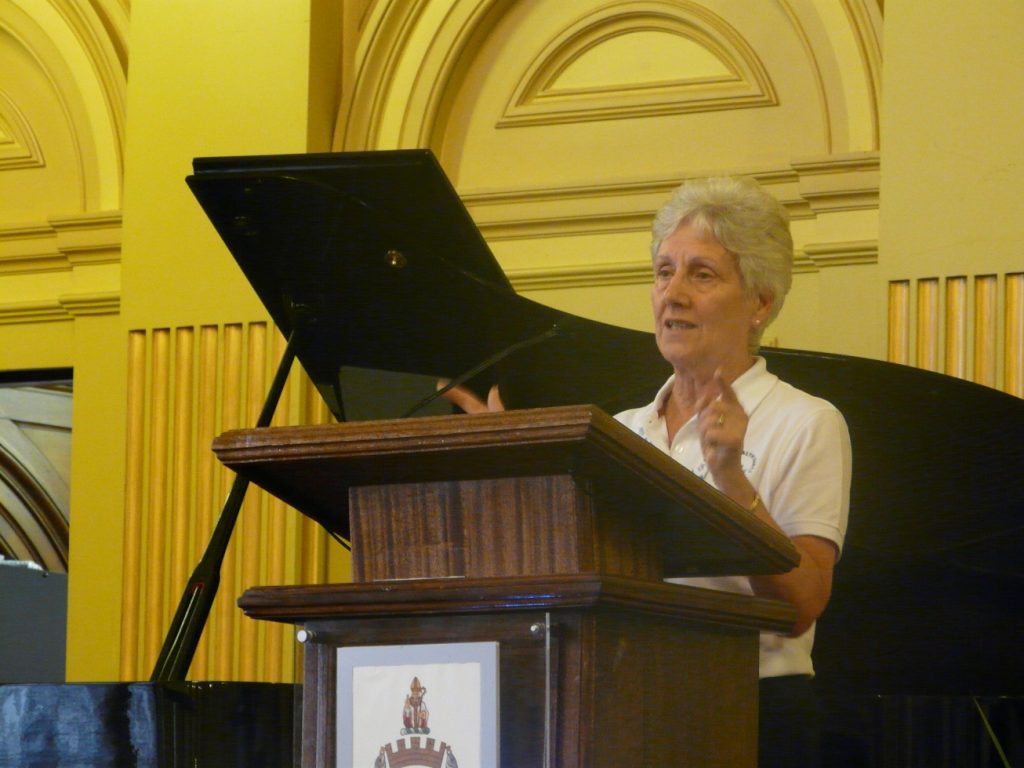
Having led the bid for Glasgow’s universally-acclaimed Commonwealth Games and served as long-standing Honorary Secretary for the Commonwealth Games Federation, it came as no great surprise – except to her – when the news emerged that she was planning on running for the position of President of the Federation.
“It was made public much earlier than I was expecting it to come out, because we are not calling for nominations until May,” she told HOST CITY.
Despite this, she was happy to talk about her motivation.
“It’s the right time for me now because I have served for four quadrennials on the Federation as the Honorary Secretary.”
Her decision to stand was driven in part by changes to the Federation, which is being remodelled as a corporate structure with a President and three Vice Presidents.
“The Honorary Secretary position ceases to exist, so I had to decide what to do,” she said.
“One of the positions would be doing what I have already been doing and having done four quadrennials, it’s time for me to move – and the only way I can move is up.”
She revealed to HOST CITY that she has long had the ambition to lead the Federation. “It’s something I’ve always thought I would love to do.
“Having chaired a national sporting agency, sportscotland, with 350 staff and a turnover of millions, I know I can do it. I’ve been chair of Commonwealth Games Scotland and I’m also chair of the Commonwealth Advisory Body on Sport, so I have got experience behind me.
“The time is right for me to put my hat in the ring.”
Although she has not yet formalised a manifesto, she was happy to discuss the changes that she has in mind for the federation – particularly in relation to the role of the member associations.
“We have to have a proper structure and good governance in place, to make sure that all the associations are more vibrant and more effective.
“As far as I am concerned we are all equal; we all have one vote, irrespective of size or wealth. We have to deliver equally, across the board.
“One of the things I want to ensure that we do is to communicate more effectively and more openly.”
With the 2022 Games now faced with just one bidding city, Durban – for which Martin is leading the evaluation commission – the Federation is looking at ways to boost the appeal of its major property.
The situation is analogous to the issues the IOC grappled with over the last twelve months as it handled its own 2022 Games crisis through the Agenda 2020 review of its bidding procedure.
“I certainly want more cities to bid for the Games. We want to make it more appealing and we need to make sure that we keep it affordable,” said Martin.
“So one of the things we have to do is work very closely with the international federations to ensure that the sports and the events that we deliver are not cost- prohibitive.
“We’ve got to make sure that the events are accessible for the whole of the Commonwealth and that those bidding cities can deliver a good and successful Games.”
Although the Commonwealth contains many small countries that can’t aspire to host a
Commonwealth Games or Commonwealth Youth Games, there are still opportunities to host smaller events.
“One of the things we want to try and take control of is to encourage the countries that cannot host either of those to host a Commonwealth Championship in a specific sport that they are good at.”
As a former athlete, Martin is keen for the Commonwealth Games Federation to boost the development of sport in the Commonwealth.
“I want to make sure that Commonwealth sport offers more to athletes and to individuals in communities that we are working with.
“I’ve got to ensure that we really make the most of all the opportunities that we have. We are a dynamic sporting movement and we do transform lives through sport.
“We’ve got so much potential in the Commonwealth; the momentum has started and we’ve got to keep it moving.”
Much of this momentum comes from Glasgow 2014, which was widely regarded as the greatest Commonwealth Games in history. Having led the bid, Louise Martin describes it as “a dream that took 12 years to come to fruition, and it did in a big way.
“I can’t believe it’s all over; it’s funny to say that it’s not there anymore, but everybody’s still talking about it.
“It set the scene and we delivered exactly the way we wanted to deliver: athlete-centred, sports-led, we kept it small, we kept it the way that we in Scotland are – we didn’t try to emulate anybody.”
There may be some advice for Durban here.
“Never try to be something you aren’t; don’t try and copy. Deliver for yourself; stay true to yourself and your own ambitions and everything will work out.
“We proved it can be done, and I would encourage anybody to follow that example. Just believe in yourself and do it.”
Louise Martin is speaking at HOST CITY 2015 – the leading EU-based meeting of cities and sports, business and cultural events – in Glasgow on 9th and 10th November.
-

Pope and Prince Ali discuss football’s power to develop
With just over a month to go before the FIFA presidential election, candidate HRH Prince Ali Bin Al Hussein met with His Holiness Pope Francis at The Vatican on Thursday to discuss the global development of football and how to promote peace and social responsibility through sport.
In the private meeting, Pope Francis and Prince Ali discussed the challenges and opportunities around developing football globally. They also talked about how sport and football can help to promote peace and social responsibility.
“I have been greatly inspired by Pope Francis’s work to use sport to build bridges between people of differing faiths and cultures,” said Prince Ali.
“Pope Francis is a true innovator in this regard; it was a great honour to meet with him not only in his capacity as the leader of one of the largest faiths in the world, but also in his capacity as a much-admired champion for peace, tolerance and inter-faith dialogue and understanding. Our discussions were very fruitful and we share a common vision of using sport as a force for good in the world.”
Pope Francis is a football lover and supporter of Buenos Aires-based team the Saints of San Lorenzo. Before the 2014 FIFA World Cup, he published a video message in which he described football as “a game and at the same time an opportunity for dialogue, understanding and reciprocal human enrichment”.
Last year, the Vatican hosted an interfaith charity football match to promote peace, in which he welcomed past and present greats of the football world for the high-profile game at the Vatican.
Prince Ali is said to be a direct descendant of the prophet Mohammed.
The development of football is a key concern of Prince Ali, who has been vice president of FIFA since 2011. In January 2012, he founded the Asian Football Development Project (AFDP), a non-profit youth commission headquartered in Amman, Jordan.
The AFDP works to develop football across Asia with a focus on youth development, empowering women, social responsibility and the protection and evolution of the game. AFDP led the successful campaign to lift the ban on head scarves in football.
Prince Ali has worked to promote unity and develop football since becoming President of the Jordan Football Association in 1999. In 2000, he founded the West Asian Football Federation (WAFF), of which he is president. WAFF’s members are Iran, Iraq, Jordan, Lebanon, Palestine, Syria, Qatar, United Arab Emirates, Yemen, Bahrain, Kuwait, Oman and Saudi Arabia.
The president of FIFA will be elected on May 29th.
-

Blatter resigns as corruption claims escalate
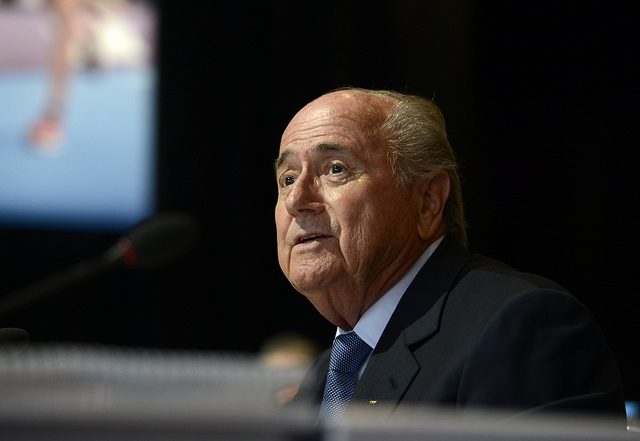
With charges of corruption within FIFA escalating, president Sepp Blatter announced on Tuesday that he will resign to make way for “deep-rooted structural change”.
At a press conference in Zurich called at extremely short notice, Blatter announced he will resign “at the earliest opportunity”.
The announcement came shortly after reports that FIFA administered an alleged $10m bribe from the South African government to CONCACAF president Jack Warner in 2008, and an ABC News report claiming that Blatter was himself under investigation by FBI and US prosecutors.
Two days before Blatter’s re-election, several officials were arrested in a dawn raid on the Baur au Lac Hotel. The US Department of Justice has since charged 14 officials employed by FIFA and associated agencies with 47 charges of corruption including racketeering, fraud and money laundering.
“While I have a mandate from the membership of FIFA, I do not feel that I have a mandate from the entire world of football,” Blatter said.
“Therefore, I have decided to lay down my mandate at an extraordinary elective Congress.”
The extraordinary Congress is likely to be convened between September 2015 and March 2016.
“This will need to be done in line with FIFA’s statutes and we must allow enough time for the best candidates to present themselves and to campaign,” said Blatter.
Waiting until the next ordinary FIFA Congress on 13 May 2016 would “cause unnecessary delay”, he said.
Blatter said by stepping down he would be able to focus on reforming FIFA. “Since I shall not be a candidate, and am therefore now free from the constraints that elections inevitably impose, I shall be able to focus on driving far-reaching, fundamental reforms that transcend our previous efforts.
“For years, we have worked hard to put in place administrative reforms, but it is plain to me that while these must continue, they are not enough.”
He also said the structure of FIFA’s Executive Committee and its relations with the continental confederations must be overhauled.
“The Executive Committee includes representatives of confederations over whom we have no control, but for whose actions FIFA is held responsible. We need deep-rooted structural change.
“The size of the Executive Committee must be reduced and its members should be elected through the FIFA Congress. The integrity checks for all Executive Committee members must be organised centrally through FIFA and not through the confederations.”
Blatter, who has presided over FIFA for 17 years, also called for term limits, “not only for the president but for all members of the Executive Committee.”
“I have fought for these changes before and, as everyone knows, my efforts have been blocked. This time, I will succeed.”
Blatter has asked Domenico Scala, Independent Chairman of FIFA’s Audit and Compliance Committee to oversee the transition over the coming months.
“Mr. Scala enjoys the confidence of a wide range of constituents within and outside of FIFA and has all the knowledge and experience necessary to help tackle these major reforms.”
Blatter thanked all his supporters, saying “What matters to me more than anything is that when all of this is over, football is the winner.”
Prince Ali bin al Hussein of Jordan denied Blatter a majority in the first round of voting in Friday’s election and he has not ruled out standing again.
Prince Ali told CNN “I think this is the right move from Sepp Blatter and I think we have to look to the future.
“I am always there to serve football and I think that’s the most important thing and to do so much work to fix this organisation in a proper way.
“I am at the disposal of our national associations. I don’t want to be somebody who kicks somebody in the knees. At the end of the day I will do my part to help the national associations.”
Other possible candidates include Michel Platini, Luis Figo, Jerome Champagne and Michel van Praag.
His resignation was welcomed by IOC president Thomas Bach, who said “We highly respect this decision of President Blatter to step down and to initiate the necessary reforms – and to make way for a new leadership of FIFA to drive these changes.”
Sepp Blatter remains an IOC member until his 80th birthday on 10 March 2016.