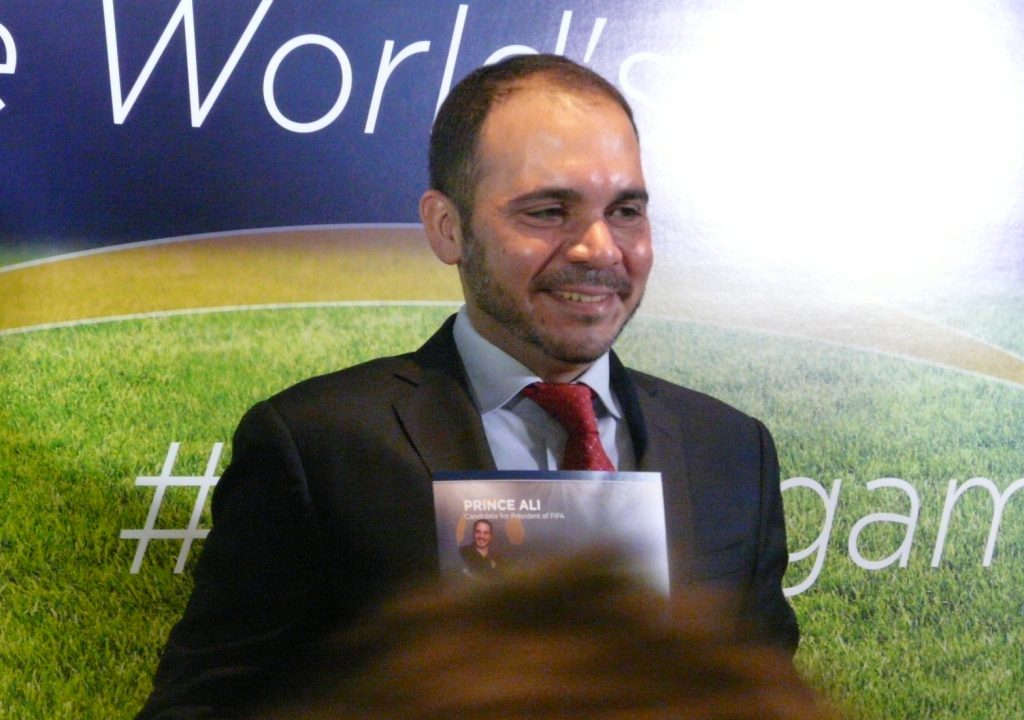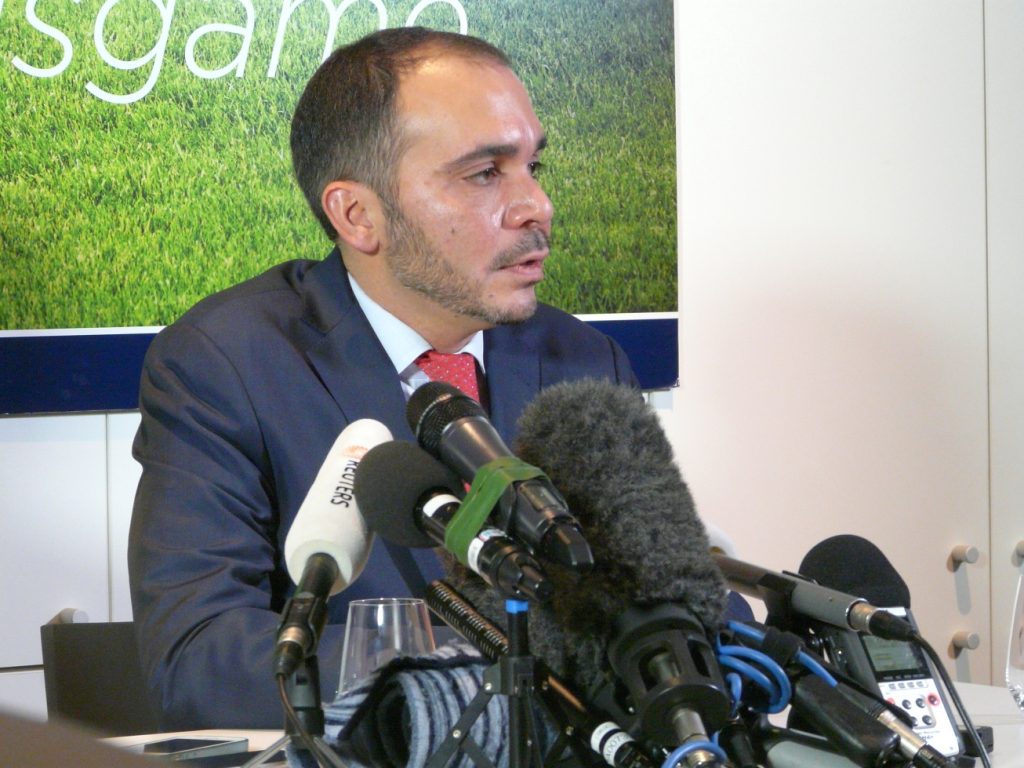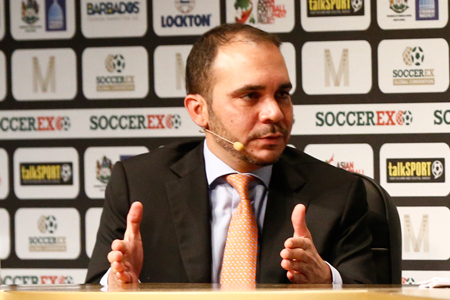
With several FIFA officials charged with corruption just two days before the presidential election, HRH Prince Ali Bin Al Hussein of Jordan has called for an end to FIFA’s ongoing crisis.
“We cannot continue with the crisis in FIFA, a crisis that has been ongoing and is not just relevant to the events of today,” he said in a statement to the press.
“FIFA needs leadership that governs, guides and protects our national associations. Leadership that accepts responsibility for its actions and does not pass blame. Leadership that restores confidence in the hundreds of millions of football fans around the world.”
After a raid at Baur au Lac hotel in Zurich on Wednesday morning, ten FIFA Executive Committee members will be questioned by Swiss authorities “on suspicion of the acceptance of bribes and kick-backs” in relation to 2018/22 World Cup bids. The arrests were instigated by US Department of Justice.
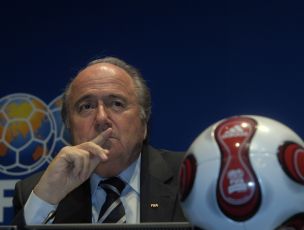
Prince Ali is the only challenger to FIFA president Sepp Blatter, who was widely predicted to be reelected on Friday. FIFA has faced calls from the English Football Association and Transparency International to postpone the election.
Sepp Blatter has not been charged. FIFA spokesman Walter de Gregorio told press that Blatter was “relaxed” about the day’s events because he was “not involved in them at all”, going on to explain: “Well he is not dancing in his office. He is very calm; he is fully co-operative with everything. That’s what I meant. He’s not a happy man, saying ‘wow wow’.”
De Gregorio also said the presidential election would go on ahead on Friday as planned and that a revote on the 2018 and 2012 World Cup hosts was out of the question.
“This for FIFA is good. It is not good in terms of image or reputation, but in terms of cleaning up, this is good,” he said.
“It is not a nice day, but it is also a good day. The process goes on and we are looking forward.”
Tag: Presidential Election
-

FIFA can’t go on like this, says Prince Ali
-

The democratisation of FIFA
Joseph “Sepp” Blatter’s surprise announcement on June 2 that he was resigning as president of FIFA was sensational, not least because it happened just four days after his re-election for a historic fifth term.
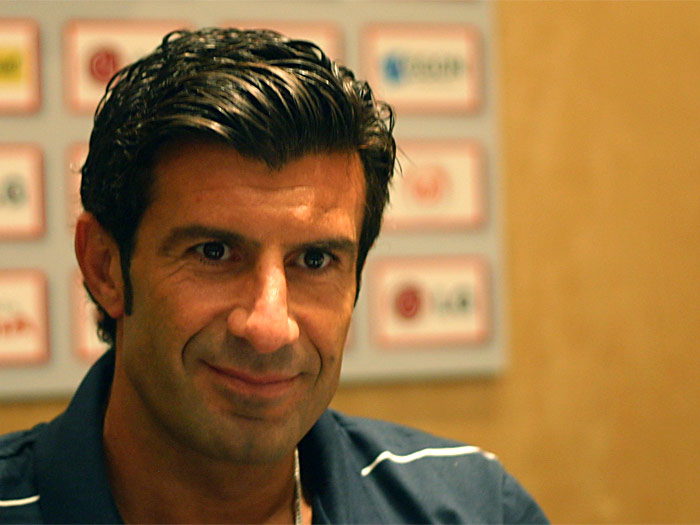
Blatter’s rivals for the presidency – Jerome Champagne, Luis Figo, Michel Van Praag and of course Prince Ali, who was the only challenger left standing at the FIFA Congress – all based their campaigns on a common message: the organisation was tainted with allegations of corruption and needed to clean its image.
Blatter, on the other hand, barely uttered a word to the press during the run up to the election – even when investigators raided the Baur au Lac Hotel in Zurich to arrest a number of officials on corruption charges.
In the election, Blatter emerged victorious but storms continued to gather, including allegations that FIFA administered a $10m bribe from South Africa to CONCACAF president Jack Warner. As media reports emerged that Blatter was himself under investigation by FBI and US prosecutors, he announced to the world – at just a couple of hours’ notice – that he was to step aside.
What was perhaps most extraordinary about Blatter’s resignation speech was that he used it as an opportunity to position himself as a reformer at heart, shackled by circumstances. His resignation, he said, was necessary to make way for “structural changes” that he had himself been advocating for many years.
These changes including loosening the grip of the continental confederations through which FIFA’s members are aligned, a reduction in size of the Executive Committee – presumably to give non-ExCo FIFA members greater influence – and capping terms of office.
Whatever you may think of Blatter’s claims to be a democratiser, a process of reform is now inevitable. While it might have taken external events to drive FIFA to the brink, at last it can contemplate the reform it needs.
Football remains the world’s most popular sport and the FIFA World Cup its biggest single sport event. And if democratisation may not be Blatter’s true legacy, FIFA has undeniably embraced all regions of the world under his presidency.
Anything can happen now, depending on the outcome of further investigations, which are by no means focused exclusively on the hosts of the future World Cups. The world waits.
-

FIFA to bring in new president and reforms in 2016
FIFA’s executive committee met today to take the first steps towards transforming the organisation, discussing key areas of reform and setting the date for the presidential election and Extraordinary Congress at 26th February 2016 in Zurich.
This is significantly later than expected, with most observers predicting a December election.
The meeting was chaired by outgoing FIFA President Blatter, who will not be standing for president again as “a new FIFA President will be elected”, according to a FIFA statement.
Candidates can now declare their interest in running for the office of FIFA President, with a deadline of 26 October. The Ad-hoc Electoral Committee will hold its first meeting on Tuesday, 21 July.
Domenico Scala, chairman of the Audit and Compliance Committee delivered presentations on the proposed topics for reform. These include “enhanced centralized integrity checks for Executive Committee members, the introduction of term limits, higher standards of governance at all levels of football structures including confederations and member associations as well as individual disclosure of compensation.”
FIFA is to set up a “Reforms” Task Force with a “neutral chairman”.
The “concrete and comprehensive reform proposals” will be presented at the next ordinary FIFA Executive Committee meeting in Zurich on 24 and 25 September and submitted for approval at the extraordinary Congress in February.
FIFA said its bidding procedure is being reformed in line with the guidance of the United Nations’ strategy for “Safeguarding against Corruption in Major Public Events”. Future World Cup bids will have to recognise the provisions of the UN Guiding Principles on Business and Human Rights, with which suppliers must comply.
The Executive Committee also stated its firm commitment to reform and “its full cooperation with the on-going US and Swiss investigations”.
Djimrabaye Bourngar from Chad has been appointed as the deputy chairman of the investigatory chamber of the FIFA Ethics Committee.
The themes of sports governance and bidding procedures will be discussed at HOST CITY 2015 in Glasgow on 9th and 10th November. -

Seb Coe: presidency gives IAAF chance to renew itself
Sebastian Coe said the IAAF presidential election campaign, through which he received 115 (56 per cent) of the votes of 207 member federations, has created an opportunity for the organisation to renew itself.
Lord Coe will take up the presidency of the International Association of Athletics Federations (IAAF) at the close of the IAAF World Championships in Beijing on 31st August.
The second candidate, Sergey Bubka received 92 votes and was elected as vice president.
“I’m very flattered, very, very honoured to have been elected president,” Coe said at a press conference after the election on Wednesday.
“You have a president that will devote himself full-time to the IAAF. It has been a long and hard campaign but it has given us the chance to pause for breath, the chance to review and renew itself,” added Coe.
The presidential election comes at a time of great pressure for the organisation as it faces allegations of widespread doping within the sport.
On 2 August, the Sunday Times and German broadcaster ARD reported that IAAF data leaked by a whistleblower showed that a third of medals won in endurance events from 2001 to 2012 were awarded to athletes who had recorded “suspicious” blood tests.
The IAAF dismissed the reports as “sensationalist and confusing”, pointing out that the results did not refer to positive tests, but the questions are still being raised of the federation, with the Sunday Times alleging on 16th August that the IAAF blocked publication of the data.
As an Olympic medallist and former chairman of London 2012 and vice president of the IAAF, Sebastian Coe brings a wealth of experience to the organisation’s leadership.
“We have a man who has devoted his life to the sport,” said outgoing president Lamine Diack, who has held the presidency since 1999.
Coe paid tribute to Diack, saying “Lamine has left us with an extraordinarily strong foundation and one aspect of that foundation is that we are a truly global sport. I will do my best to continue from those firm foundations
“In 2001 and 2002, I sought the advice of Lamine Diack about playing a greater role in the sport and in 2003 I became a Council member. In 2007 I sought his advice again before I became a Vice President.
“It has been an apprenticeship that has helped me understand greater the balances and nuances within the sport.
“I want to thank the (member) federations but I also want to thank those that cover and broadcast our sport. We tend to forget that the media is most potent sponsor of our sport; and I will maintain my chairmanship of the media committee.”
A number of new members were elected to the IAAF Council, including European representatives Jose Maria Odriozola (ESP), Bernard Amsalem (FRA), Sylvia Barlag (NED), Mikhail Butov (RUS), Antti Pihlakoski (FIN), and Anna Riccardi (ITA).
“This has been a good day for European athletics,” said Svein Arne Hansen, president of European Athletics.
“I am very pleased for all the European representatives elected to the IAAF Council. I call on them to work hard and cooperate with the members from the rest of the world for the good of our sport.
“There are a lot of urgent issues to address over the coming years, including the integrity of the sport, our competition programme and development.”
-

Louise Martin elected Commonwealth Games Federation president
Louise Martin has been elected president of the Commonwealth Games Federation, unseating Prince Imran of Malaysia to become the first woman to hold the position.
As revealed by HOST CITY in March, Martin built her successful campaign on deepening the CGF’s engagement with member associations and potential host cities.
Her manifesto, launched in August, also pledged to increase CGF revenues with the signing of at least four headline sponsors. The CGF had reported a loss of more than GB£3 million in the financial year ending 31st March 2015.
The outcome of the election was far from predictable, although Martin’s pivotal role in bidding for and delivering the Glasgow 2014 Commonwealth Games was a major advantage.
Martin served as CGF honorary secretary for four terms and is also chair of Sportscotland.
Martin is to speak at HOST CITY 2015, the leading meeting of cities and sports, business and cultural events, in Glasgow on 9th and 10th November.
Prince Imran served one term as CGF president and many onlookers expected him to remain in post, despite his controversial attempt to move the organisation’s headquarters to Kuala Lumpur.
“Now is the time to ensure progress is delivered in an open and transparent way and that the views of the CGAs are fully reflected in the running of the CGF,” Martin said.
“I believe that the time is right for a new style of leadership to ensure that together we can fully unlock our potential and deliver on the needs of CGAs and our wider partners, especially in terms of maximising commercial opportunities. If we get this right, we can deliver enhanced revenues to support every CGA as well as Commonwealth sports development through greater investment.
“There is also much more we can do to grow the profile of our great sporting Movement across the world to ensure that its unique identity is valued and our Games attract the best Commonwealth athletes, sponsors and, critically, future host cities. As someone with a proven track record of collaboration and delivery, as well as dedication and passion for our Movement, I believe I am the right person to guide the CGF through the next stage of its Commonwealth journey and unlock the immense potential of our unique sporting Movement.”
The election took place at the CGF General Assembly, where Durban was confirmed as the host city of the 2022 Commonwealth Games.
-

Sarah Lewis OBE OLY runs for International Ski Federation presidency
Sarah Lewis OBE OLY has announced her candidacy for President of the International Ski Federation (FIS – Fédération Internationale de Ski), the world’s largest winter sports governing body.
The official candidacy nomination has been submitted to FIS by the Royal Belgian Ski Federation, of which she is a member.
The candidacy could ultimately make her the fifth – and first female – President in the 97-year history of FIS, founded in 1924 and whose disciplines now represent over half of the Beijing 2022 Olympic Winter Games programme.
Lewis is pledging to transform FIS into a global movement for world skiing and snowboarding as part of her FIS Piste Map – the blueprint for the future of the organisation.
She will further integrate the 135-member ski and snow sport National Associations and the athletes into the governance, drive a digital transformation to strengthen commercial potential and introduce crucial governance reforms to future-proof FIS.
She is also pledging to implement a Covid Recovery Fund for National Associations, renounce a presidential salary and introduce financial efficiencies notably in these unprecedented times. Boosting gender diversity, athlete, youth and emerging member nations initiatives, strengthening the all-important symbiotic relationship between ski, snow sport and tourism, and focusing on sustainability, the environment and legacies for the mountain regions hosting global events are also important priorities.
FIS, whose current President Gian-Franco Kasper stands down after 23 years, will see its first contested and virtual election in its history, on 4 June 2021.
New era
Lewis was Secretary General of FIS for twenty years until last October, when her departure was announced – she is now running for President in this “new era” of FIS.
She had always stated that she would not declare a candidacy to run as President before the conclusion of the FIS World Cup and Championship season, to maintain complete focus on the sport and athletes.
“We are entering a new era for FIS and global sport – an era that requires FIS to tackle its role in a changed, more inclusive and demanding society, and an era that FIS must embrace for growth, a healthy future for our sport, with our athletes at the centre,” she said.
“We have been presented with a unique opportunity – to elect a 21st Century President, whose full focus is to work hand-in-hand with the National Associations and stakeholders, leading FIS on a strategic transformation to become a global movement for world skiing and snowboarding.
“I have devoted myself to our sport as an Olympian, to FIS and our community, and to the Olympic Movement as a participant, manager and a leader.
“I am now making this journey for one reason – to work together to build a FIS that is fully representative of the global ski and snow sport community, and fully equipped to take us well into the second centennial of FIS, with a crystal clear plan, transparency and accountability. Together I believe we can achieve much more.”
Lewis, who put on skis aged five, has spent her life in snow sport. By the age of 15 she was training internationally, becoming a ‘citizen of the world’, and at 24 she represented Great Britain at the 1988 Olympic Winter Games in Calgary.
In 2000, after two years as FIS Director, she was appointed Secretary General.
She has made it her mission to understand the global landscape and has actively participated in competitions and events in 59 member nations over the years, while taking every opportunity to promote FIS and snow sport as a member of the International Olympic Committee Programme Commission, sitting on three Olympic Winter Coordination Commissions and two Youth Olympic Games Commissions, and working at five Olympic Winter Games.
Lewis has also served as Secretary General of the Association of International Olympic Winter Sports Federations (AIOWF) and Chair of the World Anti-Doping Agency Independent Observers at the Beijing 2008 Olympic Games.
In 2018, she was awarded the title of Officer of the Order of the British Empire (OBE) for her services to sport.
[Source: Grundy Communications]
Visit www.sarah-lewis.com to see the full Presidential campaign manifesto of Sarah Lewis.
The International Ski Federation (Fédération Internationale de Ski) is responsible for the Olympic disciplines of alpine skiing, cross-country skiing, ski jumping, Nordic combined, freestyle skiing and snowboarding, and is headquartered in Oberhofen, Switzerland, in close proximity to some of the world’s most famous snow sport destinations.
Sarah Lewis is speaking at Host City Americas on 29-30 June, Online. -

What the IOC presidential manifestos mean for host cities
As the International Olympic Committee (IOC) prepares to elect its next president, the seven candidates vying for the role have laid out their visions for the future of the Olympic Movement. While their manifestos cover a range of topics – including governance, sustainability, and athlete welfare – each candidate presents a unique perspective on how future host cities will be selected, supported, and shaped by their policies.
Here’s how the key proposals could impact cities bidding for and hosting the Olympic Games.
Lord Sebastian Coe: greater accountability for host cities
Coe introduces a bold governance reform: an initial four-year presidential term with a confidence vote for renewal. If implemented, this could create a more dynamic leadership approach that holds the IOC accountable to its promises – something host cities have long demanded.
His emphasis on modernising the Olympic brand and broadcasting strategies also suggests a stronger focus on ensuring host cities benefit from global media engagement, helping them maximise commercial and tourism opportunities.
Kirsty Coventry: athlete-centric host cities
Coventry’s manifesto prioritises athlete welfare, which could influence how host cities plan their venues, accommodations, and support services.
She also calls for leveraging AI and digital platforms to enhance engagement with younger audiences. For host cities, this could mean greater emphasis on interactive fan zones, esports integrations, and digital-first engagement strategies to make the Games more appealing to the next generation.
Johan Eliasch: sustainability and flexibility in hosting
Eliasch is the most radical when it comes to rethinking the structure of the Games. He proposes a rotational hosting model for the Winter Olympics, where specific cities or regions would repeatedly host the event. This would significantly reduce costs and environmental impact, making the Winter Games more accessible to cities that struggle with long-term infrastructure investments.
Additionally, his manifesto calls for a complete review of all sports and event formats to enhance their appeal to fans – potentially leading to changes that affect venue requirements and the commercial viability of hosting.
HRH Prince Feisal Al Hussein: a more inclusive bidding process
Prince Feisal emphasises modernising and democratising the Olympic bidding process. His proposal to raise the IOC membership age limit from 70 to 75 could allow for greater continuity in the Games’ strategic direction.
For host cities, a notable idea is the creation of an “Olympic Agenda 2036,” which includes integrating cultural festivals into the Youth Olympic Games. This would encourage cities to rethink their event planning beyond just sporting venues, potentially making the Games a broader cultural and tourism initiative.
David Lappartient: more transparent selection and host representation
Lappartient focuses on governance reforms that could reshape how cities are chosen to host the Games. He proposes:Reducing the number of IOC commissions to streamline decision-making
Hosting an Olympic Congress, where all stakeholders – including prospective host cities – can discuss the future of the Games
Achieving gender parity within the IOC by 2036, potentially influencing the selection of host cities based on their commitment to gender equity in sportHis emphasis on broader participation in IOC decisions could make the host selection process more transparent and inclusive.
Juan Antonio Samaranch: restoring full member voting for hosts
Samaranch seeks to return Olympic host city selection to a full IOC membership vote, reversing recent changes that shifted the decision-making power to the Executive Board.
This would bring greater transparency and competition back to the bidding process. Cities bidding for future Games would need to engage more directly with the entire IOC membership rather than focusing on a smaller group of decision-makers.
Morinari Watanabe: a multi-host Olympic model
Watanabe presents the most dramatic change for host cities: a decentralised Olympic model, where the Games are hosted simultaneously across multiple continents. This approach aims to:Reduce the financial burden on a single host city
Increase global participation
Expand the commercial reach of the GamesIf implemented, this would completely reshape how cities approach Olympic bidding and planning, moving from a single-city model to a shared responsibility between regions or nations.
what’s at stake for future host cities?
While all candidates recognise the need for sustainability, financial viability, and inclusivity, their approaches differ significantly. Some, like Samaranch and Lappartient, advocate for greater transparency in the bidding process, while others, like Eliasch and Watanabe, propose fundamental changes to how and where the Games are hosted.
For cities considering a bid, these manifestos highlight key questions:Will the host selection process become more democratic or remain streamlined under the Executive Board?
Will future Games prioritise financial sustainability with rotational or multi-host models?
How will digital and AI-driven engagement reshape expectations for host cities?The next IOC president’s policies will shape not just the future of the Games, but also the cities that host them.
-

Sheikh Joaan bin Hamad announces candidacy for President of the Olympic Council of Asia
[Source: QOC] His Excellency Sheikh Joaan bin Hamad Al-Thani, President of the Qatar Olympic Committee and Senior Vice President of the Association of National Olympic Committees (ANOC), has officially announced his candidacy for the Presidency of the Olympic Council of Asia (OCA), reaffirming his commitment to contributing to the development and unity of Asian sport in the years ahead.
The announcement follows the Olympic Council of Asia’s official call for nominations for the presidential elections, issued on 15 July 2025, in preparation for the upcoming General Assembly, which will be held in January 2026 in the city of Tashkent.
On this occasion, H.E. Sheikh Joaan expressed his sincere gratitude and appreciation to H.E. Raja Randhir Singh, the current OCA President, for his significant contributions and dedicated leadership in advancing Asian sport, as well as his unwavering commitment to strengthening solidarity and cooperation among National Olympic Committees across the continent. His Excellency also fully supported the OCA Executive Board’s decision to appoint H.E. Raja Randhir Singh as Honorary Life President of the Olympic Council of Asia, in recognition of his longstanding service and enduring legacy within the Olympic Movement in Asia.
H.E. Sheikh Joaan affirmed that his candidacy is rooted in a strong belief in the power of sport to foster development and unity among nations. He emphasized the potential of Asian sport to achieve transformational progress in areas such as governance, sustainability, digital transformation, and athlete empowerment.
He also highlighted the importance of promoting fairness in opportunity distribution, strengthening collaboration among NOCs, enhancing sports infrastructure, and creating greater platforms for youth and women to take part in shaping the future of sport in Asia.
His Excellency’s candidature is built on an ambitious strategic vision for Asian sport, grounded in five core pillars: solidarity, digital transformation, sustainable development, credibility, and economic and financial resilience. It is underpinned by His Excellency’s extensive experience in sports, his proven track record at the helm of the Qatar Olympic Committee, and his active role within the international Olympic Movement, particularly as Senior Vice President of ANOC.
The upcoming OCA election is expected to draw significant interest from the international sporting community, amid growing global challenges and the need for dynamic leadership that promotes transparency, cooperation, and innovation across the Asian sports landscape.
Founded in 1982 and headquartered in Kuwait City, the Olympic Council of Asia is one of the most prominent continental sports organizations. It brings together 45 National Olympic Committees and plays a pivotal role in coordinating regional sports activities, supporting development initiatives, and enhancing cooperation in governance, infrastructure, and institutional capacity building.
The OCA also oversees the organization of major multi-sport events including the Asian Games, Asian Winter Games, Asian Indoor and Martial Arts Games, Asian Beach Games, and the Asian Youth Games – competitions that continue to elevate Asia’s sporting profile on the world stage.