Tag: Sports Development

  • Teqball takes off

    Teqball takes off

    Host City: How is interest growing internationally for competing in Teqball events?
    Spencer Hidge: In just a few short years, Teqball has grown from a sport invented in the courtyard of an apartment complex in Hungary and played sporadically throughout Central Europe, to being officially recognised by the governing bodies of two continent’s Olympic Committees (Olympic Council of Asia and the Association of National Olympic Committees of Africa).
    We received the seal of approval from the Olympic Council of Asia (OCA), declaring Teqball an official sport, just a year after the International Teqball Federation (FITEQ) was established and it really felt like the birth of the sport and the start of an ambitious journey towards the Olympic Games. It gave us the credibility we needed to take the next step in the evolution of the sport and a platform for us to have Teqball feature at future OCA events and to reach more people, not only in Asia, but the rest of the world. That sort of recognition can take 30 years or more, but we managed to do it in just under three.
    We’re due to have the third Teqball World Championship in December, attracting players from around 50 different countries to compete for the doubles and singles titles. This has more than doubled since the first Teqball World Championship in 2017 and is attracting global media interest as more and more countries are represented.
    We estimate there are around 5,000 regular Teqball players globally, with the figure growing all the time. We’re now hosting events around the world, including the recent African Beach Teqball Cup in Sal, Cape Verde and the upcoming 2020 Asian Beach Games. These are proving really popular among athletes and spectators and form part of our strategy to work towards gaining Olympic sport status.
     
    Host City: You have some amazing ambassadors for Teqball – what do you think they see in the sport? 
    Spencer Hidge: We’re really fortunate to have such high profile current and former footballers including our Teqers: Ronaldinho, Simão Sabrosa Robert Pires and Cafu to name a few, who genuinely endorse Teqball as they see the real benefit it has from a training and skill-enhancement perspective. Our Ambassadors not only play Teqball to enhance their skills, but enjoy Teqball in their downtime and we are delighted to have the likes of Neymar and Messi thoroughly enjoy playing Teqball.
    The sport has become a key aspect of training at some of highest profile clubs, and offers a fun way to train without adding impact or stress on the body between sessions, which at the highest level we know can be incredibly taxing. Teqball can be played by people of all ages and abilities, which means it has wide appeal. In fact, a number of amputee footballers are using Teqball in their training too. Without knowing it, people are improving their coordination, concentration, touch and control of the ball.
    Currently, nine Premier League clubs, Arsenal, Chelsea, Manchester United, Everton, Wolverhampton, Watford, Bournemouth, Southampton and Burnley, plus more in the La Liga, Serie A and Bundesliga, use Teqball as a way of enhancing skill and training, a real credit to the impact Teqball is having across sport.
     
    Host City: What potential do you see for spectator interest in Teqball events, both in the arena and on broadcast platforms?
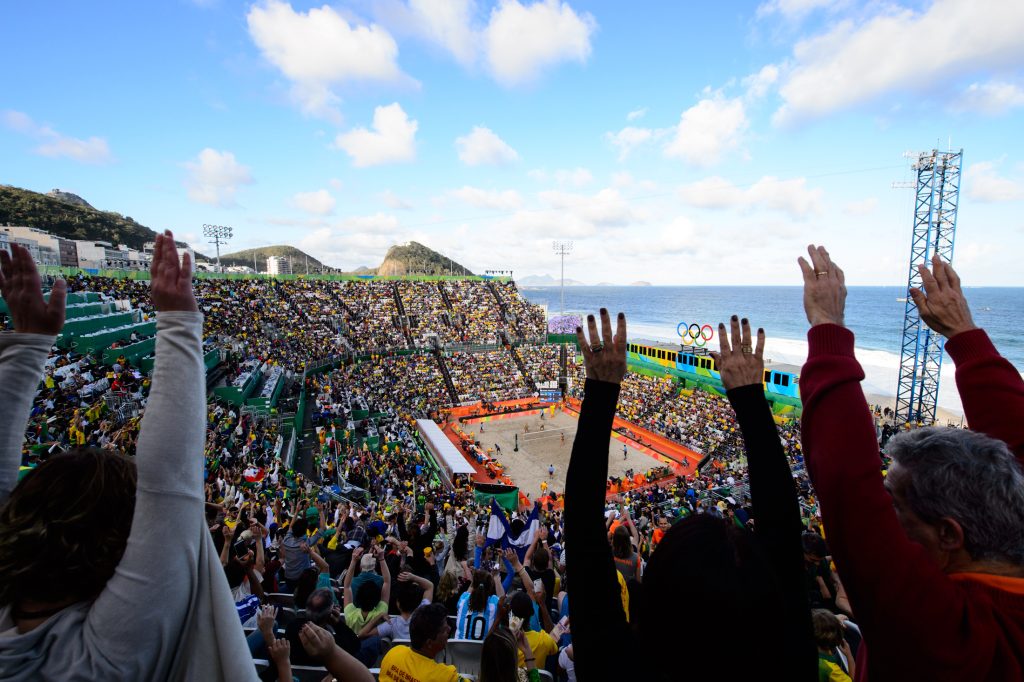
    Spencer Hidge: It’s an exciting sport to watch, with some incredible skill and flair on show including bicycle kicks and aerial spikes. The crowd reaction from those who have watched it live is indication enough that it keeps people on the edge of their seats. The games are also not too long, squeezing maximum action into a short space of time, making a tournament a really easy and enjoyable experience for spectators.
    The third Teqball World Championships this year will be broadcast on Eurosport, reaching 54 countries throughout Europe and the Asia-Pacific regions helping us to grow awareness of the sport and showcase the skills of our elite players.
    We’ve also made a deliberate choice to keep Teqball a mixed-gender sport, meaning men and women compete side by side. We’ve seen our mixed teams and female singles players do remarkably well at our international events, proving that there is no real barrier to success depending on your gender. This also helps us to attract both boys and girls into the sport from a young age, providing diverse role models for them to look up to. We also have a number of para-athletes who compete on the international circuit and provide inspiration for people of all abilities to get involved.
     
    Host City: What are the requirements for hosting the Teqball World Championship?
    Spencer Hidge: We have a number of core values at Teqball, which are all equally important to the delivery of the Teqball World Championship and identification of a suitable host city, who demonstrate their ambition to bring a legacy of respect, inclusion and strategy to their city.
    Teqball is a sport with no limitations, and can be played by anyone, anywhere at anytime; therefore, the host city should mirror these values.
    There are a number of key deliverables required by the host city, covering areas including; travel, accommodation, venue and infrastructure. For a detailed overview please contact our Event Partnerships Manager, David Watts on  david.watts@teqball.com who will be happy to share more information.

  • Baltimore-Maryland 2026 partners with Benin on international football development initiative

    Baltimore-Maryland 2026 partners with Benin on international football development initiative

    Baltimore-Maryland’s bid to host 2026 FIFA World Cup matches has launched a new ‘International Football Development 2026’ (IFD26) initiative as part of its commitment to creating strong local and international football legacies.
    As part of the campaign, Baltimore-Maryland 2026 is partnering with regions across the world to offer support where sports development resources may be limited. The launch of the initiative is accompanied with the announcement of the initiative’s first partner, West-African Benin.
    “We’re very excited to be part of the IFD26 family and to be forging a close relationship with the Baltimore-Maryland 2026 team. We are looking forward to working alongside Baltimore 2026 as the first region to develop, not only our domestic football landscape, but also close economic and cultural ties with the city. For us this a natural alignment because it is evident we share similar values,” said Benin’s Minister of Sports, Mr. Oswald Homeky.
    “As a diverse and welcoming city, Baltimore-Maryland would offer FIFA a unique and unrivalled opportunity if chosen as host of 2026 FIFA World Cup matches. The bid’s proven commitment to creating enduring legacies is testament to its central vision of welcoming the world to enjoy the 2026 FIFA World Cup.”
    IFD26 will see Benin and Baltimore-Maryland 2026 collaborate and share knowledge, building on the West African country’s passion for football and developing its women’s and youth programs to empower all areas of the game. Capability-building lies at the heart of the IFD26 initiative, and the partnership will grow Benin’s domestic football industry, creating employment pathways, education, skills and job opportunities.
    “Baltimore-Maryland 2026 is committed to expanding the global horizons of football and delivering impactful programs that deliver a strong football legacy for local and world football and FIFA,” said Terrance Hasseltine, President of Baltimore-Maryland 2026 and Executive Director of Maryland Sports Commission.
    “Baltimore-Maryland 2026 has been described as underdogs in this race and that simply pushes us on to deliver a dynamic bid that shows our diverse city is ready to welcome the football family. IFD26 will be a central focus for our bid, and we are looking forward to supporting fellow ‘underdogs’ and their football development.”
    Aligning with Baltimore-Maryland 2026’s vision of expanding football’s audience locally and internationally, IFD26 will enable the bid to engage new global audiences with the 2026 FIFA World Cup and grow the game in new markets.
    “Expanding the horizons of football is a core commitment of our bid to host 2026 FIFA World Cup matches and the IFD26 initiative will support football’s long-term development in Baltimore-Maryland and across the world. Partnering with Benin is a fantastic opportunity for our shared passion for football to grow and to deliver tangible legacy initiatives for current and future players to benefit from,” said Olubunmi Jinadu, Senior Advisor to and Member of the Baltimore Maryland 2026 FIFA World Cup Host Committee.
    “Baltimore-Maryland 2026 promises to be a platform for growing football in new markets and engaging new audiences locally and internationally and IFD26 is a key part of this.”
    According to the announcement accompanying the launch, Baltimore-Maryland’s bid to host 2026 FIFA World Cup matches offers “a unique and unrivalled opportunity to build one of the most welcoming, diverse and inclusive host cities in World Cup history. As an easy to navigate city ready to accommodate football, Baltimore-Maryland 2026 will promote sustainable practices and human rights and provide a catalyst for positive change through football.”