Credited with the design of some of the world’s most iconic stadiums, specialist sports architectural firm Populous continues to build upon its impressive record this year.
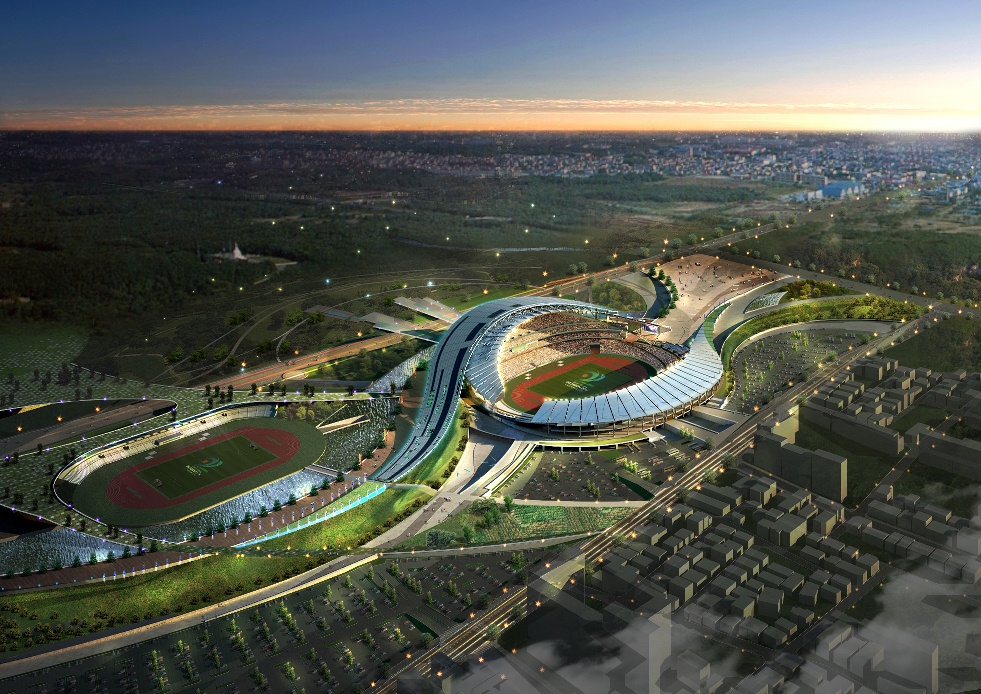
Populous has worked on nine Olympic Games to date and most recently played a significant role in the Sochi Winter Olympic Games, including the design of the 40,000 capacity Fisht Olympic Stadium and the Arena das Dunas stadium in Natal for the 2014 FIFA World Cup in Brazil. Later this year, the Nanjing Youth Olympic Games and the Incheon Asian Games will be hosted in spaces designed by Populous.
So it comes as little surprise that Populous were awarded the prestigious AJ100 International Practice of the Year award this year, beating seven other global architecture practices in the process. The expert panel mentioned the firm’s work in Sochi and Brazil as particular highlights.
Senior Principal Ben Vickery says “We are delighted to be recognised in this way for designing stadiums and temporary installations for major events around the world. Each country and event is different and Populous has a great deal of experience designing venues and events that relate to the culture of the club, location and host country.”
Populous divide their activities between the design of individual sports facilities and the masterplanning of mega events. Their expertise ranges from supporting the bid for an event, to site masterplans, overlays using temporary installations and world class stadiums. In Sochi, they took on the challenge of designing a masterplan for the Winter Olympic Games in a city that had never previously hosted any major sporting events.
Tom Jones, Principal of the architectural practice, says “In Sochi there was no existing sporting infrastructure. This meant the Winter Park master plan required a much more extensive arrangement of new builds, as well as having all the usual functional requirements in terms of ease of access for spectators, athletes and visiting dignitaries.”
New territories
These masterplan projects have become more frequent for Populous in recent years with the trend of sporting mega events being awarded to areas of the world not previously used to hosting them. With international governing bodies becoming more inclined to take their sporting properties to cities in South America, the Middle East, Eastern Europe and Far East Asia, Populous has had to face a whole new set of challenges and opportunities.
“In some of the territories which lack any sort of significant sporting infrastructure, you need to look at creating the entire infrastructure from the beginning, which is often not needed in cities that are more traditional hosts,” says Jones.
“On the other hand, this does give you the ability to produce a very comprehensive design that includes the transport, venue and residential requirements and assist in a regeneration of a precinct for the long term.”
Populous was involved in the design of the Incheon Asiad Main Stadium, which is set to host the opening and closing ceremonies and athletics competitions of the 2014 Asian Games. For the purpose of the Games, the stadium will have a capacity of 61,074, yet this will reduced down to 30,000 post-Games.
“When we look ahead to the legacy we want to ensure that the venues have a long term use and that is where the balance of permanent and temporary design comes into play,” says Jones.
“There needs to be consideration of how much is built initially and the flexibility in the master plan to allow for further phases of development after the event.”
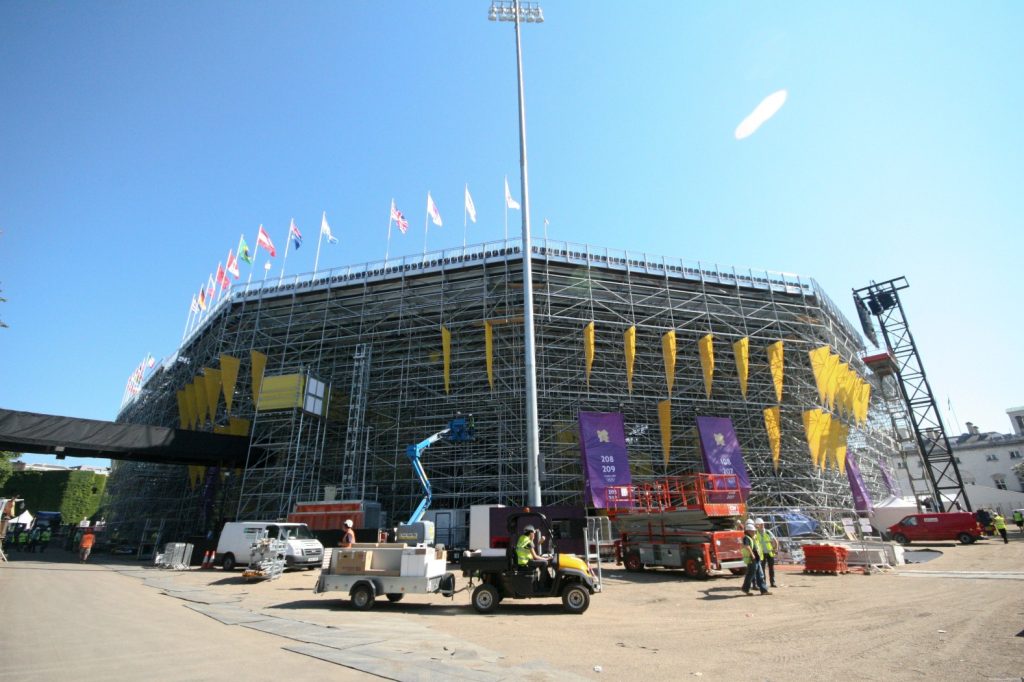
With the Incheon stadium, Populous further developed its innovative modular construction methodology, showcased at London 2012, designing just the west stand as permanent and leaving the other three sides as temporary seating built into the landscaping of park.
“Those temporary seating elements can be very easily and quickly removed, but you’re left with a sculpted landscape bowl that people can still go and sit on and watch events. Therefore, it would be quite easy to scale back up again if you had another major event.”
New or existing; temporary or permanent?
As every city is different, Populous studies each host individually to understand its requirements and formulate the best balance between building new facilities and refurbishing existing venues, as well as the balance between permanent and temporary structures.
“Some states want to construct entirely new venues for major events whilst others might want the balance of permanent and temporary installations. Either way the long term viability and ability for ongoing revenue generation is critical and needs to be judged for each event and location,” says Vickery.
“With the right mix of temporary and permanent venues, an event will be more sustainable: economically, by only constructing venues that will have a long-term life, and environmentally by using less resources for construction. It is the development of new ideas, like these, in venue design that will be the motors of improvements in the design for sports.”
With more major events on the horizon, Populous will be working on them in a variety of capacities. In the case of the Nanjing Youth Olympic Games, much of the sporting facilities are already built, so Populous’ role has been to design a master plan for the residential and transport requirements.
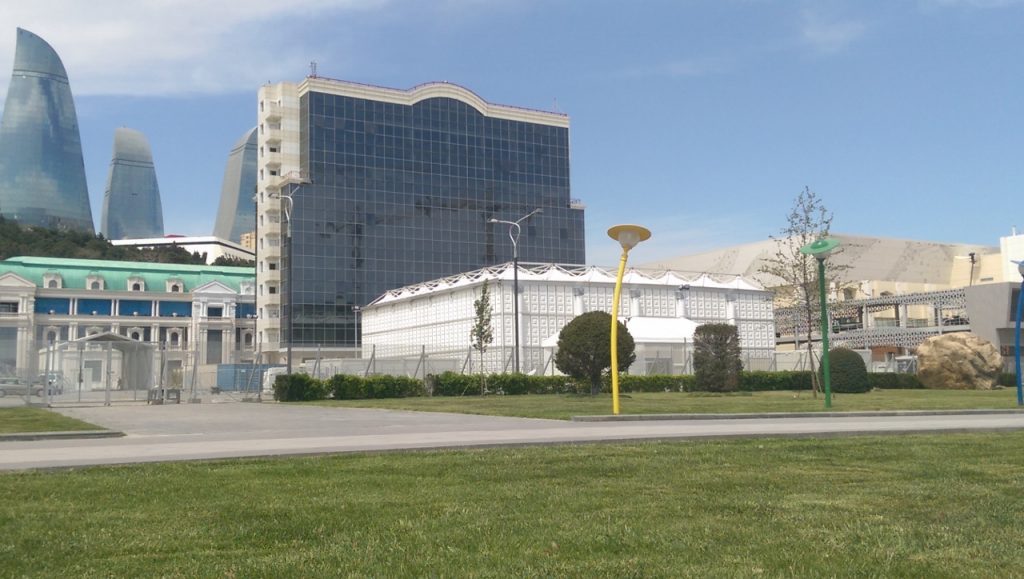
In the case of next year’s inaugural European Games in Baku, Azerbaijan, the firm is working on the overlay (temporary installation) design for two of the venues.
“The European Games is a new event and we have not worked in Baku before, so it is exciting to develop ideas for a new location, building on the experience of designing for the London 2012 Olympics,” says Vickery.
Tag: temporary construction
-

A big year for Populous
-

Arena Seating chosen for English FA’s national centre
A modular solution from Arena Seating – part of global event supply company Arena Group – has been selected for St George’s Park, the English FA’s national football centre.
Five uncovered demountable grandstands, consisting of four tiers each, will be located along a covered, elevated walkway overlooking the elite training pitch and reconfigured as required by the venue’s event programme.
Speaking at Soccerex Global Convention in Manchester, Dave Withey, Arena UK & Europe’s sales and marketing director, said: “It will essentially be a permanent installation to begin with, but the modular nature of the system means that the grandstands can quickly and easily be reconfigured and moved elsewhere when needed; such as the indoor Futsal hall or any of the 12 outdoor pitches.
“St George’s Park hosts a variety of different events, in various locations across the site, so the ability to do this was a vital part of the FA’s brief. They can then be moved back to the elite training pitch, negating the need for any additional storage facilities.”
The grandstands will be installed on the 15th October by six crew in a single day. Arena Seating will train St George’s Park on how to reconfigure and extend the grandstand for larger events, using Arena’s rental stock.
“There is no need for permanent construction work, making it extremely cost effective,” said Withey. “This is achieved without compromising on spectator comfort and viewing angles, which is very important for a world class facility like this.”
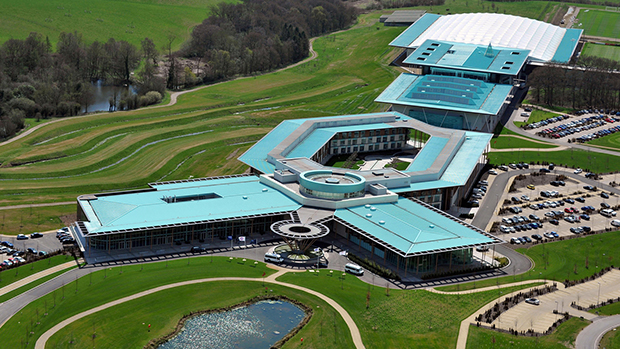
St George’s Park, based in Burton-upon-Trent in Staffordshire, is the preparation ground for all of the England national football teams and home to the FA’s coaching and development work.
Arena Group is exhibiting at Soccerex Global Convention at stand 219. The company will also be exhibiting at HOST CITY: BID TO WIN conference, which takes place in London on 28th October 2014. For more information visit www.bidtowin-hostcity.net -

Rio 2016 announces business opportunities
The organising committee of the 2016 Olympic and Paralympic Games in Rio de Janeiro has announced nine tenders.
The work covers a range of specialisms, with application deadlines ranging from November 2014 to February 2015.
Rio 2016 wishes to hire companies in the following fields and timeframes:
IT Outsourcing. Application deadline: 13th November.
Barriers and Fences. Application deadline: 27th November.
Temporary Arena with Overlay. Application deadline: 28th November.
Medical Supplies and Products. Application deadline: 4th December.
Commentators Positions & Tribunes. Application deadline: 4th December.
Venue Hospitality. Application deadline: 4th December.
Stands and Seating. Application deadline: 10th December.
Cleaning and Waste Services. Application deadline: 22nd January 2015.
Waste Services. Application deadline: 21 February 2015.
UK companies interested in bidding should contact fabio.alves@fco.gov.uk -

Temporary venues must innovate to meet demand, say IOC and UEFA
With growth in demand for temporary infrastructure set to continue to grow from one event to the next, innovation will be crucial to keep pace with this demand, according to senior officials at the International Olympic Committee (IOC) and the Union of European Football Associations (UEFA) speaking at the first conference of the Association of Global Event Suppliers (AGES).
“Temporary infrastructure is crucial for the operation of large events. The demand for such venue infrastructure for media, security, logistics, hospitality and fan zones is increasing from event to event,” said Martin Kallen, director of UEFA operations division and CEO of EURO 2016 SAS – the organisation responsible for all operational aspects of Europe’s biggest football tournament.
There are major business opportunities for suppliers of temporary infrastructure at the upcoming UEFA EURO 2016 in France, Kallen said.
The recently adopted Olympic Agenda 2020 will drive demand for temporary infrastructure, said Xavier Becker, Head of Venues, Infrastructure & Services at the IOC.
“The IOC wants to actively promote the use of existing and temporary infrastructure to contribute to more sustainable and cost effective solutions,” he said.
“Furthermore the IOC wishes to develop the awareness regarding temporary infrastructure and to promote an earlier engagement with the suppliers market.
“I would also encourage the industry to develop innovative solutions, and to think about new reusable large facilities to provide more flexibility for organizers.”
The need for innovation was also stressed by Kallen, who said “Suppliers need to fulfil high selection criteria. Quality, reliability and the capacity to innovate are key.”
The conference, which took place in Derbyshire, UK on 2 and 3 March, was the first gathering of members and associate members of AGES who, along with other industry experts, discussed the challenges and opportunities for temporary infrastructures and demountable venues for large events.
The event was organized by AGES and hosted by Eve Trakway.
“We want AGES to become the platform for the industry and establish a framework and forums to become an integrated part of the delivery solution for all key stake holders,” said Daniel Cordey, chairman of AGES.
“AGES will approach governmental bodies and organisers, who face the challenge of finding appropriate solutions, to explain the huge possibilities of the industry and to help develop true legacy plans for their events.”
Since being founded by 18 members in June 2014, AGES has almost doubled in size.
“Looking down the growing list of members it is very encouraging to see the incredible level of event expertise assembled around one table,” said Guy Lodge, an honorary member of AGES who has been involved in three major events in Russia, Scotland and Brazil.
“It drives home the challenges that the industry faces, around budget pressures, varying procurement practices and regulatory compliance”.
AGES is a not-for-profit-making organisation based in Switzerland formed to become the label for quality and reliability for temporary infrastructure works for major events.
Its members are market leaders in the international event suppliers industry and front runners in the development of new products and services. Together they annually deliver services and works for close to 1.5 Billion EUR.
AGES seeks to present the capabilities of the industry to governmental bodies, key stakeholders and organisers of large sports events, to develop standards and procedures, to facilitate interaction and to obtain cost-effective infrastructure solutions for future events.
For more information, please visit www.ages.international or contact Daniel Cordey, Chairman of AGES at info@ages.international or by telephone +41 79 407 06 06 -

The three “power pillars” of major events
The fact is that events themselves are getting bigger. The Olympics, for example, continues to increase the number of sports contested and this year’s Rugby World Cup was the largest ever staged – official fan zone attendance alone broke the one million mark.
The conference industry, too, is booming – many attract tens of thousands of people and require the kind of infrastructure you might normally associate with a football match.
As events get more ambitious, the sporting and entertainment industries are constantly evolving to meet consumers’ expectations: larger screens, faster Wi-Fi connections, brighter or more interactive lighting and, more recently, the convenience of electronic ticketing.
The power needs of events, and therefore energy strategies, have to adapt to meet these challenges. A reliable power source (or several) has become a critical factor in event planning and there has also never been greater emphasis on organisers to meet energy efficiencies in this process.
Power Pillars
There has been significant investment in energy strategies across the events industry in recent years and typically we see that investment across three “power pillars”: reliability, cost & sustainability.
The show must go on. Every event planner works to this mantra and power reliability is usually first on the list of influencing factors. Unplanned disruptions can be catastrophic, especially if the issue is not resolved instantly. Losing broadcast or stadium power even for a minute could cost the event millions – and decimate its reputation. The effects spread across spectators and viewers to the experience of corporate partners, the exposure received by advertisers and, worst of all, the performance of the events’ protagonists themselves – sportsmen and women, artists and actors.
A large amount of our strategic preparation with event organisers is therefore spent on contingency planning, and rightly so. The earlier a power provider is involved in the planning process, the easier it will be to identify issues and create solutions. When we plan an event, we focus on pre-empting possible issues and creating flexibility in the way we deliver power.
Both mobile and grid-connected energy can be advantageous for the event organiser, with the latter particularly popular when the host expects to stage its event repeatedly over several years. Modern, modular power technology also brings great benefits – from having the flexibility to operate in different environments to reducing waste by managing redundancy more effectively. And while no two events are the same, each one requires a back-up power plan.
What does this mean in practice? Early stage reliability planning would include ensuring steps can be taken to synchronise and switch over from grid power to mobile power stations as well as verifying connection points for electrical distribution.
Of course, guaranteeing reliable power is only half the battle. Once an event is confident in its energy supply, it needs to deliver efficiencies both to reduce carbon emissions and manage its cost base.
This is where mobile, modular power comes into its own as it tends to be preferred for its relatively low capital cost. By virtue of being temporary, the host does not have long-term financial or environmental commitments in place either.
The scalability of modular power systems can also help event organisers to flex power levels to suit changing needs. This already happens across many industries – in mining, for example, developers will front-load power resource to construct the mine and its surrounding infrastructure, but then downgrade power resources and focus on fuel efficiencies when operational.
The events industry faces similar challenges: from the construction of permanent and temporary sites to the creation of supporting infrastructure, preparation for major events is a long-term process. However, once operational, events’ power needs fluctuate dramatically. Modular power is the ideal solution in this instance – for example, we can just as easily install fifty 1 MW generators across many sites as we can fewer, more powerful generators in a smaller area.
But it’s not just how many generators you install, and where. Power technology has made great strides and our technicians at our manufacturing plant in Scotland have made advancements in efficiencies and smart monitoring, too.
We can monitor power and fuel use of any of our power stations remotely, and can very easily synchronise our generators back to the grid without affecting the supply of power to the events themselves. These advancements can all dramatically reduce energy costs. Of course, individual generators can also be turned on and off as needed, reducing emissions and saving energy.
A final component to delivering a sustainable event is minimising noise emissions. Either the organizer can adopt technology specifically designed to operate quietly; or it can improve the event’s energy efficiency in order to reduce the number and size of generators or coolers in situ.
For instance, we provided temporary power to The 2014 Ryder Cup, where tournament golf requires a discreet audience and an even quieter built environment. We used a new set of innovative “Super Silent” generators that produce very low noise emissions (48-55 dBA at 50 feet).
However, noise levels also cause a significant challenge for city centre events and sometimes innovative ideas need to be explored in order to minimise disruption to residents. In planning for The 2012 London Olympics, we took this challenge on and placed generators on floating platforms on the River Lea, moving the noise out of the built-up area.
The events industry is growing, evolving and modernising. Power suppliers have to follow suit.
-

How Nussli created Bern’s temporary theatre
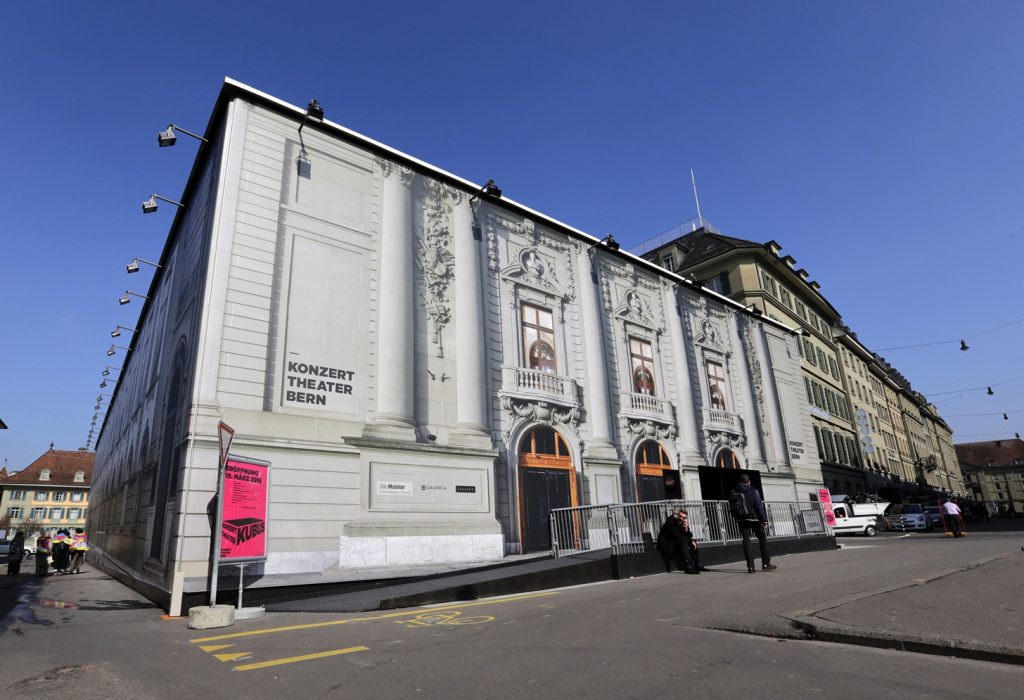
Theatre lovers in Bern are being offered something very special. Performances for the 2016 season take place not in the usual venerable municipal theatre, but in the middle of Bern’s Old Town. NUSSLI has installed a temporary theatre cube, with a historical appearance, in record time on Waisenhausplatz.
The theatre opened on March 19 with a programme of exciting, impassioned and fascinating performances that runs until October 2016.
“If the restoration work at the municipal theatre is delayed again, we can easily leave the cube standing for another season during the winter or even adjust the building to changing needs at a later date,” says NUSSLI Project Manager, Christian Frei.
For a year and a half, Frei and his team worked on the development of the system with which the halls can be constructed within a very short time, even at the most unusual locations, in any size and with column-free spans of up to 40m.
Efficient and Easy to Build
Frei was often on site during construction on Waisenhausplatz and lent a hand time and again, because the assembly of the modular hall system is almost as thrilling as its unlimited applications.
At the very beginning, the assembly crew installs the external structure with the flexible NUSSLI construction system. Then, they completely assemble the roof structure, including the sound and lighting fixtures, on the ground at a comfortable working height within the designated construction area. Finally, the entire roof structure is moved to its final height.
This construction method reduces the required installation space to a minimum and enables installation even on sensitive ground while increasing the safety of the crew. All the streets around the cube on Bern’s Waisenhausplatz were able to remain open to traffic throughout the construction, and the crane-free assembly did not stress the underlying parking garage structure in any way.
Central Location Opens up Possibilities
The idea of bringing the theatre cube to the audience instead of bringing the audience to an existing provisional arrangement opens up new possibilities for the Bern Theatre.
The program was therefore put together with a conscious effort to include events which reflect the central position in the public square and appeal to various interests. So, a tango milonga, a public viewing of the European Football Championship and a James Bond evening are scheduled in addition to ballet, opera and drama.
The modular hall system offers some important advantages, especially for construction projects in public places, on sensitive ground, or with limited access. The construction system requires no foundations, there is significantly less point loading than with construction using conventional steel supports, and the total load is evenly distributed over the entire ground surface.
Because Waisenhausplatz sits directly atop a parking garage which is subject to special static requirements, there were no problems for the theatre cube despite its 1000sq m size and 200-ton weight. No heavy crane equipment is needed, especially for assembly work in modular hall system.
“We could have set the theatre cube up on the Pilatus or on a golf course,” laughs Project Manager Frei. “That would work.”
Plan Today, Build Tomorrow
The planning of the Bern Theatre cube with 480 seats, catering, backstage and technical areas as well as a cloakroom took less than a year.
“A month after the first truck rolled out with its material, the cube was already cladded, equipped, and ready to go,” recounts Christian Frei.
He is looking forward to the reactions after the first performance, but adds quite calmly: “If the theatre organisation still wants modifications, it can be quickly and easily adjusted. The walls of the cube are also made of system material. They have just the exact thickness so that the entire installation can be accommodated in them and still remain easily accessible.”
Plans for the next projects with the modular hall system are already underway. Besides other theatre constructions, NUSSLI is planning a double-decker bridge for the IndyCar race in Boston in September. A bridge that has it all, because it crosses over the racetrack to the South Boston waterfront and will be equipped as a VIP lounge.
The sophisticated structure consists entirely of system material. Therefore, it is possible to start construction one day after approval of the construction concept on the part of the client or the authorities – which is unparalleled.
This article was written by NUSSLI
-

Rio set to repeat London’s legacy success, says AECOM
With just two months to go until the opening ceremony of the Rio 2016 Olympic and Paralympic Games, the host city is “on the cusp” of reaping the same legacy benefits enjoyed by London, according to AECOM, the company behind both cities’ Olympic masterplans.
“Despite Brazil’s current economic and political challenges, the guiding principle has always been for the Games to serve Rio and boost its development, improving the quality of life for all its citizens,” said Bill Hanway, Global Sports Leader at AECOM.
Rio is aiming to stage the world’s best value Olympic Games by reducing public cost through partnership with the private sector, and by delivering a simple and sustainable venue plan that applies many of the legacy planning strategies of the London 2012 Games.
According to the IOC, 75 per cent of capital expenditure relating to London’s preparations for hosting the 2012 Olympic Games was invested in transport and utilities infrastructure, land and water clean-up, public open spaces, new homes, and permanent sports and leisure facilities.
A similar approach has been adopted in Rio. The Games is boosting the development of public transport, with Linha 4 of the metro to Barra, the site of the Olympic Park, due to be completed just in time for the Games.
Power and data facilities installed to cater for 20,000 journalists from the international media will make the Olympic Park one of the best connected districts in Rio.
“The Games are a catalyst for changing not only the city, but the aspirations of future generations. As with London, our approach is to take a long-term view that sees the Games as a milestone in the ongoing legacy programme,” said Hanway.
“The Games and the success of the event are the primary focus, but also serve as a driver for the future. It’s an opportunity to invest in underdeveloped areas and significantly upgrade transport and infrastructure. Rio is now on the cusp of reaping the legacy benefits.”
Parallel lines: Games and legacy masterplanning
For the London 2012 Games, AECOM delivered masterplanning, landscape architecture, engineering and sustainability services. Working closely with its partners at Rio’s Municipal Olympic Company (EOM), AECOM has reprised these roles in Rio with additional responsibility for the preliminary design of the Barra Olympic Park’s sports arenas and detailed design of the International Broadcast Centre.
AECOM’s masterplan for Rio covers a 20-year period, with three distinct phases: preparation for the event; a transitional phase; and the long-term legacy. All phases were planned in parallel to smooth the transition between modes. AECOM points to the layout of roads and the capacity of utilities in the Barra Park, which were designed to cater for the planned residential, educational, commercial and sporting legacy.
The deconstruction and repurposing of temporary structures will take between five and seven years to complete after the Games. And in the legacy phase, more than three-quarters of the site will become a new neighbourhood.
Just under a quarter of the Barra site will be occupied by permanent sports facilities, which in legacy mode will provide elite training facilities for the Brazilian Olympic team as well as a sports high school for future Olympians.
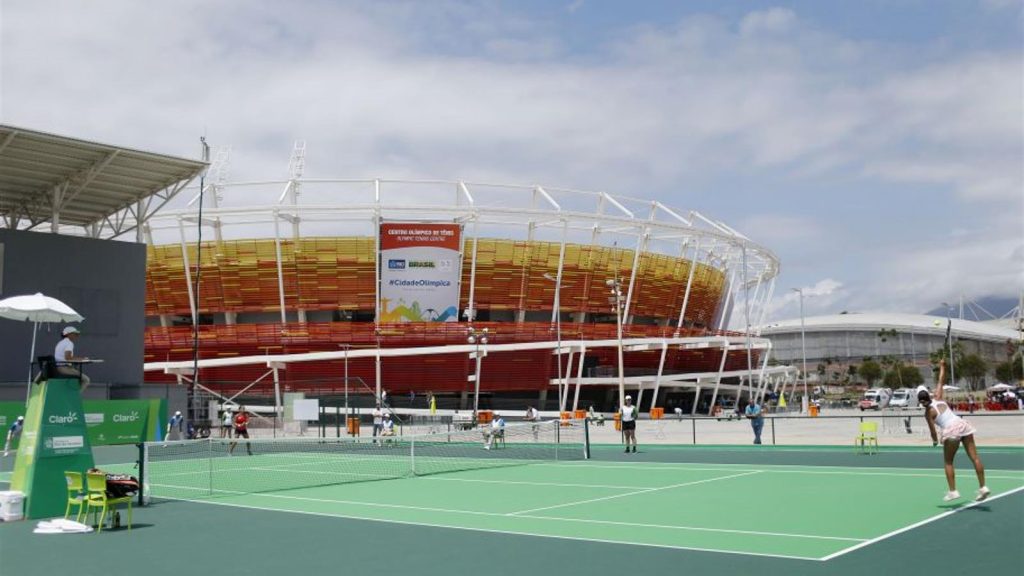
AECOM delivered preliminary designs for six new sports venues: the new velodrome, Olympic Aquatics Stadium and Tennis Centre, as well as three adjoining Carioca Arenas that will host basketball, judo, taekwondo and wrestling competitions.
The velodrome will remain a cycling venue, the tennis centre will be adapted to host tournaments, and the Carioca Arenas will become a Sports Academy School and multi-sport training facility. The Olympic Aquatics Stadium will be rebuilt as two smaller community pools.
AECOM was also tasked with delivering the strategy for reusable, temporary structures that could be moved and rebuilt as community facilities and schools after the Games.
Venues including the Handball Arena and Olympic Aquatics Stadium employ efficient, highly standardised designs based on modular, stacked and repeated bolted steel structures to ease dismantling and reassembly. This “nomadic architecture” approach will allow the Handball Arena to be transformed after the Games into four new primary schools across the city.
AECOM also provided full architectural services for the International Broadcast Centre, which meets strict environmental and sustainability standards while also fulfilling broadcasters’ needs in terms of power and data connectivity, acoustics and temperature control.
The Olympic Park is designed for more than 150,000 spectators to move safely and freely on peak days during the Games. After the Games, the focus will switch to turning the site into parkland, with AECOM’s landscape design strategy transforming large spectator areas into a new linear park for the community.
-

Handball Arena will be made into schools in Rio
During the Rio 2016 Olympic and Paralympic Games the Future Arena will host the handball events and be packed with 12,000 spectators. When the Games are over its structure will be dismantled and used in the construction of four state schools for two thousand children in the city of Rio de Janeiro.
Three schools will be constructed in Barra da Tijuca and one in Maracanã – each accommodating 500 students – as part of a US$77m legacy project.
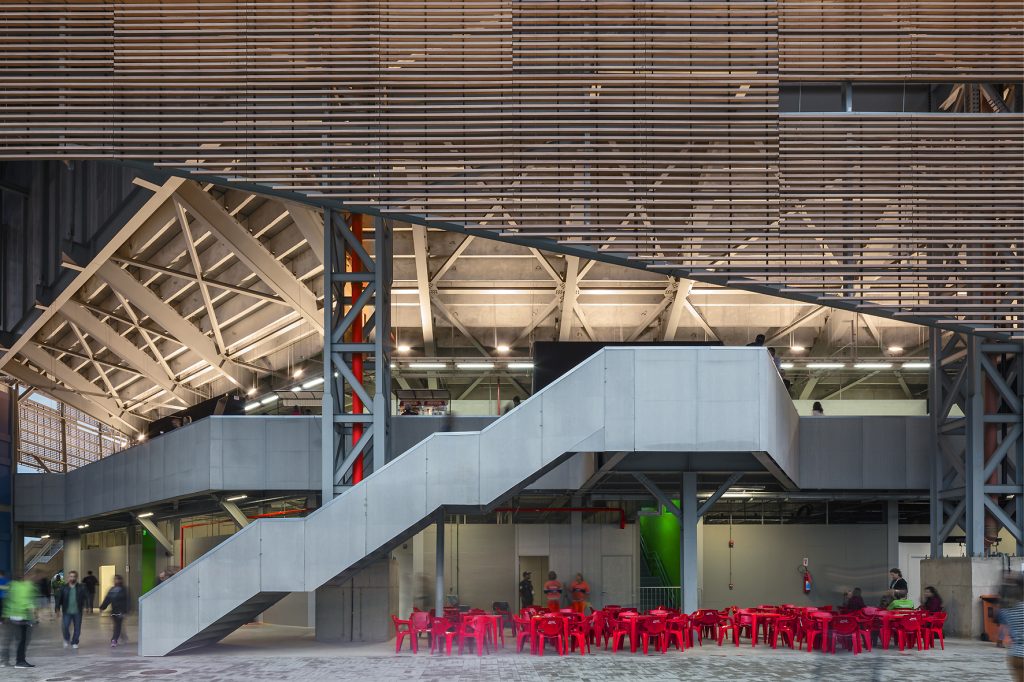
The brief for the handball arena was to build something that would contribute to the city of Rio beyond the 2016 Olympic Games. A first for the Olympics, the venue will make use of an innovative technique called “nomadic architecture”, thus ensuring that even a temporary structure can leave a lasting legacy.
The arena will be dismantled and the components transported to four separate locations to be rebuilt into state schools. The main elements that will be reused are the roof, rainscreen cladding, main structural steel elements and disabled ramps, which will form the shells of the four schools. The open nature of the rainscreen and external ramp that create the distinctive architecture of the arena will be recognisable in the new schools.
UK-based firm AndArchitects led by Rio-based practice Lopes, Santos & Ferreira Gomes provided the design for the handball arena. AndArchitects’ experience with six temporary buildings at London 2012 helped them jointly win the bid for this ground-breaking project.
Careful thought was given to what materials and systems of construction would allow this transition with minimal wasted material. The schools were designed simultaneously with the arena. The grid for the floor plates and the roof were all designed from the outset for both buildings so that the panels on the façade and on the floor and roof could be easily relocated in order for the modules to work for both buildings.
After the Games, once the arena has been converted into schools, the students will be reminded of their schools’ role in the Olympic Games. One idea that is being reviewed is that the names of the stars of the Brazilian team are engraved onto the cladding of the building and these names will remain on the walls of the classroom to inspire students.
-

Event structures for the marathon experience
Marathons in cities such as Valencia, Berlin, Frankfurt, New York, Linz and Vienna are major attractions and a mainstay in many a runner’s calendar. Organisers make these sporting events highly memorable, with flexible infrastructure enabling athletes and spectators to take in the most scenic and historical attractions alongside a programme of entertainment.
In the Divina Pastora Marathon, taking place in the Spanish city of Valencia each November, competitors run the final 200 meters on the water for an unforgettable home stretch, cheered on by spectators. This experience is made possible by NUSSLI laying down 2,000 sq m of running track in the water in front of the Museum in the Ciudad de las Artes y las Ciencias.
There are also event structures for spectators, including a grandstand with 1,000 seats, plus platforms for VIPs and the media and a stage for concerts and shows — all built in the water.
Public races are a great way of enabling a large number of people to truly experience a city or region. In Linz, more than 100,000 fans cheered competitors on last April. In New York it is estimated that there are more than two million spectators each year.
In order to offer competitors and spectators the most engaging experience possible, organisers not only choose routes with breath-taking scenery but also provide an entertainment programme.
Vienna City Marathon
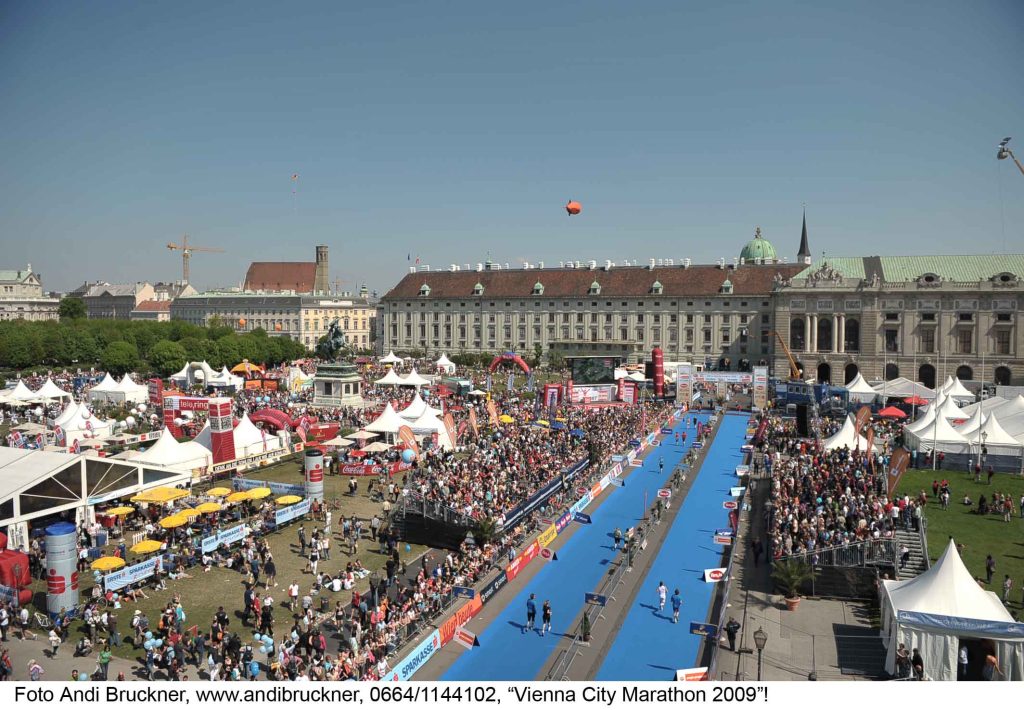
Vienna’s impressive marathon route takes runners past UN skyscrapers, over the Danube and through the Prater Park – all to the sound of waltzes by Strauss. Spectators get to experience everything up close, thanks to three 500-person standing grandstands set up by NUSSLI along the running route.
In last year’s Vienna City Marathon there were also special sponsor structures. These included a roofed 4 m high 72 sq m platform on which sponsor OMV provided guests with catering and a great view of the race; and Coca Cola’s 6 m high and 4 by 4 m wide tower surrounded by a winding staircase.
NUSSLI developed a flexible, high-quality system for branding the facades of these and other sponsor structures. Giant images displayed advertising messages on the sides of the structures. Printed sheets of mesh fabric were stretched over piping rails and looked great even up close.
The difficulty was not getting event structures to look good, but being able to build them in the first place. Since 2016, the finish area has been located directly on the Ringstrasse between the town hall and the Burgtheater in Vienna’s city centre. The Ringstrasse is one of Vienna’s busiest streets with car and bicycle lanes, as well as several lines for trams that pass by every minute.
“The assembly team had to build up to a distance of 20 cm from the street trams. Full concentration and attentiveness were required at all times,” Gerfried Salzer, the NUSSLI project manager says.
“Furthermore, it also meant that we could only set up from behind, where we had very little space to manoeuvre due to the tents, containers, equipment, and toilet installations.”
A stadium for the triathlon
Beautiful surroundings attract more participants, which is why triathlons often take place in areas with spectacular scenery.
The DATEV Challenge in Roth, Bavaria, Germany is the biggest long-distance triathlon in the world. The challenge of a 3.8 km swim, 180 km bicycle race, and a 42.2 km run drew 5,300 competitors and attracted 200,000 spectators last year. The best finished in less than eight hours.
Once again, there was a wide range of entertainment programmes for athletes and spectators.
NUSSLI builds a complete stadium each year for the shows before and after the triathlon, and for the finish area itself. Called the Rother Triathlon Park, it houses 3,000 seats for spectators and the media, a stage, a big screen, sound, light, and camera towers, and a catering area.
This is where shows, concerts, and prize presentations take place. It is also the athletes’ final goal. Last year, there were a thousand participants and more than a quarter of a million enthusiastic fans.
This article, written by Nussli, appeared in the Spring 2016 issue of Host City magazine.