[Source: IOC] It is with great sadness that the International Olympic Committee (IOC) has learnt of the passing of Honorary Member Sir Craig Reedie at the age of 84.
Sir Craig held a number of leadership positions at the highest levels of international sport, where he helped shape policy, expand global participation and confront some of the most difficult challenges facing the sports world. Among others, he was IOC Vice-President, President of the World Anti-Doping Agency (WADA), President of the International Badminton Federation (IBF) – today known as the Badminton World Federation (BWF) – and Chair of the British Olympic Association (BOA).
On learning of his passing, IOC President Kirsty Coventry said: “Sir Craig dedicated his whole life to the service of sport and the Olympic Movement. He was a steadfast guardian of integrity, guiding the global sporting community through some of its most challenging moments with dignity and resolve. His contribution to the Olympic Games, to clean sport and to the development of athletes worldwide will endure for generations to come.”
Sir Craig began his sporting career as a national and international badminton player representing Great Britain in the 1960s. After his time as an athlete, he made a name for himself as a leading sports administrator. He was secretary of the Scottish Badminton Union and subsequently President. In 1981 he was elected IBF President, where he led the successful campaign to include badminton on the Olympic programme at the Barcelona 1992 Olympic Games.
He joined the IOC as a Member in 1994, later serving on the IOC Executive Board (2009–2012) and as Vice-President (2012-2016). Over more than two decades, he contributed to numerous IOC commissions, including Marketing, Olympic Programme, Ethics and the Evaluation Commissions for the Beijing 2008 and Rio 2016 Olympic Games, as well as the Coordination Commissions for the Athens 2004 and Beijing 2008 Olympic Games.
In 2013, Sir Craig was elected as the third President of WADA. He expertly steered WADA through one of sport’s most turbulent periods – the revelation of the systematic manipulation of the anti-doping system in Russia – drawing on his well-respected diplomatic skills.
Sir Craig, who was also an enthusiastic golfer, chaired the BOA from 1992 to 2005, during which time he played a crucial role in London’s successful bid to host the 2012 Olympic Games. He served as an inspirational Director of the London 2012 Organising Committee for the Olympic Games and Paralympic Games between 2005 and 2012.
In recognition of his service to the Olympic Movement, he was awarded the Olympic Order in 2023 at the 141st IOC Session in Mumbai.
On top of a wide range of academic honours and national awards, Sir Craig was honoured by the British Crown: he was appointed Commander of the British Empire (CBE) in 1999, knighted as a Knight Bachelor in 2006, and later elevated to Knight Grand Cross (GBE) in 2018, reflecting his extraordinary contributions to sport and public life.
As a mark of respect, the Olympic flag will be flown at half-mast for three days at Olympic House in Lausanne.
Category: Event Management
-
Host City and IOC mourn the passing of Sir Craig Reedie
-

Identity expands to APAC with EPG acquisition, hailing “Golden Age of Experience”
[Source: Identity] Identity has established Australian operations, completing the global experience agency’s major projects footprint across UK and Europe, the US, Middle East and Australia. The agency can now deliver major sporting events, expos, business conferences and cultural activations seamlessly east to west, with local expertise backed by global infrastructure in every market.
Identity has acquired EPG, the Queensland-based major projects specialists, to establish its Australian presence. Led by Andrew Sharp and Jake Benson, EPG brings an exceptional track record in major sporting events, expos, business conferences and cultural activations delivered globally.
EPG retains its name, brand identity and operational autonomy as “An Identity Company,” operating from its Queensland headquarters. Andrew Sharp and Jake Benson join Simon Dunnell’s major projects leadership team, bringing decades of experience delivering complex, high-stakes projects across sport, business, culture and expos worldwide.
The move strengthens Identity’s capability in Australia, combining EPG’s proven local expertise with Identity’s global creative teams, operational infrastructure and specialist sub-brands. This enables the agency to deliver more ambitious, impactful major projects at scale across the region whilst enhancing Identity’s capability globally.
“This represents a significant strengthening of our global major projects capability,” said Simon Dunnell, Director of Major Projects at Identity. “Andrew and Jake have built an exceptional business with deep expertise in sporting events, expos, business activations and cultural projects delivered worldwide. Their capability enhances our delivery across existing operations in the UK, US and Middle East, whilst establishing our presence in Australia. This isn’t about adding a logo to our portfolio – it’s about genuine capability expansion backed by proven expertise.”
“The Golden Age of Experience is happening on every continent, and we’re delighted we can now deliver on four of them,” said Michael Gietzen, Group CEO of Identity. “Our clients demand world-class experiences regardless of where they’re activating. With major projects teams across Europe, North America, the Middle East and now Australia, we can deliver seamlessly around the world – local expertise backed by global resources, 24 hours a day.”
“We’re thrilled to join the Identity family,” said Andrew Sharp, Director, EPG. “Our clients will continue working with the same EPG team they trust, whilst gaining access to significantly enhanced capabilities. Major projects deserve major resources and local expertise – now we can strengthen our delivery of both. Whether it’s a major sporting event, an expo, a multinational business conference, or a large-scale cultural activation anywhere in the world, we can deliver even greater creative excellence and operational rigour.” -
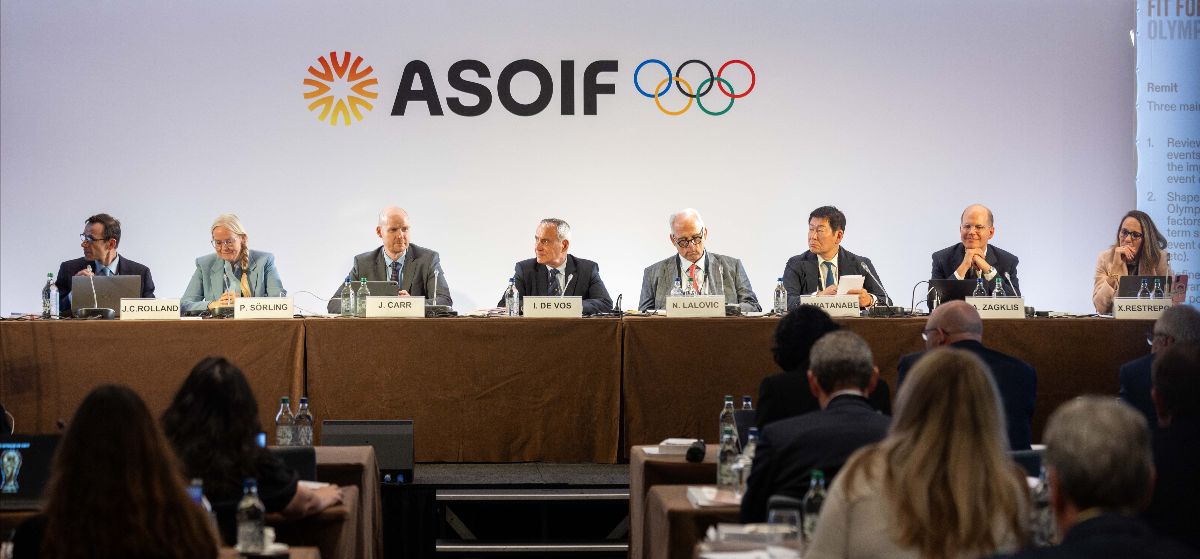
ASOIF General Assembly focuses on strategy, governance and Olympic Games preparations
[Source: ASOIF] The 36 Full and Associate member federations of the Association of Summer Olympic International Federations (ASOIF) gathered today in Lausanne, Switzerland, for the organisation’s 50th General Assembly, with discussions centred on the implementation of the new ASOIF Strategy 2026-2032, the Sixth Review of International Federation (IF) Governance, and preparations for upcoming Olympic Games and Youth Olympic Games.
The General Assembly was officially opened by ASOIF President Ingmar De Vos before International Olympic Committee (IOC) President Kirsty Coventry addressed the member federations.
The IOC President highlighted the power of sport and emphasised that all stakeholders within the Olympic Movement must work closely together to fully unlock its potential. She also underlined the vital role played by the IFs and the importance of their continued development and ambition, stating: “If you are not strong and striving, neither are we.”
Implementing the ASOIF Strategy 2026–2032
ASOIF presented the implementation roadmap for its new Strategy 2026–2032, which is built around three strategic pillars: Advocacy, Influence and Representation; Olympic Games Excellence; and Collaboration and Knowledge Sharing.
During the meeting, ASOIF also highlighted its refreshed brand identity which was launched in April and is aligned closely with the organisation’s strategic direction and future ambitions. The new visual identity reflects ASOIF’s commitment to innovation, collaboration and a strong partnership with the IOC.
Reflecting on the new strategy during his opening remarks, ASOIF President Ingmar De Vos said: “Importantly, the strategy recognises that collective action matters more than ever. No single IF can navigate every challenge alone. The strength of ASOIF ultimately comes from the willingness of IFs to collaborate, to share expertise and to act collectively where it matters.”
Governance remains a priority
Governance continues to be a central focus for ASOIF and its members. The General Assembly received an update on the Sixth Review of International Federation Governance, the outcomes of which will be published in June.
All 36 Full and Associate Members participated in the review process, which is overseen by ASOIF’s Governance Task Force and supported by an independent governance consultancy. The review is based on a comprehensive framework of governance principles and indicators tailored specifically to the needs of international sport federations.
Olympic Games and Youth Olympic Games preparations
The General Assembly also received in-person updates from the Organising Committees of LA28, Brisbane 2032 and the Dakar 2026 Youth Olympic Games.
Representatives from LA28 presented how they are planning to deliver the largest sports programme in Olympic history and outlined planned testing and readiness activities. They also highlighted accelerated recruitment across key operational areas as preparations move increasingly toward Games delivery and test event planning.
The Organising Committee reported strong public interest following the launch of the ticket draw, with more than four million tickets sold across 85 countries and all 50 states in the first drop.
The seventh LA28 Coordination Commission meeting with ASOIF representation will take place in Los Angeles from 2-4 June 2026.
Preparations for Brisbane 2032 continue to progress, with the Queensland Government’s Delivery Plan now in place and venue development and procurement processes under way.
The Organising Committee confirmed ongoing engagement with the IOC and IFs regarding the development of the sports programme, with the initial programme expected to be finalised in late 2026 or early 2027. Additional milestones foreseen in 2026 include further venue delivery developments, sustainability strategy confirmation, commercial announcements and the unveiling of the Games emblems. Brisbane 2032 has also set up an Athlete and Sport Advisory Group to ensure structured athlete engagement and input.
Taking place from 31 October to 13 November 2026, the Dakar 2026 Youth Olympic Games will be the next Olympic sports event and the first one on African soil. The Organising Committee presented progress updates across key operational areas, while highlighting continued collaboration with IFs to support sport planning and delivery.
The eighth Coordination Commission meeting with ASOIF participation took place in Dakar in March 2026 and marked the transition from planning to operational readiness.
Updates from the IOC, WADA and ITA
The General Assembly also received updates from the IOC on matters relating to IFs and the Olympic Games, especially in the context of the IOC’s “Fit for the Future” process and the related Working Group discussions. Meanwhile, the World Anti-Doping Agency (WADA) and the International Testing Agency (ITA) delivered reports on their anti-doping efforts and collaboration with IFs.