During the Rio 2016 Olympic and Paralympic Games the Future Arena will host the handball events and be packed with 12,000 spectators. When the Games are over its structure will be dismantled and used in the construction of four state schools for two thousand children in the city of Rio de Janeiro.
Three schools will be constructed in Barra da Tijuca and one in Maracanã – each accommodating 500 students – as part of a US$77m legacy project.
The brief for the handball arena was to build something that would contribute to the city of Rio beyond the 2016 Olympic Games. A first for the Olympics, the venue will make use of an innovative technique called “nomadic architecture”, thus ensuring that even a temporary structure can leave a lasting legacy.
The arena will be dismantled and the components transported to four separate locations to be rebuilt into state schools. The main elements that will be reused are the roof, rainscreen cladding, main structural steel elements and disabled ramps, which will form the shells of the four schools. The open nature of the rainscreen and external ramp that create the distinctive architecture of the arena will be recognisable in the new schools.
UK-based firm AndArchitects led by Rio-based practice Lopes, Santos & Ferreira Gomes provided the design for the handball arena. AndArchitects’ experience with six temporary buildings at London 2012 helped them jointly win the bid for this ground-breaking project.
Careful thought was given to what materials and systems of construction would allow this transition with minimal wasted material. The schools were designed simultaneously with the arena. The grid for the floor plates and the roof were all designed from the outset for both buildings so that the panels on the façade and on the floor and roof could be easily relocated in order for the modules to work for both buildings.
After the Games, once the arena has been converted into schools, the students will be reminded of their schools’ role in the Olympic Games. One idea that is being reviewed is that the names of the stars of the Brazilian team are engraved onto the cladding of the building and these names will remain on the walls of the classroom to inspire students.
Blog
-
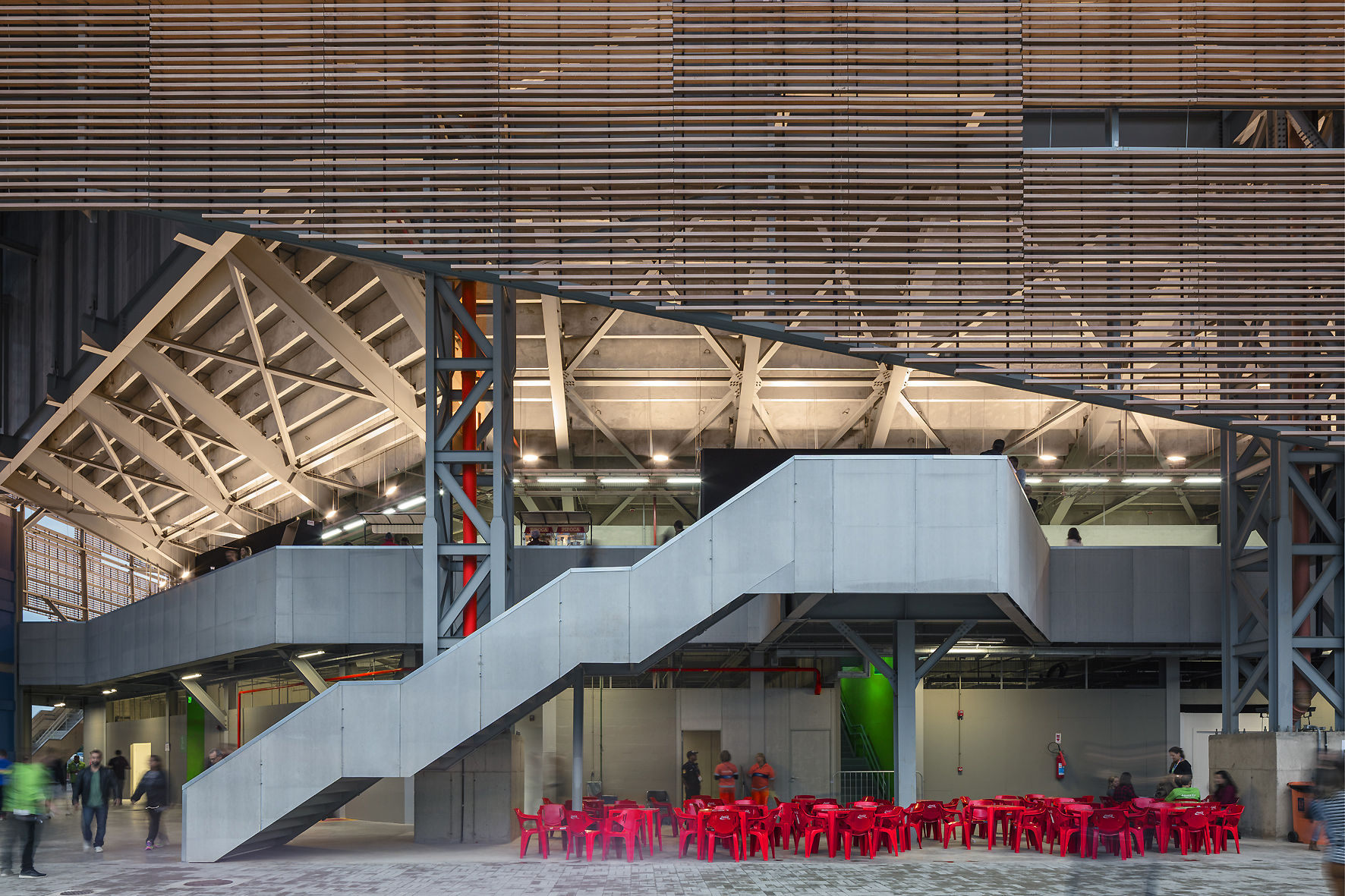
Handball Arena will be made into schools in Rio
-
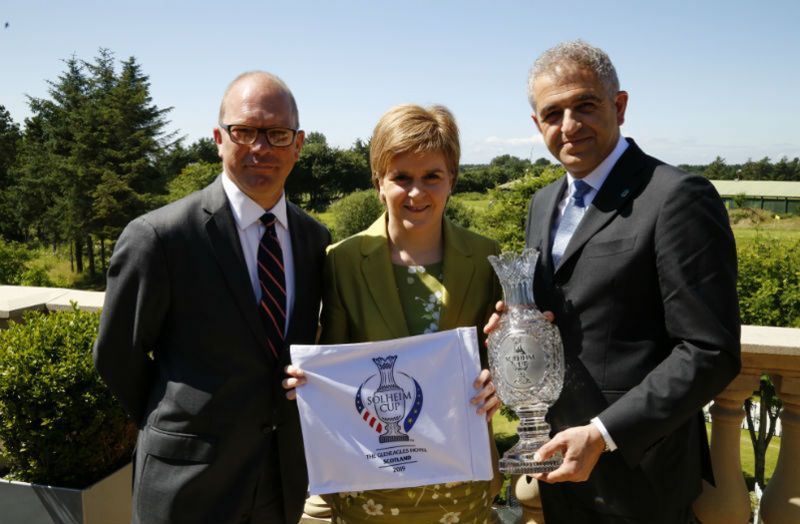
IMG appointed to stage 2019 Solheim Cup at Gleneagles
Scotland has agreed a unique partnership with global sports, media and events organisation IMG to stage the 2019 Solheim Cup at Gleneagles, ensuring the country hosts a world-class spectacle and delivers on its key principles of equality, experience and innovation.
Appointed by VisitScotland on behalf of The Scottish Government, IMG will bring its vast expertise and experience to ensure the competition will be one of the best in the tournament’s history.
“This partnership brings together two of the world-leading brands within the global golf industry and will allow Scotland to realise the many benefits of hosting one of the most prestigious sporting events on the planet,” said First Minister Nicola Sturgeon, announcing the partnership during the Aberdeen Asset Management Ladies Scottish Open at Dundonald Links.
“IMG’s vast experience in staging major events will ensure that Scotland stages the best-ever Solheim Cup when it visits Gleneagles in 2019 and delivers a spectator experience that is second to none.
“They share our vision of an open and inclusive event and will work alongside us to show that in Scotland golf is a family-orientated game that is open to everyone. We want to use The 2019 Solheim Cup to encourage greater participation among women, young people and families and IMG’s strong track record in the women’s game will help us to achieve this.”
The Solheim Cup is the biggest event in women’s golf, pitting European and US teams against each other in a team format which mirrors that of The Ryder Cup. Scotland was awarded the right to host The 2019 Solheim Cup in October 2015 following a successful bid led by VisitScotland. Responsibility for delivering the event on behalf of The Scottish Government will sit with the EventScotland team within VisitScotland’s events directorate.
“IMG is one of the most experienced sports events organisations in the world and, having worked with them over the years on various projects, we are confident their professional and innovative approach will help us to deliver the best Solheim Cup to date and one of the best sporting occasions to be hosted in Scotland,” said Paul Bush OBE, Director of Events at VisitScotland.
“We are proud to have played a role in enhancing the Ryder Cup brand with the 2014 staging in Scotland and look forward to doing the same with the Solheim Cup through this partnership with IMG.
“After a thorough procurement process, IMG stood head and shoulders above the other candidates in terms of their experience, in-house resources and their standing and experience within the golf industry. They share our key principles in the bid of equality, experience and innovation and we are very much looking forward to working together.”
IMG operate in more than 30 countries with unrivaled experience in event delivery. IMG’s Golf Division has staged more than 750 golf events and their current portfolio includes over thirty tournaments staged annually around the globe. The organisation has previous experience of delivering major golf events in Scotland through their work with the Ricoh Women’s British Open and the Johnnie Walker Championship over many years.
“We are delighted to have been chosen to partner with VisitScotland to deliver the 2019 Solheim Cup,” said Guy Kinnings, Global Head of IMG Golf.
“It is a fantastic challenge to deliver a Solheim Cup in Scotland following the success of the 2014 Ryder Cup. Our team can’t wait to get started on this exciting project and we look forward wholeheartedly to working with the considerable resources within the Scottish government to ensure that this Solheim Cup delivers in every aspect.”
The event is regarded as the biggest tournament in women’s golf and sees the best female professional golfers in Europe competing against their United States counterparts, attracting a huge worldwide audience and media profile for the host country.
“We welcome the appointment of IMG to partner with Scotland on the staging of the 2019 Solheim Cup,” said Ivan Khodabakhsh, Chief Executive of the Ladies European Tour.
“We are confident it is in excellent hands and look forward to an event that will continue to enhance the reputation of the women’s game on an international stage and inspire many more women and juniors to get involved in the sport.”
-
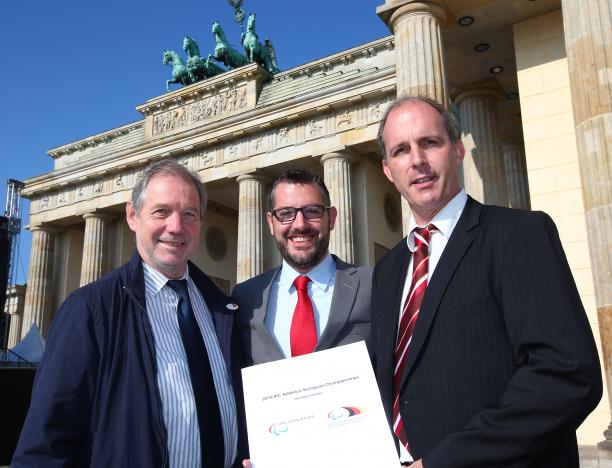
Berlin to stage 2018 European Para Athletics Championships
Berlin, Germany, will stage the 2018 European Para Athletics Championships, the sport’s global governing body IPC Athletics has announced. More than 600 athletes from 40 countries are set to compete at the Friedrich Ludwig Jahn Sportpark.
The event will take place between 20-26 August 2018, shortly after the 2018 European Athletics Championships, which takes place in Berlin from 7-12 August 2018 as part of the multi-sport “2018 European Championships” co-hosted with Glasgow from 1-12 August.
The 2018 European Para Athletics Championships will be organised by IPC Athletics, the National Paralympic Committee (NPC) of Germany and Behinderten-und Rehabilitations-Sportband Berlin.
“We are very excited that the 2018 European Para Athletics Championships will be staged in the German capital, a city with an excellent track record for staging major athletics events” said Ryan Montgomery, the IPC’s Director of Summer Sports.
“The Championships will take place with roughly two years to go until the Tokyo 2020 Paralympic Games and will be one of the biggest Para athletics events of the year.
“This venue has successfully staged Grand Prix events for the last four years and has a reputation for delivering fast times and long distances. We have seen a number of world and regional records broken in Berlin over the last few years, and I expect to see many more in 2018 as the performance level of Para athletes continues to increase.
“We look forward to work with NPC of Germany and the Behinderten-und Rehabilitations-Sportband Berlin to deliver a hugely successful event.”
Friedhelm Julius Beucher, President of NPC Germany, said: “We are glad and proud that the German capital will host the next European Championships in 2018 – a competition that will take place exactly between the Rio 2016 and Tokyo 2020 Paralympic Games.
“We are convinced that Berlin will deliver excellent Championships and we hope for a big attention, especially because this competition will begin just after the European Championships for athletes without disabilities. It is our wish that there are many spectators who will certainly be fascinated by Para sport. I am sure that we will have a highlight in Berlin.”
First held in Assen, the Netherlands, in 2003, the European Championships have taken place every two years since 2012. Four years ago, Stadskanaal, the Netherlands, played host before the event moved to Swansea, Great Britain in 2014 and then Grosseto, Italy in 2016. The 2018 Championships in Berlin will be the sixth edition.
“This is a fantastic opportunity for Berlin to host this great event. For all of us, volunteers and staff, this for sure will be an extraordinary time,” said Klaas Brose, Director of Behinderten-und Rehabilitations-Sportband Berlin.
-
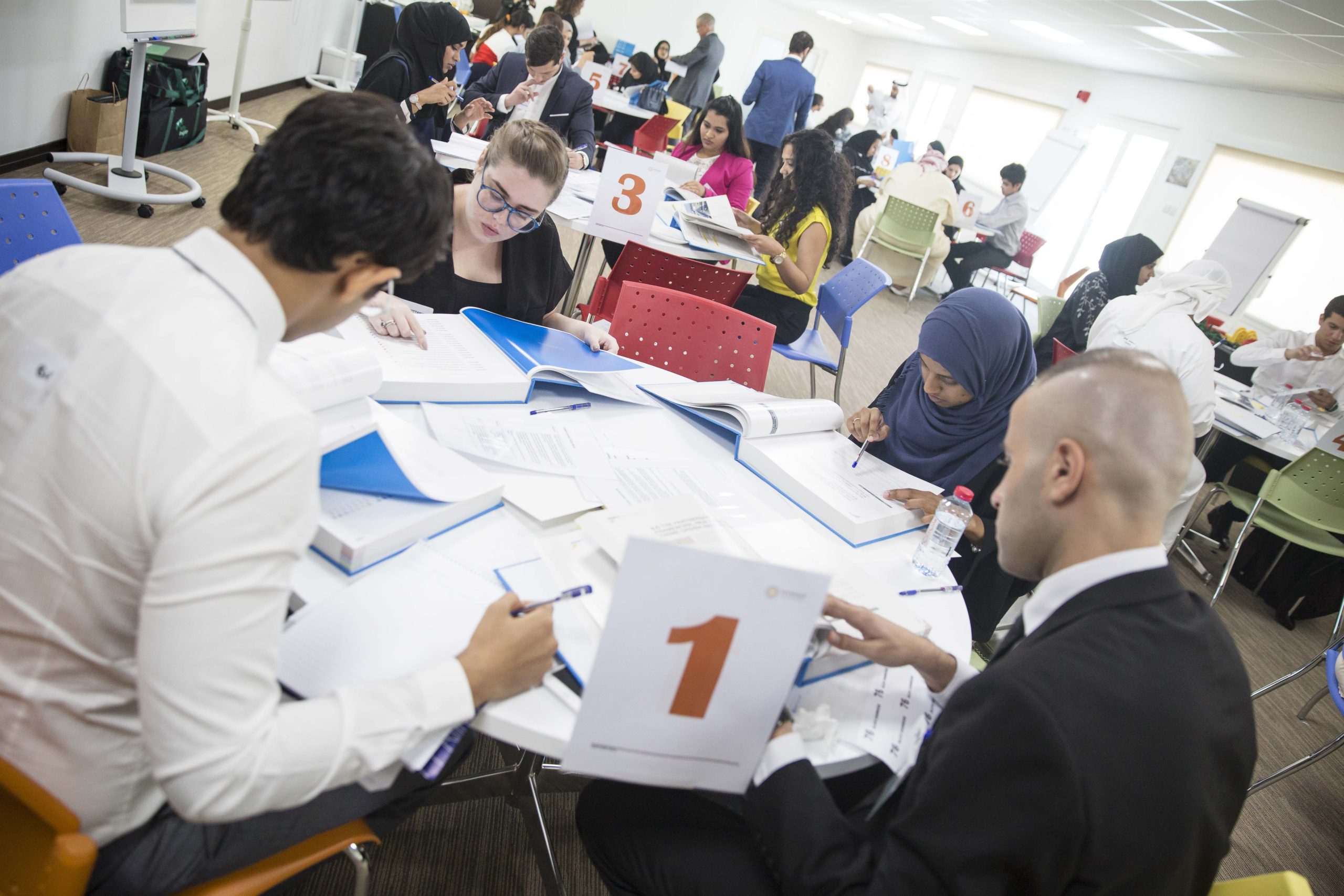
Candidates shortlisted for Expo 2020 Dubai apprenticeship programme
Following its launch in April 2016, the programme attracted in excess of 2,700 applications, reflecting the high level of interest in Expo 2020 amongst the nation’s young people. From these, 150 candidates were invited to assessment days that began last month at the Expo site in Dubai South. Expo 2020 Dubai took an innovative approach to these workshops, using a series of engaging challenges and tasks to evaluate candidates on criteria that included leadership, teamwork and their ability to identify and solve problems under pressure.
Ila Kuntum, an Indonesian engineering student currently completing her Masters of Science at the Masdar Institute of Science and Technology, said, “I really enjoyed the fact that the assessment included group-based activities. It showed us how real-life, quick decision scenarios play out, and highlighted our strengths and weaknesses.”
Emirati Marketing graduate, Ayesha Sharaf, and Farshied Jabarkhyl, who has studied in both the UK and UAE, described the day as “very challenging and unlike any other assessment I have ever taken part in. It taught us the importance of being open minded to other people’s opinions and ideas and was a great chance to meet new people.”
Candidates were then scored on their performance and around 50 were invited to attend a further round of one-to-one interviews with senior members of the Expo 2020 team, including the heads of the 19 departments offering work placements.
Commenting on the programme, Manal AlBayat, Vice President of Engagement, Expo 2020 Dubai, said: “The Apprenticeship Programme is an important part of our commitment to engage and empower young people through our journey leading up to Expo 2020 Dubai. We were heartened to see such a high demand from a diverse group of applicants and particularly impressed by the high quality of applications received.”
“The feedback from candidates that have taken part at the various stages of this process demonstrates the value of this experience. Those that are selected for the programme will develop useful competencies for their future career development, and will be important contributors to Expo 2020 Dubai’s educational and economic legacy. We are all looking forward to welcoming the first cohort later this year.”
The Apprenticeship Programme is aligned with the UAE Government’s Youth Empowerment Strategy. It also reflects Expo 2020 Dubai’s theme, “Connecting Minds, Creating the Future”, and addresses one of the Expo’s subthemes, “Opportunity”, by providing practical opportunities for young people to develop a skillset that positions them for future employment across a range of industries.
Successful candidates will be informed in mid-July with the programme commencing at the end of August.
Source: Expo 2020 Dubai
-
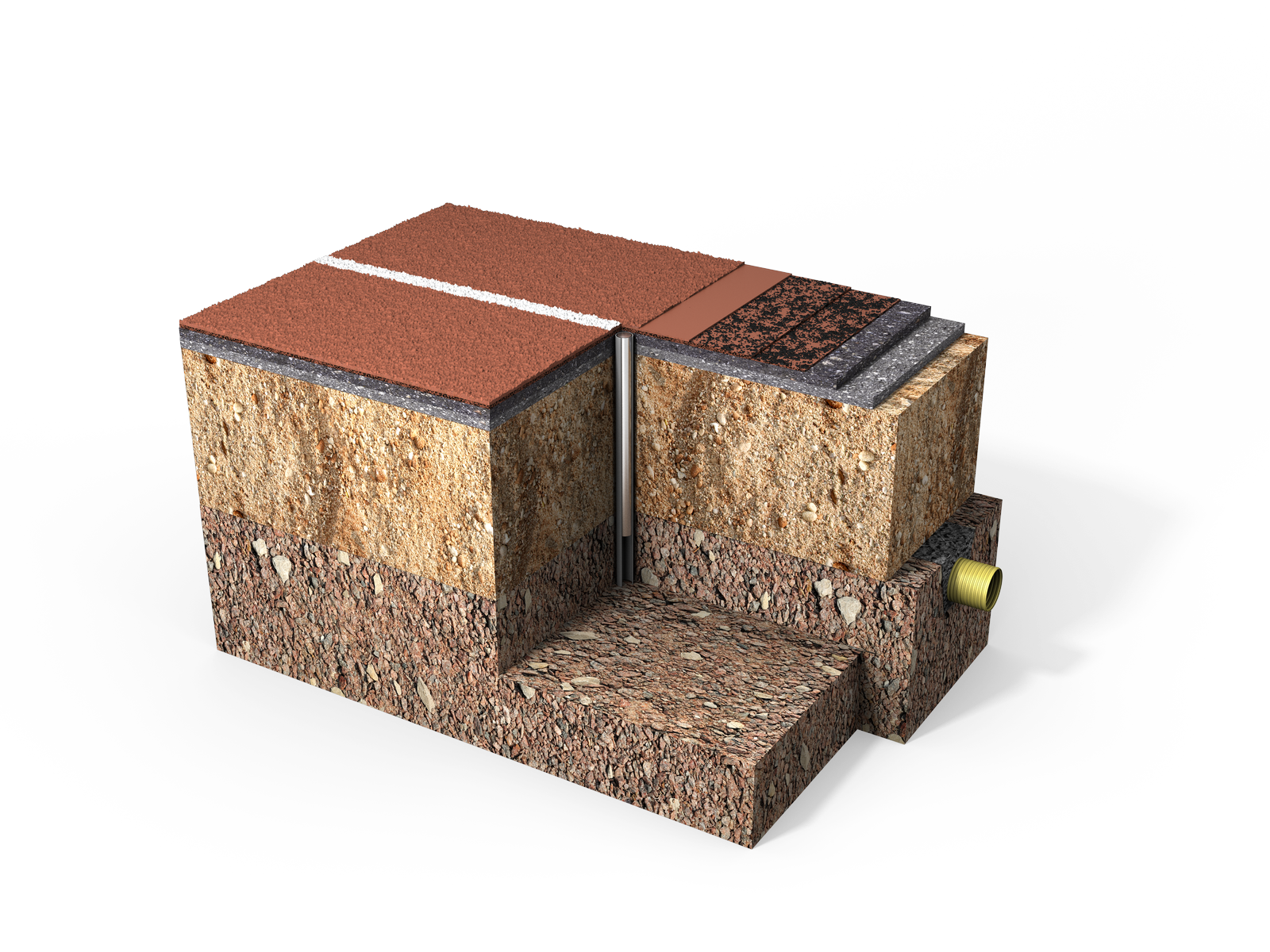
Turn your track into a coaching assistant
A precision data logging system for track and field athletes that facilitates daily training diagnostics without costly technical installations – that’s Polytan SmarTracks, the new addition to the Polytan product range.
The system consists in the interplay of three components: magnetic timing gates built invisibly into the track; a waist-belt with sensor; and tried-and-tested analysis software.
Not only can this special technology be used to record the movement data of several athletes simultaneously, its diagnostic capabilities also go far beyond simple time measurement.
In conjunction with the fast and optimally cushioned Polytan synthetic sports surface, the sophisticated sensor technology lays the foundation for optimal training conditions in all performance classes, from school and recreational sports to elite sports.
The technology has been developed by humotion, a company specialising in the capture and analysis of human movement data. The easy-to-operate data logging system is suitable for all outdoor synthetic surfaces from Polytan and can also be retrospectively incorporated into existing athletics facilities with ease.
Its use in sports halls is currently in the development phase as components made of iron and steel may interfere with the magnetic field of timing gates in certain circumstances. The properties of the subsoil should also be tested prior to outdoor installation for the same reason.
Compared with other time recording systems such as photoelectric sensors, GPS analysis and video analysis, the winning features of Polytan SmarTracks are low measuring tolerances, full protection against vandalism, a complete lack of dependence on weather conditions and no time-consuming setup and dismantling of technical equipment.
Polytan provides “Professional”, “Performance”, “Basic”, “Sprint” and “School” standard facility concepts in order to simplify training diagnostics, although individual training plans can of course also be taken into account.
The Polytan SmarTracks solution gives clubs and organisations an opportunity to provide professional training conditions – and thus make their sports facilities more attractive to members and sponsors. The advantages for coaches and athletes are twofold: a comprehensive training analysis with a diagnostic procedure but without the need for a diagnostician, and the ability to compare their performance with that of other athletes in competition conditions.
The movement data are captured by the timing gates in the ground and the sensor, which weighs just 24 g, worn on the body. Speed, step length, step frequency and jump height are recorded as well as running time. This is made possible by humotion’s highly developed sensor technology with three-dimensional data capture, which actually consists of a number of intelligent individual sensors rather than a single one.
Two round magnetic elements (600 mm long and 25 mm thick) are sunk into the ground at intervals of 1.0-1.30 m to form a timing gate. The upper end of the magnetic elements lies no more than 25 mm beneath the upper edge of the synthetic surface. One track needs two magnetic elements, two tracks need three, three tracks four and so on. Polytan recommends a minimum distance of 3 m between the photoelectric sensors in the running direction.
Versatility in action
The first reference project with SmarTracks technology was implemented in Osnabrück in August 2008. A system on the site of the Westfälische Wilhelms-Universität Münster has likewise been in daily use for a few years.
Andreas Klose, who is a research associate at the Institute of Sport Sciences at WWU Münster, a physiotherapist and a high-jumper, says of his experience with the facility: “For me, Polytan SmarTracks has proven its worth in everyday use. The technology does not depend on the weather; it is versatile and can be activated in no time at all. The small and manageable sensor delivers all the data I need in order to diagnose performance as a basis for training recommendations. I also use the system to log my own performances.”
The third athletics facility with Polytan SmarTracks is due for completion at the training ground of the TSV GutsMuths Berlin 1861 e.V. sports club in early 2016. Like the one in Münster, it has magnetic timing gates built into the fast and optimally cushioned Polytan M sports surface. The fourth one is planned for Hamburg.
This article appeared in the Spring 2016 issue of Host City magazine -
Event structures for the marathon experience
Marathons in cities such as Valencia, Berlin, Frankfurt, New York, Linz and Vienna are major attractions and a mainstay in many a runner’s calendar. Organisers make these sporting events highly memorable, with flexible infrastructure enabling athletes and spectators to take in the most scenic and historical attractions alongside a programme of entertainment.
In the Divina Pastora Marathon, taking place in the Spanish city of Valencia each November, competitors run the final 200 meters on the water for an unforgettable home stretch, cheered on by spectators. This experience is made possible by NUSSLI laying down 2,000 sq m of running track in the water in front of the Museum in the Ciudad de las Artes y las Ciencias.
There are also event structures for spectators, including a grandstand with 1,000 seats, plus platforms for VIPs and the media and a stage for concerts and shows — all built in the water.
Public races are a great way of enabling a large number of people to truly experience a city or region. In Linz, more than 100,000 fans cheered competitors on last April. In New York it is estimated that there are more than two million spectators each year.
In order to offer competitors and spectators the most engaging experience possible, organisers not only choose routes with breath-taking scenery but also provide an entertainment programme.
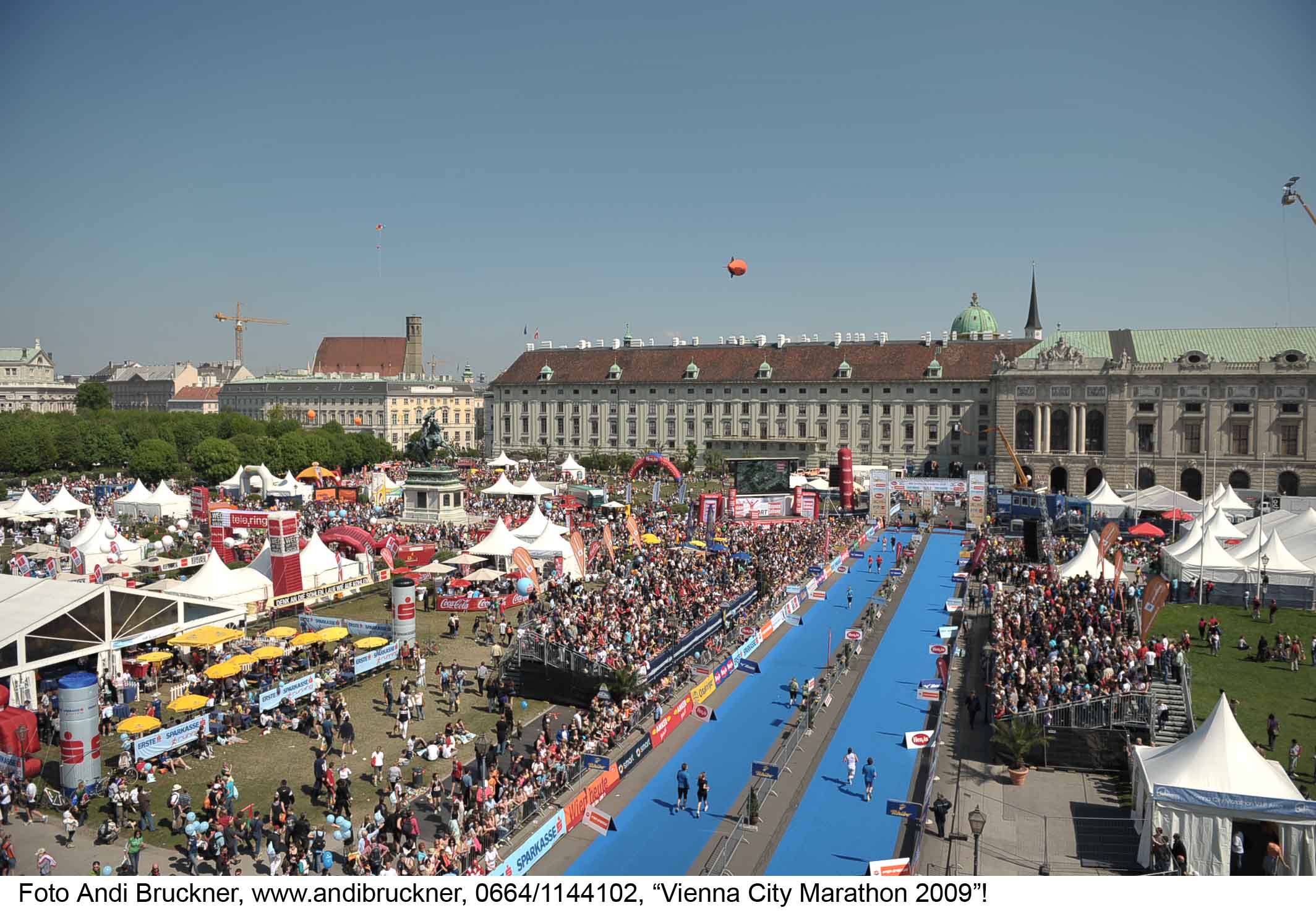
Vienna City Marathon
Vienna’s impressive marathon route takes runners past UN skyscrapers, over the Danube and through the Prater Park – all to the sound of waltzes by Strauss. Spectators get to experience everything up close, thanks to three 500-person standing grandstands set up by NUSSLI along the running route.
In last year’s Vienna City Marathon there were also special sponsor structures. These included a roofed 4 m high 72 sq m platform on which sponsor OMV provided guests with catering and a great view of the race; and Coca Cola’s 6 m high and 4 by 4 m wide tower surrounded by a winding staircase.
NUSSLI developed a flexible, high-quality system for branding the facades of these and other sponsor structures. Giant images displayed advertising messages on the sides of the structures. Printed sheets of mesh fabric were stretched over piping rails and looked great even up close.
The difficulty was not getting event structures to look good, but being able to build them in the first place. Since 2016, the finish area has been located directly on the Ringstrasse between the town hall and the Burgtheater in Vienna’s city centre. The Ringstrasse is one of Vienna’s busiest streets with car and bicycle lanes, as well as several lines for trams that pass by every minute.
“The assembly team had to build up to a distance of 20 cm from the street trams. Full concentration and attentiveness were required at all times,” Gerfried Salzer, the NUSSLI project manager says.
“Furthermore, it also meant that we could only set up from behind, where we had very little space to manoeuvre due to the tents, containers, equipment, and toilet installations.”
A stadium for the triathlon
Beautiful surroundings attract more participants, which is why triathlons often take place in areas with spectacular scenery.
The DATEV Challenge in Roth, Bavaria, Germany is the biggest long-distance triathlon in the world. The challenge of a 3.8 km swim, 180 km bicycle race, and a 42.2 km run drew 5,300 competitors and attracted 200,000 spectators last year. The best finished in less than eight hours.
Once again, there was a wide range of entertainment programmes for athletes and spectators.
NUSSLI builds a complete stadium each year for the shows before and after the triathlon, and for the finish area itself. Called the Rother Triathlon Park, it houses 3,000 seats for spectators and the media, a stage, a big screen, sound, light, and camera towers, and a catering area.
This is where shows, concerts, and prize presentations take place. It is also the athletes’ final goal. Last year, there were a thousand participants and more than a quarter of a million enthusiastic fans.
This article, written by Nussli, appeared in the Spring 2016 issue of Host City magazine. -
Russia doping report “had to be published” before Rio Games – WADA
The World Anti-Doping Agency (WADA) has taken note of the views expressed by some concerning the timing of publication of the Agency’s independent McLaren Investigation Report, which was published by Professor Richard H. McLaren on 18 July, exposing Russian State manipulation of the doping control process; and, the Agency’s subsequent recommendations – both that led to the International Olympic Committee’s (IOC) decision of 24 July.
WADA understands that the timing of the McLaren Investigation Report has been destabilizing for a number of organizations as they prepare for the Rio Olympic and Paralympic Games. However, WADA wishes to factually clarify that the Agency acted immediately on allegations concerning Russia when it had corroborated evidence and the power to do so under the World Anti-Doping Code (Code).
When German-based ARD released their first documentary in December 2014 that contained corroborated evidence, WADA quickly initiated its Independent Commission. The Commission, which was chaired by Richard W. Pound, commenced its investigation in January 2015 when WADA acquired its new powers of investigation under the 2015 Code.
“While our Independent Commission’s Report suggested that doping in Russia was likely not restricted to athletics, and that the Russian secret services (FSB) were present within the Sochi and Moscow laboratories, the Commission did not uncover concrete evidence to the effect that the Russian state was manipulating the doping control process,” said Richard W. Pound. “The Pound Commission leveraged all information that the whistleblowers had provided; and yet, there was no concrete evidence to support State manipulation.”
On 9 November 2015, the Pound Commission reported and exposed wide-spread doping in Russian athletics; and, on 10 November 2015, WADA took quick and decisive action on the Commission’s recommendations.
“It was only when CBS 60 Minutes and the New York Times, on 8 and 12 May 2016 respectively, published the allegations from the former director of the Moscow and Sochi laboratories, Dr. Grigory Rodchenkov, that WADA had concrete evidence suggesting Russian state involvement that could be investigated by initiating the McLaren Investigation, which we did immediately,” said Craig Reedie, WADA President. “This decision was endorsed by WADA’s Executive Committee and WADA’s Athlete Committee,” he continued. “It must be understood that Dr. Rodchenkov was heard several times by the Pound Commission in 2015; and that, he never provided the information that he later revealed to the New York Times in May 2016. This information was subsequently corroborated by the McLaren Investigation, which also unveiled a wider implication of the Moscow laboratory.”
“WADA’s Executive Committee – composed in equal parts by representatives of the Olympic Movement and Governments of the world – supported Professor McLaren’s independent mandate, which was to obtain evidence as quickly as possible in the interest of clean athletes,” said Reedie. “While it is destabilizing in the lead up to the Games, it is obvious, given the seriousness of the revelations that he uncovered, that they had to be published and acted upon without delay.”
“Further to the International Olympic Committee’s criteria being outlined on 24 July, WADA has facilitated the transfer of relevant information that is available to date, concerning individual athletes, from the McLaren Investigation team to International Federations,” said Olivier Niggli, Director General, WADA. “It should be noted however that Professor McLaren’s focus thus far was on establishing involvement of the Russian State and not regarding individual athletes that may have benefitted,” Niggli continued. “WADA will continue supporting anti-doping organizations by providing information as and when it becomes available via McLaren’s ongoing Investigation.”
As it relates to WADA’s process of accreditation and proficiency testing of anti-doping laboratories, it focuses on the technical abilities of laboratories. In the case of the Moscow laboratory, WADA suspended the laboratory in 2015 as soon as breaches were identified via the Pound Commission. Addressing corruption within the anti-doping system – including state or secret service interference in laboratory operations – will be one of the topics discussed during the first in a series of multi-stakeholder Think Tanks that WADA will hold in September 2016.
Source: WADA -
The UK’s special Olympic relationship with Brazil
What is the Department for International Trade responsible for?
“We are a UK government department working with businesses based in the United Kingdom to ensure their success in international markets, and encourage the best overseas companies to look to the UK as their global partner of choice. Trade and Investment has never been more important to the country’s economic prospects. We help UK companies of all sizes to grow their businesses through international trade by offering expert advice and practical support through a range of programmes. We also connect businesses to the world’s top commercial opportunities and drive targeted campaigns centred around them.”
Why is the major sports event sector a key focus for you?
“The budgets for the world’s Top 50 major sporting events between 2016 and 2025 are estimated to be worth a total £230 billion. With 30% of procurement made internationally, this creates a potential export market of nearly £70 billion for UK companies. Obviously the Olympic Games is a key focus for the companies we work with, but we have been encouraging them to remember that there are also opportunities to explore around the Paralympics which we feel don’t always get the exposure they deserve.”
Have UK companies been particularly successful in securing business at Rio 2016?
“The special relationship that exists between countries that host back-to-back Olympic and Paralympic Games, and enhanced through a yearly UK-Brazil dialogue which has taken place since 2012, has led to 40 UK companies winning contracts worth so far in excess of £150m from the Rio 2016 Olympic and Paralympic Games. Some of the areas where UK companies have been successful include: Architectural and design consultancy, Olympic Park Masterplan, Venue design consultancy, Security consultancy, Engineering and sustainability consultancy, Audio and video operations, Temporary structures and event overlay consultancy, Cost Consultancy, Temporary Kitchens.”
What is the Department for International Trade’s history with the IPC Academy Campus?
“The UK government has been involved with the IPC Academy Campus since the London 2012 Paralympics where we sponsored and hosted the Inclusion Summit which was a great success. Apart from the insightful programme and networking, it was an opportunity for us to make the event venue – Lancaster House – accessible for people with physical impairments for the first time ever through the fitting of wheelchair ramps for example. For Sochi 2014, we sponsored the Closing Cocktail Reception at the Campus.”
What will you be sponsoring specifically at the 2016 IPC Academy Campus in Rio?
“As was the case in Sochi, we will be sponsoring the Closing Cocktail Reception. This will bring proceedings of the 2016 IPC Academy Campus to a close on the relaxed roof terrace surroundings of the British House at the Shopping Metropolitano Barra. The reception will offer networking opportunities for all IPC Academy Campus participants and act as a ‘graduation ceremony’ for the Campus. Approximately 400-500 people will come together to celebrate the success of the Campus and will be the biggest event-learning gathering of major sport event organisers and their stakeholders ever held in the world. It really is a unique opportunity to rub shoulders with a wide range of people from the major events industry who have attended the Campus and also with industry people from Brazil and the UK who we will be inviting.”
Are you pleased with the engagement you have had from UK companies for the Paralympics and the Campus?
“Yes, definitely. We are bringing over a delegation of UK companies who are a mixture of ones familiar with the industry and others who are keen to explore new opportunities that may be linked to the Paralympics or other major events. In the coming weeks we will be working with them to ensure they get the most out of the trip and the opportunities that come within the unique environment of the Campus.”
What is your advice to organisations attending the IPC Academy Campus for the first time?
“What was great about the last Campus was being asked to stand up at the beginning of the Games Experience Programme and to go and speak to five new people that we had never met before. That was a great ice breaker and really got people integrating. Often people attend events like these and spend the whole time speaking to people they know already and that can be a wasted opportunity to not only to make new friends of course, but also to source new business opportunities. My advice for anyone attending Campus is to make the most of networking with the wide variety of people there and also to learn what you can from the experts who will be hosting the various elements.”
This interview was conducted by the World Academy of Sport (WAoS). Delivered by the IPC Academy – the International Paralympic Committee’s educational division created in 2009 as a partnership between the IPC and the WAoS – the 2016 IPC Academy Campus is a unique event-based learning initiative that will include an Observers’ Programme, Games Experience Programme, Inclusion Summit and Closing Cocktail Reception. The IPC Academy Campus will give stakeholders of major sports events the chance to learn from their peers during the Paralympic Games.
The IPC Academy Campus takes place in Rio de Janeiro between 6-17 September 2016. Its Event Partners include the Adecco Group and the UK’s Department for International Trade. Its Media Partners are Sportcal (Intelligence Partner), Major Events International (Digest Partner), Around the Rings (Online Partner), Host City (Magazine Partner) and AXS Chat (Social Media Partner). For further information about the the IPC Academy Campus, please visit www.ipcacademycampus.com or contact Claire Bennett, Project Coordinator, World Academy of Sport cbennett@worldacademysport.com.
-
Scotland expects major boost from 2016 Davis Cup
The semi-final of the 2016 Davis Cup by BNP Paribas World Group between will take place at Glasgow’s Emirates Arena from 16-18 September 2016 – and the host nation is upbeat about the benefits the event will bring.
The decision by the Lawn Tennis Association to host the tie between the Aegon GB team and Argentina follows Scotland’s successful hosting of Davis Cup matches last year.
“Scotland was delighted to host the Davis Cup first round and semi-final in 2015 and, on both occasions, the support at The Emirates proved why Scotland is the perfect stage for events of this magnitude,” Paul Bush OBE, VisitScotland’s Director of Events tells Host City.
“I have no doubt that this year’s semi-final against Argentina, which we are supporting through EventScotland’s International Programme, will be no different and expect tennis fans from across the UK and further afield to travel to Glasgow as Great Britain attempts to retain its Davis Cup title.”
The international appeal of the event is particularly attractive proposition for the host nation.
“For Scotland as host nation, and Glasgow at a local level, major occasions such as this are hugely valuable. The sell-out matches in 2015 saw a total attendance of more than 47,000, with a significant proportion of those people, 31% and 42% respectively, travelling from outside of Scotland. We expect similar interest in September’s fixture, meaning, again, Scotland is set to benefit from the associated economic impact that this influx of visitors brings.
“Additionally, for both Scotland and Glasgow, the prospect of staging such an important match means an increase in exposure across all media formats both at home and abroad. In terms of reinforcing Scotland’s capability in staging world-leading events and promoting Scotland as a tourist destination, raising the nation’s profile in this way is critical.”
Tennis, along with cricket golf, basketball and athletics, is attracting more participants. According to statistics released in July by SportScotland, sports participation has risen over the last two years, with sports club membership rising from 706,764 to 768,212 since 2013/14.
Scotland hosting the Davis Cup is set to increase this trend – particularly given that last year’s winners and Scottish brothers Andy and James Murray are currently on top form.
“The timing of the match lends itself to generating further legacy benefits by encouraging more young people to become involved in sport,” says Bush.
“After Andy Murray’s second victory at Wimbledon, Jamie Murray’s continued success as one of the world’s best doubles players and shortly following tennis in the Rio Olympics, we are confident the Davis Cup can further inspire youngsters to take up tennis and become more active. This is vital for the development of the sport in Scotland and in encouraging young Scots to lead healthier lifestyles.”
-
How Eurosport embraces digital disruption
Once controlled by a powerful and small number of major players, media channels are now increasing exponentially and unregulated. The ability to create, publish and distribute content is now at everyone’s fingertips. In this new world order, how can a broadcaster retain influence and attract audiences?
“The reality is that it’s clearly a lot easier for sports federations and brands to have a direct-to-consumer relationship now,” Peter Hutton, CEO of Eurosport told Host City at World Football Forum.
“But we are in a lot of conversations with different federations and brands about how we can actually help them. Because with your own site, you are preaching to the converted; you speak to your established audience, your known database. And the problem with that is: how to you bridge a new audience?”
The Professional Squash Association launched “SQUASHTV” on its own website in 2009 to broadcast its World Tour series of events directly to its fans. But in December 2015, the organisation went on to sign an agreement with Eurosport to host matches on Europlayer in order to reach more viewers across Europe.
“We bought out their streaming rights because they had an established streaming platform that was doing very well. But their concern was how to promote that to a new audience.
“So I think there are ways where you can have the brand and database that a federation has, but you can put it under a wider umbrella and you can direct more people to it. And for me that’s one of the real challenges of a sport channel, in that you accept undeniably that more people are going to consume their media in different ways. But you’ve got the strong brand that people will direct themselves to.”
The Eurosport brand was established 30 years ago and Eurosport.com is now the most viewed sports website in Europe.
“People naturally see it as an area of trust where they come for sports results and information. And that’s a great start, but one of our challenges is to make it more a video-based site – and how to build a relationship with the federations where they can use that site to generate traffic for their own use as well.”
Pushing out short, engaging content on social media is one mechanism of driving traffic to a site – but the question is how then to convert these visitors into paying subscribers.
“It’s very much part of the idea that sport is a stepping stone process where you get attracted by an idea, an individual or a story. And because you’re attracted to that first contact point, you then watch more and more of the long form of that sport, and then you potentially become a paid subscriber for that sport. But you need to have that engagement with the sport on a very emotional level to start with.
“So if you can take people up that step-by-step route then I think that’s good for a sports business. A free web or social media presence is a really useful part of that as a tactic. We can really benefit from sports brands pushing out material that then directs people up the platform of experience towards the immersive paid TV or paid consumer experience.”
The role of the broadcaster has irrevocably changed with the rise of digital media. Not only can sports federations and brands publish their own content directly on their own sites and social media channels, but fans too can generate and share their own content using smartphones.
“I think the reality of that disruption is something that you fight with every day. As a football fan I know that the moment there’s a goal anywhere in any game of significance anywhere in Europe that you can get that goal via Twitter, via different sites, you’ve got illegal streams up there – it’s there, you can’t knock it on the head and ignore the fact that it’s going to be there.”
While it can be possible to stop illegal recording and uploading, this is not necessarily worthwhile.
“You can have take-downs, but by the time you’ve taken it down the value has gone, because if I hear there’s been a goal in a game I want to see it straight away. Somebody will have filmed it off air from somewhere and put it on, it gets shared amongst their community of people and then it’s taken down later but it’s OK – I’ve seen it by that point.
“For us we don’t see a massive value in short clip rights to content because you just accept the fact that they are going to be viral, and therefore they are uncontrollable.”
Broadcasting Games and Championships
Every Olympic Games breaks new records for viewing figures to become the most watched event in the world. Broadcasting rights to the Olympic Games in Europe were traditionally owned and managed by the European Broadcasting Union (EBU) right up until London 2012. To broadcast the Sochi 2014 and Rio 2016 Games, Europe’s national networks had to buy rights directly from the International Olympic Committee.
In June 2015, Discovery was awarded the European broadcasting rights to the Olympic Games from 2018 to 2024 – and bought all its remaining shares in Eurosport.
In the meantime the EBU, in partnership with the cities of Glasgow and Berlin, launched its own multisport event format, the 2018 European Championships. Eurosport will work with the EBU on this event, which combines the European championships of several sports.
“We are going to show it pan-European as well – so we are tied in with the EBU on the event. Traditionally, Eurosport was borne out of the EBU so it has a really close relationship there. Historically we have worked with the EBU on most of their events. And now in this new world of Eurosport being Discovery-owned, we have to find a place. Certainly that place includes cooperating in European Athletics and all the European championships.”
The boundary-free nature of the internet means that Eurosport’s drive to reach new audiences is not confined to Europe.
“Eurosport.com traffic is genuinely worldwide. Clearly our focused markets are Europe and Asia but you know if you throw content out there it’s going to go anywhere.”
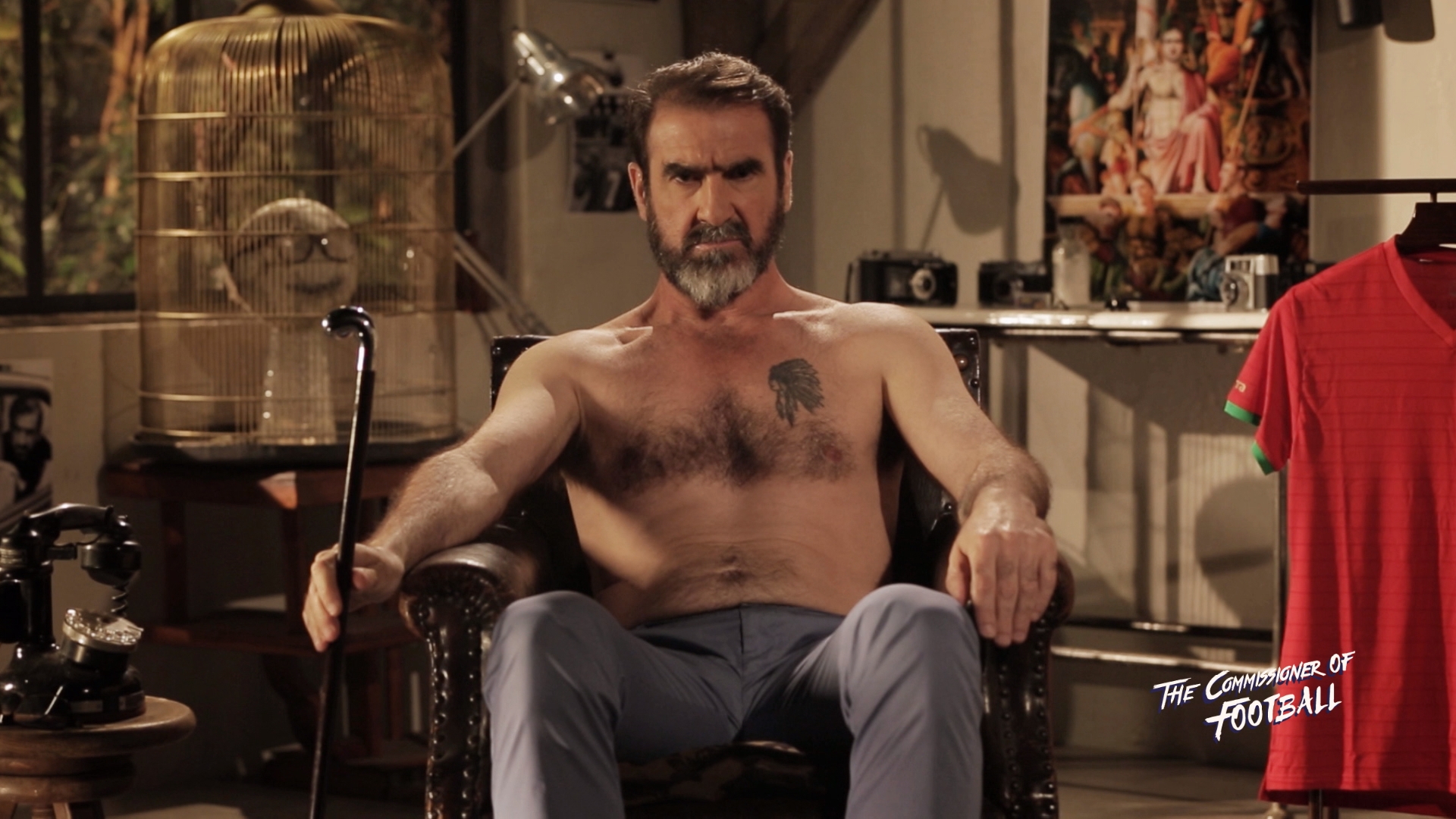
Hutton cites the “Commissioner Cantona” series of videos recently broadcast on Eurosport.com as an intercontinental hit. “The last one got 15m views and it’s only been out there for five days and the number of views is still going up. And the views are everywhere. Once it becomes viral you know that you will just keep growing and growing for a really long time to come.
“And it’s a brilliant learning experience to see that happen. The challenge is how to build it into your normal business and make sure it adds value back to you.”