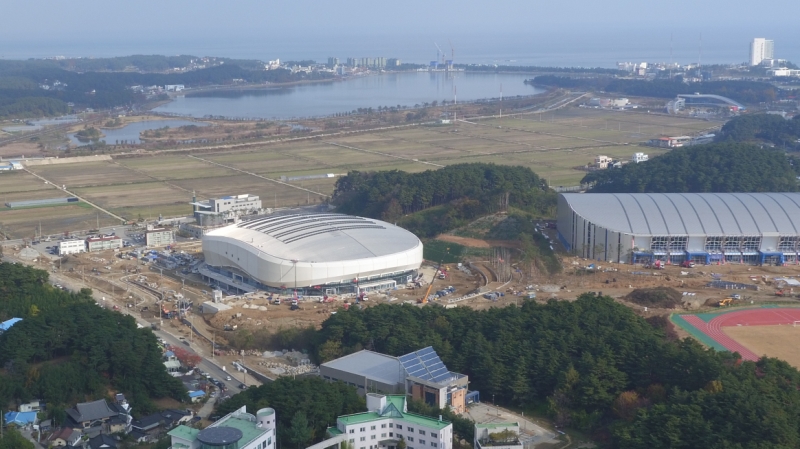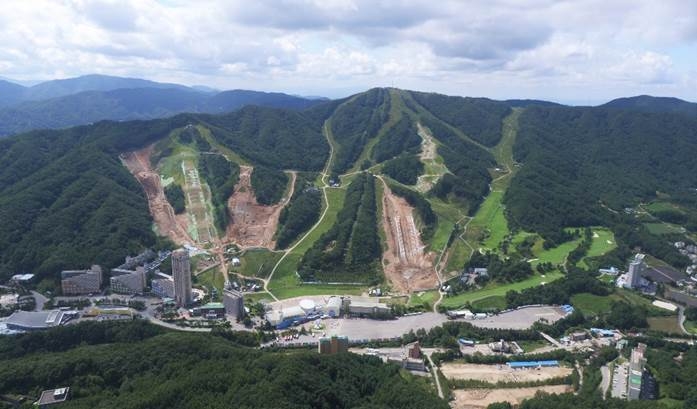
The International Olympic Commission (IOC) Coordination Commission on Thursday completed its third inspection visit of PyeongChang, the host city of the 2018 Winter Olympic Games, concluding that progress was good but that work could not be allowed to slip behind schedule.
The Commission highlighted transport management, accommodation contracting and developing the Mountain Olympic Village as areas where timeframes are particularly “tight” for the PyeongChang Organising Committee of the Olympic Games (POCOG).
Venue construction, test events, marketing and Games services have also been identified as “key areas that require POCOG’s focus over the next six months,” the IOC said in a statement.
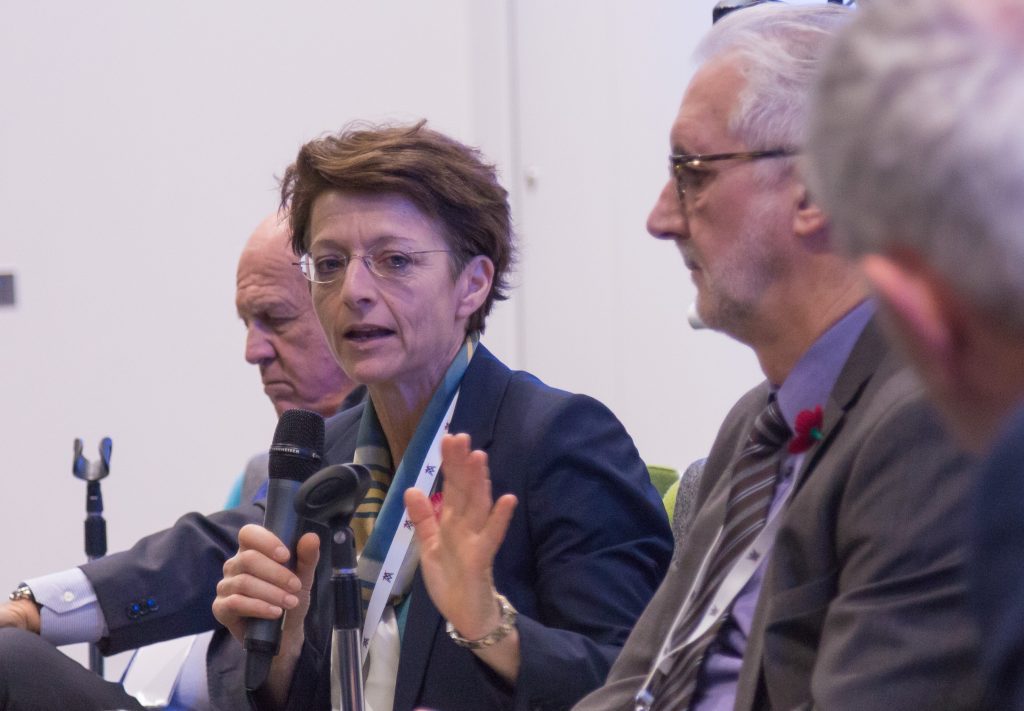
“We were able to see that a large amount has been accomplished by POCOG and its partners since our last visit in June 2013,” said Gunilla Lindberg, chair of the IOC coordination commission. “The 2018 Games are on the right track but it is clear that much work remains.”
POCOG President and CEO Jin-sun Kim said: “The eyes of the world are now on PyeongChang.
“This year is a big turning point for us. We must establish a solid framework. As I always stress, we have no time to practise and no time for trial and error. We will streamline our Master Schedule and set our priorities straight so that everything runs smoothly according to the timeline.”
The IOC said in a statement: “With timelines tight for the completion of accommodation contracting, the development of the Mountain Olympic Village and the transport management plan, the Coordination Commission encouraged POCOG to ensure that the appropriate focus and resources were dedicated to these important areas.”
Construction companies are being appointed for venues and some construction is underway. The commission “underlined the need for timelines to be carefully defined and adhered to, so as to avoid any impacts on test events.”
The IOC will undoubtedly be keen to avoid a situation like Rio 2016’s, where construction is critically behind schedule.
The commission also highlighted the need to prepare for the non-infrastructural aspects of test events, saying “the hiring and training of staff and volunteers should also begin in the near future”.
In the field of marketing, POCOG is in the process of finalising its first domestic partnership contract to build on progress so far.
“The awareness of the PyeongChang 2018 Olympic Winter Games has been strengthened by the success of PyeongChang House in Sochi, and the very innovative Closing Ceremony segment, which presented the 2018 Games to a worldwide audience of millions,” the IOC said. “The Commission encouraged the local organisers to continue to engage and promote their Games at this high level over the next four years both at home and abroad.”
The meetings in PyeongChang were attended by all levels of government. “The participation of the International Federations, the Korean Olympic and Paralympic Committees, and the Korean national winter sports federations was also very beneficial and allowed POCOG to engage in in-depth discussions on all topics related to the venues and sport,” said Lindberg.
“We are confident that POCOG and Korea will deliver great Games for the athletes in 2018.”
In June, PyeongChang will host the official IOC Debriefing of the Sochi 2014 Winter Games. The fourth Coordination Commission visit to PyeongChang will take place at the end of November 2014.
Tag: winter olympic games
-

IOC urges PyeongChang to stick to deadlines
-

Almaty, Beijing or Oslo can profit from 2022 Games
Impressed by their legacy plans, the International Olympic Committee (IOC)’s Executive Board today unanimously agreed to progress applicant cities Almaty, Beijing and Oslo to the candidate city phase as they vie to host the 2022 Winter Olympic Games.
The IOC would have had a larger pool of cities to choose from, had Krakow, Lviv and Stockholm not already pulled out of the race. Despite losing half of the potential bidders along the way, the rights holder of the world’s greatest multi-sports event asserted that candidature was by no means a guarantee for the three remaining contenders.
“Three is a good number to go forward,” said IOC vice president John Coates. “If there was one of those that wasn’t of quality we wouldn’t have sent it forward.”
The decision of the Executive Board was based on a technical analysis of applications submitted earlier in 2014, assessing areas such as venues, transport, accommodation and security.
The IOC noted that all three bids have the potential to benefit the host cities and regions.
“Each city was encouraged to produce a bid best suited to their own unique circumstances, with plans that reflect their own specific vision for how the Games can benefit their cities and regions and ensure positive, sustainable legacies for their populations. Oslo, Almaty and Beijing have done that,” the IOC said in a statement.
The legacy plans differ in focus: Oslo aims to engage young people and the population as a whole in a healthier lifestyle; Almaty plans to use the Games to attract people to the city for future events of all kinds; while Beijing’s plans focus on boosting Winter sports in China.
”It was good to see that each of the bidding cities understood the difference between the Olympic Games budget and the long-term infrastructure and investment budget, which will benefit their communities for decades to come,” said IOC President Thomas Bach.
“The Executive Board is confident that the future hosts of the Olympic Winter Games can break even with the Olympic Games budget – as Vancouver has just announced for the Olympic Winter Games 2010. Or, as in the case of Sochi, make a considerable profit, which they project to be in the range of 200 million dollars.
“This is possible not least because of the extensive financial assistance given by the IOC. In the case of Sochi, this amounted to USD 750 million and it is likely that figure will be even higher for the host of the Olympic Winter Games 2022.”
The three cities must submit their detailed candidature files – or “bid books” – by January 2015, when the IOC will begin the process of evaluating the bids and finally electing the host city at the IOC Session in Kuala Lumpur on 31 July 2015.
To find out more about the bidding process for the Olympic Games and other major events, register to attend HOST CITY: Bid to Win, which takes place in London on 28th October. -

Global survey shows growing appeal of Olympic Games
A survey commissioned by the IOC has found that the awareness and appeal of the Olympic Games and the Olympic Winter Games was higher than any other sports or entertainment events surveyed.
The research, conducted by Kantar Media after Sochi 2014, took on board the views of 36,000 people in 16 countries.
Announcing the results, the IOC said in a statement that Sochi 2014 reached a broadcast audience of 2.1 billion people, up 13 per cent since Vancouver 2010. The individual broadcasters at Sochi totalled 250, more than twice as many than at Vancouver.
The proliferation of digital media has boosted the reach of the Winter Games, with the number of broadcasting hours doubling to 114,000 at 2014 as compared to 2010. Digital video views reached 1.4 billion, up 334 per cent from 2010.
Athletes and spectators surveyed at the Games in Sochi rated their enjoyment of the Games very highly, citing the standard of the sports competition, the quality of the venues and the atmosphere as factors contributing to their enjoyment.
The Olympic symbol remains the most widely recognised of brands surveyed, with 93 per cent of respondents showing awareness. This brand recognition showed little variation across regions, gender and age.
The values that people surveyed associated with the Olympic rings included global, inspirational, friendship, diversity, peace and excellence. In a further boost to brand integrity, the IOC was seen to be strong and strict on doping.
The survey also showed “widespread recognition that hosting an Olympic Games brings benefits to the host country” – a welcome finding as the IOC conducts its Agenda 2020 review into the appeal of the Olympic Games.
-

PyeongChang 2018 appoint former bid leader as permanent chief
Cho Yang-ho, chairman and CEO of South Korean conglomerate Hanjin Group and airline Korean Air, led PyeongChang’s bid for the 2018 Games and will be appointed as chief organiser at a general congress of the organising committee in the coming days.
POCOG appointed their vice-president Kim Jung-haeng as an interim leader following Jin-sun’s unexpected departure but have quickly found a new successor.
Yang-ho is the current president of the Korea Table Tennis Association and vice president of the Asian Table Tennis Union but his appointment has been criticised by some because of his lack of experience in sports administration.
Yang-ho said in a statement: “Now that I’ve agreed to take on the job as the chief organizer, I will dedicate myself to ensure a successful Winter Olympics in PyeongChang, relying on my experience as the top bid official.”
“Many people in and outside Korea recommended that I take this position and I also wanted to keep the promise I’d made with the International Olympic Committee to work for a successful Olympics here.”
Yang-ho will come into the job at a troubled point for the Games with results from an investigation by the South Korean Board of Audit and Inspection into the financing and management of the Games still pending. -

PyeongChang 2018 appoint chief following abrupt resignation
Following the unexpected resignation of PyeongChang 2018 Winter Olympic Organising Committee chief Jin-sun, the committee have appointed one of their six vice-presidents, Jung-haeng, to take charge in the interim. Jung-haeng will be briefed on the progress of the Games preparations on Thursday and will head the organisation until a permanent replacement can be found.
Kim Jin-sun left his post on Monday citing the need for new leadership. It was revealed yesterday that this had followed an investigation by the South Korean Board of Audit and Inspection into the financing and management of the Games, leading to speculation in the South Korean media that Jim-sun’s departure was not voluntary.
Jin-sun resigned in a speech to POCOG, saying: “PyeongChang 2018 is at a turning point for the latter half of its Games preparation, which requires more detailed planning and execution. At this critical juncture, I believe that PyeongChang 2018 needs new leadership and a stronger system that will effectively carry out various Games-related projects. And this is why I decided to resign as President of POCOG.”
Jin-sun was head of PyeongChang’s bidding committee on two failed bids for the 2010 and 2014 Winter Olympics and his position as chief of the 2018 Games was not meant to expire until October 2015
This all follows a troubled few months for the PyeongChang Games which have faced a slew of construction and sponsorship problems as well as the resignation of vice president and secretary general of the organising committee, Moon Dong-hoo, due to health concerns.
In May the IOC urged PyeongChang to focus on venue construction, test events, marketing and Games services due to tight timeframes. Gunilla Lindberg, chair of the IOC coordination commission, said: “The 2018 Games are on the right track but it is clear that much work remains.”
Following the resignation of Kim Jin-sun the IOC released a statement saying: “We have full confidence that these activities will be delivered by the POCOG team in a timely manner and using their existing processes. We continue to work closely with them on their preparations for the Games.”
-

Samsung extends Olympic partnership to 2020
Samsung has been a part of IOC Worldwide TOP Programme since the 1998 Nagano Winter Games and the extension means the South Korean firm will now feature as a supporter of the Rio de Janeiro, PyeongChang and Tokyo Games as well as the Youth Olympic Games through to 2020.
IOC President Thomas Bach said: “We are delighted to be able to continue our partnership with Samsung. The funding generated by the TOP Programme directly supports the staging of every Olympic Games, as well as every one of the National Olympic Committees, enabling athletes from all over the world to prepare for and compete at each Games.
Samsung will be the official Worldwide Olympic Partner in the Wireless Communication Equipment and Computing Equipment category and has previously provided the Olympic Games with its wireless communications platform and mobile phones, most recently at the Sochi 2014 Winter Games.
The expanded product category includes smartphones, tablets, laptops, personal computers and other computing equipment as well as desktop printers.
“Samsung also supports the operations of each Games by providing leading wireless telecommunications and technology equipment,” said Bach. “In addition, Samsung’s technologies and global marketing reach will engage fans around the world with the Olympic values and the Olympic Movement.”
Samsung said in a statement: “As mobile technologies have become an inseparable part of our daily lives, Samsung believes its continued support will play a significant role in bringing further innovation to the staging of the Olympic Games.”
The new deal means all of the existing Olympic TOP partners have committed to the programme through to 2020. Other companies to sign up to the IOC’s Worldwide TOP Programme include Coca-Cola, Atos and Panasonic who have similar deals, with each covering their own area of expertise.
-

2022 Olympic bids shock is a one-off
The drop-out of several European cities bidding for the 2022 Olympic Games has created “shockwaves”, but IOC reforms and stronger communication from cities will enable them build the public support needed to bid for future Games.
This is the view of Mike Lee, chairman of Vero, who led on the communications strategies for Rio 2016 and London 2012.
“The race for 2022 has sent a few shockwaves around the Olympic movement, so it’s good that the IOC have already been thinking about this for a while under President Bach,” Lee told HOST CITY.
A lack of public support led the European cities of Stockholm, Munich, Krakow and Oslo to withdraw from bidding for the 2022 Winter Games. The perceived cost of hosting, at a time when Sochi was investing billions in hosting the 2014 Winter Games, was a major factor in suppressing public appetite for hosting the Games.
The Olympic Agenda 2020 reforms set in motion by IOC president Thomas Bach are addressing this issue in a number of ways. “A number of the reforms that are being proposed for the bidding process and the way that cities engage with the IOC are all good news,” said Lee.
One important recommendation is the possibility of regional bids, which would allow existing venues in different cities to feature in bids. “There’s definitely going to be a lot more dialogue and flexibility – tailoring, if you wish, the way in which a bid is constructed.”
While these changes from the rights holder are clearly a positive step, city governors will also have a major role to play in building public support for bids.
“You will still need to have support from the relevant levels of government. The lessons from all the recent cycle of bidding is that that remains central. The way you have democratic scrutiny and, in some cases, all the requirements of a referendum – it’s a reminder that you need to build public support.”
The two cities left in the race for 2022 – Beijing and Almaty – do not have a tradition of public referendums. Some observers fear that democratic nations might remain disadvantaged in future bidding cycles.
“This issue of public opinion and political support go hand in hand and you’ve got to pay a lot of attention to it. It’s clearly solvable; otherwise you’d never see bids emerging from democratic countries.”
The timing of polls needs to be considered carefully. “Ideally you want to be able to test public opinion after you’ve had some sort of campaign, because if you have a cold test, don’t be surprised if you have a negative result.
“The London bid would be a very good example. If were depending on the poll in the early days of the London bid, London would never have progressed. It took some time to build the campaign and in the end the polling figures for London were very good, and the national joy came with London winning in Singapore.”
Warning Signals
Rights holders of major events can expect to see a larger number of applicant cities emerging from this bearish period. “It would be wrong to judge the state of the appetite for major events just from the Olympic bidding process for 2022,” says Lee.
“Most mega events do have multiple bidders – people can’t be looking at the willingness of cities to host purely through the prism of the 2022 Winter Games race, because that is a bit of a one-off. But it’s sent off some warning signals and Agenda 2020, from an Olympic perspective, is all a part of responding to that.”
-

IOC: Agenda 2020 reforms apply to Almaty and Beijing
The two candidate cities for the 2022 Winter Olympic Games submitted their candidature files to the International Olympic Committee in Lausanne on Tuesday.
Both candidates, Almaty and Beijing, highlighted how they amended their bids to take into account the Agenda 2020 reforms approved by the IOC in December, with IOC president Thomas Bach confirming the IOC will work with the candidates to apply the reforms.
“Working with the two Candidate Cities, we will apply the first reforms which have been approved by the IOC members very recently in Monaco as part of our Olympic Agenda 2020 roadmap,” said IOC president Bach on Tuesday,
“This will be done through ongoing consultation with the Candidate Cities.”
Developed over the course of 2014, when several European cities pulled out of bidding for the 2022 Winter Games, Agenda 2020 introduces a number of changes to make bidding for and hosting the Games more sustainable, affordable and beneficial for cities.
Almaty and Beijing have retrospectively adjusted their bids to incorporate some of the IOC’s recommendations and reforms.
“Many recommendations of Agenda 2020 were taken into consideration while developing the concept of the 2022 Winter Games,” said Mrs Zauresh Amanzholova, vice mayor of Almaty City.
“We believe our bid is a perfect fit with this new philosophy and brings essential benefits to the Almaty and Kazakhstani people.
“Almaty 2022 can be a catalyst for social, economic and sports growth in the region where winter sports facilities are badly needed.”
Janez Kocijan?i?, vice president of the International Ski Federation was in Monaco for the approval of Agenda 2020. He told HOST CITY “Almaty plan to build their winter sport capacity,” but could not reveal details of the scope or potential cost of the work.
Agenda 2020 promotes the use of existing and temporary infrastructure to reduce infrastructure costs for bidding cities. While both bids require significant infrastructure development, Almaty would need to invest more than Beijing, which incorporates the more developed resort of nearby Zhangjiakou into its candidature.
“Our Candidature File embodies the requirements of the IOC and the philosophy of Olympic Agenda 2020,” said Mr Wang Anshun, president of the Beijing 2022 Olympic Winter Games Bid Committee and mayor of Beijing.
“The important concept of running athlete-centred, economical and sustainable Games will be represented well in our bid and actual organisation of the Games in 2022.”
The successful candidate will receive an estimated US$880m contribution from the IOC, derived from marketing and broadcasting revenues as well as “assistance provided to the Organising Committee by the IOC and related entities”.
For the first time, the Host City Contract will be made public, as recommended by Agenda 2020. The host city will also be bound to the new principle of non-discrimination on sexual orientation.
Kocijan?i? also made comments to HOST CITY that could be interpreted to support the view that Beijing represents the richest potential for the development of winter sports in Asia.
“Europe is where skiing and most winter sports were born and have their home, but regarding the development of the sport it would be very wise to go east.
“Because there are tremendous changes in the modern world – the countries are changing, the social structure, there are more and more people who can afford skiing.”
Asked which country represents the biggest market, he said “Everybody knows China is China… and Kazakhstan is Kazakhstan.”
René Fasel, IOC member and president of the International Ice Hockey Federation went further still, breaking IOC rules by telling local press during a junior championship event in Toronto, “This is a fact, China is a favourite.”
Anything can happen in a bid campaign however and the coming months will be critical for both candidates.
The evaluation commission will inspect Almaty’s sites from 14 to 18 February and Beijing’s from 24 to 28 March and publish their report on www.olympic.org before the briefing for IOC members that will take place from 9 to 10 2015.
The appointment of Russian IOC member Alexander Zhukov as chair of the evaluation commission is interesting, as his country neighbours and has strong ties with both China and Kazakhstan – potentially reducing the cost of the evaluation process without compromising objectivity.
The host city for the 2022 Olympic Winter Games will be elected at the 128th IOC Session in Kuala Lumpur following a final presentation by the cities to the full IOC membership on 31 July.
The IOC has informed candidate cities that they can make their candidature files public, and the candidates will inform HOST CITY if and when this happens.
-

IOC praises Lillehammer 2016’s young team with one year to go
As Lillehammer celebrated one year to go until the Winter Youth Olympic Games (YOG), its young organisers were praised by the event’s owner and custodian, the International Olympic Committee.
Celebrations began in Lillehammer on Wednesday night with His Royal Highness Crown Prince Haakon of Norway unveiling an OMEGA countdown clock showing 365 days to go.
Speaking at the ceremony, IOC vice president Nawal El Moutawakel said: “This is truly a Games by young people for young people and a big thank-you goes to the tremendous efforts of the young and talented local Organising Committee.”
Lillehammer 2016 CEO Tomas Holmestad said: “Every one of the next 365 days now counts to making Lillehammer 2016 a huge success. We have an amazing team of young, talented staff and I know we will deliver a unique Winter Youth Olympic Games.”
The festivities will continue for several days in Lillehammer, Hamar and Gjøvik, with cultural spectacles, a YOG-themed ice hockey match and the “Sjogg Film Festival” in the centre of the city.
Sjogg, the Norwegian word for snow, is also the name of the Lillehammer 2016 mascot.
During the Games, Lillehammer, Hamar and Gjøvik will also host “learn and share” activities, which the IOC says is designed to provide guidance on Olympic values, the benefits of leading a healthy lifestyle and “how to be true champions on and off the field of play”.
During the unveiling of the clock, the Crown Prince and El Moutawakel were joined by Angela Ruggiero, Chair of the IOC coordination commission and Norwegian Minister for Culture Thorhild Widvey.
Earlier in the day, El Moutawakel and Ruggiero took part in activities including a school sports day and a session on the ice, where Olympic ice hockey champion Ruggiero provided a coaching session to local youngsters.
Lillehammer hosted the Winter Olympic Games in 1994.
“We have an Olympic Games legacy under our belts, and now we will create the legacy of Lillehammer 2016,” said Holmestad.
Lillehammer 2016, the second Winter Youth Olympic Games, will take place from 12 to 21 February 2016, featuring more than 1,000 top athletes between the ages of 15 and 18 from over 70 countries.
The athletes will compete in the same seven sports as those on the Olympic programme, plus some new additions such as Monobob, snowboard cross and cross-country cross as well as mixed-gender and mixed-National Olympic Committee competitions.
“With its exciting sports and unique spirit, this will certainly be a wonderful and unforgettable YOG,” said El Moutawakel.
-

Beijing 2022 points to US$858m Games revenues
Beijing 2022 is anticipating at least US$858m of revenues as it seeks to host the Winter Olympic Games, the bid committee told IOC evaluation commission members on the final day of presentations.
China’s economic growth is continuing to lead the world and the country is prioritising the development of sports, leisure and tourism, the bid committee said.
China has set a target for its sports industry to grow to 800 billion USD by 2025 through promoting sports businesses, developing sport facilities and opening up the market to consumer products and services.
By 2022, the bid committee anticipates that the combined sports, culture, tourism, leisure, conferences and exhibitions industries will amount to about 20 per cent of GDP of the Beijing-Zhangjiakou region, which is being developed as a “Sport, Culture and Tourism Belt”.
US$660m of organising committee revenues would be raised through sponsorship.
Beijing 2022 has already secured eight sponsors, including: Tencent Group, fourth largest Internet company in the world, Snow Beer, the world’s bestselling beer brand, PricewaterhouseCoopers, the world’s largest professional service network, Beijing Bank, Beijing Automotive Group, Anta Sports, True Colour Stationary and Sandaogu Travel Company.
The remaining revenue would be raised through the licensing and ticketing programmes.
Beijing 2022 is optimistic about ticketing sales, partly because the Games will coincide with the Chinese New Year festival and school holidays.
The bid committee includes Olympic marketing experts who worked on Beijing 2008.
“We guarantee that Beijing 2022 will meet the revenue targets, secure the best returns for the IOC TOP partners, as well as national partners, ensure full stadia with amazing atmosphere, in strict respect to all the IOC’s and IPC’s marketing rules,” said Mr. Chen Feng, former deputy director of marketing of the Beijing 2008 Olympic Games.
In its bid to host the 2022 Games, Beijing is competing against the Kazakh city of Almaty, which the IOC evaluation commission visited in February and where sponsorship and marketing are newer concepts.
“The sponsorship landscape is evolving, and Almaty 2022 would help speed up this evolution,” said Alimzhan Akayev, marketing advisor to Almaty 2022 and marketing director of the Combat and Strength Sports Confederation of Kazakhstan.
“Almaty 2022, and the National Olympic Committee of Kazakhstan have agreed on a Joint Marketing Programme in order to optimise and protect the revenue-generating ability of the OCOG. All required guarantees were provided”.