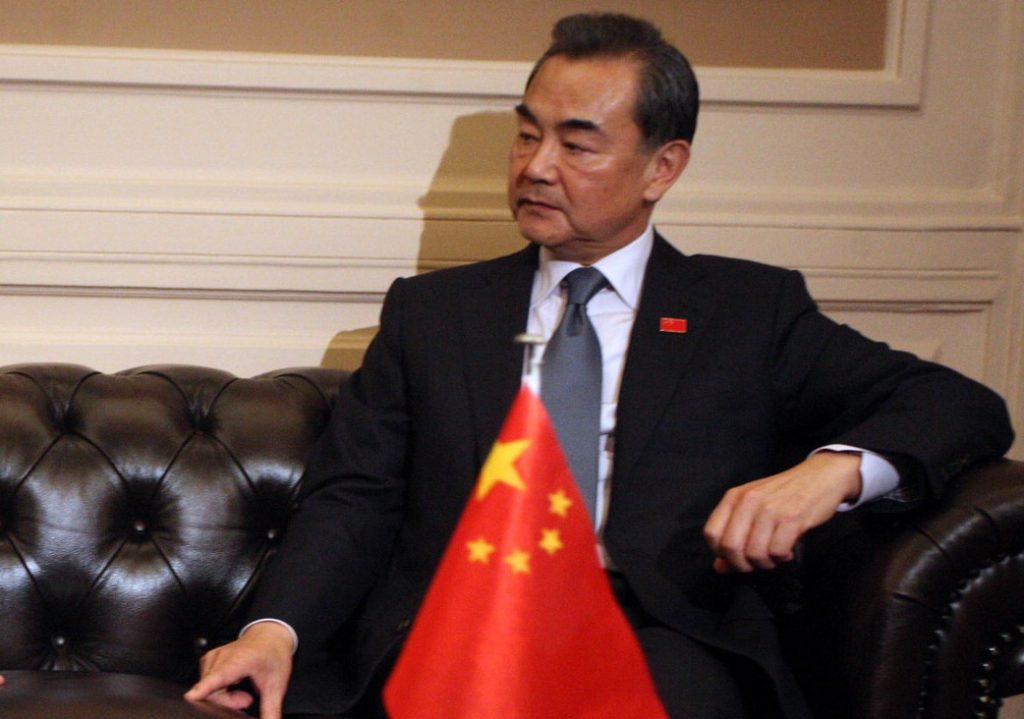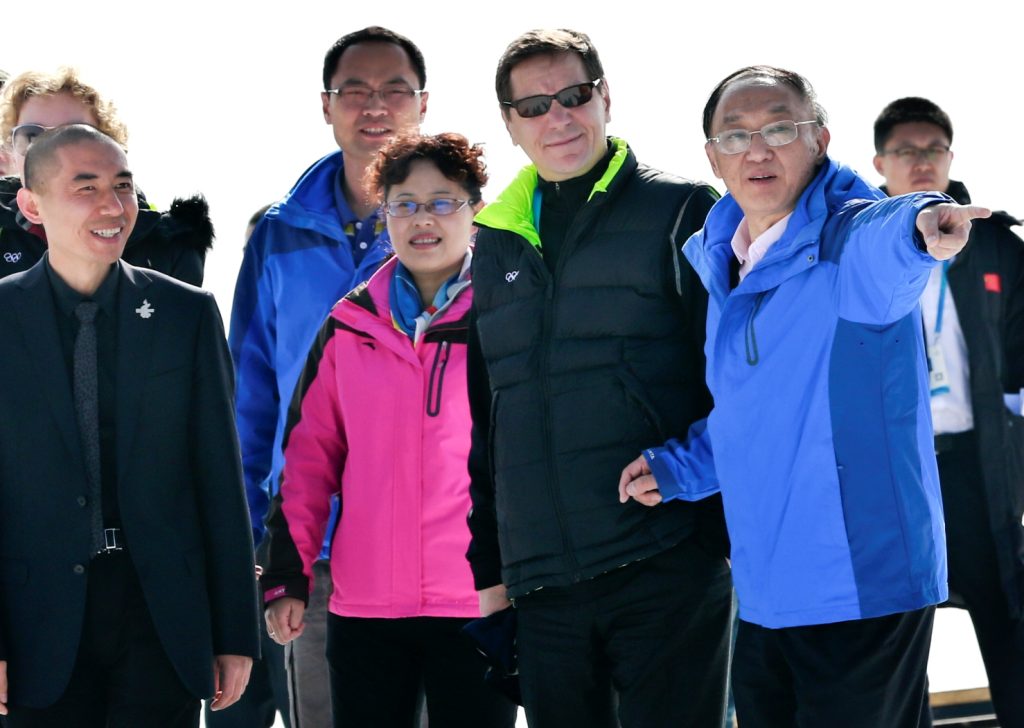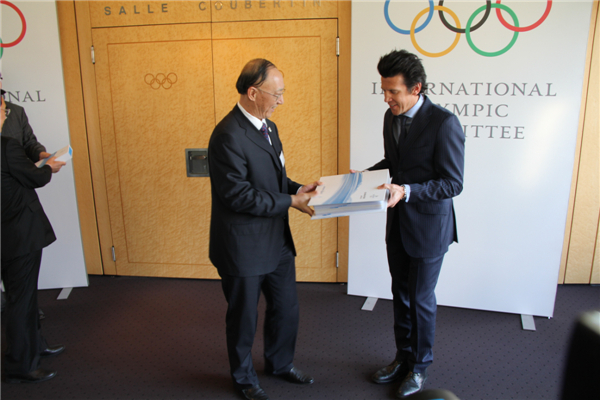
On a diplomatic trip to Switzerland, China’s foreign minister Wang Yi met with IOC president Thomas Bach on Monday and underlined the government’s commitment to the Winter Olympic Games in 2022.
Joined by IOC vice-president Yu Zaiqing, president Bach praised the China’s development of sport in and its leadership on the role of sport in development internationally.
“China has a real vision about the importance of sport for education, for social cohesion and for international representation,” said Bach.
“I would like to thank again President Xi for not only promoting the role of sport in China but also for supporting the mention of sport within the sustainable development goals (SDGs) of the United Nations.”
The UN Member States are expected to use the SDGs as goals and targets to frame their agendas and political policies over the next 15 years.
Bach also praised the “outstanding development of sport” in China under the leadership of president Xi Jinping.
The meeting took place in the Olympic Museum in Lausanne, shortly after the IOC Evaluation Commission’s inspection of Beijing’s bid to host the 2022 Winter Olympic Games.
Wang reiterated that the Chinese government is fully supportive of the bid, assuring the IOC that all commitments made during the bidding phase would be implemented.
He was in Lausanne for negotiations on Iran’s nuclear programme, along with Sergey Lavrov, Russia’s minister of foreign affairs, with whom Bach discussed Russia’s contribution to the UN SDGs and his upcoming visit to Sochi at the end of April.
Bach also met with Germany’s foreign minister, Dr Frank-Walter Steinmeier and discussed the bidding procedure for the 2024 Olympic Games.
Tag: winter olympic games
-

IOC president talks with China’s foreign minister
-

Samsung throws US$92m lifeline to PyeongChang 2018
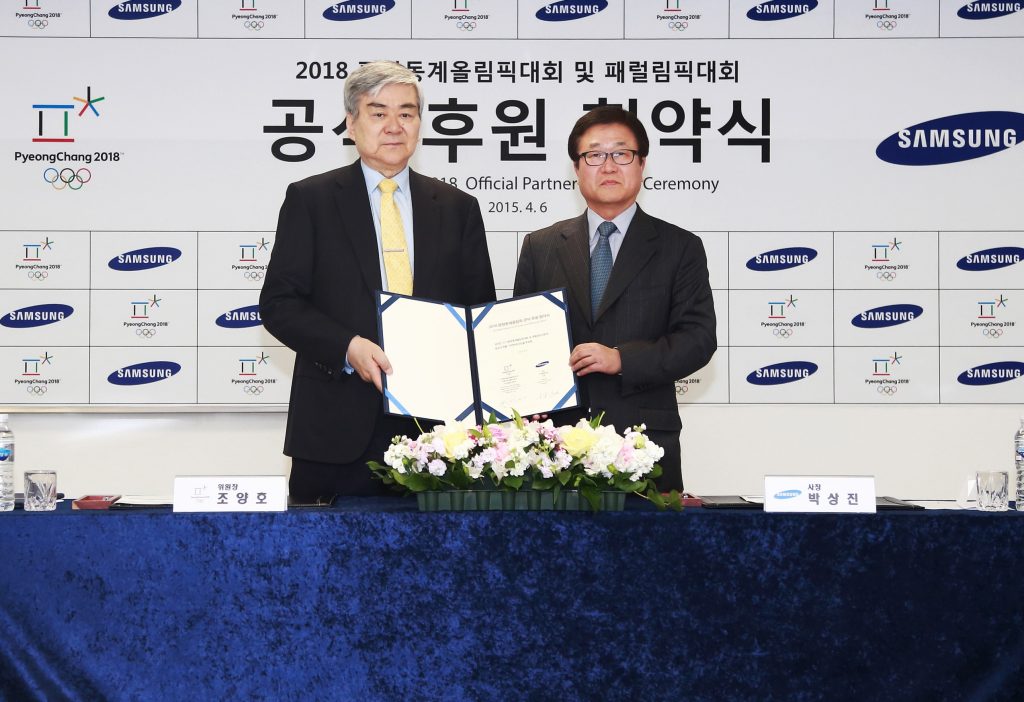
Samsung Group on Monday signed as domestic sponsor of the PyeongChang 2018 Olympic Winter Games.
Samsung will support the PyeongChang Organizing Committee for the 2018 Olympic and Paralympic Winter Games (POCOG) with a sponsor package valued at KRW 100 bn (USD 92m) to become a domestic partner working in various business areas across the Samsung group.
The domestic sponsorship is in addition to the Worldwide TOP Partnership with the IOC, which Samsung recently renewed until 2020 and which includes the provision of wireless communications equipment, tablet PC, notebook computer and desktop PCs.
“We are happy to have Samsung support in addition to the TOP partner agreement with POCOG,” Cho Yang-ho, president of POCOG said. “We are confident that this sponsorship agreement will encourage other Korean companies to join as sponsors for the PyeongChang 2018 Olympic and Paralympic Winter Games.”
POCOG has also signed domestic sponsors agreements with Samsung Group, Korean Air, KT, Youngone Outdoor (The NORTH FACE Brand), Pagoda Education Group and Samil PricewaterhouseCoopers, but has so far only achieved 41 per cent of its sponsorship target.
According to AFP, POCOG anticipates reaching 70 per cent of its sponsorship target by the end of 2015.
“Samsung Group is thrilled that Korea has won the right to host the Olympic Winter Games. The Corporation demonstrates its support by extending the domestic marketing rights for PyeongChang 2018 that are already in place through the TOP (The Olympic Partner) contract with the IOC,” said Park Sangjin, president of corporate relations at Samsung.
“Indeed, Samsung has made a meaningful decision to provide additional support for the PyeongChang 2018 organizing committee to contribute to the successful Olympic Winter Games. This sponsorship agreement furthers our efforts to commit to social responsibility as a corporate representative of Korea.” -

Beijing promises economical 2022 Games
The Beijing 2022 bid committee has promised to keep costs down on being elected as the host city of the 2022 Winter Olympic and Paralympic Games at the 128th IOC session in Kuala Lumpur on Friday, with the International Olympic Committee citing manageable infrastructure costs as a key factor in the success of the bid.
“Just as with the Beijing 2008 Summer Games, the Olympic Family has put its faith in Beijing again to deliver the athlete-centred, sustainable and economical Games we have promised,” the newly elected host of the 2022 Olympic Games said in a statement issued to the press.
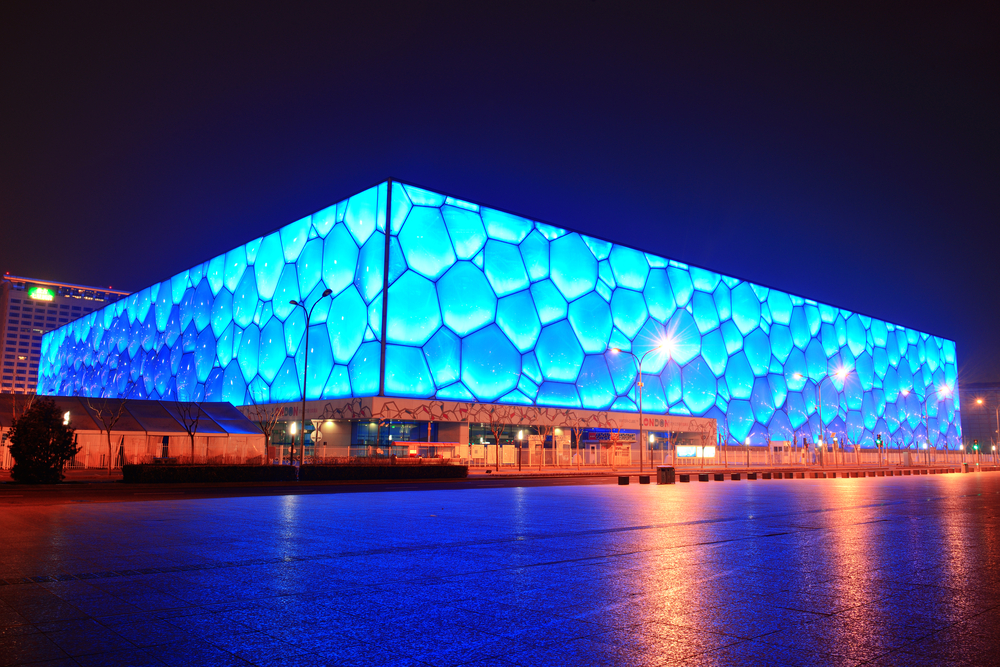
Existing venues, such as the iconic Bird’s Nest stadium built for the Games in 2008, will feature in the Games. US$1.5bn will be spent on Olympic villages, sports venues and other infrastructure, a sum that is “significantly less than for Olympic Games in the past”, according to the IOC.
“Olympic Agenda 2020 calls for a stronger focus on sustainability, legacy, and transparency, while making it easier for host cities to tailor Games that meet their needs rather than trying to fit a template,” the IOC said in a statement issued after the election.
“Beijing took advantage of the flexibility provided by Olympic Agenda 2020 to improve its plans for the Games and reduce costs.”
Despite being widely viewed as the runaway favourite, Beijing won the vote narrowly with just 44 to Almaty’s 40. Only 84 of the 100 International Olympic Committee members participated in a vote that had to be recast after technical difficulties.
The Beijing 2022 Winter Games will immediately follow the 2018 edition in PyeongChang, South Korea. Developing winter sports further in the Asian market promises to be a valuable effect of hosting the Games in Beijing.
“Beijing aims to use the Games to accelerate the development of a new sport, culture and tourism area, and to encourage interest in winter sports in a region that is home to more than 300 million people in northern China,” the IOC said.
The Beijing 2022 bid committee said “This will be a memorable event at the foot of the Great Wall for the whole Olympic Family, the athletes and the spectators that will further enhance the tremendous potential to grow winter sports in our country, in Asia and around the world.”
Beijing will be the first city to host both a summer and winter edition of the Olympic Games – facilitated in part by hosting many skiing events at Zhangjiakou, 220km away from Beijing. Artificial snow is also likely to play a role in enabling the competitions to take place.
The host city contract signed by Beijing representatives and IOC president Thomas Bach has been made public for the first time.
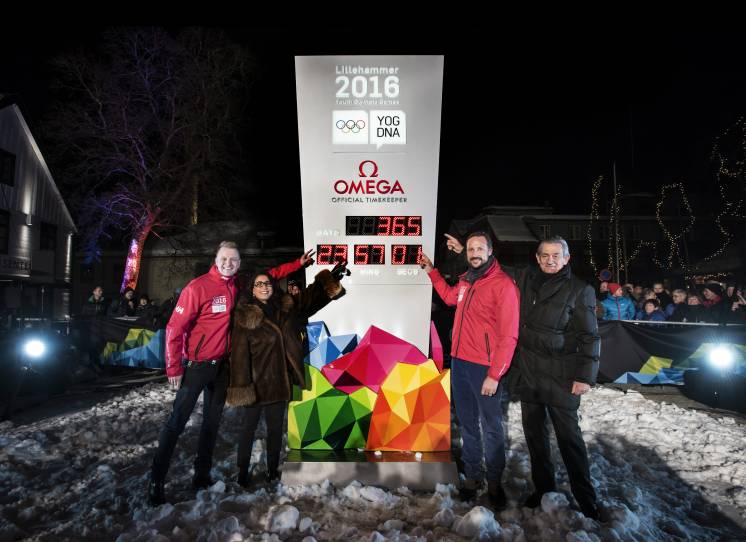
Meanwhile, the “Olympic capital” city of Lausanne was elected as the host of the 2020 Winter Youth Olympic Games at the IOC Session, garnering 71 votes to Brasov’s 10.
The IOC Evaluation Commission singled out Lausanne for its good use of existing, temporary and demountable venues, which is in line with Olympic Agenda 2020 sustainability reforms.
-

Atos delivers IT infrastructure for PyeongChang 2018
Atos, the Worldwide IT Partner for the Olympic Games, announced on Wednesday that it has delivered the cloud IT infrastructure that will be used for the Pyeongchang 2018 Winter Olympic Games.
The system represents a significant step forward in the digitisation of the Olympic Games as it extends the use of cloud to most applications.
“The delivery of the secure cloud, IT infrastructure to support all Olympic Games from 2018 is a major milestone in our digital transformation,” said Jean-Benoît Gauthier, Technology Director at the International Olympic Committee (IOC).
“Cloud is a perfect fit for the Olympic Games and we are delighted to be working with our long-term Worldwide IT Partner on this important project that will benefit all those who participate in the Games – media, athletes and spectators.”
The new secure cloud IT infrastructure, powered by Atos’ strategic partner EMC, will be used to test and run IT applications used to distribute results to the media worldwide.
The solution will also support the core planning systems used to recruit volunteers, support workforce management, manage the competition schedule and process accreditations for athletes, media and the wider Olympic Family.
The converged infrastructure solution, which uses Atos’ Canopy Enterprise Private Cloud and VCE’s Vblock System, can support other businesses on their journey to cloud.
The system will be first to test the competition schedule and the workforce management systems that will be used by the Pyeongchang 2018 Organising Committee from the end of 2015.
The capacity of the cloud solution can be increased and decreased according to the demands of the different stages of event delivery.
In September 2015, cloud capacity will increase to perform technical testing proving the solution can support the expected demand through the project, and then decrease to support the limited production needs at the early stages of the project.
Around two years before the Games, capacity and bandwidth will be increased again to cover the high level of demand for thousands of volunteer requests as the volunteer portal goes operational.
“The move to the cloud brings many benefits for the Olympic Games. It takes away the need to rebuild an entire infrastructure for each of the Games, which is both timely and costly,” said Patrick Adiba, group chief commercial officer, CEO of major events at Atos.
“It also helps the IT team to react faster and to anticipate new needs and perhaps most importantly, it provides flexibility. As the Olympics does not need to operate at full capacity all the time, a cloud infrastructure will enable computing power to be scaled up and down to meet demand and ensure the best experience for users.”
-

PyeongChang progress hailed as ski events approach
As IOC’s Coordination Commission for the PyeongChang 2018 Winter Olympic Games concluded on Thursday, the International Ski Federation (FIS) secretary general Sarah Lewis told HOST CITY that progress is impressive, expressing confidence that venues will be ready in time for test events in 2016.
“The Alpine Skiing downhill course at Jeongsong and Freestyle and Snowboard cross and slopestyle courses are really starting to taking shape now and the progress with their construction over the past three months is impressive,” Sarah Lewis, FIS Secretary General told HOST CITY, speaking from PyeongChang.
“We’re confident that the FIS World Cup competitions in February 2016 will prove to be an important milestone in the preparations for the Games and generate true excitement in PyeongChang and Korea when the world’s best athletes are competing.”
Sarah Lewis, who is also Secretary General of the Association of Winter Olympic International Federations, is to speak at HOST CITY 2015 on “The Changing Face of Sports Organisations”.
The IOC’s Coordination Commission Chair Gunilla Lindberg also hailed the good progress.
“The preparations for the Olympic Winter Games PyeongChang 2018 are developing well. Support from all the local partners continues to be strong, with the national and regional governments both present during our meetings. We were also delighted to have with us representatives of the seven International Federations on the 2018 programme, who brought their sport-specific expertise to the discussions.
“This was helpful for PyeongChang 2018, as it has now entered the delivery phase of preparations and is working on the detailed services for the athletes and technicians. This will be particularly important for the first sports events early next year, which include important dates on the international calendar, namely an FIS Alpine World Cup, an FIS Freestyle Skiing and Snowboard World Cup, and an IBSF/FIL pre-homologation event.”
She also stressed that PyeongChang 2018 Organising Committee (POCOG) must maintain its good progress as these test events loom.
“The venues continue to progress rapidly. We visited Jeongseon and the Alpensia Sliding Centre, and got a really good impression of what the athletes will experience come Games time. I am confident that they will be very pleased.
“The competition sites remain on schedule for the Games, but the organisers need to maintain their focus, as some delivery dates are very close to the start of the test events. It is important that PyeongChang 2018 delivers these events successfully and, in particular, the first events next February, in order to create a solid basis for its planning and preparations for the Games.
“This will also be a great opportunity for Koreans to experience elite winter sport and get engaged in the Games, as some of the world’s best athletes in those sports will be present in order to get a feeling for the 2018 Olympic venues.”
The next IOC Coordination Commission visit will be in March 2016.
PyeongChang 2018 Organising Committee President Yang-ho Cho said, “It has been a very productive three days. I feel that we are moving in the right direction to stage great Olympic and Paralympic Games.
“With the feedback and support of the Coordination Commission, we have made a number of important and critical decisions. As we move further ahead into the operational phase of the Games, I would like to thank the national and International Federations for their guidance and support. Their expertise and Games experience have been instrumental to guiding POCOG.”
-

Beijing 2022 organising committee reviews bid pledges
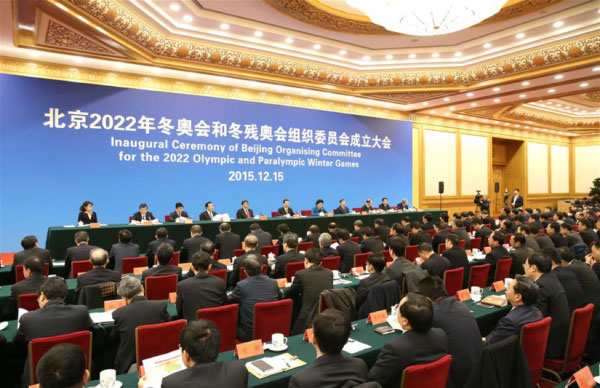
The organising committee for the 2022 Winter Olympic Games has been established five months after the election of Beijing as host city, with Guo Jinlong confirmed as president of the newly formed body.
During the 2008 Olympic Games, Guo was mayor of Beijing and executive chairman of the organising committee.
Guo said the first duty would be to review Beijing’s host city contract in light of the IOC’s Olympic Agenda 2020.
“We will pore over the HCC and the Olympic Agenda 2020, and review our bid commitments before we work out the roadmap and timetable,” Guo was reported as saying by Xinhua News Agency.
“We shall ensure every task is accomplished.”
The organising committee, created by the city and the National Olympic Committee, will be responsible for ensuring the Games are organised successfully. Its establishment follows an Orientation Seminar that was held in early November in Beijing.
Guo’s appointment was welcomed by IOC president Thomas Bach.
“On behalf of the International Olympic Committee, it is my great pleasure to congratulate everyone on the inauguration of the Organising Committee for the Olympic Winter Games Beijing 2022,” he said.
“Allow me to congratulate Mr Guo Jinlong, the President of the Organising Committee.
“Beijing is making history as the first city in the world to host both the Olympic Summer Games and the Olympic Winter Games.”
Reducing the cost and increasing the sustainability of hosting the Games is a key aim of Agenda 2020.
Using infrastructure from the 2008 Olympic Games will help Beijing to keep costs down, with a projected budget of US$1.5bn.
“The formation of the Organising Committee represents the start of an exciting journey for the entire Olympic family,” said Bach.
“This milestone is the first step on our six-year journey together to deliver brilliant Olympic Winter Games in 2022 for Beijing, for China, and for the world.”
Beijing was selected as host of the 2022 ahead of Almaty, the only other city that progressed to the candidature stage.
The host faces challenges in managing air pollution in the city and ensuring there is enough snow in the mountain resort of Zhangjiakou.
According to Xinhua, Chinese President Xi Jinping has asked the organizers to “work harder to host a fantastic, extraordinary and excellent Games”, saying city management, environmental protection, budgetary control and the appeal of winter sports in China will all need to be heightened.
A number of Chinese dignitaries atteneded the launch of the organising committee, including Chinese Vice-Premier Zhang Gaoli, Beijing 2022 President Guo Jinlong, Chinese Olympic Committee President Liu Peng, Chinese Vice-Premier Liu Yandong, Beijing Mayor Wang Anshun and Hebei Governor Zhang Qingwei. -

IOC “well pleased” with PyeongChang 2018 progress
[Source: IOC] The International Olympic Committee (IOC)’s Coordination Commission for the Olympic Winter Games PyeongChang 2018 wrapped up its seventh visit well pleased with the progress of venue construction.
The Commission, led by IOC member Gunilla Lindberg, assessed every aspect of Games preparations during three days of venue visits and collaborative discussions with the PyeongChang 2018 Organising Committee.
The Games organisers reported that, on average, the new venues in PyeongChang and nearby Gangneung are 90 per cent complete in advance of 26 test events scheduled between this November and April 2017. PyeongChang will host the mountain events; Gangneung will host the ice sports.
“We saw first hand the progress of the construction projects,” Chair Lindberg said at a closing news conference with PyeongChang 2018 President Hee-beom Lee on Friday. “There is no doubt that the venues will be ready for the upcoming test events.”
President Lee also expressed satisfaction with the visit, calling it “a productive three days”.
He added: “With the Rio Games now behind us, it is time for PyeongChang. Based on thorough preparation, we will strive to provide the best of service to all participants and realise our goal of making the PyeongChang 2018 Games Cultural Olympics, Environmental Olympics, Olympics for Peace and Economic Olympics, and pleasantly surprise the world with our performance.”
President Lee also announced that PyeongChang 2018 will launch ticket sales in conjunction with the one-year-to-go milestone celebration in February 2017.
Representatives from all seven winter International Federations (IFs) joined the discussions in PyeongChang, which focused on 10 areas: test events, sport, venues, legacy, Games services, full stadiums, finance, accessibility, governance, and communications and engagement. The Commission and POCOG held two plenary sessions and a series of side meetings devoted to specific topics, such as athletes and National Olympic Committees; sport and IFs; and spectators.
The IFs were particularly focused on preparations for test events involving their sports. The first test event, scheduled for 23-26 November, will be the FIS Snowboard Big Air World Cup. Snowboard Big Air will make its Olympic debut at PyeongChang 2018.
“PyeongChang 2018 is entering the last stages of preparations,” Chair Lindberg said in her closing remarks. “My colleagues and I leave here more confident than ever that PyeongChang 2018 will deliver great Games.”
Source: IOC -

“Host City provides a great platform” – Sarah Lewis, FIS
Host City 2016 conference and exhibition takes place in Glasgow on the 21 and 22nd November 2016, drawing together the owners, organisers, hosts and enablers of sports, business and cultural events.
Sarah Lewis, Secretary General of FIS and the Association of Winter Olympic International Federations, is speaking at the conference, the theme of which is “Creating Safe and Engaging Events”.
In this exclusive interview, she talks about how Host City can help to create safe and engaging event experiences in a competitive world.
Host City: What do you see as the most important issues facing the events industry today and why?
Sarah Lewis: Guaranteeing a safe event is becoming increasingly complex and yet something every organiser must ensure, regardless of the costs and logistics.
The market has become so competitive to gain media attention and fan support with such a wide array of different events on offer for consumers to choose from.
As far as our FIS sport of Alpine and Cross-Country Skiing, Ski Jumping, Nordic Combined, Freestyle Ski and Snowboard are concerned, today it is not enough for the organisers to simply stage a competition to attract visitors and fans, there must be a complete experience and this is also an excellent opportunity for sponsor engagement.
How do you think public perception of Winter Olympic Games changed since Sochi 2014 and what are your expectations of the future for the Games?
Leading into the Sochi 2014 Games many of the headlines concerned the huge expenditure that was made for construction, but the reality is that this investment was related to building logistical infrastructure for developing tourism in the area including the roads, railway and airport as well as three ski areas and many hotels.
Recently the image of Sochi 2014 suffered another blow with revelations and allegations about corruption and doping that have further damaged the perception of these Games. But the extraordinary performances of the athletes captured the public’s imagination and hearts which is the fundamental mission of the Games.
The IOC has taken many steps to address the future of the Games in a proactive manner through measures adopted in Agenda 2020 and specifically for the Winter Edition through an expert working group that has looked into adapting the model to make them more accessible for more candidates. Looking at the number of countries that are presently studying potential bids for 2026, the new model appears to be making steps in achieving this objective.
What has been the highlight of 2016 for you so far in the event hosting world?
The two major events with the Rio 2016 Olympic Games and European Football Championships have had the biggest global impact and produced many memorable sporting accomplishments.
In the winter sport world, back in February the Winter Youth Olympic Games was on a different scale, but it successfully engaged youngsters and uncovered some future champions.
The ski and snowsport world is just gearing up for the main winter season and we have many highlights ahead, led by our FIS World Championships in Alpine Skiing (St. Moritz – Switzerland), Nordic Events (Lahti – Finland), Freestyle Ski and Snowboarding (Sierra Nevada – Spain).
Before these begin in early February, the FIS World Cups will be in full swing, including Olympic Test Events in PyeongChang, Korea as part of the tours.
As a speaker at Host City 2016, what are your expectations of this important event – what do you hope to share and learn?
Host City provides a great platform to communicate and promote our sports and events to a knowledgeable audience, and also gain valuable information from other important events. It is particularly interesting to encounter new and different events, who we are not generally meeting up with in the Olympic Movement.
Why is it important for cities, rights holders and their partners to have the opportunity to connect at Host City 2016?
Host City offers a convergence of the various stakeholders involved in staging events and it is always helpful to learn of the challenges and opportunities from other angles of event organisation and participation.
What can the organisers of sports, business, culture and entertainment events learn from one another?
Transfer of knowledge is important in every area of business, but perhaps none more so than the event industry. There is so much experience among those that hosts events, and so many excellent best practices out there, that it can only benefit organisers – and ultimately those that attend the events – to provide the most compelling consumer experience possible.
Sarah Lewis, the Secretary General of FIS and the Association of Winter Olympic International Federations, is speaking at Host City 2016. Register your attendance here. -

Königssee to host 2017 IBSF World Championships after Sochi stripped
The International Bobsleigh and Skeleton Federation (IBSF) has chosen an alternative to Sochi for hosting its 2017 World Championships.
The BMW IBSF Bobsleigh & Skeleton World Championships will now take place in Königssee, home to the oldest permanent bobsleigh, luge and skeleton track in the world, from 13 to 26 February 2017.
Critical factors taken into consideration when selecting the surrogate host were, according to an IBSF statement, “Minimal financial impact on teams regarding travel and organisation; Keep the dates and timing of the original schedule; Experience on the operational and logistic level to host a two-week event at such a short notice; Availability of the track during the two-week time period.”
The federation said it prioritised a European host because most of the teams will be racing in Europe on the BMW IBSF World Cup Series just before participating in the BMW IBSF World Championships.
And as Königssee hosted the IBSF World Cup in February 2016, it will not need to undergo an “international training period” usually required of the host race organiser.
The IBSF said it was “very impressed by the solidarity and commitment shown immediately by the IBSF Race Organisers to support this effort in any possible way.”
The decision to move the event from Sochi was made amid ongoing investigations into the integrity of sport in Russia.
“The IBSF Executive Committee felt that during this difficult time it is prudent not to organise such an event in Russia,” the IBSF said in a previous statement, issued a few days before announcing Königssee as the host.
The IBSF said it was moving the event out of Russia “to allow athletes and coaches from all nations to participate in a competition that focuses on sport rather than accusations and discussions – whether justified or not.”
It said “The Russian Bobsleigh Federation has put a great effort in the preparation of the World Championships, but the current climate would make it nearly impossible to appreciate the efforts of the Organising Committee to host a great event or the quality of the Sanki Sliding Centre as one of the best tracks in the world.”
The IBSF also “asked all members and athletes for fair play and respect, which also includes the assumption of innocence for any athlete, regardless of national affiliation, until proven guilty.”
The International Olympic Committee (IOC) Executive Board had in July asked all Winter Olympic Sports Federations to find alternative host nations for any upcoming events.
“Because of the detailed references to the manipulation of samples during the Olympic Winter Games Sochi 2014 the IOC asks all International Olympic Winter Sports Federations to freeze their preparations for major events in Russia, such as World Championships, World Cups or other major international competitions under their responsibility, and to actively look for alternative organisers,” the IOC said.
Adam Pengilly, IBSF Vice President International Affairs, was the only IOC member to raise his hand to vote for a blanket ban on the Russian national team competing in the Rio 2016 Olympic Games.
“I’m an athletes’ representative, so I don’t want innocent athletes to have a consequence that’s nothing to do with them,” he explained to delegates at Host City 2016 in Glasgow during the panel discussion “Has Sport Lost Its Integrity?” on November 21.
“But in a bigger picture of what’s right for the long term of clean sport and the Olympic movement – and to protect that 12 to 14 year old Russian athlete that would in previous system have been forced to take drugs at some point in their career – based on the information I had, I was of the view that there should have been ineligibility for the whole team.”
All other IOC members – close to 100 – voted in favour of passing on to international federations the responsibility of deciding whether to allow Russian athletes in their sports to compete at Rio 2016.
“I can certainly accept the idea to give international federations the opportunity to look at individual athletes, and find out which ones had been part of a robust anti-doping system outside of the Russian one – I thought that was a reasonable approach,” Pengilly said at Host City 2016.
“But when someone abuses the Olympic Games, which as a movement is held so dearly, it in the way that it was abused in Sochi there should be some sort of symbolic consequence. For me, that was that we let those athletes that we deemed to be clean to come in, but not allow the Russian flag to be flown.
“I was in the minority within the IOC. I had a lot of people come up to me afterwards, both fellow members and within the sporting movement, to say well done. Some said: well done, I don’t agree; others said I do agree – and I’m like, OK you could have put your hand up as well! We need to develop our systems so it’s OK to disagree.”
For Sochi, the loss of the IBSF World Championships will be another blow to the legacy of the 2014 Winter Olympic Games – already said to be the most expensive Games in history due to reports of expenditure of US$51bn on infrastructure. -

Aggreko wins PyeongChang 2018 power contract
Temporary power provider Aggreko has been awarded the contract to deliver electricity to the 2018 Winter Olympic Games in PyeongChang.
The deal is valued at approximately US$40m and Aggreko will also have sponsorship of the Games.
The company will generate electricity for all 15 competition venues in the mountainous resort county of PyeongChang.
Aggreko will also power three competition venues in the coastal city of Gangneung, where figure skating, curling, ice hockey, speed and short-track skating events will take place.
The International Broadcast Centre in PyeongChang will also be powered by Aggreko.
“I am delighted that Aggreko has been appointed the official power provider for the Olympic Winter Games PyeongChang 2018,” said Chris Weston, chief executive officer of Aggreko.
“We look forward to helping the organising committee deliver another successful Games.”
A major part of the company’s business is providing power and temperature control solutions for sports events, such as the Olympic Games, cricket, football and rugby world cups, Pan American/Parapan American Games, PGA Tour, Tour de France, Ryder Cup,Red Bull Air Race and Formula One.
In August 2016 Aggreko announced that it had won the contract to provide power for the 2018 Commonwealth Games in Gold Coast, Australia, having powered the 2014 Commonwealth Games in Glasgow, where the company has its headquarters.
Aggreko also has a long track record of providing power to entertainment shows, such as I’m a Celebrity, Cirque du Soleil and music festivals including Glastonbury, as well as high profile events like the US Presidential Inauguration.