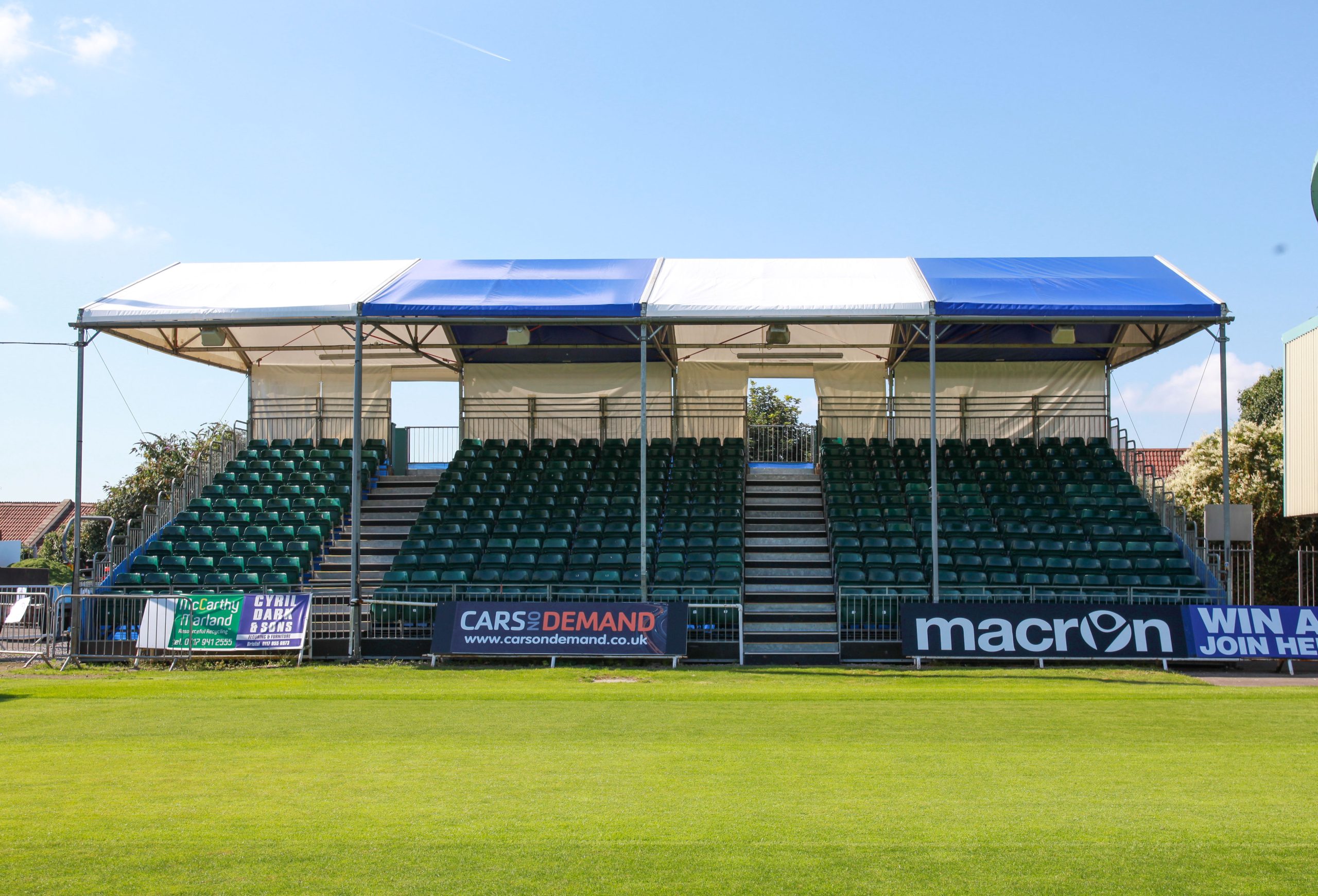
Bristol Rovers’ Memorial Stadium has an expanded capacity with two new look stands designed and installed by Arena Seating for the 2016/17 season.
The use of Arena’s demountable, or semi-permanent, seating systems meant the Club’s upgrades could be achieved quickly and economically.
Following consecutive promotions from Conference Premiership and League 2, the club was taken over by the Al Qadi family in February this year, and has since enjoyed an impressive third promotion into League 1. With the team performing well on the pitch the demand for tickets is up and the new owners have invested in upgrading the aging ground.
In line with advice from the local City Council and the Safety Advisory Group, the club took the decision to lower the control room at the cost of about £10,000 to the football club, enabling a 20 per cent increase in capacity.
“I have dealt with Arena Seating for 18 years, so there is a lot of trust and understanding between us. Their director Bradley Merchant is absolutely superb for this football club, he has always looked after us,” said Ian Holtby, Stadium General Manager.
“Arena have always made themselves available, given fantastic service and been a professional company from start to finish.”
Arena Seating’s in-house CAD design and structural engineering teams combined to ensure the plans were fully approved by the clients and local licensing authorities before the South Stand was totally refurbished and given a 20 per cent expansion in capacity from 850 to 1,056 seats. On the adjacent corner a smaller South West Stand was also installed by Arena, adding 360 seats and taking the ground’s capacity to 12,300.
Success on the pitch means Bristol Rovers has the opportunity to accommodate increased demand.
“Let’s be honest, this is an old, antiquated stadium, so Arena have once again been a very valuable part in upgrading the facilities we can offer,” said Holtby.
“We have also got 18 executive boxes and we have sold all of those, the new owners are probably spending in the region of another £100,000 to make good those facilities.
“With the new stadium plans well underway we are only planning on being here for two years all being well, and obviously we need to maximise the facilities we have, not just on a normal Rovers match day but also non-match day for conferences, meetings, weddings, banquets – that’s what we are looking to achieve. Fingers crossed we get there!”
Blog
-
Bristol Rovers upgrade facilities with Arena Seating
-
Host city selection process opens for 2022 European Championships
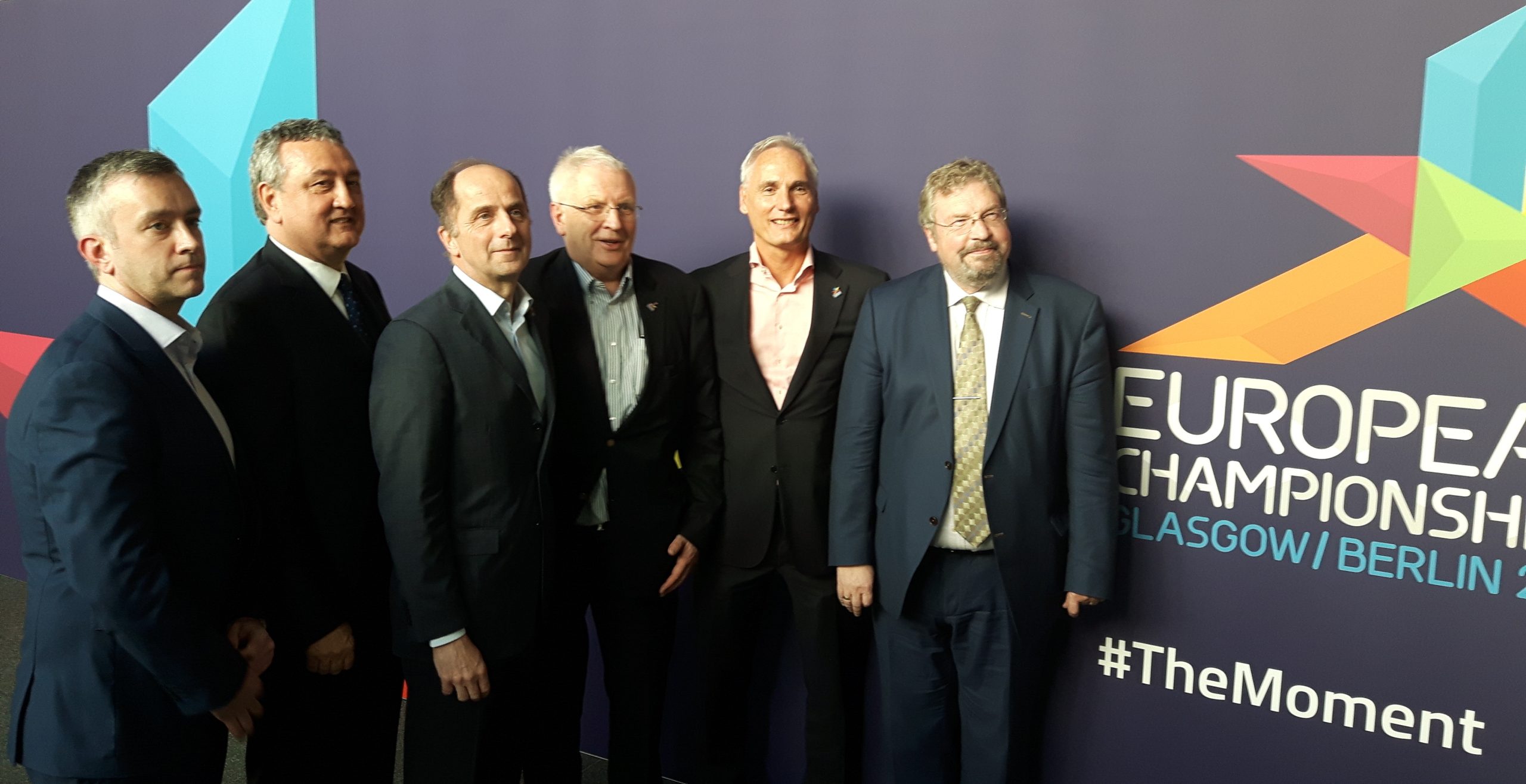
[SOURCE: European Championships Management] The European Sports Federation members of the European Championships Board are pleased to announce the start of the host venue selection process for the 2022 edition of the multi-sport event.
The European Championships is a major new multi-sport event every four years, which aggregates the existing senior continental championships of Athletics (European Athletics), Aquatics (LEN), Cycling (UEC), Gymnastics (UEG), Rowing (FISA), Triathlon (ETU), with a new Golf Team Championships (ET & LET), unified under a common brand.
The event will bring together Europe’s very best athletes in an exciting new format with the full support of Europe’s free-to-air broadcasters. The first edition will be staged from 1-12th August 2018, co-hosted by Glasgow and Berlin, and the second edition is planned for summer 2022.
The first step in the bidding process for 2022 is the distribution of the official Bid Information Document to interested parties, with a preliminary questionnaire to be submitted by the end of 2016.
The participating European Sports Federations will announce the 2022 hosts in November 2017. The European Championships Board has expressed its preference for all events to be staged in one city or region in a window between late July and August 2022.
The key highlights of the European Championships 2022 for a host city/region are:
– The opportunity to host 7 European championships with 13 disciplines across 12 days: Athletics (including road events), Aquatics (Swimming, Diving, Synchronised Swimming and Open Water), Cycling (Track, Road/time trial, BMX, Cross Country Mountain Bike), Artistic Gymnastics, Golf, Rowing and Triathlon.
– Over 4,500 competitors contesting over 170 gold medals.
– A projected 250 hours of host broadcaster coverage showcasing the city’s sports venues, landmarks and tourist destinations.
– An anticipated 2,700 hours of television coverage broadcast on free-to-air public networks.
– An estimated cumulative TV audience of over 1 billion with many more opportunities to access content across digital and radio platforms.
– Millions of fans engaged on the road to 2022 across multiple social media and digital platforms.
– Approximately 700,000 spectators will have the chance to see the Championships in stadia, competition halls and at road and open water events.
– Attention from all the major media outlets with 3,500 media professionals expected to attend.
– A platform for a creative and far-reaching mass participation programme across all sports.
– Public, commercial partnership, educational, technology, cultural, sporting and economic benefits for the host city, region and nation, with strategic opportunities to utilise the European Championships in city regeneration and development programmes.
European Athletics President Svein Arne Hansen, co-chair of the 2018 European Championships Board, said, “The 2022 European Championships will be an incredible opportunity for host cities considering the direct and indirect economic benefits. We believe the innovative and sustainable event is very attractive and affordable, not least because of its cost-efficient staging model which is very good value from a host city perspective in comparison to other multi-sport opportunities in the market.”
Fellow co-chair Paolo Barelli, President of the Ligue Europe?enne de Natation (European Aquatics), said, “By bringing together our existing championships once again, without adding to a crowded sporting calendar, we – the participating European Federations – will further protect and enhance the rich history and heritage of our respective sports. Both the federations and our hosts will see the powerful benefits of aggregation in 2022.”
Colin Hartley, Glasgow 2018 Championships Director, said: “This sustainable new model for staging a multi-sport event helps us deliver on our long-term commitment to produce strong economic benefits – as well as sporting, cultural and social legacy – by attracting new audiences to Glasgow and Scotland.
“The beauty of this new concept is it brings key sports together in our city at one time with a far greater media profile than we could achieve from individual events. We have not needed to build new stadia or an athletes’ village and we are able to showcase our existing facilities and landmarks. This new event is a critical element of our strategy to continue to be one of Europe’s premier sporting destinations.”
The European Championships Board requests that parties interested in staging the 2022 European Championships email EC2022@europeanchampionships.com to receive hosting information. European Championships Management (ECM) is co-ordinating the selection process for the 2022 European Championships on behalf of the European Federations. For media enquiries, please contact European Athletics Head of Communications and European Championships Strategic Communications Working Group Chairman James Mulligan at +41 79 694 48 29, james.mulligan@european-athletics.org.
[SOURCE: European Championships Management] -
International Association of Event Hosts to meet during Host City 2016
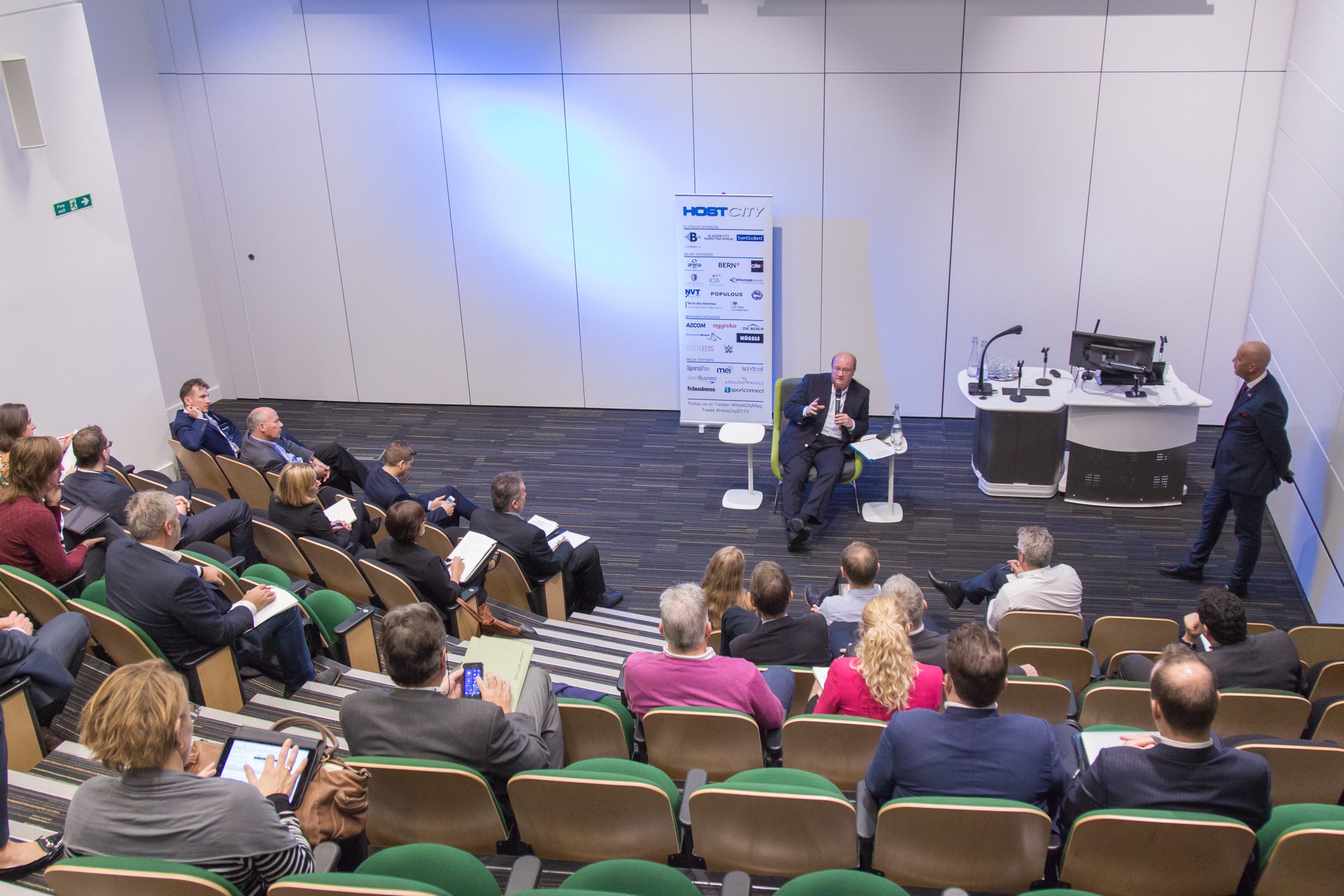
The International Association of Event Hosts (IAEH), whose membership has grown to include six new destinations, has revealed plans to meet during Host City 2016 in Glasgow.
Host City 2016, the largest meeting of cities and sports, business and cultural events, takes place in Glasgow on the 21 and 22 November.
Meetings of event hosts have been taking place informally at a small number of conferences, including Host City in November 2015. But it was not until the SportAccord Convention in April 2016 that a number of destinations gave a joint resolution to form IAEH.
The next formal meeting of IAEH will take place during Host City 2016.
“Further new members will be announced soon along with plans for the next regional meeting in Glasgow at the time of the Host City conference, and informal gathering in Lausanne around the Smart Cities and Sport conference,” IAEH said in a press release published on its website on Thursday 15 September.
A group of founder members of IAEH also met at British House in Rio on 16th August and agreed details of the interim management of the Association.
“As a result of the meeting, new members will now be formally welcomed and be encouraged to participate in knowledge sharing initiatives over coming months. Initial research on key topics is expected to be shared by the end of the 2016,” IAEH said after the meeting in Rio.
The six new destinations that have joined IAEH are: Maryland Sports, Events Management Queensland, innsbruck-tirol sports, Seattle Sports Commission, Edmonton Events and Ottawa Tourism.
Maryland Sports is the Sports Commission for the State of Maryland in the USA.
Events Management Queensland is a not-for-profit subsidiary of the state-owned tourism and events agency, Tourism and Events Queensland, based in the Australian Gold Coast.
innsbruck-tirol sports GmbH was formed from the legacy of the 1st Winter Youth Olympic Games 2012 in Innsbruck, Tyrol, Austria.
Seattle Sports Commission is the Sports Commission for Seattle, USA.
Edmonton Events is a strategic partnership between the Canadian City of Edmonton and Edmonton Tourism.
Ottawa Tourism is a not-for-profit, membership-based organization, working to profile Ottawa and Canada’s Capital Region.
They join ten other city and country members of IAEH: Auckland; Canada; Denmark; Ireland; London; Los Angeles; New Zealand; Scotland Tampere; and USA. -
IPC Academy Inclusion Summit turns to theme of event operations
[SOURCE: IPC Academy / WoAS] The second and final day at the 2016 IPC Academy Inclusion Summit (15-16 September) is now underway in Rio de Janeiro with the event turning its attention away from understanding inclusion through policy setting and good leadership towards the theme of ‘Delivering Inclusion Operations, how inclusion has been applied’.
Addressing the Inclusion Summit audience, Shanthi Flynn, Chief HR Officer, Adecco Group (Partner of the Inclusion Summit) covered the issues of inclusion in the workplace, and how Paralympic athletes can achieve life-long success on and off the field of play. Flynn discussed the IPC Athlete Career Programme, which helps athletes through education, career coaching and job placement and boosts diversity in the workplace.
“There are more than one billion people with an impairment in the world – 15%-20% of the global population,” she says. “Unfortunately people with impairments face prejudice, discrimination and limited accessibility in the workplace.”
She considers that sport events, such as the Paralympic Games, have the power to drive societal change and believes inclusiveness is about respecting and valuing differences.
“It’s about changing perceptions and understanding that conscious and unconscious bias are barriers to being an effective workplace,” Flynn says.
“From there, it’s a short step to see that inclusiveness can help companies be more innovative, engaging and competitive. Watching Paralympians in action is truly inspiring. It is clear that they have key skills and attributes that employers seek and need: they are highly driven, focused on success and team players who overcome barriers every day. Why wouldn’t you employ individuals with this profile?”
Over 200 people from a wide variety of Organising Committees and Candidate Cities of Olympics and Paralympics Games, International Federations, government bodies, suppliers to the major events and educational institutions have been listening to the insights of a wide variety of global speakers over the last two days including Sir Philip Craven, President of the International Paralympic Committee (IPC); Andrew Parsons, Vice President of the IPC & President of the Brazil National Paralympic Committee; Carlos Nuzman, Chairman, Rio 2016 Olympic and Paralympic Games; Madame Zhang Haidi, Executive President, Beijing 2022 and President, NPC China; and Charlotte McClain-Nhlapo, Disability Advisor of the World Bank.
A must-attend IPC Academy Campus Cocktail Function, hosted at British House and sponsored by the UK’s Department for International Trade, will bring proceedings to a close on 16 September and allow attendees to network with all participants of the Campus, which also includes an IPC Observers’ Programme and Games Experience Programme.
About IPC Academy Campus and the Inclusion Summit
Standing alongside but distinct from the IPC Academy Observers’ Programme, the Inclusion Summit provides the ultimate forum to bring together business leaders, governments and the Paralympic Movement. Together they are discussing inclusion and accessibility, their impact on society, and how the Paralympic Games have developed into the world’s number one sporting event for driving social inclusion.
Delivered by the IPC Academy – the educational division created in 2009 as a partnership between the International Paralympic Committee (IPC) and the World Academy of Sport (WAoS) – the 2016 IPC Academy Campus (4-17 September) is a unique event-based learning initiative that gives stakeholders of major sports events the chance to learn from their peers during the Paralympic Games. The IPC Academy Campus features an Observers’ Programme, Games Experience Programme (GEP), Inclusion Summit and a Closing IPC Academy Cocktail Function, hosted at British House.
Its Event Partners include the Adecco Group and the UK’s Department for International Trade. Its Media Partners are Sportcal (Intelligence Partner), Major Events International (Digest Partner), Around the Rings (Online Partner), Host City (Magazine Partner) and AXS Chat (Social Media Partner).
For further information about the the IPC Academy Campus, please visit www.ipcacademycampus.com or contact Claire Bennett, Project Coordinator, World Academy of Sport cbennett@worldacademysport.com. -

Formula E invites cities to host 2017/18 season
Formula E on Tuesday said it would be inviting expressions of interest from new prospective host cities to join the 2017/18 calendar.
The structured selection process will be managed by London-based firm The Sports Consultancy, whose co-managing director Robert Datnow is speaking at Host City 2016 – the largest meeting of cities and sports, business and cultural events.
Successful hosts will be announced in June 2017, subject to approval of the FIA World Motor Sport Council (WMSC).
“We have enjoyed remarkable growth over the first two seasons of Formula E and now have partnerships with some of the most iconic cities in the world and cutting-edge automotive brands,” said Formula E CEO Alejandro Agag.
“There is now a unique opportunity for new cities to join our calendar and share in the continued exponential growth of the championship.”
The FIA Formula E Championship races on the streets against a backdrop of some of the most iconic host cities, including New York, Marrakesh, Buenos Aires, Monaco, Paris and Montreal.
The inaugural season of Formula E launched in September 2014 around the grounds of the Olympic Park in Beijing.
The third season, which opens in Hong Kong on 9 October 2016, sees 10 teams and 20 drivers race in 12 cities spanning five continents. The season ends in a double-header event in New York on 29 and 30 July 2017.
According to Formula E, the championship represents “a vision for the future of the motor industry, serving as a platform to showcase the latest innovations in electric vehicle technology and alternative energy solutions”.
The rights holder anticipates that the further opening of regulations in future seasons will allow manufacturers to focus on developing motor and battery components. -
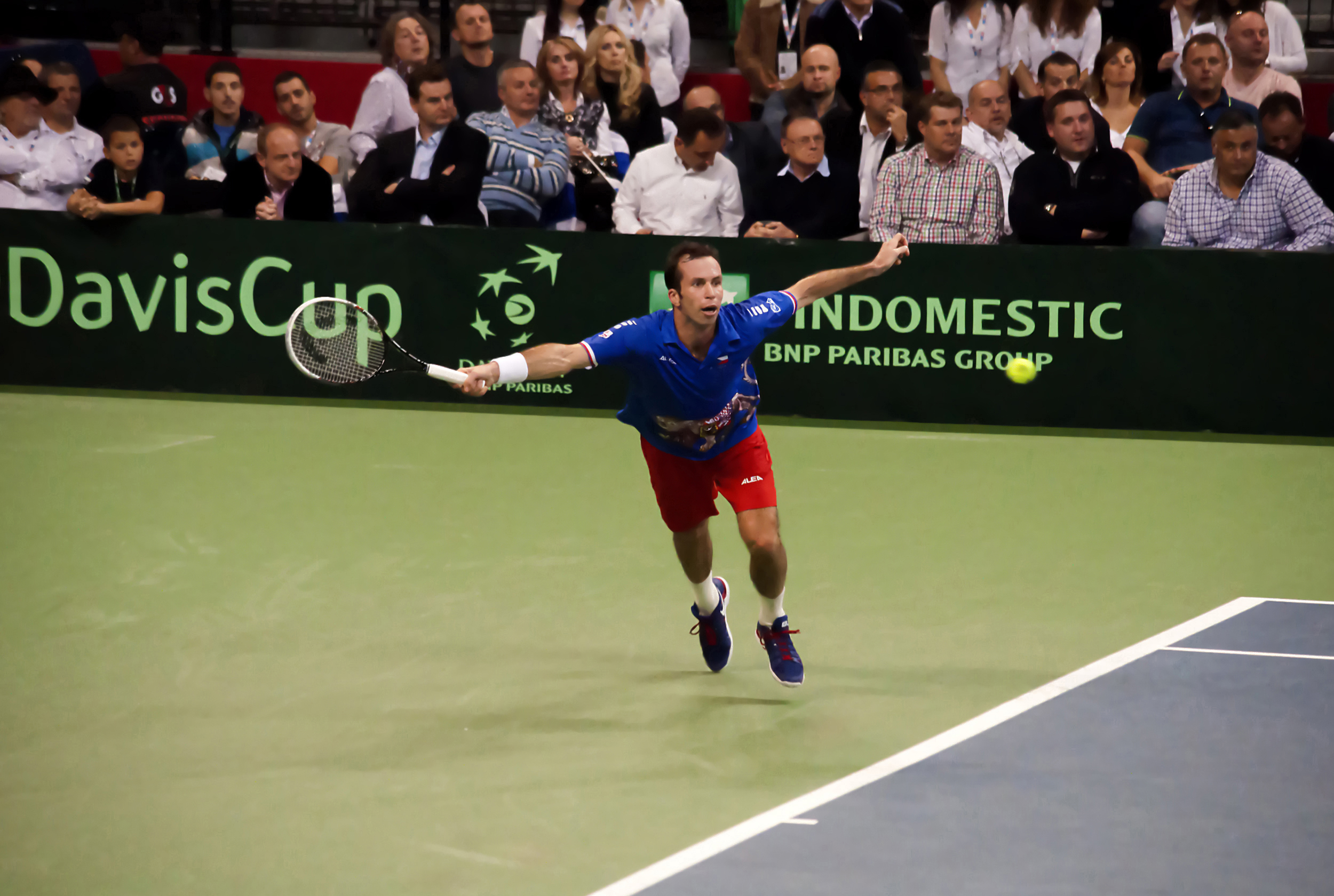
ITF to open Davis Cup final to host city bids
The International Tennis Federation (ITF) is planning to invite cities to bid to host the Davis Cup final from 2018.
Currently, each of the matches is hosted by one of the teams competing in that match, including the final.
“Right now we know who are in the finals but we don’t know where it is going to be,” ITF President David Haggerty told Reuters.
“It is really hard to plan and get viewership and fans excited,” he said. “If you have a fixed site, people can begin to plan and look ahead.
He is proposing a new system whereby the final will be hosted in a host city in a neutral nation to be decided in advance.
“This is a way to unlock potential revenue which will help grassroots tennis,” he told Reuters.
This system is also used by the UEFA Champions League where the final is held in a neutral host decided two years before the event, and the NFL’s Super Bowl final where the is host city is decided three to five years in advance.
“This is all part of our mission to make the appeal of tennis broad and wide,” said Haggerty, who was elected president of ITF in 2015. “Davis Cup is 135 nations.”
The ITF is also reported to be considering shortening matches and expanding the Fed Cup to include 16 nations.
Haggerty anticipates the price cities would pay for hosting the final will be “significant”.
“We’re waiting for cities to distinguish themselves,” he told Reuters. “And we’ll see what it is. I don’t want to prejudge what it might be.”
The proposals will be voted on by the ITF membership in August 2017 for implementation by 2018.
Haggerty anticipates a successful bid covering more than one year. “The most likely scenario would be for two-to-three-year terms,” he said.
Croatia will host the 2016 Davis Cup final on 25 to 27 November, after they won their semi-final against France in Zadar, but a host city has not yet been named.
They will play Argentina, who beat Great Britain in a semi-final in Glasgow on16 to 18 September.
The current system gives little time to engage fans in the build-up to the event. “Last year we had a fantastic final in Ghent. But the reality is, Britain could have sold out the (13,000-capacity) stadium. Belgium could have sold it out, too.
“Our mission is to make tennis broad and wide. We have 700,000 spectators that come to Davis and Fed Cup each year… about 3.6 billion people view it on TV, but it’s got to be more than that.
“It’s got to be bigger than that, and with a neutral final venue we can work with our broadcast partners and make it a much bigger show than just two nations that know they’re playing each other.” -
CGF, Red Bull, Feld (Disney) and European Commission speakers join Host City 2016
Host City 2016: Two months to go and CGF, Red Bull, Feld (Disney) and European Commission join as speakers
With two months to go until Host City 2016, a new wave of international event brands has joined an already impressive line-up of speakers.
The largest meeting of cities and sports, business and cultural events will open on 21 November with a Keynote Address by Sir Craig Reedie CBE, President, World Anti-Doping Agency.
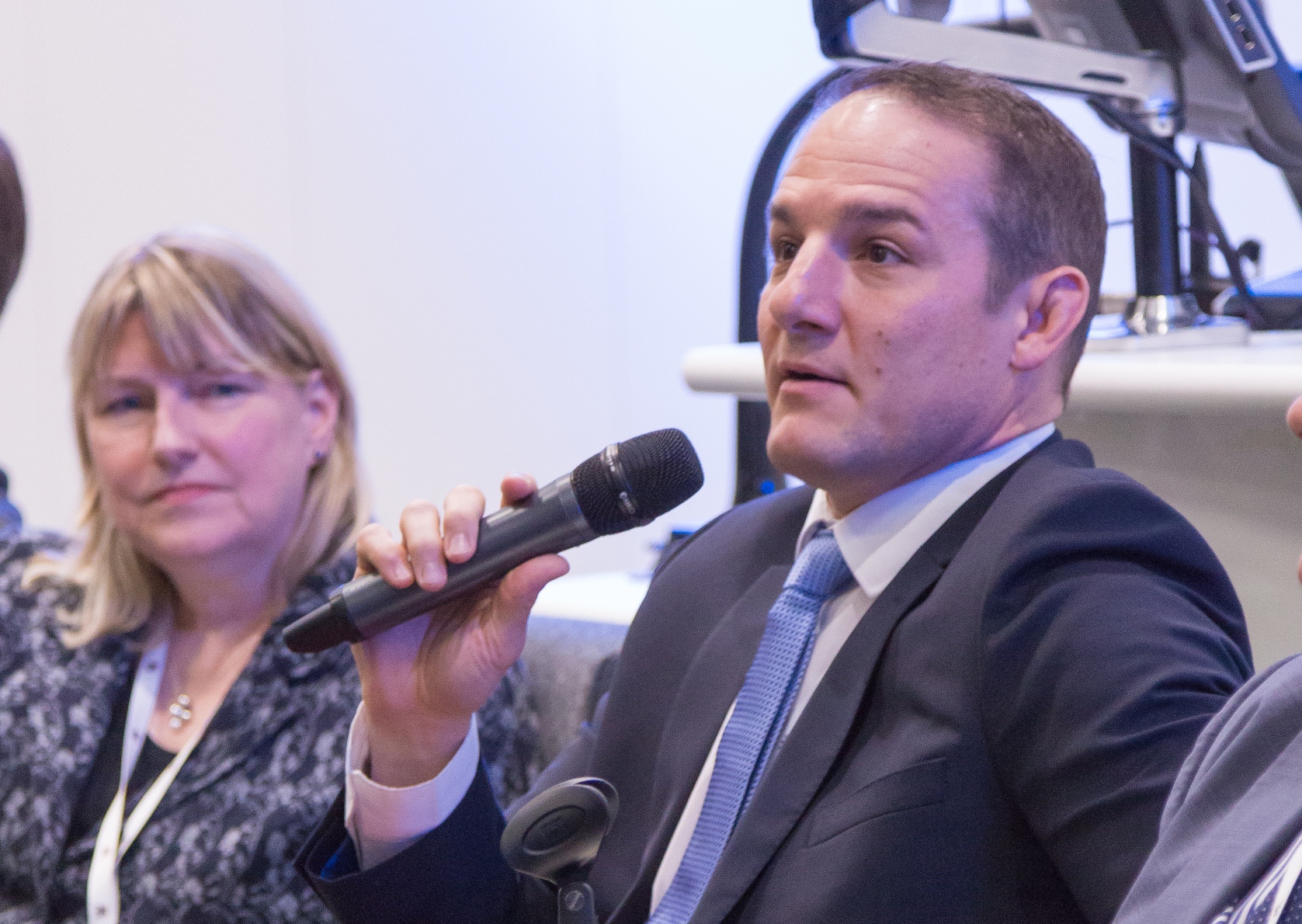
David Grevemberg OBE, CEO, Commonwealth Games Federation makes a welcome return to Host City to speak on “Transformations in Multi-City and Multi-Sports Events”.
Erich Wolf, Managing Director, Red Bull Air Race and Claire Ballard, Regional Marketing Manager, Feld Entertainment (Disney Live) will join Wang Dong, Vice President, Alisports in a panel on “Building Sports and Entertainment Brands; China’s Investment Strategy”.
Also recently confirmed to speak at Host City 2016 are Bridget McConnell CBE, Chief Executive, Glasgow Life; Yves Le Lostecque, Head of Sport Unit at the European Commission and Risto Nieminen, President, Finnish Olympic Committee.
These new speakers join a star-studded cast that includes city leaders from New Zealand, Odense, Rotterdam and Paris, as well as: Paul Bush OBE, Director of Events, Visit Scotland; Ugur Erdener, Vice President, IOC; Dimitri Kerkentzes, deputy Secretary General, BIE (World Expos); Simon Clegg, Chief Operating Officer, World Expo Dubai 2020; Michel D’Hooghe, FIFA Council Member and Chairman of the Medical Committee, FIFA; Reinhard Pfeiffer, Deputy CEO, Messe Munich; Sooad Islam, Associate, Populous; John Langford, Vice President and General Manager, The O2, AEG Facilities and more international experts.
Host City 2016 is firmly established as the largest meeting of cities and sports, business and cultural events. View the full speaker line-up on the Host City website.
Host City 2016 is an event that you don’t want to miss! Get your pass today to attend the leading meeting of cities and sports, business and cultural events in Glasgow on 21-22 November. Register online
A very limited number of speaking opportunities remain. For opportunities please contact Ben Avison on +44 (0) 7876 682072 or ben.avison@hostcity.net
-

Smart cities worried about cyber attack threat
An overwhelming majority of IT professionals in US cities expect to be hit by cyber attacks that could pose a threat to public safety, according to the results of a survey announced on Thursday.
The survey assessed cyber security challenges associated with smart city technologies. Respondents included more than 200 IT professionals working for state and local governments.
Eighty-eight percent of respondents said “yes” when asked if a cyber attack targeting critical city infrastructure posed a threat to public safety
And seventy-eight percent of respondents said a cyber attack against smart city services was likely in 2016.
The survey was conducted by Dimensional Research on behalf of Tripwire, a leading global provider of security and compliance solutions for enterprises and industrial organizations.
The smart city sector is growing rapidly, with revenues from global smart city technology revenue predicted by Navigant Research to reach US$36.8 billion in 2016.
But cyber security experts are concerned that these technologies are being implemented faster than the technology required to safeguard them.
“While smart cities offer great efficiencies for their citizens, the same internet connectivity that enables these efficiencies can be used to deliver physical damage to infrastructure and also cause loss of life if accessed by malicious actors,” said Rekha Shenoy, vice president and general manager of industrial cyber security for Belden, Tripwire’s parent company.
IT solutions are deployed by smart cities to manage utilities such as electricity grids and wastewater treatment as well as transport, surveillance and more.
The survey also found that eighty-one per cent believe a cyber attack targeting critical city infrastructure could cause physical damage.
Eighty-three of the respondents said they are worried about cyber attacks that target smart city transportation initiatives.
And just three per cent believed there would be no cyber attacks against smart city services this year.
“As we use more and more technology to innovate around the management of cities and their infrastructure, we also create new attack surfaces that can be exploited,” said Tim Erlin, director of IT security and risk strategy for Tripwire.
“Protecting public infrastructure from cyber and physical attacks is a key consideration in the evolution of smart city technologies. We need to build smart cities with cyber security in mind, not add it as an afterthought.” -
Damaged FIFA will fight discrimination, says Fatma Samoura
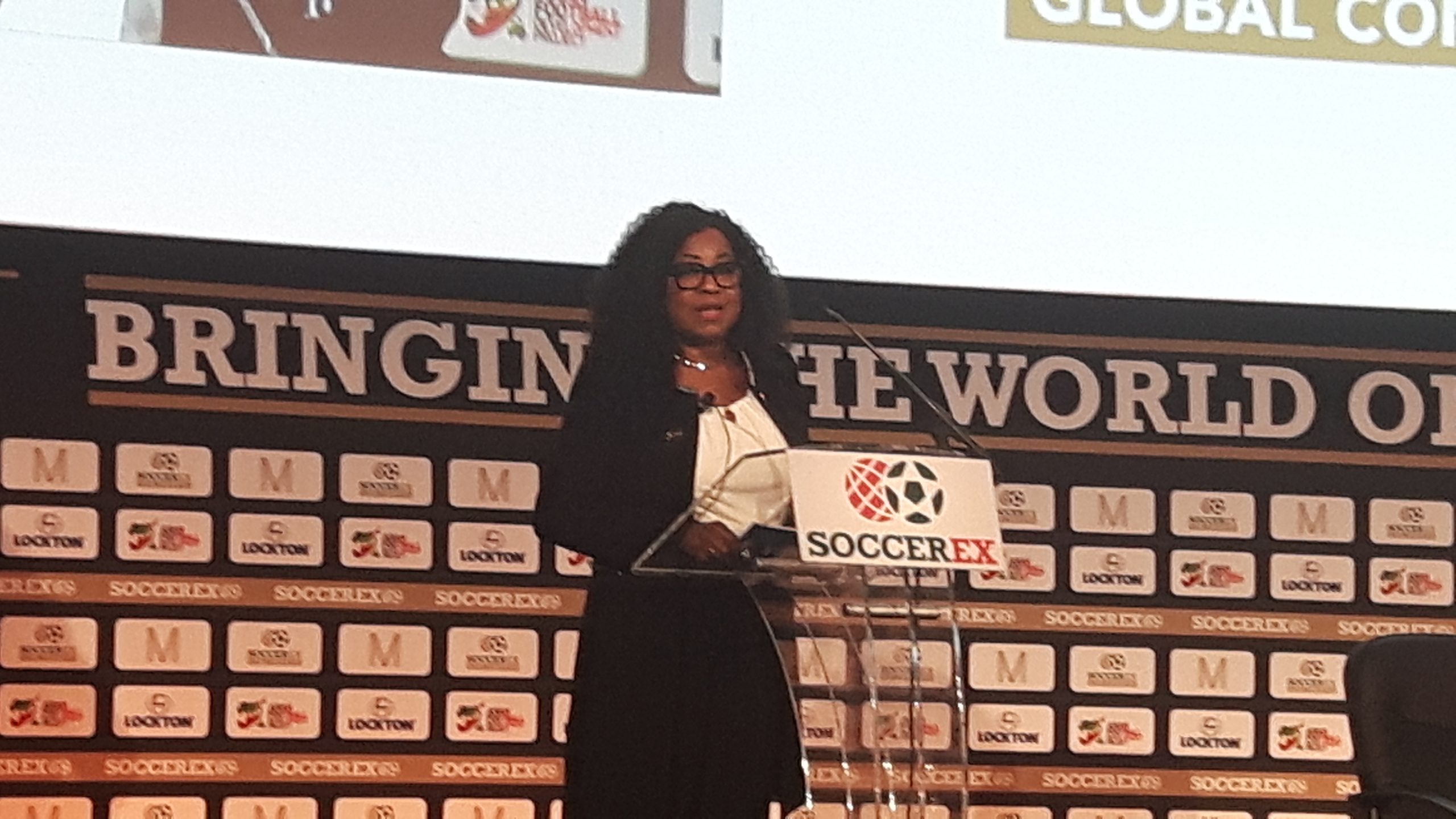
FIFA Secretary General Fatma Samoura on Monday acknowledged that FIFA is a damaged brand that it has not focused enough on grass roots or women’s football, but insisted that the new leadership will be stronger on discrimination, despite the closure of the anti-racism task force.
Samoura joined FIFA from the United Nations in June. “There were many surprises, good and bad,” she said at Soccerex Global Convention, citing FIFA’s “incredibly committed and highly educated staff” as a positive revelation.
“On the bad side, there were some habits that needed changing. There are some cultural behaviours that we have already started acting on, for example: not really focussing on the development of football at the grass roots level; putting women’s football at the centre of our core business.
“Through the FIFA Forward programme we are really trying to prioritise those two things.”
She began her first major public speech as FIFA Secretary General by admitting she was “new to the administration side of football,” and that attending such events will be important for her in “establishing relationships”.
“I bring another perspective derived from 25 years in the UN system, mostly in crisis and complex emergency situations,” she said.
“In the midst of turmoil, gunfire and confrontation, the only time people would stop warfare was when it was raining or when there was a football game – including during Ramadan and Christmas.
But despite this power, football is still not universally accessible, she said.
“This has given me a desire for an even bigger women’s game and for women to play a greater role in administration. Men and women, young and old, well off and not so well off, have a role in the game.”
“Stronger on discrimination”
FIFA has been widely criticised for closing down its anti-racism task force, with Prince Ali Bin Al Hussein, President of the Jordanian Football Association calling the move “incredibly worrying”.
Pressure group Kick it Out said in a statement “This comes at a time when there is clear evidence that discrimination, prejudice and hate are on the rise in developed societies, particularly in Europe but also in different forms across the world.”
Samoura’s speech at Soccerex Global Convention in Manchester followed a welcome address from Andrew Burnham, the frontrunner to become the first Mayor of Greater Manchester, in which he challenged her justify the closure of the anti-racism task force.
“It had a very specific mandate, which it has fully fulfilled” Samoura responded. “Its recommendations have now turned into a programme and a strong one.”
Asked by host David Davies if the problem is one of perception, she replied “We can live with perception, but what I can tell you that we are taking very seriously our role as the governing body to fight discrimination.
“As an example, we have a monitoring tool and we act when this comes to bullying and facing strange and extreme behaviours in the stadiums.
“We have several cases of disciplinary measures against several clubs and teams which have been accused, and based on solid legal grounding we have taken them through this disciplinary committee, which has taken very strong sanction against them.”
Despite the closure of the task force, she said “the new leadership will be stronger, not only on racism but any kind of discrimination – including any violation of human rights.
“We need to be firm. The zero tolerance policy is at the top of the new FIFA administration’s agenda.”
“Reputational damage”
Assuring stakeholders of the integrity of the organisation will be crucial to its continued success under the leadership of new president Gianni Infantino.
“It’s clear to me that fans and our member associations have all great expectations for FIFA,” said Samoura. “They are counting on Infantino to fundamentally change the way we do business.”
She cited the creation a Chief Compliance Officer position within FIFA, as “an example that is now being replicated by all the confederations.”
The development of the game at grass roots level will be driven by the new FIFA Forward programme, which consists of investments via member associations.
“The goal of FIFA Forward is to have a high impact programme with broader participation, better teams and leagues and a more attractive sport.
“In the end, this is all about making the difference and reducing the gap between dreaming about the World Cup and participating in the World Cup.”
Historically, investments intended for grass roots development have not always reached their intended recipients.
“We really want to put in place a monitoring and controlling tool, because the Forward programme is about a lot of money to national associations. It’s about US$5m – for clubs in England that’s nothing, but where I come from that’s a lot of money and we need to ensure that those resources are really well channelled,” the Senegalese diplomat said.
“I had a very comfortable position at the UN. I was convinced by Infantino that it is time for change. Yes, our brand has suffered a lot of reputational damage.
“My appearance here today is testimony to how we would like to restore trust and confidence. We have already started really working with commercial affiliates who still believe in the brand of FIFA, giving certainty that we are the partner of choice.
She insisted that the worst is over for FIFA, despite ongoing criminal investigations into several senior figures that led the organisation.
“We are putting the past behind us.” she said. “Let’s get the investigation done while not repeating the mistakes of the past.”
“We want to have the best administration by recruiting the best people we can find. In terms of governance and accountability, we have to reach the highest standard.
“I am ready to take these challenges. I count on everyone’s support to make the FIFA mission a successful one.” -
Do foreign players help or hinder national football development?
In all sectors, we gain invaluable experience from working alongside skilled professionals from overseas. This brings all kinds of benefits – and sport is no exception, except for the fact that it is structured around international competitions.
Does foreign talent in leagues really overshadow the development of national teams, or is that just an excuse for other issues around local football development? And what difference would quotas make, if any?
Everyone seems to have a view on these subjects and there were plenty to be heard at Soccerex Global Convention.
Andy Burnham MP, Mayoral Candidate, Greater Manchester
“The English Premier League was set up with a very specific objective: to improve the England team. Clearly that hasn’t happened.
“Can you have the best league in the world and the most successful team? Of the countries that have tried to do that I think Spain has got the closest to managing that, but I think here we haven’t managed that.
“And I think we need to give more thought to that, because a strong national team is something that builds pride in football and boosts participation at the grass roots.
“In the 25 years of the Premier League we’ve had one semi-final, at our own home European championship in 2016.
“Could Brexit mean something different for football? Could Brexit mean that English football takes a step away from the European directives in relation to free movement in sport – and could we look at introducing quotas for our homegrown players, so that the Premier League doesn’t become a playground for the world’s best talent, but actually we make sure that we bring through more English homegrown players in our domestic league.
“We look at the European Championships in France in the summer and I observed the England team’s disappointing performance, and it seemed to me that there was a lack of heart; a lack of hunger, or desire. And you have to ask the question; is that something that the modern game is increasingly bringing – a sense that there’s nothing playing for, because these players have it all.
“And you look, by comparison at Wales, at Iceland and Slovakia, and there was a different sense of team spirit. I think the game also has to ask where its priorities truly lie.
“The nature of the game has changed, I believe, since the 25 years that the premier league started.”
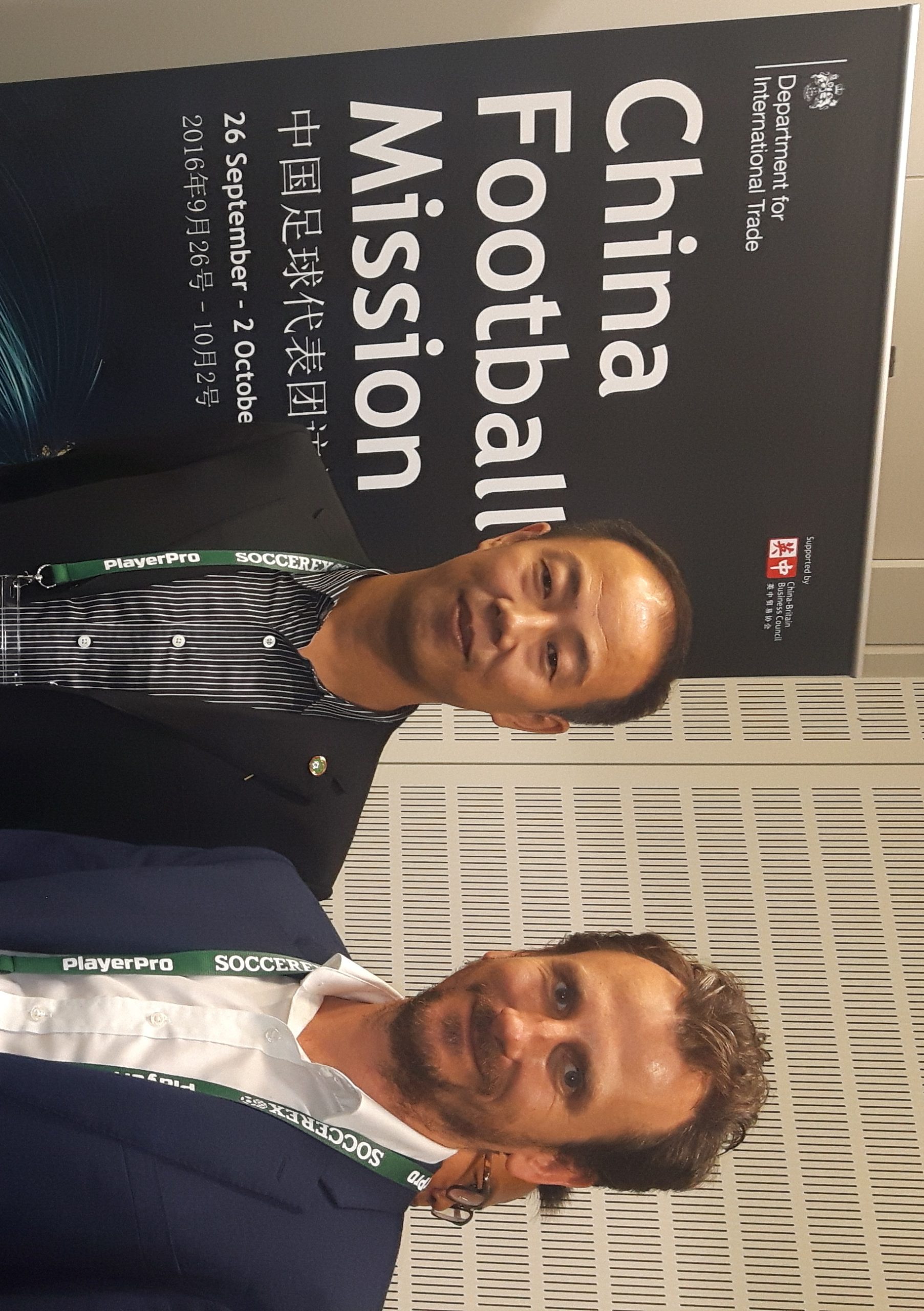
Li Jiuquan, Director of Marketing Department, Chinese Football Association
“I think there are conflicts for some clubs; they want to have more international players.
“Some suggest that we should have more foreign players in the clubs so we can have better performance in the club championships. They say if we have more international players we will have better performance. But we need to have a balance between the league and the national team.
“Is it good for china to have foreign coaches? It depends how you see it. If you say big names can bring something new, they can bring their knowledge and the Chinese coaches can learn from them, it’s good. But they get their positions and for the Chinese coaches have no practice at all. For most of the CSL clubs, we have almost no Chinese coaches.
“Personally I think there might be some problem, because the Chinese coaches have no chance to practice. It’s the same for the national team; if all the strikers are foreign, we have no good strikers.”
Simon Li, Chairman, International Football Connections Limited
“In my experience in the Chinese Super League they have a four plus one rule: four foreign players that can come from outside Asia, plus one Asian player.
“That might change to three plus one, from January 2017. The league below can have only three foreign players full stop.
“For the league below there is no restriction – apart from one important thing: no foreign goalkeepers allowed.”
Gerard Houllier OBE, former Liverpool FC Manager
“Quotas can work for under21s, but they are not suitable in Europe. In France, for example if you were to say you were to have five French and six European or whatever, I don’t think this would work.
“If a player has been developed in your country, if that player is at the same level as the foreign player I would always take that player. At Liverpool, if two players were the same level I would take the local above the foreign.”
The above are a combination of exclusive interviews with Host City and statements made to the conference at Soccerex Global Convention