Tag: Bidding Process

  • SportAccord president slams IOC over events

    SportAccord president slams IOC over events

    Marius Vizer, the president of SportAccord, the umbrella group of international sports federations, has directly criticised IOC president Thomas Bach and his programme of reform, Agenda 2020. 
    Agenda 2020 was unanimously approved by IOC members in December 2014, but Vizer said the reforms are not in the interests of sports and international federations. 
    He criticized the IOC’s decision to launch the new Olympic TV channel, which he said was taken without consultation or transparency. 
    Speaking at SportAccord Convention in Sochi on Monday, Vizer also complained that the IOC is preventing the launch of new multi-sports Games event. 
    “After becoming SportAccord President, I always tried to develop a constructive collaboration with the IOC and with President Bach. A collaboration based on respect towards the Olympic Movement, its members and the values in which I believe. Unfortunately, it never became reality,” Vizer said. 
    “I made a number of proposals in favour and for the benefit of IFs and SportAccord but we have never received a positive reaction. Mr. President, stop blocking the SportAccord strategy in its mission to identify and organize conventions and multi-sport games. 
    “Do not try to create a theory around which sports are and are not eligible for multi-sport games. Do not try to impose upon the organizers of SportAccord events guidelines on how to distribute funds generated and earned by ourselves. Do not interfere in the autonomy of the sport organizations.”
    The primary feature of Agenda 2020 is its reform of the bidding procedure for Olympic Games, which has been changed to reduce the cost of bidding to make it more appealing to cities. 
    One of the changes brought in was to prevent bidding cities from presenting at SportAccord Convention. “The voting for potential host cities of the Olympic Games is compromised,” said Vizer. 
    “Key stakeholders are excluded from making informed decisions when selecting Olympic host cities: the bid cities cannot present their candidatures at SportAccord Convention to all stakeholders, IOC members cannot visit bid cities and during the IOC Session, when the vote takes place, IF presidents – who are organizers of the Olympic Games, are obliged to leave the room.”
    Vizer said the interests of the international federations (IFs), which SportAccord represents, were not properly addressed.
    “The Agenda 2020 hardly brings any real benefit to sport, to IFs, or athletes. It did not bring about more clear criteria, rules and principles,” he said.
    Vizer singled out recommendations 9 and 10 of Agenda 2020 as leading to “a destabilizing of the Olympic sports”. 
    Recommendation 9 manages the scale of the Summer Olympic Games by limiting accreditations to 10,500 athletes competing in 310 events, and the winter Games to 2,900 athletes and 100 events. 
    Recommendation 10 sets out to structure the Olympic programme around events rather than sports. The IFs are to be involved in regular reviews of the programme and organising committees will be able to suggest adding one or more sports to the programme, but the IOC retains ultimate decision making power over which sports and IFs to include in the programme. 
    “We must protect the Olympic sports and disciplines currently in the Olympic programme and at the same time we must encourage and support the new sports and disciplines who want to join,” said Vizer.
    He also described recommendation 19, to launch an Olympic TV channel as “very surprising”. 
    “The IOC Members voted in December 2014, in the IOC Session, unilaterally, without a clear business plan, a commercialization plan and project, to reduce the dividends to International Federations in order to establish the Olympic channel. Leaving from the premise that the Olympic Movement has the assets, any business project in the world needs a business plan, investors, professional partners, breakeven points, strategy, consultation with stakeholders – International Federations and to generate a benefit for all stakeholders. Only after the decision it appears that a plan is in process. 
    “At the same time, the cost of more than 450 million dollars to establish a digital channel seems exaggerated. Do consult us as stakeholders of the Olympic Movement regarding all the proposals, contracts and partnerships that are being signed and make them transparent!”
    Vizer took over as president of SportAccord in May 2013, before which he was president of the International Judo Federation. He is faces no challenger in the presidential election due to take place at the SportAccord Convention.
    Read the full transcript of the speech here.

  • 2024 Olympic bid consultants register welcomed

    2024 Olympic bid consultants register welcomed

    The International Committee on Thursday launched a Register of Consultants representing cities bidding for the 2024 Olympic Games. 
    The register was one of the recommendations of Olympic Agenda  2020, the “strategic roadmap for the Olympic Movement” initiated by IOC president Thomas Bach and unanimously approved by IOC members last year. 
    The news was welcomed by Mike Lee OBE, chairman of Vero Communications, who has been involved in a number of successful Olympic bids including London 2012, Rio 2016, PyeongChang 2018 and Buenos Aires 2018. 
    “I think the idea of a register and codes of ethics and conduct are a very good way forward; we are very pleased to see that.” he told HOST CITY. 
    “Like others, we will be making an application to be on that register and I think it’s a healthy development and it’s something which the business in sport in general should embrace. 
    “Certainly you see it in other walks of life – it’s been around in the public affairs industry in many countries, so it’s a good thing and all part of increasing the opening and transparency of the bidding process.”
    According to the IOC, all consultants wishing to participate in or support a candidature for the Olympic Games must be entered in the IOC’s Register of Consultants list for the city concerned.
    Entry in the Register is a prerequisite for providing any service and/or signing any service contract by the National Olympic Committee (NOC) and/or the city.
    The Register and Rules of Conduct form part of Olympic Agenda 2020’s Recommendation 3, which aims to reduce the cost of bidding for the Olympic Games, stating: “The IOC to create and monitor a register of consultants/lobbyists eligible to work for a bid city. Formal acceptance of the IOC Code of Ethics and Code of Conduct by such consultants/lobbyists as a prerequisite for listing in the register.”
    The IOC considers a consultant to be any individual or company not linked by an employment contract to the NOC, the city or the bidding committee, and which/who participates in or supports a candidature by providing consultancy or similar services in any way and at any time.
    The register will be published on www.olympic.org


  • Ten cities interested in FINA 2021 and 2023 World Champs

    Ten cities interested in FINA 2021 and 2023 World Champs

    The bidding process for the 2021 and 2023 FINA World Championships is underway, with ten cities from seven countries across four continents having expressed an interest. 
    Budapest had originally been selected for the 2021 Games, but its hosting was brought forward to 2017 when Guadalajara, Mexico pulled out of hosting the 2021 edition. 
    FINA said it has received expressions of interest from Argentina, Australia (Melbourne or Sydney), China (Wuhan or Nanjing), Germany (two potential cities), Japan, Turkey and Qatar to host the showcase aquatics event.
    FINA said it is in discussions with each of the potential candidates, providing them with all the necessary information to plan their proposals. 
    An information meeting will take place on 30 June 2015 for nations and cities that have shown an interest in bidding.
    FINA said it hopes to announce the chosen host cities of the 2021 and 2023 FINA World Championships by the end of 2015.
    “We are delighted with the strong level of interest from a number of different cities who want to host swimming’s showcase event,” said FINA President, Dr. Julio C. Maglione.
    “I believe that they are all attracted by the evidence that the FINA World Championships brings clear economic, social, cultural, tourism and sports impacts to every host city. There is a measurable benefit through better youth and community facilities, through high-performance opportunities, and through showcasing your city to a global audience.”
    The FINA World Championships is one of world’s most followed international sport events. A cumulative audience of 4.5 billion watched the 2013 FINA World Championships in Barcelona, Spain, across six platforms.
    The 2015 FINA World Championships will take place in Russia for the first time on 24 July to 9 August 2015, in the city of Kazan. 2,200 athletes from a record 188 countries have registered so far.
    The next two editions will be held in Budapest, Hungary, in 2017 and in Gwangju, Korea, in 2019. 
    FINA, the Fédération Internationale de Natation, is the governing body for aquatics worldwide. Its five disciplines – swimming, open water swimming, diving, water polo and synchronised swimming – are all included in the Olympic programme.
     

  • How to be a European Capital of Culture

    How to be a European Capital of Culture

    The European Capitals of Culture programme has grown immeasurably since its launch in 1985. 
    “We started modestly 30 years ago and now we are typically having cities spend up to EUR 70-100m for a yearly programme being a European Capital of Culture,” says Karel Bartak, Head of the Creative Europe Coordination Unit at DG Education and Culture, European Commission.
    “So it is very prestigious from the point of view that there is a huge interest in every country.”
    Initiated by Greek culture minister Melina Mercouri and originally called “European City of Culture”, the programme was renamed “European Capitals of Culture” in 1999. Two hosts are now appointed each year, enabling a wider range of destinations to benefit. 
    “In the past most of the bidding and winning cities were capital or very big cities, but now many of these have already been European Capitals of Culture, so now we are seeing smaller cities bidding and it brings a new and very interesting edge”.
    “If you have a smaller place of 100-200,000 inhabitants, the impact is much, much bigger and also much more visible for the city’s inhabitants than if you have a European Capital of Culture in say Paris or Athens.”
    In 2013 the medium-sized Slovakian city of Kosice was a European Capital of Culture. 
    “Everyone who comes from there says the city has been changed beyond recognition by the year, and it has really become a cultural hub including Ukraine, Hungary, Poland and so on,” says Bartak.
    “In Umea last year in Sweden it was similar case; and this year the town of Mons in Belgium, which has only 80,000 inhabitants, is having a huge impact and the whole country is celebrating.”
    Mons is joined by Pilsen in the Czech Republic as a European Capital of Culture for 2015.
     
    How to bid
    The bidding procedure is based on a “Decision” of the European Parliament and the Council of the European Union, which is the legal basis for the selection and monitoring processes.
    “This legal basis determines which countries are concerned with European Capital of Culture for the next eighteen years, so we all know well in advance which countries are going to be concerned,” says Bartak.
    The country concerned typically issues a call for applications six years in advance of the title year. Interested candidates submit a bid book of 80-100 pages and present it to a panel that pre-selects a shortlist of candidates. 
    The pre-selected candidates then have another seven to eight months to prepare the final bid. 
    The panel is now composed of 10 members who are selected by European Commission, Parliament, Council and Committee of the Regions, plus two selected by the governments of bidding country. This international jury of experts is renewed by a third every year. 
    The process is democratic. “The chairperson, who is always chosen by the jury from among its members, is always trying to have a consensus. But if there is no consensus then there is a vote,” says Bartak. 
    “It is always tense as the responsibility is huge, cities investing a lot of energy, hope and financial resources in their bid.”
    Once selected, the host cities have four years to prepare their programme for the year. During this phase, the Commission convenes monitoring meetings during which the panel give cities advice and guidance and take stock of their preparations.
     
    How are the bids evaluated?
    The international jury judges the bid on criteria specified in the Decision of the European Union. 
    One of these criteria is the European dimension of the programme: how it brings to the fore the cultural diversity in Europe and our common cultural features, how it leads to new or reinforced cultural partnerships and cooperation at EU level. Another is the participation of the citizens and of the various cultural, social and economic stakeholders of the city in the design and implementation of the yearly programme. The jury also looks at sustainability and legacy issues as the project must be embedded into the longer term cultural development strategy of the city.
    “They make sure that once the year is over the overall level of cultural life and the investment in culture has long lasting effect, and the level of cultural life stays much higher than it was before the year,” says Bartak.
    “Besides that, the jury is looking into the financial sustainability – the composition of the package of money that is available. We are always keen on having a good mix between private and public funding and so on.”
    The financial contribution of the European Commission is relatively small.
    “The Melina Mercouri prize which is given to each city which has won the title is 1.5m Euros, so it is just a kind of symbolic contribution; otherwise the city has to find the budget. Many hosting cities however use the money coming from the EU Structural Funds.”
     
    Future hosts
    The selection process for 2020 European Capitals of Culture is now underway. Ireland and Croatia are currently running their competitions for 2020 and the bidding process is set to change slightly. 
    “The current situation is that the Commission is monitoring the process, but is not at all interfering in it. This is run by the independent panel, the jury. Until now, the national governments and then the institutions of the EU (European Parliament, Commission and Council) would then take on board the recommendation of the jury,” says Bartak.
    “As of the 2020 titles, this will be done differently; the jury will recommend the city to the government concerned, so the institutions of the European Union will be left out of the process – to make it simpler and less bureaucratic.”
    The pre-selection process in Croatia was completed in May 2015. “We had nine cities competing and four were preselected. The recommendation for the final selection will happen in January of next year.” 
    By October, it will be clear which cities in Ireland are competing to host the 2020 European Capital of Culture. “I think all bidding cities have a chance. Each application is judged on its merits,” says Bartak.
     
    Creating a network of cities
    There is a great opportunity for the European Commission and its network of European Capitals of Culture to share experiences.
    “As previous title-holders, Mons and Pilsen have organised a gathering of previous and future European Capitals of Culture, which was an interesting moment of brainstorming and bringing together their experiences and stories of preparation and implementation.
    “We feel that with our thirty years of experience, we have more and more knowledge and advice to give and, with the lessons learned it becomes easier for cities to avoid mistakes made in the past.”
    The European Commission will discuss these issues and opportunities in greater detail at HOST CITY 2015 on 9th and 10th November in Glasgow.
    To find out more about the bidding process for European Capital of Culture visit http://ec.europa.eu/programmes/creative-europe/actions/documents/ecoc-candidates-guide_en.pdf or register to attend HOST CITY 2015
     

  • “Blind bidding” adieu?

    “Blind bidding” adieu?

    I listened on recently as a member of the Scottish parliament described the transformation effect sport has had on his city, Glasgow, over the course of his relatively short adulthood. While, as a child, being subjected to pervasive messaging which labelled Scotland’s largest city ‘the sick man of Europe’, he now takes particular delight in the continued regeneration on our west coast. 
    This renaissance owes much to the foresight and subsequent effort of those who have successfully secured events like the 2014 Commonwealth Games, FIG World Artistic Gymnastics Championships and 2018 European Championships for the city, amongst many others. 
    Accordingly, the catalyst for this revolution of sorts has been sport. A great love of sport, has, in the words of this MSP, driven and irreversibly altered how his constituents experience the city in which they reside: be it in the evolving cityscape, the upgraded infrastructure or prevalent belief among citizens that Glasgow is, once again, a powerhouse. No longer in an industrial sense, of course, but as the eighth greatest sporting city on earth. 
    As a slight aside, I would argue that these events have altered the consciousness of the Scottish nation as a whole, not only in a sporting sense. Scotland now recognises that its sons and daughters are capable of shining on the world stage and that our investment in sport has engendered invaluable social impacts, as well as numerous medals and new records. 
    Aside from partisan praise for Glasgow and Scotland, this anecdote serves a very simple purpose in this wider narrative; it demonstrates the potential created by events governed well. 
    And as all of those involved in the process of attempting to secure events for their respective municipalities will know, good governance starts from the initiation of the bidding process.  
    Now, I cite Glasgow as a recent example in which, through rigorous care and procedural best practice, the city has reaped myriad benefits which were successfully sown many years previously. There are many others, however, that do not realise such prosperous outcomes, the reasons for which are both too numerous and complex to discuss herein. The solution for the unpredictable nature of results in an industry where, at least on the pitch/track/court, results are the only thing of any consequence, is, fortunately, less obscure. It is the more transparent governance around the process of event bidding. 
    Technical evaluations are, in principle, an excellent means towards this end. However, controversy arises when they inform the choice of candidates, rather than underpin their decisions. Of course, factors not taken in to account in the process of a technical evaluation have to be considered, not least political climate. But to those unacquainted with event bidding as it presently stands, the fact that the, apparently, most accomplished bid often loses out in the final reveal, bears further scrutiny. And probably rightly so. 
    It begs the question over whether there is scope for a standardised stable of tools to be provided to federations and governing bodies to help inform their decisions. Objective criteria, consistently adhered to across all sports and all major events, would help better gauge the competency of competing bids and help to eradicate votes potentially cast on instinctive or misguided judgement. 
    In support of this line of argument, it has even been reasoned that completed technical evaluations should be published to encourage stricter adherence to their recommendations, or at least to elicit an explanation as to why any departure from the recommendations of a technical evaluation is selected as the chosen course. 
    Leaving aside any insinuations of wrongdoing, more must also be done to encourage economic transparency in order to eradicate the ramifications experienced by host cities who fail to predict difficulties some way down the line. 
    At present, a situation often arises where, in an effort to impress, candidates overpromise only to, ultimately, under-deliver. To give one example, the Olympic Games are seemingly beset by a perennial sprint finish, whereby, only aware of shortcomings all-too-late, infrastructure projects are rushed or pared-back by the host city. At best, this erodes confidence in the potentially profound social impacts mega-events should guarantee; at worst, it risks dereliction of duty and gives rise to social unrest.
    For those familiar with game theory, the competitive nature of bidding must be of the greatest interest. Lacking definitive criteria to meet, cities and states must simply seek to outshine their nearest competitors. Or, more accurately, seek to outshine what capacity they imagine their nearest competitor may have. The result of this ‘blind bidding’ is a less than ideal outcome for all involved, including the winner. 
    With more strongly defined and widely publicised benchmarks upon which bids are judged, one can claim with some confidence that capability and credibility, rather cash, will become the foundations upon which successful bids are constructed. The result? Greater likelihood of well-placed investment, improved legacy benefits and less empty stadia as the circus leaves town. 
    While it is not for me to pass judgement on the current health of global sporting governance, I am more than willing to indicate the current circumstances, while regrettable, present an invaluable opportunity. 
    In the course of numerous allegations, withdrawal of support and widespread condemnation in recent months, we have learned in no uncertain terms that the forces behind the extraordinary commercial success of sport will no longer endure dubiety. Due to the extent of its own success, all of sport, particularly its governance, is being called to account, and it must reform. 
    Emboldened by the voice offered by social media and the internet age, the public can no longer be categorised as homogenous factions of brand advocates. Today, the consumer more fluidly elects those it wishes to trust, and brands with a sponsors’ stake in sport will no longer tolerate its flaws. 
    That being said, it should not be forgotten that, by the same token, the consumer of today is now open to more routes of engagement than ever before thanks to those same technologies. As such, the potential is more people, more enthused by a greater diversity of sporting pursuits. For the general health of the sector, that can only be an exciting prospect. But it can only be realised through change. That change being excellent governance from the ground-up. 
    And, if we agree with the assertion above that good governance is established from the outset of the bidding process, what better area for us to concentrate those initial efforts towards reform. 
     
    This opinion piece was written by Paul Bush OBE, VisitScotland’s Director of Events and Chairman of Commonwealth Games Scotland

  • Japanese Olympic Committee clears Tokyo bid of breaking law

    Japanese Olympic Committee clears Tokyo bid of breaking law

    The Tokyo 2020 Olympic bid committee did nothing wrong in making payments to the Black Tidings consulting company during its campaign, the Japanese Olympic Committee (JOC) has concluded after an investigation into allegations of illegal activities.  
    The Guardian newspaper in the UK revealed in May that the Tokyo 2020 Olympic bid committee had made a payment of GB£1m to Black Tidings – a company headed by Singaporean consultant Ian Tan Tong Han.
    Tan has since the 2008 Beijing Olympic Games been a close associate of Papa Massata Diack, the son of Lamine Diack – who himself resigned from the IOC amid claims that he accepted bribes to cover up positive drugs tests when he was president of the International Association of Athletics Federation.
    The payment to Black Tidings, reportedly signed off by JOC President Tsunekazu Takeda, was the subject of an investigation by French police into whether the money was connected to votes in the host city election.
    But the report by the JOC, released on Thursday, said there was no evidence that the relationship between the Tokyo 2020 bid committee and Tan was “illegal or invalid under the civil laws or criminal laws of Japan, and there is no doubt that it is lawful”.
    The JOC also said the payment did not break French laws or violate any IOC ethical guidelines.
    “I believe that Tokyo has been cleared of any suspicion of bribery”, said Yoshihisa Hayakawa, a lawyer who led the three-member panel told the Guardian.
    The news comes shortly after the recently elected Yuriko Koike governor of Tokyo hit out against the spiralling cost of hosting the 2020 Olympic Games, saying that the plan needs to become sustainable and credible again.
    In a video interview with the Wall Street Journal, Koike said: “The budget for Tokyo Olympic and Paralympic games is currently increasing.
    “I think we need to go back to our original plan of sustainability and credibility, and make a plan once again. This is what I have come to believe.”
    Since Tokyo won the bid to host the Games, Zaha Hadid’s initial designs for the main stadium have been rejected due to cost concerns. The Games logo also had to be redesigned due to allegations of plagiarism.
    And the former Tokyo Governor Yoichi Masuzoe resigned in June 2016 over a scandal relating to public funds for personal use.
    The new Governor Koike, appointed at the end of July, has highlighted sustainability as an area of focus for the Games. “Spending money does not necessarily lead to improved result,” she said. “The keyword is the three Rs: reduce reuse and recycle.”

  • “Global Britain” urges cities to join in 2022 Commonwealth Games bid

    “Global Britain” urges cities to join in 2022 Commonwealth Games bid

    The UK Government has asked cities interested in hosting the 2022 Commonwealth Games to develop and submit plans for staging the event, with multi-city proposals to be considered.
    It says applications will be assessed in a “fair and transparent competition process”, with factors to be assessed including: “the economic benefits the Games could deliver to the UK – and to the host city or cities – through international trade, investment and tourism opportunities, and how potential host cities could benefit as well as the necessary infrastructure and major event delivery experience that potential host cities have.”
    Applications from individual cities will also be assessed to ensure they offer “value for money”. Liverpool has already announced a bid for the Games. 
    This bid coordination by the UK government is a new approach. For previous Commonwealth Games, bids from British cities have been led from within England, Scotland, Wales, Northern Ireland and their Commonwealth Games Associations.
    The Department for Culture, Media and Sport says it will “work with interested cities and the relevant Commonwealth Games Associations on a detailed assessment of whether Britain can step in to host the event in 2022”.
    “Hosting the Commonwealth Games in 2022 could give us an opportunity to step up and show the very best of Global Britain as an outward-looking nation that is confident on the world stage. So it’s only right that we look into the potential for hosting one of the world’s biggest sporting events on home soil,” said Culture Secretary Karen Bradley.
    “Britain has a wealth of expertise in staging major sports events, inspiring people to get involved in sport and helping to grow our economy. The British people embrace these events and always give a warm welcome to the world. I would urge cities to consider if they have the desire and capability to stage the Games in 2022 as they could bring benefits not just to their city but across the country.”
    The Commonwealth Games Federation (CGF) reopened the bidding procedure after confirming that Durban would no longer be hosting the Games. The CGF has invited cities to express interest by 28 April and has said it hopes to determine a new host city in 2017.
    UK Sports Minister Tracey Crouch has written to the CGF to confirm the UK’s interest as a potential host in 2022.
    “The London 2012 Olympic and Paralympic Games and Glasgow 2014 Commonwealth Games showed the appetite and enthusiasm that the British people have for supporting major sporting events,” she said.
    “Now that the Commonwealth Games Federation need to find a new host for 2022, we want to hear from cities interested in repeating the triumphs of London, Glasgow and Manchester before it in 2002. We will then weigh up whether the UK should step in to host, looking at the opportunities to promote Global Britain and deliver a lasting legacy at good value for taxpayers.”
    The UK government statement said it will decide whether or not to put in a formal bid by the end of the year.
    Interested cities who require further information should email: CG2022@culture.gov.uk


  • Stockholm pulls 2026 bid as IOC president admits bidding ‘too expensive and too complicated’

    Stockholm pulls 2026 bid as IOC president admits bidding ‘too expensive and too complicated’

    International Olympic Committee (IOC) president Thomas Bach has admitted the Olympic Games bidding process is an issue that “cannot be ignored”, despite the strong support of broadcasters, sponsors and rights holders.
    After the withdrawal of Budapest, Hamburg and Rome, just two candidate cities – Los Angeles and Paris – are left in the race to host the 2024 Summer Olympic Games. And now Stockholm has announced it will not bid for the 2026 Winter Olympic Games.
    Bach said the Olympic Games are being used for political aims in some countries.
    “What we have seen is a change in the decision-making procedures in different countries – particularly in Europe but also elsewhere,” he told delegates at the General Assembly of the Pan American Sports Organization (PASO) in Uruguay.
    “I do not need to go into detail about how the Olympic Games is used for political purposes by groups in some countries.
    “We have to understand that our candidature procedure is giving arguments for this as it is too expensive and too complicated. “
    Budapest and Hamburg both withdrew from bidding for 2024 after holding referendums.
    Similarly, the 2022 Winter Games bidding procedure was reduced to two contenders – Beijing and Almaty – after the withdrawal of the European cities of Stockholm, Lviv, Krakow and Oslo.
    And shortly after Bach’s comments, it emerged that Stockholm is now withdrawing from bidding for the 2026 Games due to a lack of cross-party support and clarity around finances.
    Stockholm Mayor Karin Wanngard said in a statement: “We Social Democrats have always thought that the Olympic Games are important for Stockholm’s growth and development… Unfortunately, we are alone to have this position about the Olympic Games.”
    Speaking in Uruguay, Bach said “The good old times are over with regard to candidature procedure.
    “Today hardly any Mayor or political authority can go to their population and say, ‘Let’s try again, and maybe we will win’ after spending millions on an unsuccessful bid.
    “Maybe it will change back in five or 10 years, but it is not possible today.”
    Bach stressed that, despite the apparent lack of enthusiasm from host cities for hosting the games, the Olympic Games remains commercially secure with long term agreements with sponsors and broadcasters in place.
    “We have contracts on the TV side until 2032 and we have TOP sponsors on board until 2028 and there are more in the pipeline.”
    He also said relationships with rights holders was stronger than ever.
    Such is the level of concern about the prospects for future Olympic bids that a working group comprising four IOC vice presidents is currently assessing the possibility of awarding the 2024 and 2028 Summer Olympic Games simultaneously to Los Angeles and Paris.
    The host city election for 2024 – and potentially 2028 – takes place in Lima in September.

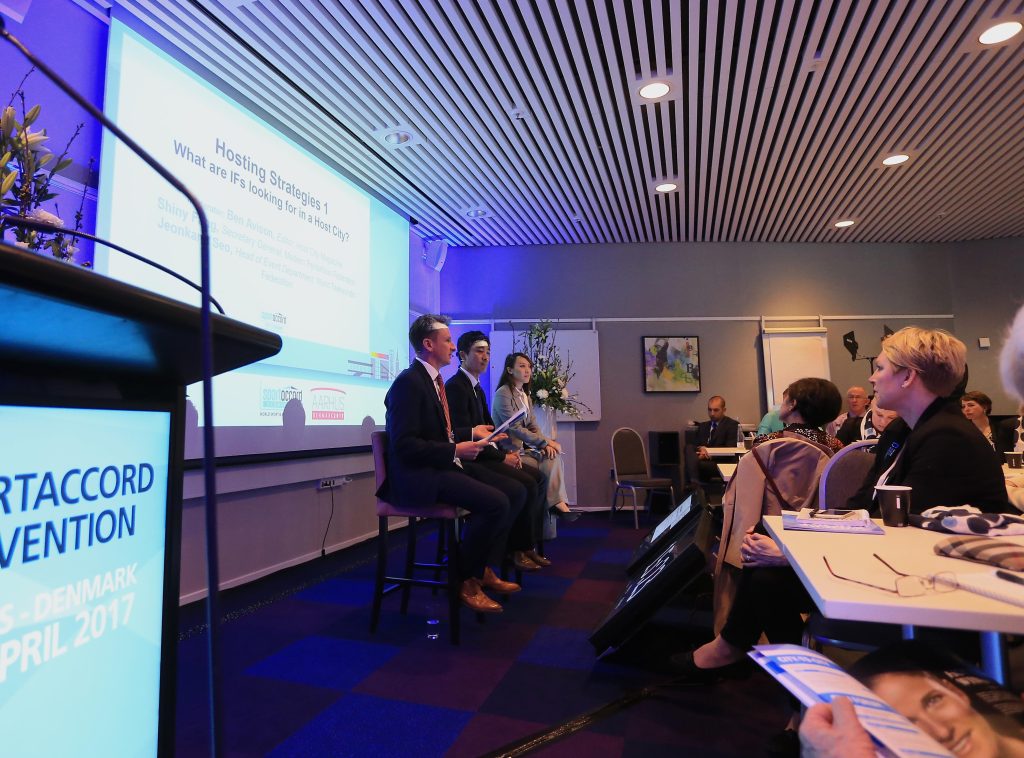
  • What are international federations looking for in a host city?

    What are international federations looking for in a host city?

    Ben Avison (BA): It has been said that cities are becoming less interested in hosting major multi-sports events than smaller championships. Do you think that’s true of your events? How keen do you think cities are on hosting your own events?
    Jeongkang Seo (JS): Smarter cities carefully assess the return on investment and may find it not very attractive to host mega events which require huge investment if there is no matching benefit. Taekwondo is a relatively cost-effective sport which does not require any huge investment but is capable of bringing competitive values and leaving strong legacy, so we are finding more cities showing interests in hosting our events based on our measurable value proposition.
    Shiny Fang (SF): In our case cities are quite keen – it’s all about the anticipation and expectation of the cities. Before they bid for competitions they want to know what would happen and what are the opportunities. We have many cities bidding for our competitions, but we try to divide different levels of competition. When we choose cities, the world championships go to bigger cities and smaller events go to some smaller cities which are more suitable hosts in terms of infrastructure and facilities.
     
    BA: The World Taekwondo Championships this year is in Muju, the home of taekwondo. How important is it to take your sport to new regions as well?
    JS: Hosting events is a very effective way of developing a sport in a country or a region. It creates new national heroes who inspire spectators and TV audiences to take up the sport. Five medals were taken by African nations at the Rio 2016 Games and taekwondo is now increasingly popular there. So, it is undeniable that it is stable to go to the region where taekwondo is already developed and popular, but equally it is critical to find the less-developed place for the purpose of sport development.
     
    BA: People talk a lot about the importance of readiness for events – we hear examples of cities that are only just ready in time and in the worst case scenario it become apparent they are not going to be ready. How important is this for you and how does it impact your choice of host city?
    SF: In our discussions, we always talk about the working relationship and how closely the city and federation can work together to host the event. Even though we are aspiring to the highest standards you still have to rely on local partnerships; sometimes they will wait until the last moment and they will say they are ready when actually they are still not ready. It’s a constant struggle but it’s not impossible to find solutions.
    Good project planning is essential for anyone, including the IOC, the IFs and not only in sport but in industry. Therefore when we choose a working partner it’s important to examine how precise they can be and how confident you can be in your expectations of the plan together.
     
    JS: If a city has clear objectives and has willingness to collaborate with the right holders as partner, I think it will be able to prepare events quickly and to a high standard. We are also providing the host cities with support program called STEP (Support taekwondo event program) to ensure the host cities clearly understand operational requirements for hosting our event in every stage in the lead up to actual organization. So, I would say that close collaboration and partnership are more important than readiness.
     
    BA: You mentioned the importance of partnerships there – how important is the alignment between city and national governments?
    SF: I think it’s super important. Especially when bigger sized competitions and the national federations have limited resources. It is a significant commitment from the federations, so they need to have the support of the local authority government or central government. It is very important. Our new bidding procedure enables us to award a competition to a city instead of a national federation – of course they will be involved in any case but mainly on the technical side. At the end of the day a competition is not only a competition, it’s an event, so you need effort and input from all sides.
    JS: Strong and sustainable partnership among themselves will ensure smooth preparations and everlasting legacies. For example, the City of Manchester built such a strong relationship with the national taekwondo organization, matching their long-term strategies. The city helped build the national training center and the national federation is teaching self-respect and self-discipline to young kids in the city. Also partnering with UK sport, they presented three events in three years, a plan that perfectly matched our long term strategy as well. We are encouraging this know-how with other potential cities at our annual Partnership Workshop program.
     
    BA: In an age where events are mainly experienced remotely via TV and digital, does it make a difference where an event is hosted?
    SF: I would say yes, because you have a better atmosphere inside a competition than outside that can seriously affect the whole production. If you want to show the best images that sum up the drama and excitement of your competition, you have show how excited people are on site watching.
    JS: These days, there are several different ways to consume sports, so it is of course important to produce high quality production and utilise social media to effectively deliver the footage to the audience at home but it is equally important to create great atmosphere onsite as it improves the experience for those watching from their homes. Spectators have a vital role to play in contributing to the success of the event, transmitting vivid impression of the sport from venue.
     
    BA: Is it possible to evaluate all factors in a bidding procedure – for example the venues, broadcast infrastructure and local culture? How do you select your cities bearing all these things in mind?
    JS: Hosting an event is a partnership between an IF and a city and it should be a collaborative process. Both parties have to benefit from the partnership and as an IF we must not be too prescriptive. We ask questions in the bid file where they need to answer: What’s the purpose of bidding? What’s the legacy you want to leave? What’s your capacity for producing all these requirements? By answering the questions the bidders already have in their mind if the event is suitable for them or not and at the same time we are able to evaluate the capacities and suitability of the cities who want to organize our events.
     
    BA: Another approach might be to have a range of events that are suitable for different types of cities. In the case of the UIPM I know you have the Laser-Run that be held in different venues…
    SF: Sure. In certain competitions you always have set criteria. Within those criteria you can always enlarge the number of spectators, so you can award the event based on the final bidders. The criteria are clear; you always have to have a basic host standard which you cannot compromise.
    For IFs, to be very practical, we are looking for cities to have the ability to host the competition – that’s goal number one. Only when you have a place where you know things will happen according to your requirements are you safe. We are not in a bad situation for bidding cities but the commercial valuation of our sport is not simple. For sponsorship and partnerships it’s not easy for any sport.
     

    CITY VIEW: What does a host city want from an IF?

    Colin Edgar, director of strategic partnerships, Glasgow Life told the session: “What Glasgow wants with IFs is a true partnership, one where both the host city and the federation feel jointly responsible for delivering each other’s priorities.
    “Sometimes the city feels responsible for delivering the federation’s priorities, because you had to make all these promises to bid. I think in the future, as cities need to much smarter about how they invest and spend their money, they are going to be looking for deep and true partnerships where the federation understands what the city wants and feels that they have a responsibility for delivering that.”

  • Four countries express interest in hosting 2022 Commonwealth Games
    Four countries express interest in hosting 2022 Commonwealth Games

    The Commonwealth Games Federation has received expressions of interest in hosting the 2022 Commonwealth Games from Australia, Canada, Malaysia and the United Kingdom.
    The bidding process for 2022 was reopened after Durban was unable to fulfil financial obligations. Durban had been awarded the Games when it became the sole bidder after Edmonton pulled out.
    But with four countries having expressed interest by the 28 April deadline, the CGF is now set to have a strong pool of cities bidding for the major multi-sport event.
    “We are delighted with the level of initial interest expressed by nations across the Commonwealth and look forward to working with all parties as plans develop for a Games to be proud of in 2022,” David Grevemberg CBE, CEO of the CGF said in a statement.
    “This is the first step in a collaborative process that will see a clear and detailed set of criteria applied to any Games hosting ambitions. The process has been streamlined to be as agile as possible given the time available and to minimise costs for potential hosts, whilst maintaining the transformative ambitions of the Commonwealth Sports Movement.
    “An expert CGF Review Team will work with each country in the evaluation of proposals of potential host cities. This will include a rigorous on-the-ground feasibility assessment and dialogue regarding hosting capacity and capability, resourcing and legacy ambitions, before a recommendation is made to the CGF Executive Board for final review and decision. Based on the number of interested parties it is not expected that the process will finally conclude until early Autumn.”
    It has not been specified at this stage in the process which cities are proposed to host the Games. Cities connected with possible bids include Liverpool, Manchester and Birmingham in England; Sydney, Melbourne, Perth and Adelaide in Australia; and Kuala Lumpur in Malaysia and Victoria, Edmonton and Toronto.
    The CGF has not ruled out the possibility of cities sharing hosting duties.