Tag: fifa world cup

  • Prince Ali stands to lead FIFA away from controversy

    Prince Ali stands to lead FIFA away from controversy

    HRH Prince Ali Bin Al-Hussein of Jordan has announced that he will stand for the presidency of FIFA, in a bid that could bring Sepp Blatter’s 17 year reign to an end.
    “This was not an easy decision,” Prince Ali said in a statement. 
    “It came after careful consideration and many discussions with respected FIFA colleagues over the last few months.”
    His decision comes soon after the culmination of FIFA’s investigations into allegations of corruption in its bidding process for the 2018 and 2022 World Cups, which failed to identify any culpable wrongdoing and led to the resignation of Michael Garcia, the lawyer hired by FIFA to investigate the allegations. 
    Prince Ali has pledged to run a positive campaign and to steer FIFA away from the controversies of recent years.  “The message I heard, over and over, was that it is time for a change. 
    “It is time to shift the focus away from administrative controversy and back to sport.”
    Prince Ali became vice president of FIFA in 2011. He is also president of the Jordan Football Association and the West Asia Football Federation, which he founded in 2001. 
    If elected, Prince Ali would be the first FIFA president from the Asia region and only the second from outside Europe, after Brazil’s Joao Havelange.
    At just 39 years old, Prince Ali is a contrasting candidate to FIFA’s 79 year old candidate Sepp Blatter, who announced in September 2014 that he would run for a fifth term. 
    At Soccerex Global Convention in September, Prince Ali spoke out in favour of time limits for presidential terms 
    Blatter is a formidable opponent who has weathered many a storm without any apparent loss to his power or personal reputation. 
    The only other candidate in the race is Jerome Champagne of France, who also announced he would stand in September 2014. 
    The deadline for presidential candidates to come forward is the 29th January. All candidates must be nominated by five FIFA members, of which there are 209. 
    The election takes place by secret ballot on May 29th.
     

  • Genset demand surges as Qatar 2022 approaches

    Genset demand surges as Qatar 2022 approaches

    The power rental market in Qatar is set to grow at a compound annual growth rate of 23.3 per cent until 2020, according to research by 6Wresearch.
    “Upcoming FIFA World Cup 2022, rising public and private infrastructure, construction of hotels and stadiums and increasing flow of investments in the country are exhibited to fuel the growth of Qatar’s power rental market,” the researchers said.
    The majority of this growth will be accounted for by diesel gensets, but environmental concerns and the local abundance of natural gas will also drive growth in non-diesel gensets. Gas generators are expected to rise in prominence. 
    International suppliers such as Aggreko, RSS, JTC, Byrne Investments, Hertz are cited as key players in the Qatar power rental market, alongside domestic players such as Qatar Building Co., Al Reyami and Qatar Industrial Equipment.
    American multinational Cat Entertainment Services is another big player in major event power generation with the potential to tap into the growing market in Qatar.
    More than US$200bn is being invested in infrastructure developments in the run up to the 2022 FIFA World Cup. 
    The temporary power supply industry is in huge demand on projects such as Lusail City, the Doha Metro Rail, construction of expressways, hotels and other facilities, as well as nine new stadiums and major renovations to three existing stadiums. 
     

  • Glasgow 2014 tops UK ranking; unlucky FIFA 13th

    Glasgow 2014 tops UK ranking; unlucky FIFA 13th

    The Glasgow 2014 Commonwealth Games has topped a UK ranking of the impact of the “buzz” of sports events in 2014, the SportIndex 2015 Annnual Report. 
    “It’s such a fantastic thank you to everyone who put such energy and effort into the Glasgow 2014 Commonwealth Games to know that people across the UK ranked us as their number one positive world sporting experience of 2014,” said David Grevemberg, chief executive of the Commonwealth Games Federation and former chief executive of Glasgow 2014.
    While the ranking does not discriminate between British and international events, those that were hosted in Britain or featured strong performances by British sportspeople inevitably created the biggest buzz. 
    According to the findings of the report, the FIFA World Cup in Brazil was only the thirteenth most positive sporting event of 2014 for British consumers.
    The UK, like several other countries around the world, broke record viewing figures for the opening matches of the 2014 FIFA World Cup. However, audiences in the UK quickly lost interest after England’s exit at the group stage. 
    The authors of the report also cite the Luis Suarez biting incident as negatively impacting British interest in the World Cup.
    The report found that Wimbledon created biggest buzz for an annual event, despite a below par performance by British star Andy Murray. 
    The FA Cup was the most widely enjoyed football event, with its highest buzz score ever.
    The Formula One British Grand Prix had the biggest growth in buzz, on the back of British star Lewis Hamilton’s winning performance. 
    The SportsIndex 2015 Annual Report, powered by YouGov, analyses the levels of overall recent UK public awareness and news sentiment for 50 leading domestic and international sports events. It measures “peak buzz score”, the net difference between the amount of respondents hearing positive news and those hearing negative news.
    “What a great way to mark exactly six months on from an Opening Ceremony which launched a festival of sport and culture which people across the Scotland, the UK, Commonwealth and beyond could feel part of,” said Grevemberg.
    “Six months on, the athletes of the Commonwealth who competed, the thousands of volunteers and staff who delivered the Games and the people of Glasgow and Scotland who were the warmest of hosts can feel hugely proud of their achievements, the pleasure they shared and the special place they’ve won in the nation’s hearts.”

  • Brazil 2014 World Cup hailed as sustainability benchmark

    Brazil 2014 World Cup hailed as sustainability benchmark

    Sustainability is a relatively new concept to the FIFA World Cup, which has a significant impact on the environment, but last year’s tournament set new standards that will influence other future mega events, FIFA and Brazilian officials said on Tuesday.
    “Sustainability is something quite new in the organisation of the FIFA World Cup,” FIFA secretary general Jérôme Valcke said at the launch of a sustainability report on the 2014 World Cup.
    “Brazil learned a lot with the FIFA World Cup, Rio learned a lot for Rio 2016, but we also learned a lot and we will implement these learnings in 2018 in Russia in the 11 host cities and 12 stadiums.”
    The deputy sports minister of Brazil, Luis Fernandes added “The FIFA World Cup stadiums in Brazil became a benchmark for the world because they have all pursued sustainability certificates. 
    “Based in this experience, a sustainability certificate has become a requirement by FIFA in the future editions of the World Cup. This is a legacy to Brazil for the world.”
    Hosting the FIFA World Cup involves large transportation operations, catering for millions of spectators, managing waste as well as powering and broadcasting the event globally.
    “This has inevitably had an impact on both society and the environment in the host country,” said Federico Addiechi, FIFA’s Head of Corporate Social Responsibility. 
    “To us, sustainability is about how we do things and trying to find a balance between the social, economic and environmental aspects. It is also about minimising risks associated with the event and reducing the negative impact of it, while maximizing the positive one.”
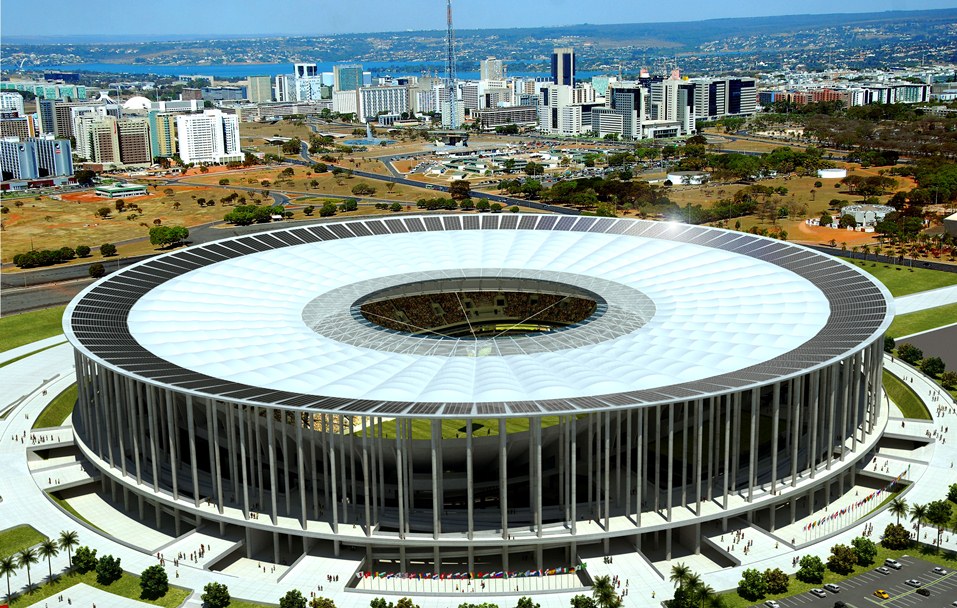
    The 2014 World Cup in Brazil took place in 12 stadiums, seven of which were new and five of which were renovated. Eight of the stadiums integrated solar power in their designs. 
    Nonetheless, preparing for and hosting the 2014 FIFA World Cup is estimated to have produced 2,723,756 tonnes of CO2 equivalent.
    “Brazil is a developing country and we identified that the opportunity to host the FIFA World Cup was a historical window to leverage investments in infrastructure and services, which our country needed and still needs,” said Fernandes. 
    “Brazil today is recognized as a country that, in spite of the scepticism, delivered the FIFA World Cup with excellence and today we have infrastructure that improved the lives of Brazilians.”
    The venues were spread over all the major regions of the huge country. The 41,000 capacity Arena Amazonia, for instance, was built in the remote resort of Manaus. There is not a big footballing culture there and the only event since the World Cup to draw a capacity crowd was Boi, a local cultural festival. 
    “The FIFA World Cup left us memories of great football, but also a great responsibility. Brazil has now 12 modern arenas in all five regions,” said José Maria Marin, chairman of the Brazilian Football Confederaition (CBF) and 2014 local organising committee.
    “A challenge, but also an opportunity for clubs and cities to strengthen local football and offer a new entertainment option for the community beyond football matches.”
    Despite the challenges of utilising this new infrastructure, FIFA is working in Brazil to continue building even more venues in more regions of the country through a US$100m legacy fund. 
    “Brazil is already a giant in football, but we still need to develop infrastructure and this will be done by FIFA and CBF through the Legacy Fund,” said Fernandes. 
    According to FIFA, the main areas to benefit from the fund will be football infrastructure in the states that did not host World Cup matches (60 per cent), grassroots (15 per cent) and women’s football (15 per cent). 
    “For the Legacy Fund, we agreed it should go to developing women’s football, grassroots and to regions where there were no FIFA World Cup matches,” said Valcke.
    “On women’s football, there is potential to do more in Brazil. We work together with CBF so they can establish a dedicated structure for female football through the legacy fund,” said FIFA Director of Member Associations and Development, Thierry Regenass.
    “There should be good grassroots programmes. The idea is also to work in partnership with local government and other partners in order to publicise more women’s football and make it sustainable.”
    Valcke stressed that the awarding of contracts will be carefully monitored. “FIFA is supporting CBF in order to identify and make sure we are working in the right projects. We have a permanent audit system that monitors our member associations, certifying everything is under clear rules and regulations. 
    “Not a single pay will be made without FIFA having a look at the way it will be used and making sure we are part of the decision process.”
     

  • Luis Figo runs for presidency of “deteriorating” FIFA

    Luis Figo runs for presidency of “deteriorating” FIFA

    Luis Figo on Wednesday put himself forward as a candidate for the presidency of FIFA, promising to improve the organisation “deteriorating” image and remove its association with “scandal”.
    Announcing his bid with just one day to go before the deadline, Figo joins Prince Ali of Jordan, Jerome Champagne and David Ginola as a challenger to FIFA president Sepp Blatter. 
    “I look at the reputation of Fifa right now and I don’t like it. Football deserves better.
    “In recent weeks, months, and even years, I have seen the image of Fifa deteriorate,” Figo told journalists. 
    “If you search FIFA on the internet, you see the first word that comes out: ‘scandal.’ Not positive words. It’s that we have to change first and try to improve the image of FIFA. Football deserves much better than this.
    “I’ve been talking with so many important people in football – players, managers, president of federations – and they all think that something has to be done.
    The brand image of FIFA’s most valuable product, the World Cup, is at risk, Figo said.
    “Last year was the World Cup, I was in Brazil and I saw the reaction of all the fans regarding the image of FIFA and I think something has to be changed.
    “Change in leadership, governance, transparency and solidarity, so I think it’s the moment for that.”
    All candidates will need to show the support of at least five nominating member associations in order to validate their presidential campaigns. 
    FIFA’s Harold Mayne-Nicholls, who led the evaluation commission for, and questioned the outcome of, the controversial 2018 and 2022 World Cup bidding procedure has said he may also enter the race.
    The 42-year old footballing legend played for Barcelona, Real Madrid and Inter Milan, winning FIFA World Player of the Year award in 2001 and the Ballon d’Or in 2000.
    FIFA requires presidential candidates to demonstrate that they have worked as “a board member, committee member, referee, assistant referee, coach, trainer [or] any other person responsible for technical, medical or administrative matters in FIFA, a Confederation, Association, League or Club”.
    The president will be elected on 29th by FIFA members. Support for incumbent President Blatter is said to be very strong. 
     

  • Qatar 2022: We can host World Cup any time of year

    Qatar 2022: We can host World Cup any time of year

    The uncertainty surrounding the timings of the 2022 World Cup is set to continue until 24th February and the country is able to host at any time of year, according to the Qatar 2022 Supreme Committee for Delivery and Legacy (SC). 
    The World Cup traditionally takes place during the northern hemisphere’s summer months, during which the European football leagues take a break.
    The Asian Football Confederation (AFC) president Sheikh Salman bin Abraham Al Khalifa of Bahrain’s earlier this week asserted that the World Cup would take place in the winter, preferably November and December 2022, and that “the matter is resolved.”
    But Nasser Al-Khater, the executive director of communications and marketing at the Qatar 2022 SC is reported to have said a press conference at the Doha’s Aspire Zone: “Look, first and foremost we are confident of hosting the World Cup anytime of the year. 
    “It is also no secret that the peak tourism timing is November and December.”
    According to Inside World Football, Al Khater said “There is a meeting of the task force on the 24th of February. What we understand is that a final decision will be recommended during that meeting. It’s the last meeting of the task force to discuss a winter or a summer World Cup.”
    Qatar’s summer months reach blistering heats of over 50 degrees centigrade and many observers have commented on the risks of hosting football matches in these conditions. 
    The SC says it has the cooling technology to overcome these challenges. 
    “We believe the methods and principles [of cooling] are a solution for many countries that will host the World Cup and other events in the future,” Al Khater said.
    “Utilising this technology on such a large scale and having to think outside the box, we are really providing optimal climate conditions.”
    The SC also told press that Qatar’s venue infrastructure projects are on schedule, with five stadiums under construction and two more set for an imminent design launch. 
    Al Khater also faced questions about FIFA’s investigations into the manner in which Qatar was elected as World Cup host.
    “It’s important to highlight it’s an investigation into the bidding process of 2018/2022, but also into individuals,” he said.
    “Everyone coins it as an investigation into Qatar, which is absolutely false and incorrect. We are happy with judge Eckert’s conclusion. At times it was a bit harsh, but, you know this is a World Cup and you will always have criticism and negativity.”
     

  • FIFA Election: how Blatter’s challengers compare

    FIFA Election: how Blatter’s challengers compare

    The presidents of the world’s 209 Football Associations will elect the president of FIFA at the FIFA Congress on 29 May. 
    With FIFA’s continental “confederations” holding great sway over voting intentions, and with all of these confederations bar UEFA said to be supporting Sepp Blatter, the incumbent president looks set to secure a historic fifth term. 
    Candidates must state their intention to run for president on 29 January, with the support of five nominating member associations. Are there any serious challengers in the mix?
     
    Sepp Blatter
    Nationality: Swiss
    Age: 78
    Announced campaign: 26 September, 2014
    Core message: Says he is on a mission to complete the reform process initiated in 2011
    Strengths: FIFA President since 1998, seeking a fifth term. Retains strong support of the majority of FAs outside Europe. Five of FIFA’s six continental Confederations are said to be backing Blatter: AFC (Asia), CAF (Africa), CONCACAF (North and Central America and Carribean), CONMEBOL (South America) and OFC (Oceania).
    Challenges: FIFA enduring external pressures and the emergence of Prince Ali of Jordan as a challenger demonstrates that internal discontent is not limited to Europe.
     
    Jerome Champagne
    Nationality: French
    Age: 56
    Announced campaign: 26 September, 2014
    Core message: To remove elitism and global imbalance from the administration of football.
    Strengths: Says he is close to gaining the five required nominations.
    Challenges: Time is running out and a host of other, more outspoken candidates have emerged.
     
    Prince Ali Bin Al Hussein
    Nationality: Jordanian
    Age: 39
    Announced campaign: 6 January 2015
    Core message: Reform of FIFA, increasing transparency. 
    Strengths: Experience as vice president of FIFA, president of Jordanian Football Association and president of West Asian Football Federation. Has backing of the English FA. The only challenger to Sepp Blatter from outside Europe.
    Challenges: Has yet to confirm whether he has the number of nominations required. His message of reform is echoed by those of other candidates who have since entered the race. 
     
    David Ginola
    Nationality: French
    Age: 48
    Announced campaign: 16 January 2015
    Core message: To restore democracy, transparency and equality to FIFA
    Strengths: Has the support of pressure group ChangeFifa but has yet to declare the support of any FAs.
    Challenges: Ginola’s campaign is financially supported by bookmaker Paddy Power, yet FIFA rules prohibit candidates “being associated with betting, gambling, lotteries and similar events”. 
     
    Michael van Praag
    Nationality: Dutch
    Age: 67
    Announced campaign: 26 January 2015
    Core message: To normalise, modernise FIFA and regain public trust. Presenting himself as the only credible opponent to Blatter.
    Support: Has the required five nominations, including support from Scotland.
    Challenges: Other European candidates offering a message of reform and transparency could split the vote, if they gain the required nominations. Support outside Europe is limited.
     
    Luis Figo
    Age: 42
    Nationality: Portuguese
    Announced campaign: 28 September 2015
    Core message: To repair FIFA’s public image.
    Support: Has the required 5 nominations.
    Challenges: A recently retired footballer, he lacks experience in football administration.

  • FIFA proposes launching Women’s Club World Cup in 2017

    FIFA proposes launching Women’s Club World Cup in 2017

    FIFA’s Committees for Women’s Football and the Women’s World Cup are proposing to the Executive Committee that the inaugural Women’s Club World Cup should take place in 2017.
    Executive Committee member Moya Dodd convened a meeting of the FIFA Task Force for Women’s Football in Zurich on Monday, when the date of 2017 was proposed for the Women’s Club World Cup. 
    The Task Force noted that the competition is important “to create an annual showcase of elite women’s football and to provide an incentive not only to clubs, but also to confederations and member associations, to strengthen club football and club structures in their respective regions.”
    This proposal is being examined by the Committees for Women’s Football and the Women’s World Cup on Tuesday, before a proposal is to be sent to the Executive Committee.
    The FIFA Executive Committee, which decides on the introduction of all new competitions, holds its next meeting on 19-20 March.
    FIFA President Sepp Blatter announced the creation of the Task Force in October 2013 in order to identify and establish priorities for the development of women’s football.
    As well as the Women’s Club World Cup, the Task Force also discussed how to implement the ten key development principles for women’s football, which were first discussed at the group’s first meeting a year ago and approved at the 64th FIFA Congress in São Paulo.
    “The approval of the ten key principles by the FIFA Congress last June marked a major milestone for the development of women’s football,” said Moya Dodd.
    “These principles have laid a foundation from which to build on, sending a clear message to confederations and member associations on what FIFA expects of them to continue growing the women’s game. 
    “FIFA is also taking concrete action, for instance the doubling of women’s development funding for the 2015-2018 cycle, and now further progress is being made towards the creation of a FIFA Women’s Club World Cup. All of our efforts need to go in one direction in order to see more women on the football pitch but also involved off the pitch as well.”
    Other topics discussed at the Task Force meeting included Futsal, the professionalisation of the women’s game, club licensing, medical issues and strategies to increase female 
     

  • Luis Figo strikes to break up FIFA’s power

    Luis Figo strikes to break up FIFA’s power

    Luis Figo was the first of the candidates for the FIFA presidency to launch his manifesto today, proposing radical changes to an organisation that he says has deteriorated under the current leadership and suffers from a “negative reaction”.
    The retired Portuguese footballer pledged to redistribute at least half of FIFA’s funds equally around the world to develop football at the grass roots level. 
    With the aim of establishing good governance, Figo wants to establish a FIFA Football Council to advise the president and Executive Committee, as well as an independent governance, audit and compliance committee with powers to “control the actions of the president”.
    He also announced a proposal to increase the number of members on the Executive Committee, with equal representation from each of the continental confederations.
    In a bid to boost the global appeal of his candidacy, he also announced plans to increase the number of non-European teams competing in the World Cup.
     
    Figo’s and FIFA’s funding
    Drawing on his own life story, Figo revealed that his campaign is entirely self-funded. “I grew up in working class of Lisbon, playing on streets,” said Figo. “My life changed through the power of football and I am lucky to be an independent man. I don’t owe anyone anything; this means I can serve FIFA in the interest of football, for football.
    “Thank God I’ve had a long and successful career. When you retire, you need to have a balance – it’s on a smaller scale than FIFA’s budget but the way I’ve managed my finances shows that I can stand on my own two feet. I have enough money to pay for my candidature.”
    Figo plans to redistribute FIFA’s revenues to enable children all over the world to get a chance to become professional footballers. 
    “I was very lucky and fortunate to play and get training from an early age but I know this opportunity does not exist for many children across the world,” he said.
    “This is why I propose radical changes to the way FIFA redistributes its membership payments.
    “I want to see at least 50 per cent of FIFA funds spent on grass roots football and to increase the size of the funds available.”
    This amounts to US$ 2.5 bn. He also wants to distribute an additional US$1bn directly to the member associations over a four year period. 
    Currently, the member associations receive less than US$ 4m per four years.
    He questioned FIFA’s current approach of setting aside a US$1.5bn reserve pool to cover the possibility of the World Cup being cancelled. “This money is not FIFA money – it is the member associations’,” he said. 
    “US $5m is enough to cover the operational cost of FIFA.”
    This offer of cash may help Figo to gain backing for his campaign from the 205 member associations around the world that elect FIFA’s president on 29th May. 
    In another bid to boost the appeal of his campaign outside Europe, Figo also said he would like to increase the number of teams competing in the World Cup, without increasing Europe’s participation. 
    “I believe we should consider proposals to expand the competition to a 40 or even 48-team World Cup,” he said. “Both these options are feasible with an extra three to four days of tournament play.”
     
    Structural changes to restore trust
    Central to his campaign is rebuilding trust in FIFA. 
    “In the last few months and years we’ve come to realise that the FIFA image has deteriorated. 
    In Brazil, during the most important sport competition the World Cup, I could see protests against the organisation – and this was in a country that loves football deeply. 
    “I could see the reaction to the president of the organisation – I could see quite a negative reaction. This is not an appropriate image.
    “When I started to look at all the news about scandals I decided that something needed to change.”
    The changes that Figo proposes are major and structural. 
    “There must be transparency. My proposal is to change structures, so there will be a wider consultation with members. 
    “In the different confederations, we will organise meetings between 10 and 15 member associations… and the summaries of those strategic meetings will be distributed and passed on to the board.”
    He also announced plans to establish a new FIFA Football Council to advise the FIFA president and the Executive Committee on issues including the calendar and format of events as well as the laws of the game and football development. 
    This council would have a moderating role over hosting decisions.
    “It is also important to maintain decisions within the council in terms of which countries go on to organise the World Cup,” he said.
    On the issue of the controversy and investigations surrounding the 2018 and 2022 World Cups, he acknowledged that there are reports of “irregularities that have taken place, reports not made public.”
    But indicative of his aim to achieve global appeal, he did not support any of these claims, saying “If there are no irregularities, I don’t think Qatar should be prejudiced [against].”
    He also proposes to merge the existing ethics and disciplinary committees to create a new governance, audit and compliance committee.
    “For there to be transparency, the governance committee would have to be a fully independent committee from the council and also from the executive committee, and therefore that they could control the actions of the president.
    “With these measures defining the different responsibilities and powers of each body, I think we would have the right measures for transparency within the organisation.”
    The composition of the Executive Committee would also become a more level playing field with equal representation internationally. Each continental confederation would have one seat per ten member associations, with an additional seat for member associations that have won the World Cup, with a limit of eight seats per confederation.
    With six confederations each bringing up to eight members, this would represents a major increase on the current Executive Committee membership of just 27. 
     
    Can he win it?
    Figo chose to launch his bid in London, with the venue for the press conference switched from Stamford Bridge to Wembley Stadium at 24 hours’ notice. 
    “London is a global city and Wembley is an emblematic football space. There is no better place to present my ideas to the world,” he said.
    Figo’s candidacy was nominated by six European associations. Whether he will be able to gain support from the 205 member associations, the vast majority of whom are said to have unwavering support for the incumbent president Sepp Blatter, remains to be seen. 
    “Mr Blatter, well I respect him, he has been leading the organisation for many years. He has had many positive achievements for football and for the organisation but a point has reached where change has needed.”
     Figo’s other competitors in the presidential race are Prince Ali Bin Al Hussein of Jordan and Michael Van Praag of the Netherlands. 
    “Looking at the other candidates, we have some good ideas, someone who is in the Executive Committee and who knows how the organisation works internally. Also the Dutch FA president I know and respect very much; he has a lot of experience.”
    He denied suggestions that he might step aside to support a single challenger to Blatter. 
    “My idea is right now is to run to the end, to see as many people as possible regarding the presidency and to convince them with my ideas.
    The president of FIFA will be elected at the FIFA Congress on 29th May.
     

  • Qatar 2022 stadium build reaches ground level

    Qatar 2022 stadium build reaches ground level

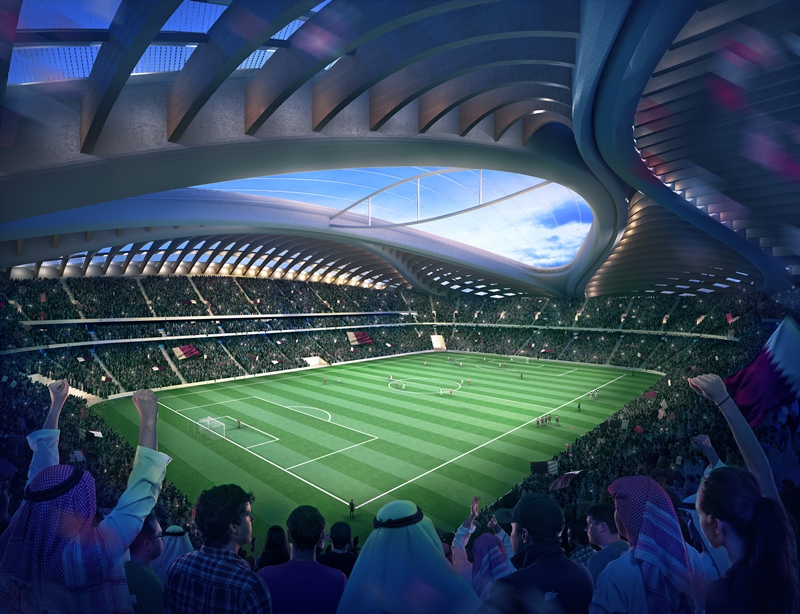
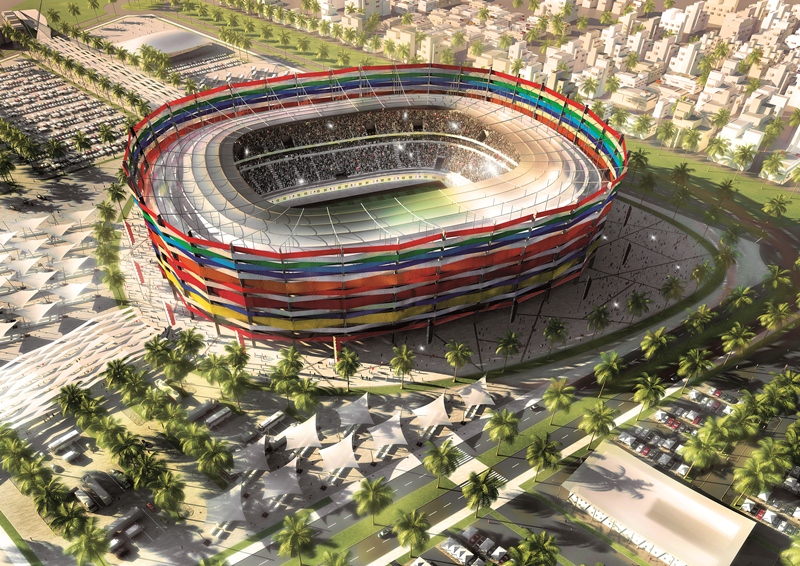
    HBK Contracting Company has laid the first concrete above ground at Al Wakrah stadium, the first of five new venues being built to host the 2022 FIFA World Cup in Qatar.
    “We have started laying the foundation of 168 m3 of structural concrete in our east slab,” said Abdulla Al-Marri, senior project engineer at the Al Wakrah Precinct. 
    “This is an important achievement, being the first above-ground casting of concrete at the site which will incorporate the structural elements to begin vertical construction.”
    To lay the concrete slab at double the usual speed, HBK is using two pumps that work simultaneously.
    The foundations of the stadium will feature 84 concrete piles, measuring 19 m by 1.2 m. Enabling works contractor HBK has poured 55 of these so far, the first pile being cast in December 2014, a year after the designs and location of the first new venue for the 2022 World Cup were made public.
    According to the Supreme Committee for Delivery & Legacy, the organisation responsible for hosting the World Cup, a top priority now for the enabling works contractor is to cast the remaining foundations to allow the Main Work Contractor to start building the stadium on these foundations. 
    The Supreme Committee also identified completing drainage works and excavations around the stadium as a priority for HBK.
    According to the Supreme Committee, HBK has completed over one million Lost Time Accident (LTA) free man-hours. 
    “We observe that all safety measures are in place before works starts and we reward safety practices every month,” said Al-Marri. 
    The Al Wakrah site is to hold a “safety fair” in March as part of regular safety training across all Supreme Committee sites. 
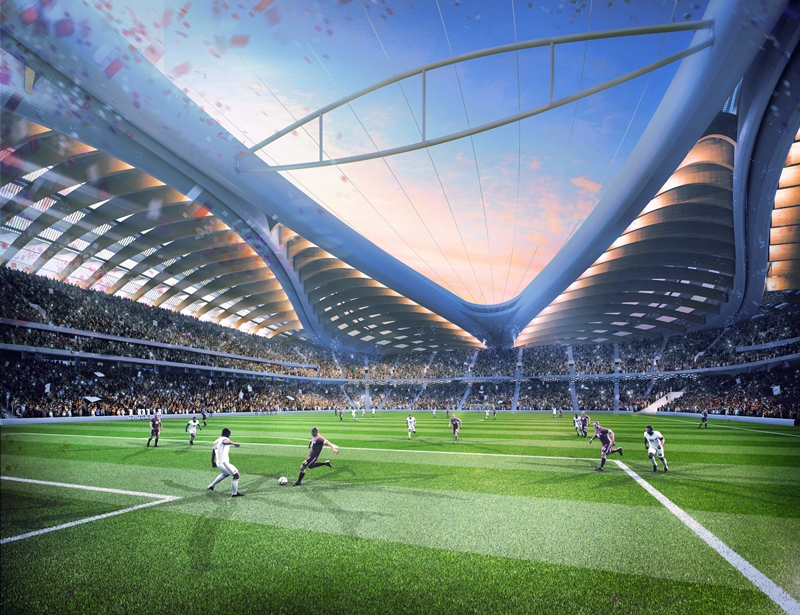
    The stadium will have 40,000 seats during the World Cup, with 20,000 seats on the upper tiers to be removed after 2022 and sent to developing countries in need of sporting infrastructure.
    The stadium will be the future home of Al Wakrah Sports Club. It will be surrounded by approximately 560,000 m2 (60 ha) of legacy precinct with a new sports centre and community facilities including a park, mosque, school, hotel, wedding hall, vocational training centre and retail outlets.