British minister for the Cabinet Office and paymaster general Francis Maude this week met with senior Qatari officials, one of whom is to visit London next week to meet with experts on cybersecurity.
Maude was in Qatar to discuss transparency, “open government” and cybersecurity – a critical issue for the hosts of major events.
“I chaired the cabinet committee in Britain on the 2012 Olympics and cyber security was a big concern,” Maude told the Gulf Times.
“We want to work very closely with the Qatar government in preparing for the 2022 FIFA World Cup. The lessons of how and what we did and all of that, we are very keen to share it with our friends,” he said, adding that Qatar and the UK have “a huge amount of common ground.”
The UK signed a security pact with Qatar last year, under which the two countries security agencies are sharing intelligence.
Information sharing between countries is crucial to maintain the security of data, as the internet transcends national boundaries.
“Governments need to work together in real time, with business and other organisations to share knowledge, information and capability quickly and effectively. Building those close relationships on these matters with our governments is of first importance.”
Bilateral trade between Qatar and the UK is valued at about GB£5.4bn (QAR30bn/US$8.2bn) annually. A British Chamber of Commerce was established in Qatar last month to boost cooperation between Qatari and British small to medium sized enterprises.
“There is a lot of Qatari investment in London and elsewhere in Britain, and we are busy building that up,” said Maude.
“We want Britain to be the best place in the world for companies to do business and we want to work with our friends and colleagues in Qatar for the benefit of both countries.”
Tag: fifa world cup
-

Qatar official to meet London cybersecurity experts
-

FIFA requests Qatar 2022 venue and dates plan by end of 2015
FIFA secretary general Jérôme Valcke has requested that the Local Organising Committee (LOC) for the Qatar 2022 World Cup propose the number of venues to be used as a “next important step” to be confirmed by the end of 2015, along with the timings of the tournament.
He also commended progress on infrastructure works and evident progress on improving the welfare of construction workers.
Speaking at the end of the LOC’s first board meeting in Doha on Tuesday, FIFA’s secretary general Jérôme Valcke said “We had a very constructive first LOC Board meeting and are pleased with the work accomplished to date by the LOC, especially in delivering a first customised operational plan to the specifications of the host country.
“As we have done with previous hosting partners, we will help find solutions that work best locally including considerations for beyond the event itself.
“Next important step will be for the LOC to provide FIFA with feasibility studies to identify the best number of venues to ensure perfect playing conditions for the teams. We aim to have a confirmation of dates, length of tournament and final number of stadia to be used by end of this year.”
On Monday, a FIFA task force recommended that the 2022 World Cup should take place in late November until late December , with a slightly shortened timeframe than the usual four weeks.
The CEO of the LOC, Hassan Al Thawadi said “We are ready to host anytime depending on the wishes of the global football community.”
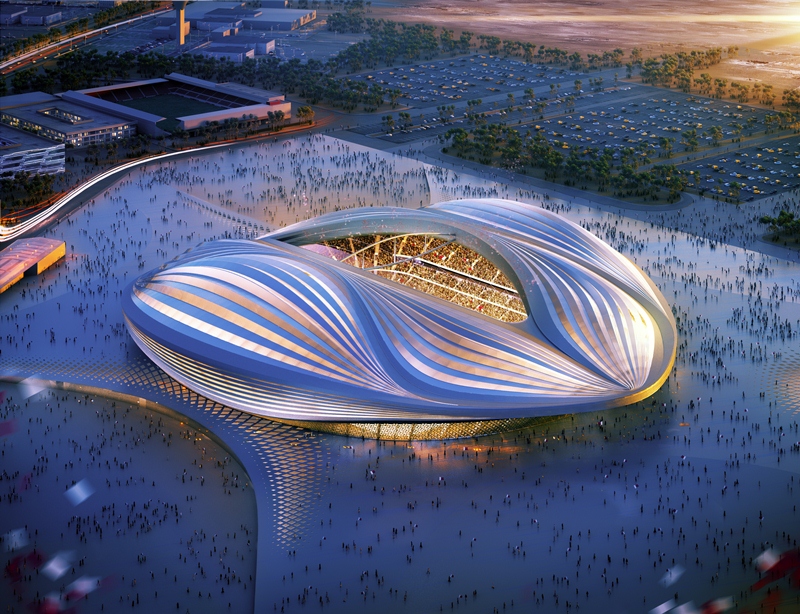
Valcke was shown around the building site of the first stadium being built for the World Cup. “It was very encouraging to see yesterday the Al-Wakrah stadium construction site as well as the respective workers living facilities,” he said.
“I am no expert on these issues but I can see that progress is being made, particularly with the standards introduced by the Supreme Committee related to 2022 infrastructure. At the same time, recognising this is a complex issue that is vital for the Qatari authorities to continue to work on with labour experts to ensure that the initiated measures on welfare standards are sustainably implemented for all workers in Qatar and not limited to 2022 projects.”
The main focus of the meeting was for the LOC to present to FIFA its Tournament Operation Master Plan (TOMP), which it describes as a “unique hosting concept based on the compact World Cup”.
The Qatar 2022 LOC will focus on operational planning, tournament preparedness and coordinating with FIFA on all competition related matters.
The Supreme Committee for Delivery & Legacy (SC) – the organisation tasked with delivering infrastructure for the 2022 World Cup and its aftermath – also gave a presentation on the development of stadiums and extensive transportation network links which will connect these and other venues across the country.
“Today’s meeting was a significant milestone as we continue to make progress towards hosting an outstanding FIFA World Cup which will leave a lasting legacy for future generations in the Middle East,” said Thawadi. “This was an opportunity to demonstrate our operational preparations and ensure we are ready to deliver the tournament as early as possible.
“The first LOC board meeting is a symbol that this World Cup is not simply a concept for a tournament that will be held in the distant future. It is evidence that we are working every single day to deliver a unique tournament that will bring people in the Middle East together and build bridges between East and West.”
-

Luis Figo welcomes winter World Cup in Qatar
Luis Figo, the retired Portuguese footballer who is running for the presidency of FIFA, has said that the organisation is right to recommend hosting the World Cup in late November and December 2022 – despite the disruption this would cause to the European football leagues.
“The FIFA Task Force recommendation is the right decision for the World Cup,” he said in a statement.
After a six month consultation process, the FIFA task force recommended earlier today that the 2022 World Cup should take place at the end of the year, to avoid clashing with the Olympic Games, Ramadan and the hottest months of the year.
“It has to be played in the best possible conditions for the fans and players who will enjoy a great World Cup atmosphere, and for Qatar who deserve to be put in the position to organise a great event,” Figo said.
“With good will and a sense of solidarity it is always possible to find the right solutions.”
Figo’s endorsement is in contrast to the reaction of other leading European football administrators. The European Professional Football Leagues and the European Clubs Association had been pressing for the World Cup to take place from 5 May to 4 June and will continue to oppose the proposed date change.
Richard Scudamore, the chief executive of the English Premier League, said “It’s the European leagues and European clubs that are going to suffer the most, so it’s very disappointing.”
While Figo has been outspoken about the need for transparency in FIFA, he is taking a very diplomatic stance on the issue of Qatar’s right to host the World Cup. At the launch of the manifesto for his presidential campaign last week, he acknowledged that there are reports of “irregularities that have taken place, reports not made public” but said “If there are no irregularities, I don’t think Qatar should be prejudiced [against].” -

Qatar to host World Cup in December 2022
A FIFA task force charged with identifying the least disruptive timeframe for hosting the 2022 World Cup finished its six month consultation process today with the recommendation that the event should take place at the end of the year.
The task force has identified end of November to the end of December as the most viable period to host the 2022 FIFA World Cup.
To minimise disruption to domestic leagues, the tournament will take place over a slightly shorter timeframe than usual, depending on the number of venues to be used.
According to unconfirmed reports, the tournament could run right up to Christmas with the final taking place on 23 December.
The dates are set to be confirmed at the next FIFA Executive Committee meeting in Zurich on 19 and 20 March 2015.
“The outcome of the discussions is also a proposed reduced competition days schedule with the exact dates to be defined in line with the match schedule and number of venues to be used for the 22nd edition of football’s flagship event,” said FIFA.
How many venues Qatar will use for the World Cup is still unknown. 12 venues were proposed in the bid; FIFA’s minimum requirement is eight but it would be difficult to shorten the timeframe of the tournament with so few venues.
Reducing the number of teams from 32 or matches from 64 has not been discussed.
Qatar’s bid for the World Cup was based on a summer tournament, but since being awarded the right to host the event it has become evident that the temperatures would be too high, even with advanced cooling technologies.
A FIFA statement also cited the 2022 Winter Olympics and Ramadan as immovable obstacles.
“Given that the two bidding cities for the 2022 Winter Olympics – Almaty (Kazakhstan) and Beijing (China PR) – pledged recently to host the winter games from 4 to 20 February 2022; that the month of Ramadan begins on 2 April in 2022; and that consistently hot conditions prevail from May to September in Qatar, the only remaining effective option is the November/December window,” said FIFA.
Postponing the event until early 2023 is not an option due to legal reasons, FIFA said.
FIFA says the proposal has the full support of all six confederations. However, European leagues have fought hard to avoid the competition taking place during their calendar.
England’s Premier League said in a statement: “The 2022 World Cup was bid for and awarded to Qatar as a summer tournament.
“The prospect of a winter World Cup is neither workable nor desirable for European domestic football.”
FIFA said the task force took on board the considerations of everyone concerned.
“The analysis aimed to find the most viable solution for all stakeholders, covering the likely and possible impacts of conditions on players, staff and fans, as well as the knock-on effect for domestic leagues.
“The representatives of the leagues once again emphasised the impact that a November/December tournament would have on their respective calendars.
“The members deliberated over the various options to determine the least impact on the national and international football calendars.
Discussions are also underway about whether to move some of the qualification matches, with a final phase in early 2022 under consideration.
“We are very pleased that, after careful consideration of the various opinions and detailed discussions with all stakeholders, we have identified what we believe to be the best solution for the 2018-2024 international match calendar and football in general,” said Sheikh Salman Bin Ebrahim Al Khalifa, the chair of the FIFA task force.
“It was a challenging task and I want to thank all members of the football community for their productive input and constructiveness in helping to find a solution that we believe can work for everyone.”
-

Qatar 2022 to keep it cool as winter World Cup confirmed
FIFA’s executive committee today approved a task force recommendation to host the 2022 World Cup in November and December.
The final is due to take place on 18th December 2022, which is Qatar’s National Day. The length of the tournament will be finalised by a working group, but FIFA stated there is “the objective, in principle, of staging the tournament in 28 days”.
The decision was welcomed by the organisers of the tournament, the Supreme Committee for Delivery & Legacy.
“We welcome the decision of FIFA’s Executive Committee in relation to the timing of the 2022 World Cup in Qatar. We are satisfied the process has reached its conclusion,” it said in a statement.
“Regardless of the change in dates, we will continue to develop the cooling technology promised during the bid, ensuring our commitment to deliver a true legacy as a result of the first World Cup in the Middle East remains.”
The daily average maximum temperature in November is around 30 degrees Celsius.
The timings of the event mean that British teams will be able to play their traditional boxing day fixtures.
The prospect of a winter world cup has been fiercely challenged by the European football clubs and administrators.
However, Luis Figo of Portugal, who is running for the presidency of FIFA, stated his support for the decision.
“A decision on the hosts and dates of the World Cup has to be as consensual as possible, after consulting all the interested persons and organizations and having in mind above all the health of the players, officials and, of course, the supporters,” he said.
“I also think that people of Qatar deserve respect and now that there is a decision I hope they will have the time to concentrate in delivering a good World Cup.” -

Kazakhstan planning 2026 FIFA World Cup bid
Kazakhstan intends to bid for the 2026 FIFA World, subject to feasibility discussions with the government, the country’s FA president said on Wednesday.
“We are discussing this issue with the government of my country to assess what are our chances,” Kazakhstan FA president Yerlan Kozhagapanov told L’Equipe.
Growing at an average of 5.4 per cent per annum, Kazakhstan’s is the largest economy in Central Asia. Its second largest city, Almaty, is currently bidding to host the 2022 Winter Olympic Games.
“Our country is developing rapidly, our economy is growing, so why not? We want to organise the winter [Olympic] Games in 2022, and we plan to engage in the race for the organisation of the World Cup 2026.”
Kazakhstan is rich in oil but its national team has yet to qualify for a UEFA European Championship, let alone a World Cup.
The criteria for bidding for the 2026 FIFA World Cup will be determined by FIFA’s executive committee on 30 May 2015.
UEFA countries may be excluded from bidding for 2026, as Russia is hosting 2018. Asian countries will not be able to bid for 2026 as it immediately follows Qatar hosting the World Cup in 2022.
If it were to bid for 2026, Kazakhstan would likely be competing against the US, the world’s largest economy which also has a fast growing soccer market.
The host nation of the 2026 World Cup will be elected by 209 FA presidents at the FIFA Congress in Kuala Lumpur in May 2017.
-

Qatar reveals 2022 World Cup stadium design
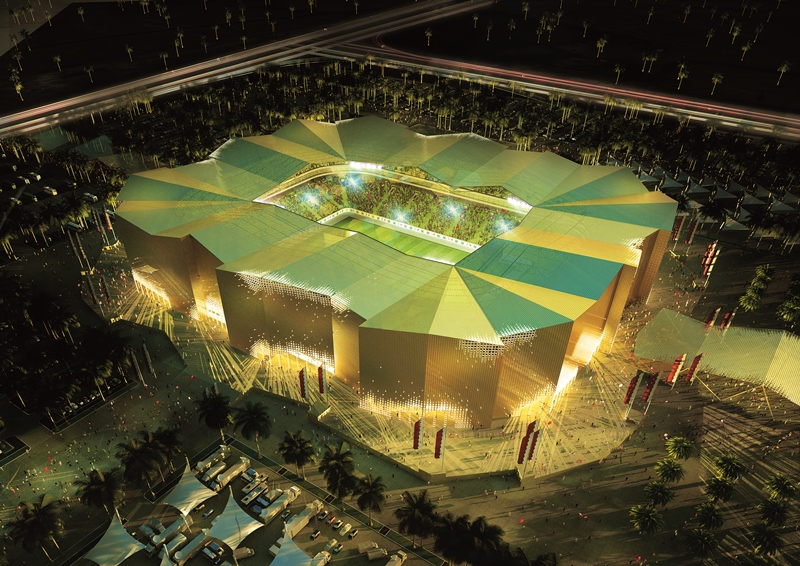
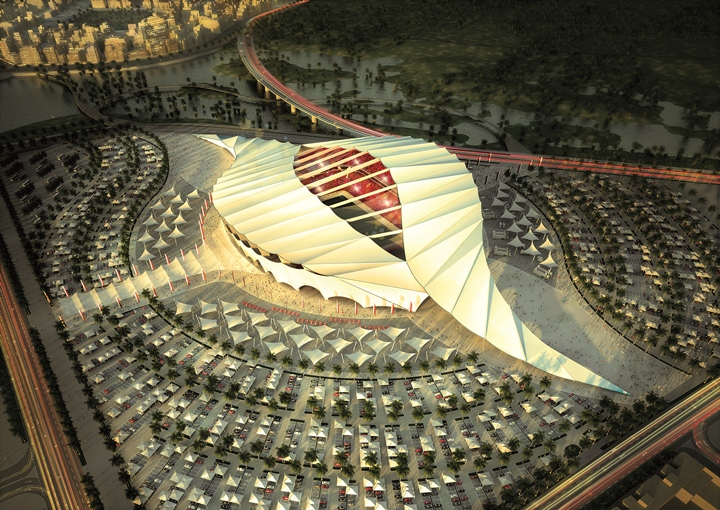
The fifth venue plan for the Qatar 2022 FIFA World Cup was unveiled on Wednesday. The new Al Rayyan stadium, which replaces an existing smaller football stadium, will have a capacity of 40,000 during the World Cup and be reduced to 21,000 after the tournament.
The construction project is set to be complete by 2019.
Material from the old stadium is being reused and recycled. The new design incorporates renewable energy and cooling technologies to maximise legacy use.
“Unveiling the design of Al Rayyan stadium is another important step forward in our preparations to host the 2022 FIFA World Cup,” said Hassan Al Thawadi, Secretary General of the Supreme Committee for Delivery & Legacy.
“We will continue to work tirelessly as our vision for the tournament takes shape on the ground.”
The upper tier of 19,000 seats will be removed after the tournament and sent to developing nations in need of sports infrastructure.
“Qatar has moved from the stage of reiterating its bid commitments towards demonstrating its ability to deliver several important infrastructure projects to the highest international standards in accordance with the timetables set,” said Salah bin Ghanem Al Ali, Qatar’s Minister of Youth and Sports.
Even though the 2022 World Cup is set to take place in the cooler months of November and December, the stadium will incorporate cooling technology to maximise the venue’s potential for legacy use.
“The sophisticated modelling employed has heavily influenced the innovative designs for cooling systems and the advanced roof and wind screen design, with best practice being used to optimise designs for waste reduction and energy management strategies,” said Yaver Abidi, regional managing director Middle East and Asia at Ramboll, the lead design consultant on the stadium.
“The Al Rayyan Stadium will deliver an impressive and comfortable experience for fans and players alike and leave a strong legacy for the Al Rayyan community.”
90 per cent of materials from the deconstruction of the current stadium is being re-used. Some of the materials will be used by local and international artists to create works of public art.
Doors, windows, frames, water fixtures and fittings, light switches and sockets have been used in construction site accommodation and offices. Concrete has been crushed and stored for future site levelling works. Reinforcement bars and other metals will be recycled by Qatar Steel. Topsoil has been stockpiled for future precinct landscaping works, while scrap timber will be recycled by licensed centres across Qatar.
The stadium precinct’s carbon footprint will be reduced through the use of on-site renewable energy, lightweight building design, careful selection of materials and energy and water efficiency measures.
The stadium is designed with the goal of certification under both the Global Sustainability Assessment System (GSAS) and Leadership in Energy and Environmental Design (LEED) ratings.
David Barwell, chief executive Middle East and India of AECOM said: “As the project manager for the Al Rayyan Stadium and Precinct, we see our strength in connection, bringing together our global team of experts from previous major sporting and FIFA events, and the embedded knowledge in country, technology and cooling experts, all of which is led by our strong project, commercial management and delivery team.
“We connect the collective knowledge, experience and innovative ideas to create an amazing sporting venue that brings people closer together and close to the action. The community and culture of Al Rayyan has been at the heart of what we are trying to achieve, creating a destination venue that will leave a meaningful legacy they can be proud of, now and in the future.”
The stadium design is intended to reflect Al Rayyan’s sporting heritage and Qatar’s environment, through patterns and designs on the stadium’s façade.
“The stadium’s distinctive façade was created using cutting-edge parametric design tools so that it also plays an important role in cooling the building.” said Dipesh Patel, architect and founder of Pattern Design, the lead design consultants on Al Rayyan. “The result is a landmark for Qatar that works effectively both as a world-stage for sport and, we hope, something that is genuinely meaningful and welcoming locally.”
Al Rayyan Stadium is the fifth stadium design the Supreme Committee has unveiled. Work is now underway across the following stadiums: Al Wakrah, Al Bayt – Al Khor, Khalifa International Stadium, Qatar Foundation Stadium & Health and Wellness Precinct and Al Rayyan Stadium.
-

How can future tournaments remain sustainable? The solution is in the format
Since the original Olympics Games in Ancient Greece, tournament format has remained the same: Round-Robin Groups and Direct Elimination (play-offs). The usage of these formats has caused several issues that organisers have failed to solve.
One major issue is flexibility in the number of participants and matches. Then there is the existence of low-value or “dead” matches, where teams have nothing to play for because they’ve already qualified for the next round or have been eliminated.
Match-fixing is another problem. In London 2012 for instance, eight female badminton players were disqualified from the tournament due to their attempts to lose their matches on purpose to get an “easier” rival in the next round.
Losing or drawing a match on purpose for the benefit of both sides is something that we see in almost every big tournament. In an attempt to address this issue, matches on the last day of group stages are played simultaneously in many big tournaments, such as the UEFA European Championship and FIFA World Cup. This precautionary move, which followed the “Disgrace of Gijon” in the 1982 FIFA World Cup, can be devastating for fans, sponsors and broadcasters and creates further problems.
Having the last two matches of a group played simultaneously means that two stadiums must be used for each group, so teams must travel from one city to another. In a group of four teams the only way to make teams have the same amount of travels, to ensure fairness, is by making all teams travel twice – that is, playing the first match in one stadium, the second in another and a third stadium for the third match. Having all teams travel once is impossible mathematically, and zero travel is not an option when staging matches simultaneously.
Travelling twice during the group stage can involve a large amount of air travel. For instance, In 2014 FIFA World Cup the United States national team had to travel from Natal to Manaus and then to Recife, a total distance of nearly 6,000 miles.
MatchVision, a company based in Chile, has the solution for this and the associated issue of flexibility in the number of participants in a tournament. In 2003, FIFA expressed an interest in raising the number of participants in the World Cup to 36, but declared it impossible as they couldn’t find a fair and simple way to select 16 teams advancing to the Round of 16.
After hearing that declaration, Leandro Shara, MatchVision President and founder, knew he had the solution for it – the POT System ©. Under the POT System © there are no groups; instead, the teams are divided into POTs, depending on the number of matches of the first round.
For instance, a FIFA World Cup with 36 teams would have three POTs, each one containing 12 teams, based on ranking – POT A would have the strongest teams, POT B the medium teams, and POT C the emerging teams. Each team, no matter which POT it is placed in, would play three matches, one against a team from POT A, one against a team from POT B, and one against a team from POT C. For instance, Germany would meet Argentina from POT A, Croatia from POT B and Jordan from POT C. On the other hand, Jordan from POT C would meet Germany (A), as well as Uruguay (B) and Costa-Rica (C).
The POTs are not groups, instead we will have one General Standing of the 36 teams, and after three match days the best 16 would qualify to the next round, fair and simple. Moreover, in the Round of 16 the 1st would face the 16th, the 2nd would face the 15th, etc. That means that teams would want to finish as high as possible to have an “easier” rival in the next match.
This will bring a revolution in the strategy of winning tournaments: the best way would always be, for the first time, to win all matches. It also kills the chances of score manipulations, as teams would not depend just on their match and one additional match (in a four-team group), but on their match and results from the other 17 matches.
Eliminating the possibility of score manipulation would allow all matches in the first round to be played at different times, so spectators around the world could watch all matches live. Additionally, we can ensure that all teams travel exactly once in the first stage and travel the shortest distance from their “home” base. This means that if each host city has another host city within 500 miles or less, than maximum travel for a team would be 500 miles, even if host cities are spread over an entire continent.
The opportunities don’t stop there. MatchVision has developed more than 30 solutions giving flexibility to tournaments. So for instance, the Olympic Volleyball competition could have 10 teams instead of 12, with teams still playing five matches in the first round, or to increase the number of teams in the Badminton tournament from 16 to 18, a 12 per cent increase, instead of the usual 50 per cent or 100 per cent increase caused by the rigidity of Groups and Play-Offs formats.
The inflexibility of the traditional tournament formats has created absurd situations, like the ATP World Tour Finals, which is played by eight players, even though the entire world of tennis, including the ATP website itself, talks always about TOP-10. To have a clearer picture of things, the phrase TOP-10 is googled 25 times more than TOP-8. The only reason just 8 players enter the O2 Arena is due to format restrictions, and thus we adjust the reality to the format.
It is time to turn that upside down and adjust format to reality, using tournament formats developed in the 21st century. The format revolution is coming.
-

2018 World Cup breaks new ground with SIS Pitches reinforced turf
The FIFA World Cup final will be played on a surface incorporating artificial grass for the first time ever, after Russia 2018 organisers selected an innovative surface called SISGRASS from SIS Pitches.
A surface of 95 per cent natural grass impregnated with more than 150 miles of specially developed synthetic yarn will be installed at Moscow’s historic Luzhniki Stadium.
The pitch is scheduled to be ready in time for the Confederations Cup in May 2017.
SIS Pitches said its SISGRASS surface offers a safer, softer surface that protects players from injury, but with three times the playing time of natural grass alone.
“It’s the first time a World Cup final has been played on anything but all-natural grass and it’s like a dream for us as a company and a community,” said SIS CEO George Mullan.
“We have come so far to get this system to the pinnacle of world sport.”
The patented system was created after SIS Pitches approached Dutch engineers to design a ‘giant sewing machine on tracks’. This machine crawls across a pitch, implanting, or ‘stitching’, more than 240 million precise lengths of two-tone green synthetic yarn 180mm deep into the sub-surface.
“We didn’t want to simply improve on existing machinery. We chose a challenge to create the perfect hybrid pitch of natural and synthetic grass and start from scratch,” said Mr Mullan.
“It strengthens the structure of the natural grass, making it stronger and more resistant to damage which means more games can be played on a pitch. It also drains more effectively. For a busy tournament like the World Cup it is perfect.
“At the same time it is player-friendly. Our polyethylene construction actually gives it a softer feel, with more consistency and greater traction than natural grass alone. That reduces injury risk and the bounce and roll is always even, so the players love all these features,” adds Mr Mullan.
SIS Pitches says the durable surface is also visually indistinguishable from natural grass.
“TV Companies also love it because the surface stays looking beautiful at all times,” said Ilyas Kobal, SIS division managing director.
“It was a long tender process but in the end our advantages meant even the local Russian companies could not match us.”
SIS Pitches had to convince the FA, FIFA and a host of international testing bodies that its new system worked better than alternatives. This involved stringent accelerated wear trials by rigorous independent testing consultants STRI.
In these trials the new surface beat unreinforced grass for damage resistance, traction, grass cover and sheer strength, SIS said, claiming that the surface can be used three times longer in all weathers without damage and can be laid in just one week.
Construction work to transform Luzhniki Stadium is underway, due for completion in early 2017. A system of undersoil aeration, drainage, irrigation and heating is being installed to allow the pitch to be used all year. A custom designed rootzone will be laid, stitched with yarn and then seeded to be ready in time for the Confederations Cup.
During the 2018 World Cup the stadium will host the opening and final matches. SIS Pitches has also signed a two-year deal to maintain the pitch after the World Cup, when Luzhniki will be the home of the Russian national team.
Since its launch in summer 2015, SISGRASS has also been selected for Chelsea, Besiktas, Hull City FC and the English FA’s centre of excellence at St. George’s Park.
-

Can Qatar develop through football?
Qatar may be under scrutiny for treatment of workers as it invests US$200bn in infrastructure projects before the FIFA World Cup in 2022, but senior figures in football administration point out that the event is an important part of the country’s process of human development.
“The government of Qatar made a clear vision in 2008 to transform from being dependent on natural resources and they aim to be an economy based on knowledge and people. As a result, well-being becomes the number one priority of the nation,” Mushtaq Al Waeli, Executive Director, Strategic and Institutional Development, Qatar Football Association (QFA) tells delegates at World Football Forum in Paris.
This development plan, National Vision 2030, has four pillars: economic, human, social and environment – and football is a key element of that vision.
“Through sports you ensure people are engaged in physical activity. It’s also a vehicle of social cohesion and integration,” says Al Waeli.
“The social structure of the country is based on people coming into the country from different cultures. Integration is key. Sports – football in particular – has that magic and charm of bringing people together.”
Bidding for the FIFA World Cup was a statement of intent to put the Middle East on the world stage – not just for the nation but for the region. “When we started the bid process in 2009, the message to the world was clear: this is not just a tournament for Qatar,” says Al Waeli.
“We are united with the region – the Middle East and western Asia. The message is to say we have the right for this major event to come to our land and it will be an amazing tournament – from the visitor experience to the field of play.
“We are also delivering legacy: a physical legacy of venues, and also contributing to how to prepare for any event that comes beyond or before the World Cup. We are creating a new process of developing sports and events.”
But the World Cup is about much more than sports events for the host nation. “I think Qatar has made all that effort and bid for the 2022 tournament – not only showing the great passion that the nation has for football and to bring the tournament to the region – but also to drive the progression towards realising National Vision 2030. It’s a catalyst, a key milestone,” says Al Waeli.
However, the value of the 2022 World Cup in Qatar in is rarely presented in such a positive light in the media. Few people feel this more acutely than Alexander Koch, FIFA’s Head of Corporate Communications.
“We are working very hard in order to leave a positive legacy of the events,” he points out. “Looking at Russia in 2018 and Qatar in 2022, I could talk for an hour about all the efforts that are being done and all the progress being achieved with this new focus. We hope that these positive elements will find their way into the media,” he says.
“When it comes to Qatar, we are being criticised for worker’s rights situation, for environmental aspects: how can you play in a desert country; what is the legacy; why are you going where there is no football tradition; and so on.
“But you can turn this all around and see what the legacy will be in an event like Qatar, and what the actual effect is for the people and the foreign workers in a country like Qatar.
“Do you really believe that this is negative, with all the media attention and for the first time ever people have a contract signed by the international trade union and Amnesty International and so on?”
A “Workers’ Cup” has been set up for people working on World Cup venue construction projects. Attendance has been high, with around16,000 people having attended matches so far.
Khalifa Al Haroon, Executive Director, Marketing and Communications, Qatar Stars League says: “We aim to be as inclusive as possible. That’s why we are organising the Workers’ Cup. Any company that wanted to compete had to sign up to the Workers’ Charter, to makes sure human rights are upheld – and to give these people the opportunity to become players. This is something we will be continuing as long as possible.”
A ladder to the stars
Qatar is the only country that has a National Sports Day that is a national holiday when everyone takes a day off to take part in sport. The country also stages a number of other different community events, such as the Asian Communities Football tournament.
“We are creating different levels of leagues, from professional to amateur, to encourage people to play the sport and maybe be future superstars,” says Al Haroon.
Crucial to the creation of Qatar’s potential future football stars is the Aspire Academy, which is open to the general public.
“The QFA is focussed on training players on how to invest their income. It’s not just about football; it’s about creating an industry that didn’t exist four years ago.
“We won the AFC U19s in 2014 and hosted the AFC U23 in 2016, which we were told was the best organised. That knowledge is being passed on to the players and the general public.”
Mushtaq Al Waeli says: “I had the honour to be part of the Aspire Academy’s creation. The first youth that joined went on to win the Asian Youth Cup, so the system proved that it’s working.
“The elite from the clubs, we bring them to a different part of the academy so they play with the best teams in the world. We work on creating a holistic player who is ready to compete anywhere in the world. If we qualify for the 2018 World Cup you will see players that came through that system.”
Even if Qatar doesn’t qualify for the 2018 World Cup it will automatically qualify for 2022 as hosts. But is automatic qualification necessarily a good thing for the country? Peter Hutton, CEO of major broadcaster Eurosport is not convinced that Qatar will be ready to compete at that level.
“You have to be realistic – it’s important to play teams that are in the same sort of FIFA team rankings area as you, and to have targets that are just above you and look to achieve target by target.
“What’s not helpful is to go to an international tournament and then be wiped out, because your whole sense of identity with your country as national football pride actually falls apart.
“And that’s the concern for Qatar – how will the Qatar national team play when they get to the World Cup, because if they don’t do well, then that can be negative story.”
The Josoor Institute
Mushtaq Al Waeli is acting director of the Josoor Institute, a centre of excellence for the sports and events Industries.
He says “Josoor is an Arabic word that means bridges. We wanted to connect the knowledge of the present, the past and the future.
“It’s all about knowledge. We are not just a training institute. We aspire to become a centre of excellence. We develop knowledge through research, we embed knowledge through training and education, and we consult on the future.
“We created Josoor when Qatar won the right to host the 2022 tournament. They set up a government vehicle called the Supreme Committee of Delivery and Legacy, to keep our promise that we will deliver an amazing tournament in the best possible time. We also wanted to create excellence in human capital development; that responsibility was given to Josoor.
“Our remit is not for Qatar only. We want to reach everybody who has an interest in working in sport or event industries or wants to move from one academy to another.”
Launched in 2013, the Josoor Institute delivers a set of products, including certificates and diplomas, working with partners in Qatar and overseas, including leading educational institutions.
This article was written by Ben Avison of Host City at the World Football Forum 2016. The comments from Mushtaq Al Waeli and Khalifa Al Haroon were made in conversation with Simon Chadwick, Professor of Sports Enterprise, Salford University