Tag: Olympic Games

  • Tokyo 2020: we must stay close to IOC and IFs

    Tokyo 2020: we must stay close to IOC and IFs

    HOST CITY: Congratulations on your appointment as President of Tokyo 2020. How have your previous experiences prepared you to take on the responsibility of organising and delivering the world’s greatest and most complex event? 
    Mr Yoshiro Mori: Of course, it is a great honour to have been appointed as President of the Tokyo Organising Committee of the Olympic and Paralympic Games. However, I am also keenly aware of the huge responsibilities that come with this position and the many challenges that lie ahead. 
    As well as having served as Prime Minister of Japan, I have also been engaged in the promotion of sports for many years. I have served as President of the Japan Sports Association, and am currently President of the Japan Rugby Football Union and Vice President of the Rugby World Cup 2019 Organising Committee. 
    Throughout my long involvement in sport, I have always recognized the importance of forging close working relationships based on mutual trust with a variety of stakeholders both domestically and internationally, and have always endeavoured to put this into practice. It is fullest intention to make the most of my extensive experience, and exert my utmost efforts towards building productive relationships with the International Olympic Committee, the International Paralympic Committee and international sports federations, as well as the wider international sporting community. 
     
    HOST CITY: Why do you think Tokyo was selected as the host city for the 2020 Olympic Games?
    Mr Yoshiro Mori: The main objective of the presentation given by the Tokyo bid committee at the 125th IOC Session in Buenos Aires last September was to demonstrate to the members of the IOC that the people of Japan had once again realised the power of sport to act as a force for good through their struggles in overcoming the tragic earthquake and tsunami of March 2011, and their strong desire to further promote these values and make a significant contribution to the international community. 
    I believe that that many IOC members were persuaded by Tokyo’s presentation, and this is a major reason behind Tokyo being elected as the host city for the 2020 Games. Other important factors were Tokyo’s meticulous plans for the successful delivery of the Games, the fact that Tokyo is a safe pair of hands for the Olympic Movement, and the fact that Tokyo has a proven track record of successfully hosting several major international sports tournaments.  
    Our overarching aim is to deliver a seamless and successful Olympic and Paralympic Games, and to communicate the power and values of sport. In so doing, I hope that we are able to respond to the expectations that the world has towards the Tokyo 2020 Games. 
     
    HOST CITY: What is the global significance of Tokyo and Japan hosting the Olympic Games in 2020, as compared to in 1964?
    Mr Yoshiro Mori: The 1964 Olympic and Paralympic Games left an immeasurable amount of both tangible and intangible legacies in Japan. Furthermore, a vast majority of these legacies remain in regular use even now, a half century later. The 1964 Games served as a platform for Japan to showcase its economic strength and technological capabilities to the world, and provided Japan with the opportunity to claim its rightful place among the world’s leading industrial nations in the second half of the 20th century. 
    Now, as we prepare for the 2020 Games, Japan has already reached the status of a ‘mature nation.’ Evidence of this can be seen by the fact that Japan, along with other mature societies, is now working towards realisation of a largely equitable society and is tackling the problem of an increasingly ageing society. I believe that countries around the world are looking to Tokyo and Japan to come up with solutions to the kind of problems faced by mature societies through its hosting of the Olympic and Paralympic Games. From a global perspective, I feel that this is one of the roles expected of Japan by the international community. 
     
    HOST CITY: What are the organising committee’s most important priorities for the second half of 2014 and for 2015?
    Mr Yoshiro Mori: The most important task facing us for the remainder of 2014 is the formulation of our Games Foundation Plan. The Organising Committee is obligated to submit our finalised Games Foundation Plan to the International Olympic Committee early next year, and we are currently working feverishly on ensuring that the plan is completed on time. 
    From next year, we will enter the phase of putting our finalised plans into practice. Accordingly, it is essential that we forge close working relationships with the IOC, the IPC, IFs, NOCs and all other stakeholders. We realise that our first priority must be to establish a relationship of trust with all the aforementioned stakeholders. 
     
    HOST CITY: Further ahead, which of the functional areas, such as security and transport, do you think will require the most attention?
    Mr Yoshiro Mori: The Organising Committee is composed of ten separate bureaus, each with responsibility for a specific function. The bureaus are Administration, Planning and Finance, Engagement, Marketing, International Relations and Sports, Games Preparations and Operations, Security, Telecommunications, Venues, and Coordination for Infrastructure. 
    Each of these is a vital function, and without even one of them a successful Games would not be possible. Of course, among these functions, it is important that some bear fruit quicker than others, but rather than saying which of the functions is more important, it is perhaps more accurate to say that our greatest responsibility should be to ensure that all functions are acting in unison towards the ultimate objective of delivering a successful Games. 
     
    HOST CITY: How do you expect media scrutiny to grow as you get closer to 2020 and how does the organising committee plan to manage the media coverage of Tokyo’s preparations?
    Mr Yoshiro Mori: Both the London and Sochi Games drew a huge amount of attention from the international media. I am certain that the Tokyo Games will attract the same amount of media attention, if not more. 
    The organising committee already has a specialist communications team in place to handle enquiries from both the Japanese and international media, and they are able to respond swiftly to the many requests for interviews we receive from journalists on almost a daily basis. The team also shares information each week with the IOC communications team by teleconference. 
    In addition, we have also set up a network to maintain regular contact with the communications teams of the Tokyo Metropolitan Government, the Japanese Olympic Committee, the Japanese Paralympic Committee and the Japan Sport Council, and we plan to further expand this collaborative network in the future. 
     
    HOST CITY: What role do you see for the many international partners and suppliers that can support Tokyo’s staging of the Games?
    Mr Yoshiro Mori: Various types of expertise and technical abilities are essential for hosting the Olympic and Paralympic Games. Of course, it is impossible to include all these areas of expertise in the organising committee. Therefore, it is essential that we avail ourselves of the professional products and services provided by sponsors and suppliers in specialist business fields. One could even say that they are indispensible partners in ensuring the successful delivery of the 2020 Games.
    Sponsors and suppliers also play a vital role in helping to create a vibrant atmosphere for the Games. The organising committee will work closely with sponsors and suppliers to further contribute to the Olympic and Paralympic Movement. 
     
    HOST CITY: HOST CITY magazine helps event organisers to deliver the best events in the world, by sharing the experience of different host cities. How important is information like this in preparing to host the greatest show on earth?
    Mr Yoshiro Mori: Without doubt, the Olympic and Paralympic Games is the most complex sporting event in the world to organise, and preparations require an inordinate amount of time and effort. It is important that we obtain as much expertise and knowhow as possible in the least amount of time. 
    We have learned much and gained vital experience of previous Games through our participation in the IOC’s Observer Programme and Olympic Games Knowledge Management Programme. However, we also realise that there is still much more we can learn from specialist international media outlets such as HOST CITY magazine.
     
    This interview first appeared in the Autumn issue of HOST CITY magazine. Register here

  • IOC should make culture equal to sports, says Agenda 2020 expert

    IOC should make culture equal to sports, says Agenda 2020 expert

    The first principle of Olympism is to blend sport with culture, but Olympic Games is still not going far enough to raise the profile of cultural events, according to a prominent UK politician and expert advisor to the IOC.
    “I think probably the IOC needs to go further in reaffirming the fundamental role that the cultural festival has as part of the Olympic and Paralympic Games,” Dame Tessa Jowell told HOST CITY in an exclusive interview. “So there are three events: there is the Summer Games; the Paralympics and the cultural festival.”
    While host cities can and often do put on major cultural events alongside major sporting events, their primary obligation is towards the sporting activities. However, Jowell, who is an expert advisor to the IOC on bidding procedure as part of its Olympic Agenda 2020 review, says that cultural events should take on just as primary a role as sporting activities during the Games.
    “I think it’s important that Pierre de Coubertin did see this duality in the Olympic ideal, and it would be a great pity to lose that,” she told HOST CITY.
    The founder of the modern Olympic Games, Coubertin envisaged the Games as a “festival of mind and body”.
    “At the time of the splendour of Olympia… literature and arts, harmoniously combined with sports, ensured the greatness of Olympic Games. This should be true for the future,” Coubertin wrote.
    While early modern Olympic Games featured medals for the arts, the prominence of arts and culture within the event programme faded in the middle of the twentieth century, until recent editions brought a resurgence of interest. London’s “Cultural Festival” drew on some of the world’s greatest cultural leaders and talents to wide-reaching effect. 
    “We had the most prominent and successful cultural festival ever for the Olympics,” said Jowell, who was also a board member of the London Organising Committee for the Olympic Games. “20 million people had a bit of Olympic experience through the cultural festival.” 
    The IOC estimated that around half a million people would have experienced Olympic-related cultural events in Sochi in 2014.
    Glasgow 2014 put on a huge programme of free cultural events across the city to rival London’s, billed as “Festival 2014”. 
    The Olympic Charter describes Olympism as “blending sport with culture and education”, but the extent to which culture should feature in the Games is nothing like as rigorously determined like the programme of sports events. 
    A Host City contract currently includes no obligation to include any specific cultural activities, other than to say that the organising committee “must organize a programme of cultural events.”
     

  • Rugby and Olympic ticket sales will be a challenge for Japan

    Rugby and Olympic ticket sales will be a challenge for Japan

    Hosting two of the world’s three biggest sports events within the space of a year will is not just a practical and logistical challenge for Japan. 
    The organising committees of both events will rely on robust ticket sales to cover the costs of delivering the events and, according to the CEO of Japan Rugby 2019, the proximity of the two events will make this a big, but achievable, challenge. 
    The 2015 Rugby World Cup takes place in England and Wales, the birthplace of the sport, and is widely anticipated to be the most commercially successful yet. 
    Speaking at IRB World Rugby Confex, the CEO of England Rugby 2015 Debbie Jevans anticipated a “positive economic impact on the country.” Alan Gilpin, CEO of Rugby World Cup Ltd said “We are positioned very nicely in that area”.
    The 2019 World Cup is also a huge opportunity for Japan. According to Gilpin, local interest in the event is stronger than a Football World Cup would have presented.
    But the head of the organising committee expressed concerns that a smaller rugby culture and the Olympic Games in 2020 might both impact negatively on the potential for ticket sales in Japan 2019.
    “There are different challenges facing us in Japan,” said Akira Shimazu, CEO of Japan Rugby 2019. “Specific challenges include the fact that Japan is not a rugby heartland, so we might struggle to sell some tickets.
    “We are also selling tickets for the Olympic Games at same time, so we want to make sure we are not making people choose between one and the other. Having said that, I am convinced we can fill up those seats.”
    Shimazu stressed that the organising committees of both events are working very closely together in Japan, rather than in competition.
    Gilpin also pointed out the cost of hosting the Rugby World Cup is not comparable to the Olympic Games. “We are not asking candidates to invest in major infrastructure projects,” he said.
     

  • IOC woos cities with proposal to pay bid costs

    IOC woos cities with proposal to pay bid costs

    International Olympic Committee (IOC) president Thomas Bach today (Tuesday) revealed 40 recommendations from the Agenda 2020 review of the Olympic Movement, which detail how to reduce costs and increase benefits for countries contemplating hosting the Games. 
    Agenda 2020 was instigated in 2013, shortly after Bach’s election as IOC president and has since engaged a vast range of people. The review has taken place against a backdrop of Sochi 2014, which was perceived to be an extremely high cost event, and cities pulling out of bidding for the 2022 Winter Olympic Games due to cost concerns.
    The first three of the 40 recommendations relate to bidding, including details of how the world’s biggest event owner might financially support bidding cities and develop wider benefits with the host nation. 
    Under the recommendations, the IOC would cover the travel and accommodation costs for six delegates for candidate city briefings to the IOC, ASOIF, AIOWF and the ANOC General Assembly, plus costs for 12 delegates travelling to the host city election at the IOC Session. 
    The cost of cities hosting IOC Evaluation Commission visits would also be borne by the IOC. Printed versions of the candidature files would be axed, and consultants and lobbyists working for bidding cities would be monitored and registered by the IOC. 
    These reductions in bidding cost are, however, tiny in relation to the costs of hosting the Olympic Games. This is why Agenda 2020 proposes “shaping the bidding process as an invitation” – a form of consultation with cities at an early stage, with a focus on cost and benefit. 
    Under Agenda 2020, the IOC plans to better communicate the difference between the two different budgets related to hosting the Olympic Games: “long-term investment in infrastructure and return on such investment on the one hand, and the operational budget on the other hand,” as well as better communicating the IOC’s contribution to the operational budget. 
    The IOC seeks to reduce the cost of venue infrastructure for cities by prioritising the use of existing and temporary facilities at this early stage of bid planning.
    “The recommendations in Olympic Agenda 2020 are designed to change the bidding process in a positive way,” said Ole Einar Bjørndalen, IOC member for Norway, whose capital city Oslo pulled out of bidding for the 2022 Games in September 2014. 
    “I think it is important to bring the Olympic Winter Games especially back to their roots, where the organisers are creating genuine winter festivals and where the inhabitants of the host city are as important as the athletes.
    It is a step forward that the bidding cities will have the chance to focus on Games that work in the local context – socially, economically and environmentally.”
    Olympic Agenda 2020 also opens up the possibility of Olympic Games events being hosted outside the host city – and even outside the host nation, in exceptional circumstances. 
    “I think it is positive that the IOC will encourage the re-use of venues, temporary venues, and even the use of some venues in other regions and countries. This will lower the costs, which will hopefully make staging the Games more attractive for more countries,”said Bjørndalen.
     

  • Multi-host Olympics allowed as Agenda 2020 approved early

    Multi-host Olympics allowed as Agenda 2020 approved early

    A day ahead of schedule, members of the International Olympic Committee approved all 40 Olympic Agenda 2020 recommendations at the 127th IOC Session in Monaco on Monday. 
    96 of the IOC’s full membership of 104 were in attendance to vote on the recommendations. IOC president Bach, who instigated Olympic Agenda 2020 shortly after taking to the helm in 2013, praised the members in approving this “strategic roadmap for the Olympic movement”.
    Two days had been allowed for the approval process, but all recommendations were approved on Monday, with no votes against and no abstentions. At the close of Monday’s meeting, members gave their unanimous support for the entire set of recommendations in an “en bloc” vote.
    “The speed at which Olympic Agenda 2020 was approved showed the great support and determination of the members to make it happen”, president Bach said at a press conference. “It was a very, very positive surprise. But it followed over a year of constructive discussions.”
    The changes that will now be put into action include allowing multi-host Games, lowering the cost of bidding for the Games, an age limit on IOC membership and the launch of an Olympic TV channel. Host City contracts will also be made public and will now include clauses on worker’s rights, environmental protection and discrimination on sexuality.
    Limiting the age of IOC membership to 70 will have an impact on a number of IOC members. FIFA president Sepp Blatter, for instance, will now have to relinquish his IOC membership in two years’ time.
    “Some of the recommendations were not easy for certain members to swallow. Some may have hoped for no recommendation or a different recommendation on a specific issue,” said Bach.
    “So it was encouraging that regardless of their individual interests or positions, they were determined to make Olympic Agenda 2020 a success. Speaking of the members, I have a great deal of respect for them to do this.”
    The first recommendation approved relates to reducing the cost and boosting the appeal of bidding. Future bids will now be able to incorporate venues in more than one city and potentially than one country. 
    This would enable countries with suitable venues in more than one city to avoid investing heavily in new sports infrastructure, which is often met with large-scale public opposition.
    The changes were also greeted with approval from a contender for the 2022 Olympic Games. 
    “Since the start of the 2022 Bid process, the Beijing 2022 Bid Committee has been paying close attention to all developments related to the Olympic Agenda 2020 and strongly supports all its recommendations,” said Madame Wang Hui, spokesperson for Beijing’s bid for the 2022 Winter Olympic Games. 
    “We highly appreciate the IOC’s approach and will work to implement these reforms.”
     

  • High hopes for Olympic reforms create tough situation for IOC

    High hopes for Olympic reforms create tough situation for IOC

    The unanimous adoption of Olympic Agenda 2020 reforms may have had a galvanising effect internally on the IOC, but influential figures close to the IOC say the project has created high expectations that may prove difficult to fulfil in good time.
    “I am very impressed. It’s a true sign of strength, both for the president and for the capability of change,” Sweden’s National Olympic Committee president Stefan Lindeberg said in an exclusive interview with HOST CITY. “But it’s also creating huge expectation for true change.”
    The president of Slovenia’s National Olympic Committee and vice president of the International Skiing Federation, Janez Kocijan?i? was at the IOC session on Monday when Agenda 2020 was adopted. 
    “The main idea, under the very robust pressure of the president, Dr Thomas Bach, was to start the changes. The process of reform is open and I hope it will continue,” he said, speaking to HOST CITY exclusively.
    But he also warned that implementing all 40 recommendations of Agenda 2020 will not be easy. “If somebody is too ambitious, it might be that the reforms stop before they really get started.
    “I hope it will go further and I believe in the courage of the president and certain people around him that they will continue like that. But there is a lot of work that needs to be done.”
    Kocijan?i? and Lindeberg both made valuable contributions as speakers at HOST CITY Bid to Win conference in London in October, where Agenda 2020 proposals were debated in great detail.
    Lindeberg was the leader of Sweden’s bid to host the 2022 Olympic Games, which was abandoned due to a lack of political support for the project as the infrastructure costs for hosting Sochi 2014 were perceived to be spiralling out of control. 
    “The fear among politicians was so massive of taking this perceived risk,” he told HOST CITY.
    An important goal of Agenda 2020 is to reduce the cost of hosting the Games and guarantee the sustainability of Games infrastructure – but this will take a decade to achieve, Lindeberg said. 
    “This is a really tough situation to face for the IOC, because it’s not until 2024 that we can see the full implementation of the new decisions regarding the buildings for the Games.
    “They will do what they can to make as much change as possible for 2022 and even for the host city contracts for 2018. Expectations will be very high, so it’s really tough.”
    Even aspects of Agenda 2020 that do not relate to physical infrastructure will take time to implement, Lindeberg warned.
    “It’s been very positive when you look at the values parts of the Agenda 2020, with inclusion of sexual non-discrimination and workers’ rights. But we need to see results coming up quick so these values will be really shown in upcoming Games, and that’s the tough part. 
    “Now that the Host City contract is being made public, it’s very important the IOC carry these changes into the contract for 2022. Because if they don’t they will have a problem with credibility.
    Neither Lindeberg nor Kocijan?i? were eligible to vote on Agenda 2020 but both stated their full support for the reforms. 
    “I would have voted for the recommendations, because I believe every process of reform has to be started,” Kocijan?i? told HOST CITY. “Agenda 2020 is a very positive approach because it means the very beginning of reforms. For the time being, I am satisfied with developments.”
    HOST CITY contacted the IOC press office for a response to these reactions and a press release was promptly issued, in which president Thomas Bach said: “Following the success of the IOC Session in Monaco and the unanimous endorsement of my fellow IOC members for the Olympic Agenda 2020 recommendations, it is critical that we utilise the momentum and energy we have created throughout the Olympic Movement and start implementing straight away.”
     

  • Sochi and London ceremonies team to do LA2015 Games

    Sochi and London ceremonies team to do LA2015 Games

    An LA-based company has won the contract to be the official executive producer of the opening and closing ceremonies of the 2015 Special Olympic World Games, which take place in the city next summer.
    The work was awarded through a competitive bidding process on the back of FiveCurrents’ experience working on 12 Olympic Games, four Paralympic Games and nine major multi-sport events over the last 25 years.
    “Having produced the Opening Ceremonies of back-to-back Olympic Games, we are looking forward to bringing the world together to celebrate another once-in-a-lifetime moment of international pride right here in our home state and country,” said Scott Givens, president of FiveCurrents.
    Most recently, FiveCurrents worked on the Sochi 2014 Olympic Opening and Closing Ceremonies. They were also the production company behind Danny Boyle’s celebrated London 2012 Olympic Opening Ceremony and will also be working on the European Games in Baku next year.  
    80,000 spectators are expected to attend the Opening Ceremony at the Los Angeles Memorial Coliseum on Saturday, July 25, 2015. The ceremony will be broadcast live and distributed internationally by ESPN, the Official Broadcaster of the 2015 Special Olympics World Games.
    The opening ceremony will put the athletes at the centre of the celebrations, with the final leg of the “Law Enforcement Torch Run” culminating in a Parade of Athletes and the lighting of the Special Olympics cauldron. 
    “We are looking forward to creating the stage that will celebrate the courage, determination and joy of our athletes,” said Patrick McClenahan, President and Chief Executive Officer of LA2015. “With the support of FiveCurrents, we will welcome the world as we cast a spotlight on acceptance and inclusion.”
    The 2015 Special Olympics World Games will run from July 25nd until August 2nd. With 7,000 athletes representing 177 countries, the event can claim to be the “largest sports and humanitarian event anywhere in the world in 2015, and the single biggest event in Los Angeles since the 1984 Olympic Games.”
    Los Angeles is vying against Boston, San Francisco and Washington DC to become the US Olympic Committee’s candidate for the Olympic Games in 2024, a decision on which is expected to be made early in 2015.
     

  • Will the marvellous city live up to its name?

    Will the marvellous city live up to its name?

    Rio de Janeiro staged seven 2014 World Cup matches including the final, but the spotlight will shine even more brightly on the ‘Cidade Maravilhosa’ when it hosts the Olympic Games in 2016.
    Brazil had to overcome delays and doubts before staging a World Cup now destined to be remembered as more successful for the host nation off the pitch than on it.
    Now Rio is under pressure after International Olympic Committee (IOC) vice-president John Coates branded its preparations the “worst ever” in April.
    The city of Sugarloaf Mountain and Christ the Redeemer promises a spectacular setting but also has a reputation for traffic jams and violent crime.
    So, did football’s showpiece event leave a legacy for the first Olympics in South America and what challenges remain?
     
    Games Infrastructure
    The renovated 78,838-seater Maracanã Stadium will be used for the opening and closing ceremonies of the Olympics and Paralympics and football matches, including both the men’s and women’s finals. 
    The Games will take place across four venue clusters:
    •The Olympic Park in Barra da Tijuca (widely known as Barra) will host around 60 per cent of events, including track cycling, boxing, tennis, basketball and swimming, and feature the broadcast and press centres. Construction work at the site has recently been extended to 24 hours per day and work on three halls hosting indoor sports only began in August. Work on athletes’ housing in the Olympic Village is more advanced – with 31 17-storey towers already standing – and should be finished by the end of 2015.
    •Deodoro, the next biggest cluster, will host 11 events, including equestrian, shooting and rugby sevens, across nine venues in a poor area of Rio. Three venues used in the 2007 Pan-American Games and 2011 World Military Games just need renovations. However, work on a new arena, hockey centre, BMX centre and whitewater stadium only began in July after the IOC warned Deodoro was two years behind schedule and questioned Rio’s social legacy planning. Two temporary structures will also be created – the Rugby and Modern Pentathlon Arena and the Olympic Mountain Bike Park.
    •The Maracanã cluster. As well as the football stadium, this includes the João Havelange Olympic Stadium that was built in 2007 for the Pan American Games and will host the athletics. Currently undergoing roof repairs, it is due to close again next year so the capacity can be raised from 45,000 to 60,000.
    •Copacabana cluster. A temporary 12,000-seater stadium on Copacabana beach will host beach volleyball. In Flamengo Park, 3,800 spectators in temporary seating will be able to see road cycling and race walking. Nearby, Guanabara Bay will host the sailing, while a temporary 10,000-seat pontoon in Rodrigo de Freitas lagoon will ensure a great atmosphere at the rowing and canoeing finish zone.
     
    Transport rush
    While some cities benefited from several World Cup-related urban mobility projects, Rio saw only one – the Transcarioca bus rapid-transit (BRT) scheme connecting Barra to the international airport.
    World Cup match ticket-holders were allowed to take the underground to the Maracanã for free and the municipal government declared public holidays for Rio’s three weekday games.
    While the arrangements allowed fans to travel without problems, critics say the city came to a halt – something Rio cannot afford over 17 days of the Olympics.
    “It appears from the outside that the city functioned well but it was not working as normal,” said Christopher Gaffney, a visiting professor of architecture and urbanism at the Federal University of Niteroi.
    The Olympic clusters are considerable distances apart and traffic leaving Rio’s beach zones often slows to a crawl around tunnels through the mountains.
    Barra is about 25km west of central Rio, the Maracanã is 13km north of Copacabana and Ipanema, while Deodoro is still more distant from tourist hotspots and hotels.
    But four BRT schemes – all terminating in Barra – will help speed traffic by providing express lanes for air-conditioned, articulated buses holding 160 passengers or more.
    The first 56km BRT opened in 2012 and the 39km Transcarioca began operating in June – along with a new international airport departures area – and is expected to carry 320,000 people daily and cut journey times by 60 per cent.
    The 26km Transolímpica, due to open in January 2016, will link the competition centres in Barra and Deodoro and is expected to be used by 400,000 people per day. 
    Finally, the 32km Transbrasil will connect Deodoro to central Rio and could benefit 900,000 passengers daily. However, Transbrasil’s tender date has been delayed and although work could begin in October, transport experts question whether it will be ready for the Games.
    A new 16km underground line, a light rail transit service and revitalisation of Rio’s port will also ease congestion and benefit visitors.
    The underground’s Linha 4, due to open early in 2016, will have six new stations linking Ipanema to Barra, and should carry more than 300,000 people daily.
    A ride from Ipanema to Barra will take 15 minutes and central Rio to Barra will take 34 minutes.
     
    Tough tactics
    The Ministry of Justice’s Extraordinary Secretariat for the Security of Big Events (SESGE) co-ordinated arrangements for the World Cup and will do so for the Olympics too. 
    Police averted the threat of large protests close to World Cup venues by establishing security perimeters 2km around the stadium.
    The tactic was condemned by civil rights groups and failed to prevent nearly 100 ticketless Chile fans breaking into the Maracanã ahead of a game against Spain.
    Police also used tear gas and batons against some demonstrators close to the cordon on the day of the final but the Brazilian government views World Cup security as a success given the fears of greater unrest.
    In early August Defence Minister Celso Amorim met top military officials in Brasilia to discuss issues for 2016 such as intelligence, disaster prevention and event access.
    Central to security planning has been the establishment of Police Pacification Units (UPPs) since 2008 in favelas previously controlled by drugs gangs. 
    Around 40 UPPs are now in operation with nearly 10,000 Military Police officers. At least two helicopters will transmit real-time video to a co-ordination centre in Deodoro during the Olympics.
    Dignitaries will be driven to events in a fleet of 36 armoured police sports utility vehicles with sirens and GPS systems.
    The threat of terrorism is considered low and there are no signs that major political protests are likely, but the security demands for the Olympics are still far greater than on any World Cup city.
    World Cup final day saw a record 25,787 security personnel deployed on Rio’s streets but Andrei Rodrigues, special secretary for security and safety at major events, says “several times” that figure will be called upon during the Olympics.
    This article was written by Robin Yapp, HOST CITY’s reporter in Brazil, and was first published in the Autumn issue of HOST CITY magazine

  • NOC leaders call for equal rights in IOC

    NOC leaders call for equal rights in IOC

    The unanimous support for the IOC’s Agenda 2020 programme of reform was remarkable, signalling a new era for the modern Olympic Games.
    But according to Janez Kocijan?i?, President of Slovenia’s NOC and Vice President of the International Skiing Federation, who was at the IOC Session when Agenda 2020 was adopted a week ago, there was one important stone unturned.
    “It is an agenda full of reforms, although in many respects the IOC remains as it was – not only the highest authority of world sport but also a self-electing body,” Kocijan?i? told HOST CITY.
    “What some people expected, a greater role of NOCs and sport federations, didn’t happen. Out of 205 recognised NOCs, only one third of them are represented, and that’s not enough.”
    The number of International Federations (IFs) represented in IOC membership is also limited, said Kocijan?i?. “There are many representatives of Olympic sports who are not there and who feel a certain discrimination.
    “One of the strongest ideas of the international Olympic movement was the fight against discrimination. This should also bring the idea that all sports and all countries should be equal.”
    All NOCs are members of the Association of National Olympic Committees (ANOC), which already works closely with the IOC. 
    “This ANOC structure, which is similar to all other international organisations – the UN, UNESCO, the World Health Organisation and the International Labour Organisation – should step by step be implemented in the IOC, so all countries would be represented. And all the Olympic sports presidents or representatives should be there as well,” said Kocijan?i?.
    Rule 16 of the Olympic Charter states that the NOCs and IFs can each have up to 15 IOC members. But Sweden’s National Olympic Committee (NOC) President Stefan Lindeberg says these limits were set a number of years ago and could now be increased.
    “This is not a big problem, as I see it now, to move forward in broadening the IOC. ANOC is getting stronger. Together with the IOC, we shape the future.” 
    Lindeberg led Sweden’s bid to host the 2022 Olympic Games until it was abandoned due to a lack of political support. He then teamed up with the leaders of three other NOCs to publish a paper that exerted a powerful influence on the IOC’s Agenda 2020 discussions. 
    “The NOCs had a strong voice on Agenda 2020. When we were working with Germany and Switzerland and Austria, we really felt that that had an impact on it, or at least came to the same conclusion that Agenda 2020 did.
    “We are big winter nations – if we can’t take the Games, that’s a really big warning bell.”
    These interviews were conducted the day after the IOC members voted unanimously to implement Agenda 2020. Kocijan?i? and Lindeberg were also speakers at HOST CITY Bid to Win conference
     

  • Tokyo 2020 signs NTT and Asahi as Gold Partners
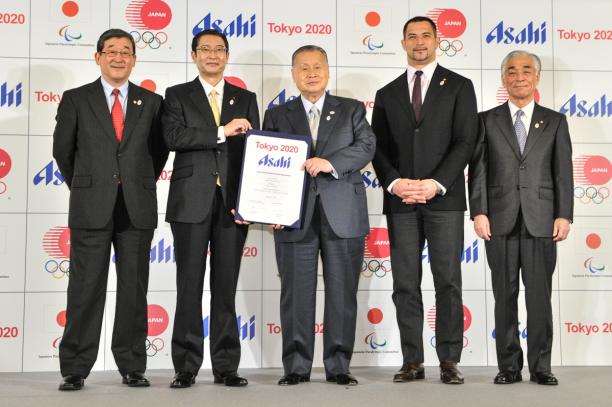
    Tokyo 2020 signs NTT and Asahi as Gold Partners

    Nippon Telegraph and Telephone (NTT) Corporation and Asahi Breweries have both signed as gold partners of the Tokyo 2020 Olympic and Paralympic Games, within the space of two days. 
    On Monday, the Tokyo-based NTT Corporation signed as Official Telecommunications Services Partner.
    NTT Corporation will provide telecommunications services for hosting the Games. 
    On Tuesday, Asahi Breweries was announced as the second Gold Partner in the “Beer & Wine” category. 
    The world’s highest earning telecommunications company, NTT also worked on Japan’s three previous Olympic Games: Tokyo 1964, Sapporo 1972 and Nagano 1998.
    “NTT has a long and distinguished history of connecting people across the length and breadth of Japan, and it is my earnest wish that we will be able to work together to further strengthen bonds between people and ensure that we deliver a successful Olympic and Paralympic Games in 2020,” said Tokyo 2020 President Yoshir? Mori.
    In today’s world, security is a major function of the telecommunications partner. 
    “With the rapid evolution of ICT (information and communications technology), the Tokyo 2020 Olympics and Paralympics require telecommunications convenience to be accompanied by safety more than ever before,” NTT said in a statement.
    “In addition to helping make the Games’ telecommunications safe, secure, and welcoming, NTT is taking advantage of the Group’s telecommunications related security technologies and its telecommunications service infrastructure inside and outside Japan, endeavouring to act as a ‘value partner’ in providing an unprecedented level of hospitality to the Tokyo 2020 and other relevant organisations, as well as competitors and guests from Japan and overseas.”
    The second Gold Partner to sign, Asahi Breweries, is already a Gold Partner of the Japanese Olympic Committee. 
    “As becoming the Tokyo 2020 Gold Partner (Beer & Wine), we are greatly looking forward to support not just the Japanese national team, but also every single athlete competing in the Games, allowing them to perform beyond their limits, and convey the message of the magnificence of having hopes and dreams to the children who bear the future,” said Akiyoshi Koji, president of Asahi Breweries.
    “Asahi Breweries has an excellent slogan, which translates roughly as ‘Let’s share the emotion,’” said Mori. 
    “This slogan very much echoes the efforts of the Tokyo 2020 Organising Committee to support athletes in their endeavours and to provide a stage where that emotion can be shared.
    “During the Games, the whole of Japan will be raising their glasses and cheering on the athletes, and we are looking forward to working closely with Asahi Breweries to share the emotion of the Tokyo 2020 Games.”
    The Tokyo 2020 organising committee is reported to be targeting $1.1bn of sponsorship revenue to fund staging the Games, with the top tier gold category said to be valued at $128m. At these prices, Tokyo 2020 could already be 30 per cent of the way towards its sponsorship revenue target. 
    The domestic sponsors of the organising committee are distinct from the International Olympic Committee’s global TOP sponsorship programme, which also makes a major contribution to hosting the Games while supporting the Olympic movement worldwide and includes Japanese companies Bridgestone and Panasonic.