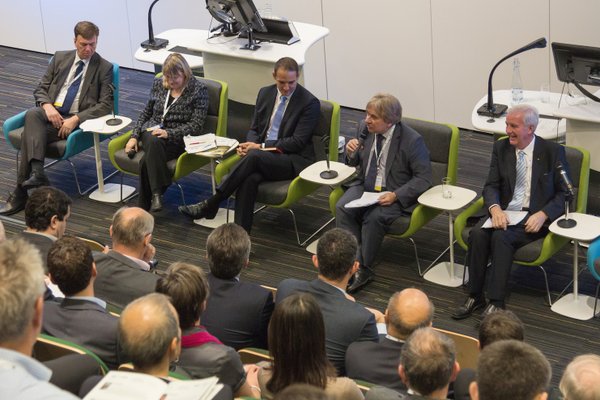
HOST CITY 2015 Conference and Exhibition drew to a close in Glasgow on Tuesday following two days of open discussions exploring the challenges and benefits of bidding for and hosting major global events.
Now in its second year, Host City has firmly established itself as the leading EU-based meeting of cities and sports, business and cultural events. Under the theme ‘Creative Innovation’ HOST CITY 2015 brought together a unique collection of city leaders and cross-sector rights holders, event owners, suppliers and world class-speakers in the business of major international events.
High on the agenda on the final day of the conference was the issue of sustainability and how a multi-city approach to hosting could allow events of the future to remain viable and grow by increasing their reach.
Speaking on the UEFA EURO 2020 Championships, Stewart Regan, Chief Executive of the Scottish Football Association, host of four matches within the tournament, said: “As you can imagine it’s a huge logistical exercise – trying to plan for one country and several stadia is a big exercise but imagine doing that across 13 countries.
“Planning the security, planning the logistics of moving sponsors, fans, and broadcasters around Europe – it’s a massive exercise. But the benefits of involving 13 countries, including some of the smaller countries who couldn’t host an event on their own, outweigh the challenges that the logistics present.”
Hampden Park in Glasgow will stage three UEFA Euro 2020 group stage games and one last 16 match.
Paul Bristow, Director of European Sports Championships Management argued that a multi-city approach could have sustainability benefits for future events.
“The key word here is sustainability. We have too many white elephants,” he said.
“We can be smarter in the way that we use existing facilities but at the same time still use major events to promote investment in sustainable new facilities that cities need. And if we can combine existing facilities in cities that will work together in partnership then I think that is a sustainable model.”
Paul Dunphy, Major Events Consultant for SportBusiness Intelligence and former Manager Event Prospecting and Bidding at Auckland Tourism Events & Economic Development said: “I think it is a long-term innovative approach. We had the Cricket World Cup in New Zealand and Australia recently and when you’re a small nation with minimal resources you need to be innovative. The [2015] Cricket World Cup was a great example of how multi-city, multi-national events are the future.”
Also under discussion was the critical question of how transport and security strategies contribute to the success of bidding for and hosting major events, including creating positive post-event legacies for cities. Malcolm Tarbitt, Executive Director – Safety and Security for the International Centre for Sport Security (ICSS), said: “Major sporting events are short-term initiatives that have major long-term impact and they pose a tremendous challenge to host nations in terms of their image, sovereignty and integrity.
“In the past few years the cost of hosting major sporting events has increased astoundingly, including cost of security strategies and operations plans. The threat landscape is ever changing, ever evolving and the responsibility on bidding nations and organising committees is becoming ever greater to determine, manage and defend their security plans and budgets. To mitigate this you need to involve security upfront, as early as possible and apply a holistic and integrated approach to planning.”
Other leading speakers across the two-day conference included: Sir Craig Reedie CBE, Vice President, International Olympic Committee; Louise Martin CBE, President, Commonwealth Games Federation; David Grevemberg CBE, CEO, Commonwealth Games Federation; Brian Cookson OBE, President of the Union Cycliste Internationale (UCI); Sarah Lewis, Secretary General of the International Ski Federation (FIS) and the Association of International Winter Sports Federations; Alexander Koch, Corporate Communications Manager for FIFA; Hidetoshi Fujisawa, Executive Director of Communication and Engagement, Tokyo 2020; Simon Clegg CBE, former COO, Baku 2015 European Games; and Ali Russell, Director of Media and Strategic Partnerships, Formula E.
Category: Event Management
-
HOST CITY 2015 experts predict rise in multi-city events
-
SOS Global joins AGES as new Industry Partner
The Association of Global Event Suppliers (AGES) and SOS Global Express has signed a three year agreement for “Logistics and Transportation” under the AGES Industry Partnership Program.
“SOS Global is honoured to team up with AGES as their Logistics Partner,” said Stephen O’Connell, Vice President of SOS Global.
“Since we started the company in 1986 we have consistently expanded our reach into Global Events and we believe this Partnership is a natural expansion that will benefit all involved.”
With the expertise and support of SOS Global AGES will develop new standards, procedures and other tools to increase efficiency and reduce costs for event logistics.
“It is not just about reliability and costs. Through our partnership we want to explore and find smarter solutions for our industry”, said Daniel Cordey, chairman of AGES.
The Industry Partnership Program is a program created by AGES for leading industrial companies who are directly connected with the business of its members and are willing to support the initiatives of AGES in specific thematic categories. Through knowledge transfer and active involvement by the partners, the IPP shall contribute to the elaboration of new standards and policies for the event suppliers industry. AGES and EY recently signed a partnership for the category “Assurance, Tax and Legal”.
SOS Global Express has provided freight forwarding and logistics for global events from the 1987 NFL Super Bowl and 1988 Olympic Games to the 2014 FIFA World Cup in Brazil, 2014 Sochi Winter Olympic Games, Nanjing Youth Olympic Games and the 2015 FIFA Women’s World Cup in Canada.
Daniel Cordey, who was an executive director of Nüssli Group from 1990 to 2014, is moderating the panel discussion on Innovations in Event Infrastructure at HOST CITY 2015, the leading EU-based meeting of cities and sports, business and cultural events, which takes place in Glasgow on 9th to 10th November.
-
Gymnastics and Golf join 2018 European Sports Championships
Gymnastics and Golf are to join the prestigious line up of leading sports who will stage their European Championships together in 2018 for the first time in their history, the sports’ European associations announced on Friday.
The dates of the inaugural Championships were also confirmed as the 1st to 12th August 2018.
The two new sports join Athletics, Aquatics, Cycling, Rowing and Triathlon, who have decided to come together for the first time for the European Sports Championships which will be staged in the Host Cities of Glasgow and Berlin.
“One of the challenges this project had to face was to create a programme that could offer the best conditions for athletes to express themselves while also creating interest for the main TV networks in Europe. The result of very fruitful discussions allow me to express my satisfaction that Glasgow and Berlin will showcase one of the best events of all time,” said Paolo Barelli, President of the Ligue Européenne de Natation (European Aquatics.
“Each individual European Federation will create a fantastic programme that will maximise interest and LEN is proud to be a pioneering partner of such an ambitious project that will contribute significantly to the development of sport.”
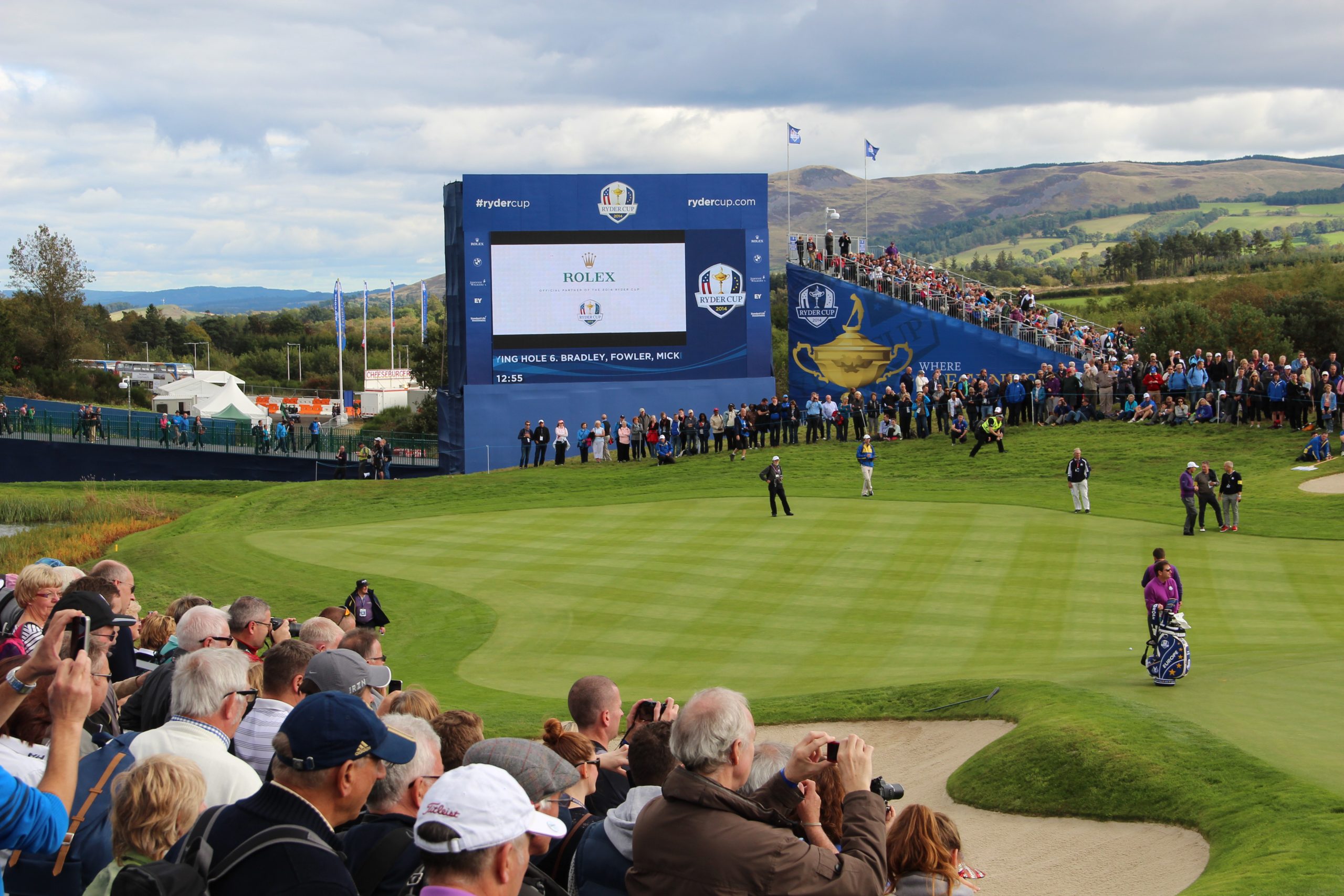
The European Artistic Gymnastics Championships will be staged in Glasgow at the SSE Hydro while the brand new European Golf team championships will take place at Scotland’s prestigious Gleneagles course.
“It is very exciting for Golf Europe to be invited to join some of Europe’s leading sports in the inaugural European Sports Championships, with three new European Golf Team Championships for female, male and mixed teams,” said Keith Waters, The European Tour’s Chief Operating Officer and Director of International Policy.
“This is part of our vision of encouraging all European nations to participate in golf, and it is fitting that Gleneagles will host the first staging of this event, having been the venue for last year’s Ryder Cup, when Europe memorably united through team golf.”
Berlin will host the 2018 European Athletics Championships from the 7th to 12th August, with Glasgow hosting the six other European Championships over the 12 days.
“As one of the key sports, European Athletics has been happy to lead the process in the creation of the principles of good governance for the inaugural European Sports Championships, and we are pleased to move forward with this strong framework in place,” said European Athletics President Svein Arne Hansen.
“We are looking forward to a fantastic European Athletics Championships in Berlin in 2018 as part of this exciting multi-sport concept. We are sure the European Sports Championships will bring additional values and benefits to athletics in Europe and to the Berlin championships.”
The partnership between European Athletics, Aquatics (LEN), Cycling (UEC), Rowing (FISA) and Triathlon (ETU) welcomed European Gymnastics (UEG) and Golf Europe is set to create a major new multi-sport event on the world stage, attracting a projected television audience of around 850 million and an even wider audience via multiple digital platforms.
The newly-formed European Sports Championships 2018 Board 2018 Board also ratified the organisational rules and decision-making processes to ensure strong governance going forward.
This innovative new approach by the governing bodies, who announced their plans earlier this year, brings the existing European Championships together from seven sports in a sustainable format once every four years in order to continue building their prestige, profile and media exposure.
Around 1,500 athletes will compete in Berlin as part of the European Athletics Championships while approximately 3,025 athletes will visit Scotland for the other six events.
All seven Championships will be staged within the agreed date window.
“With all the sports now confirmed for 2018 Glasgow is again ready to show the excellence and innovation with which it can stage world class events on the global stage,” said Councillor Frank McAveety, Leader of Glasgow City Council.
“Major events have become a crucial part of our city’s economy and we can now look forward with tremendous excitement and focus to partnering with this fantastic group of sports to continue to create opportunity and help improve health and well-being outcomes for our citizens.”
The European Broadcasting Union (EBU), the consortium for the continent’s public service free-to-air broadcasters, will be the broadcast partner for the combined championships, which are expected to generate more than 2750 hours of programming across Europe’s biggest broadcasters.
EBU President Jean-Paul Philippot, said: “With seven sports now part of the first edition, the European Sports Championships will be the centrepiece of the sports season in Europe and public service media is proud to participate in the promotion of European sports and its athletes through extensive free-to air coverage across television, digital and radio.”
The Golf event will be staged over 5 days and include men’s team, women’s team and mixed team competition.
Two male and female athletes per nation will participate, with the top 16 European nations included.
The Gymnastics event will include both the Men’s and Women’s Artistic Championships, with around 600 athletes competing in Glasgow over six days.
“We are really excited to be included in the 2018 European Sports Championships as it represents a huge opportunity for Gymnastics to further raise its profile right across Europe,” , said Georges Guelzec, President of European Gymnastics.
“We can also think of no better city than Glasgow to host our 600 competitors who will compete in the men’s and women’s European Artistic Championships.”
Innovative event hosting formats is a key theme of Host City 2015, which takes place in Glasgow on 9th to 10th November. Register your attendance at www.bidtowin-hostcity.net -
WADA president takes tough action on doping
WADA president and IOC Vice President Sir Craig Reedie CBE on Wednesday asserted he is taking quick and strong action in response to evidence of widespread doping in athletics.
In an editorial published in the Independent, he said “There have been critics of the World Anti-Doping Agency, and critics of me, and first and foremost I don’t want people to think I’m too political or too soft.
“I can categorically state I have not been soft on Russia. It was me as president of WADA that agreed with several national anti-doping organisations to create an independent commission to look into the subject of doping in Russia, the results of which we saw in all its damning detail in Geneva on Monday.”
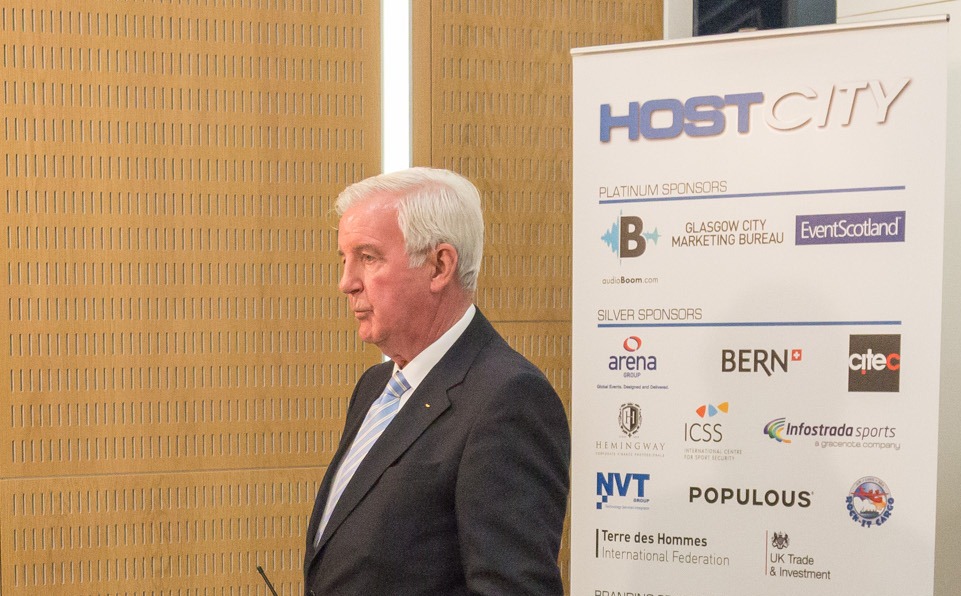
Speaking to press at Host City 2015 on Monday, Reedie said WADA was responding to calls to be tougher.
“I think the world will want us to be much stricter and aggressive in saying whether people are compliant or not.”
The independent report revealed that officials at a WADA accredited drug testing laboratory in Moscow destroyed 1,417 samples and accepted bribes to cover up positive tests.
“It’s quite clear that that was organised between a laboratory, a national anti-doping association, almost certainly a national athletics association – three different organisations combining to beat the system.”
WADA reacted immediately by provisionally suspending the laboratory’s accreditation.
“We have responsibility for the Russian anti-doping agency and its state of compliance – quite clearly it is not compliant at the moment – we can deal with that.
“As far as the national athletics federation in Russia is concerned, that is the responsibility of the IAAF and their responsibility under the code is to make sure that the national federations are code-compliant. We will clearly work with the IAAF as closely as they want us to and as we are able to resolve this issue.”
Asked by press at Host City 2015 whether the IAAF leadership was able to handle the crisis, he said “I think the allegations of people at the top end of the IAAF are intensely regrettable. They have done the sport in my view great damage.
“This is a newly elected council, a new president. And yes I think the new leadership can do it. It’s not going to be easy and it’s going to involve a great deal of effort, but we will help them as best we can.”
Responding to a question from Host City magazine about whether athletes are in some cases victims, he said: “My experience is that very few drug cheats do it themselves; they almost always have somebody else. So I am very happy with the principle that we deal with the athlete’s entourage; the rules also say that we deal with the athlete.
“But I agree with you; if you coaches and people who are administering drugs to athletes then they are in many ways more guilty than the athletes themselves.”
Reedie told Host City how WADA has become stronger under his leadership.
“We greatly strengthened the new 2015 code by specifically targeting the athletes’ entourage. Secondly we created an offence called ‘prohibited association’, so if an athlete is associating with a known member of the entourage who has been convicted of a doping offence then the athlete shouldn’t be there.
“We have produced a list and that’s now current. If any of the officials mentioned in the Pound report are sanctioned they will immediately be put on that list.”
The next phase of the WADA-commissioned report will investigate allegations beyond Russia.
“Is there a sense that things could get worse before they get better? Quite possibly. We still await further revelations from the commission and, because of its independence, I genuinely have no idea what those revelations will be,” Reedie wrote in the Independent.
“At the end of the day, I think good will come out of evil,” he told press at Host City 2015.
-
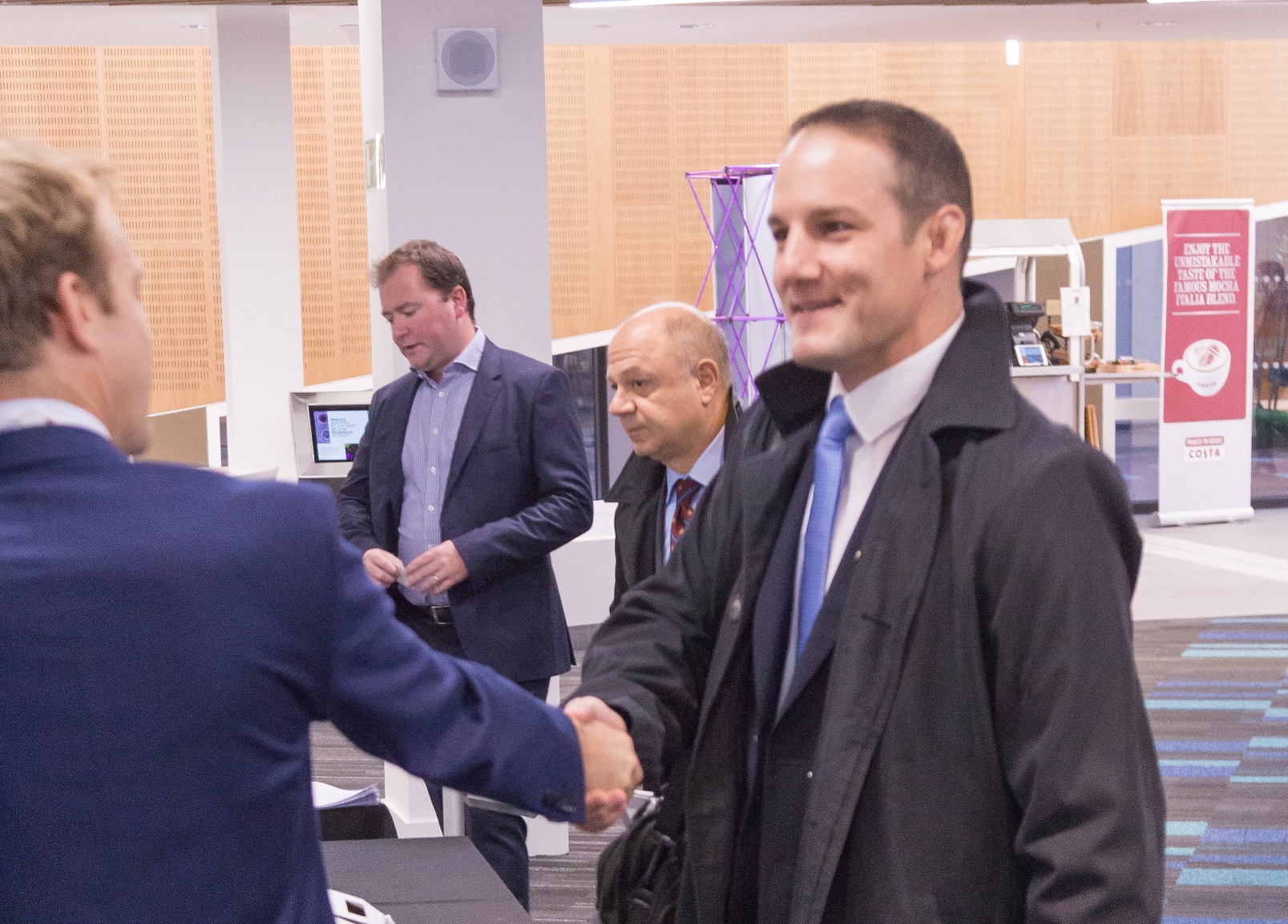
David Grevemberg awarded CBE as Host City 2015 opens
The Commonwealth Games Federation’s Chief Executive Officer, and former Chief Executive of Glasgow 2014 Ltd., David Grevemberg, has been appointed by Her Majesty The Queen as an honorary Commander of the Most Excellent Order of the British Empire (CBE).
The announcement was made by the Commonwealth Games Federation on Monday morning, just before Grevemberg spoke on the opening panel discussion of Host City 2015 conference in Glasgow.
The honour is conferred in recognition of services to the Glasgow 2014 Commonwealth Games.
In a statement issued on Monday morning – just before his arrival at Host City 2015 – Grevemberg said: “The XX Commonwealth Games were a defining moment for Glasgow, Scotland and the Commonwealth Games Movement.
“Whilst it is incredibly humbling to be recognised for my contribution, the successes and impacts of the Games were only made possible by the hard work and support of our partners, participants, staff and citizens.
“I would like to thank Her Majesty for this honour, and look forward to an inspiring, impactful future for the Commonwealth Games Movement, a powerful symbol of the flourishing, modern Commonwealth and its citizens”.
David Grevemberg CBE spoke on the opening panel discussion of Host City 2015 conference on the subject of “How Events and Cities Innovate to Thrive”.
Commonwealth Games Federation President, Louise Martin CBE also spoke at Host City 2015.
“This special honour is testimony to the success and continued legacy of the Best Games Ever, as Glasgow and its people delivered one of the standout performances in Commonwealth sporting history,” she said in the CGF statement.
“I congratulate David on this honour, as we reflect on many happy memories of the Games and move forward with our ambitious plans to deliver Transformation 2022 with our members and stakeholders”.
Born in 1972 in Louisiana, USA, David was a former wrestler, coach and administrator, before taking up post in 1999 as Executive Director of Sport and International Federation Relations at the International Paralympic Committee (IPC), headquartered in Bonn, Germany.
He moved to Scotland to lead the Glasgow 2014 Commonwealth Games Organising Committee in 2009 and still lives near Glasgow with his family. He joined the Commonwealth Games Federation as Chief Executive in November 2014.
The honour is a recognition of the transformational power of Commonwealth sport and its recent positive impact on Glasgow.
Speaking about last year’s HOST CITY conference, Grevemberg said: “I found it enlightening. The calibre of people that attended and spoke was excellent; it was excellent to meet so many experts with a shared perspective and passion and belief that the hosting of major events is a force for good.”
-
Renewing the trust in sport
As an Olympic medallist, recent developments in some sports are particularly upsetting. What saddens me most as a former athlete is that they erode the trust in the clean athlete. Clean athletes who push themselves day in day out pursuing their dreams see the finger of suspicion pointing at them. This is the very worst ‘side-effect’ of doping.
We must do everything we can to protect these millions of clean athletes around the world. For their sake and for the credibility of sports competition, they have to be protected from doping and corrupting influences. We also have to protect the credibility of sports competition from match-fixing and manipulation. The IOC has created a specific 20-million US dollar fund for the protection of clean athletes. This comes on top of overall international investments of an estimated 500-million US dollars for around 250,000 anti-doping tests a year, among other initiatives. The IOC has a zero-tolerance policy against doping and any kind of manipulation and corruption.
Doped athletes already face a four-year ban from any kind of sports competition for their first infringement. This means an effective ban from the next edition of the Olympic Games. As a young man, I called for life bans even for the first infringement. Unfortunately, such a sanction would not be upheld by any judicial court. But what we can do is making the anti-doping system more independent from sports organisations. In this respect, the IOC took the initiative to ask the World Anti-Doping Agency (WADA), the international authority in the fight against drugs in sport, to consider taking over testing programmes from the international sports federations. The IOC also proposed that the Court of Arbitration of Sports (CAS), the highest judicial body for the sports world, take over all sanctioning of doped athletes.
Zero-tolerance also means all nations and all sports have to be compliant with WADA’s rules. On this front, sport requires the support of governments. Let us not forget that governments have a 50% stake in WADA. Governments need to make sure that their national anti-doping authorities are WADA-compliant. Governments also have to ensure dealers, corrupt doctors and coaches are punished with the full force of the law.
Protecting the clean athlete goes hand in hand with ensuring that the environment in which the athletes operate is safe from corrupting influences. To fight manipulation in sport and specifically match-fixing and illegal betting, the IOC and the International Sport Federations are already working closely with police, betting operators and regulators around the world. Recognizing the international nature of organized crime, the IOC is also engaged with Interpol to safeguard the integrity of sport.
Fighting corruption also means that good governance for sporting organisations is essential. The IOC has put the necessary measures in place since a long time. More recently, the reforms passed in Olympic Agenda 2020 exactly one year ago, ensure internationally recognized standards of governance. As a result, all our accounts are audited at a higher international financial reporting standard (IFRS) and we are publishing everything in our annual report, as is common practise in the corporate world; we have term and age limits for all IOC Members; we have a chief ethics and compliance officer, an audit committee and an independent ethics commission. We have called on and we expect all sports organisations to follow this route. All these measures and others, which are publically available, allow the IOC to distribute over 90% of our revenue – that is $3.25 million each and every day – back to athletes and world sport.
The recent discussions on these issues show the huge significance sport has in our society. Sport has the power to make the world a better place. If these good governance measures are adopted and the zero-tolerance policies are followed by all sport organisations, there is a very bright future for sport. As Nelson Mandela said: “Sport has the power to change the world.” Yes, these are difficult times for sport. But yes, it is also an opportunity to renew the trust in this power of sport to change the world for the better.
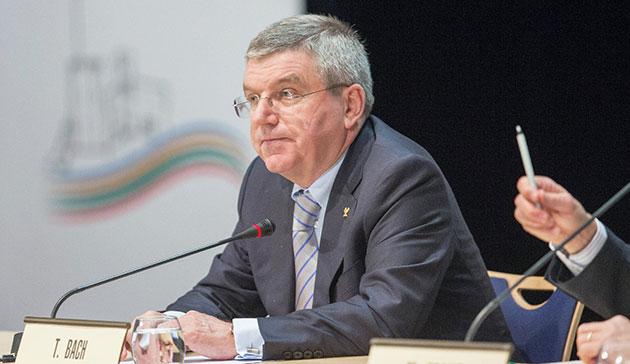
This opinion piece by IOC President Thomas Bach is also published on www.olympic.org
-
How can future tournaments remain sustainable? The solution is in the format
Since the original Olympics Games in Ancient Greece, tournament format has remained the same: Round-Robin Groups and Direct Elimination (play-offs). The usage of these formats has caused several issues that organisers have failed to solve.
One major issue is flexibility in the number of participants and matches. Then there is the existence of low-value or “dead” matches, where teams have nothing to play for because they’ve already qualified for the next round or have been eliminated.
Match-fixing is another problem. In London 2012 for instance, eight female badminton players were disqualified from the tournament due to their attempts to lose their matches on purpose to get an “easier” rival in the next round.
Losing or drawing a match on purpose for the benefit of both sides is something that we see in almost every big tournament. In an attempt to address this issue, matches on the last day of group stages are played simultaneously in many big tournaments, such as the UEFA European Championship and FIFA World Cup. This precautionary move, which followed the “Disgrace of Gijon” in the 1982 FIFA World Cup, can be devastating for fans, sponsors and broadcasters and creates further problems.
Having the last two matches of a group played simultaneously means that two stadiums must be used for each group, so teams must travel from one city to another. In a group of four teams the only way to make teams have the same amount of travels, to ensure fairness, is by making all teams travel twice – that is, playing the first match in one stadium, the second in another and a third stadium for the third match. Having all teams travel once is impossible mathematically, and zero travel is not an option when staging matches simultaneously.
Travelling twice during the group stage can involve a large amount of air travel. For instance, In 2014 FIFA World Cup the United States national team had to travel from Natal to Manaus and then to Recife, a total distance of nearly 6,000 miles.
MatchVision, a company based in Chile, has the solution for this and the associated issue of flexibility in the number of participants in a tournament. In 2003, FIFA expressed an interest in raising the number of participants in the World Cup to 36, but declared it impossible as they couldn’t find a fair and simple way to select 16 teams advancing to the Round of 16.
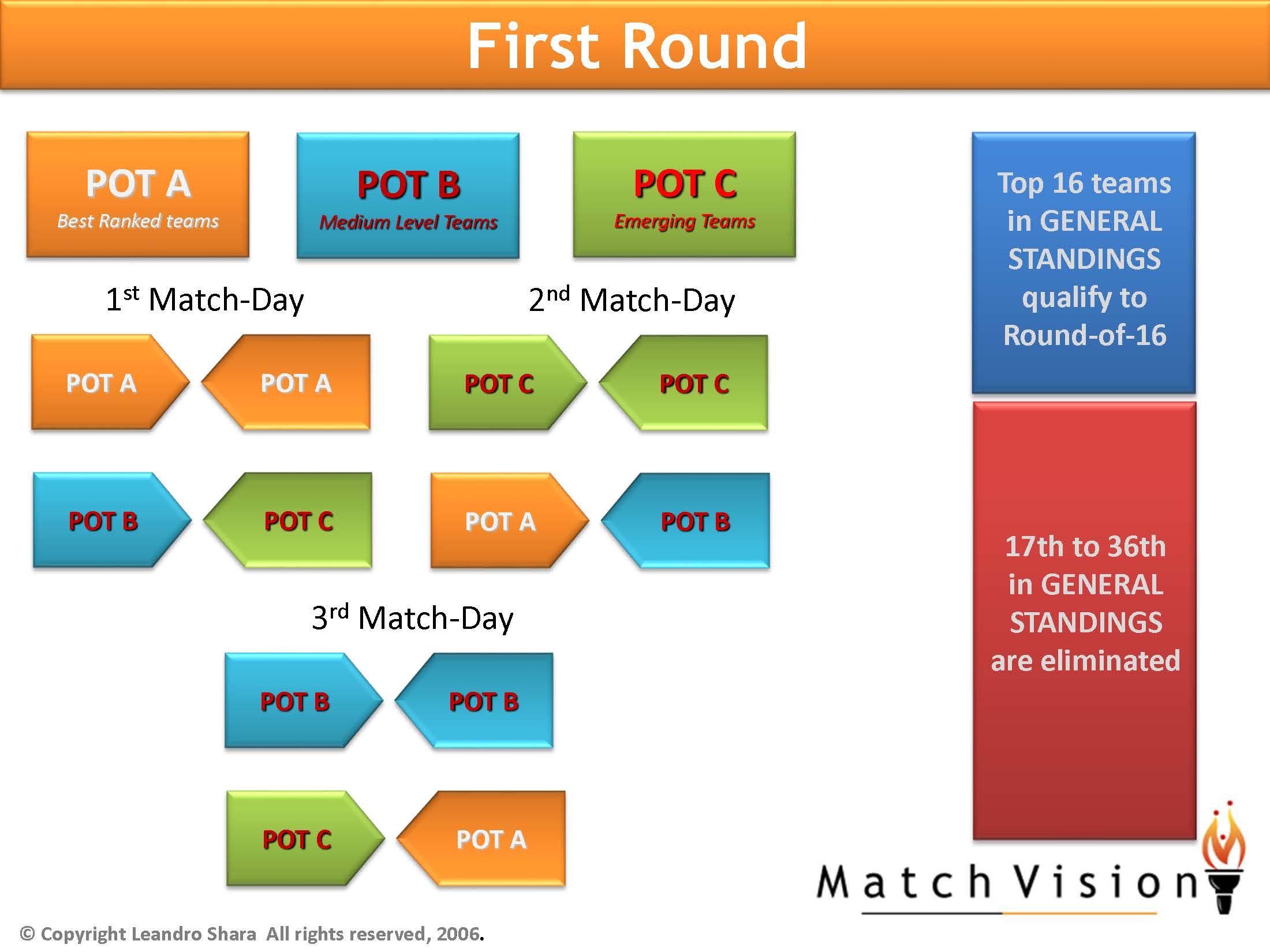
After hearing that declaration, Leandro Shara, MatchVision President and founder, knew he had the solution for it – the POT System ©. Under the POT System © there are no groups; instead, the teams are divided into POTs, depending on the number of matches of the first round.
For instance, a FIFA World Cup with 36 teams would have three POTs, each one containing 12 teams, based on ranking – POT A would have the strongest teams, POT B the medium teams, and POT C the emerging teams. Each team, no matter which POT it is placed in, would play three matches, one against a team from POT A, one against a team from POT B, and one against a team from POT C. For instance, Germany would meet Argentina from POT A, Croatia from POT B and Jordan from POT C. On the other hand, Jordan from POT C would meet Germany (A), as well as Uruguay (B) and Costa-Rica (C).
The POTs are not groups, instead we will have one General Standing of the 36 teams, and after three match days the best 16 would qualify to the next round, fair and simple. Moreover, in the Round of 16 the 1st would face the 16th, the 2nd would face the 15th, etc. That means that teams would want to finish as high as possible to have an “easier” rival in the next match.
This will bring a revolution in the strategy of winning tournaments: the best way would always be, for the first time, to win all matches. It also kills the chances of score manipulations, as teams would not depend just on their match and one additional match (in a four-team group), but on their match and results from the other 17 matches.
Eliminating the possibility of score manipulation would allow all matches in the first round to be played at different times, so spectators around the world could watch all matches live. Additionally, we can ensure that all teams travel exactly once in the first stage and travel the shortest distance from their “home” base. This means that if each host city has another host city within 500 miles or less, than maximum travel for a team would be 500 miles, even if host cities are spread over an entire continent.
The opportunities don’t stop there. MatchVision has developed more than 30 solutions giving flexibility to tournaments. So for instance, the Olympic Volleyball competition could have 10 teams instead of 12, with teams still playing five matches in the first round, or to increase the number of teams in the Badminton tournament from 16 to 18, a 12 per cent increase, instead of the usual 50 per cent or 100 per cent increase caused by the rigidity of Groups and Play-Offs formats.
The inflexibility of the traditional tournament formats has created absurd situations, like the ATP World Tour Finals, which is played by eight players, even though the entire world of tennis, including the ATP website itself, talks always about TOP-10. To have a clearer picture of things, the phrase TOP-10 is googled 25 times more than TOP-8. The only reason just 8 players enter the O2 Arena is due to format restrictions, and thus we adjust the reality to the format.
It is time to turn that upside down and adjust format to reality, using tournament formats developed in the 21st century. The format revolution is coming.
-
Blatter and Platini banned from football world
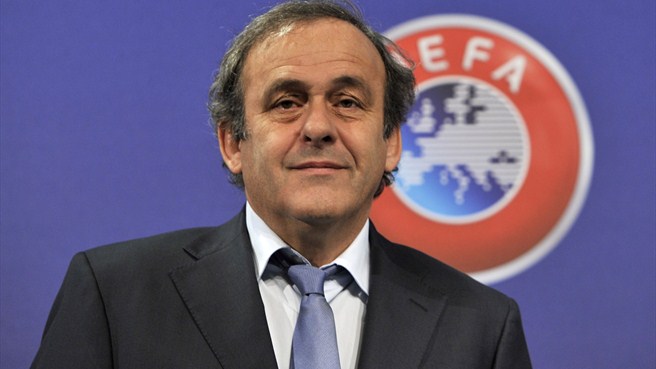
The adjudicatory chamber of the Ethics Committee chaired by Mr Hans Joachim Eckert has banned Mr Joseph S. Blatter, President of FIFA, for eight years and Mr Michel Platini, Vice-President and member of the Executive Committee of FIFA and President of UEFA, for eight years from all football-related activities (administrative, sports or any other) on a national and international level. The bans come into force immediately.
The proceedings against Mr Blatter primarily related to a payment of CHF 2,000,000 transferred in February 2011 from FIFA to Mr Platini. Mr Blatter, in his position as President of FIFA, authorised the payment to Mr Platini which had no legal basis in the written agreement signed between both officials on 25 August 1999. Neither in his written statement nor in his personal hearing was Mr Blatter able to demonstrate another legal basis for this payment. His assertion of an oral agreement was determined as not convincing and was rejected by the chamber.
The evidence available to the adjudicatory chamber in the present case was not sufficient to establish, to the extent required, that Mr Blatter sought the execution or omission of an official act from Mr Platini within the meaning of article 21 paragraph 1 of the FIFA Code of Ethics (FCE) (Bribery and corruption). However, the conduct of Mr Blatter towards Mr Platini without a legal basis constituted a breach of article 20 paragraph 1 of the FCE (Offering and accepting gifts and other benefits). Furthermore, Mr Blatter found himself in a situation of conflict of interest, despite which he continued to perform his related duties, failing to disclose said situation and the existence of personal interests linked to his prospective activities, thus violating article 19 paragraphs 1, 2 and 3 of the FCE (Conflicts of interest). By failing to place FIFA’s interests first and abstain from doing anything which could be contrary to FIFA’s interests, Mr Blatter violated his fiduciary duty to FIFA and breached article 15 of the FCE (Loyalty). Mr Blatter’s actions did not show commitment to an ethical attitude, failing to respect all applicable laws and regulations as well as FIFA’s regulatory framework to the extent applicable to him and demonstrating an abusive execution of his position as President of FIFA, hence violating article 13 of the FCE (General rules of conduct).
In consequence, Mr Blatter has been banned for eight years from all football related activities and fined CHF 50,000.
The investigation into the case of Mr Blatter was conducted by Mr Robert Torres, member of the investigatory chamber of the Ethics Committee. The investigation resulted in a final report which was submitted to the adjudicatory chamber on 20 November 2015. The adjudicatory chamber opened formal proceedings on 23 November 2015, and the hearing of Mr Blatter took place in Zurich on 17 December 2015.
The proceedings against Mr Platini primarily related to a payment of CHF 2,000,000 that he received in February 2011 from FIFA. The payment to Mr Platini had no legal basis in the written agreement signed between both officials on 25 August 1999. Mr Platini’s assertion of an oral agreement was determined as not convincing and was rejected by the chamber.
The evidence available to the adjudicatory chamber in the present case was not sufficient to establish, to the extent required, that Mr Platini obtained the payment for the execution or omission of an official act within the meaning of article 21 paragraph 1 of the FCE (Bribery and corruption). Nevertheless, the conduct of Mr Platini without a legal basis constituted a breach of article 20 paragraph 1 of the FCE (Offering and accepting gifts and other benefits). Furthermore, Mr Platini found himself in a situation of conflict of interest, despite which he continued to perform his related duties, failing to disclose said situation and the existence of personal interests linked to his prospective activities in violation of article 19 paragraphs 1, 2 and 3 of the FCE (Conflicts of interest). By failing to place FIFA’s interests first and abstain from doing anything which could be contrary to FIFA’s interests, Mr Platini also violated his fiduciary duty to FIFA and breached article 15 of the FCE (Loyalty). In addition, Mr Platini failed to act with complete credibility and integrity, showing unawareness of the importance of his duties and concomitant obligations and responsibilities. His actions did not show commitment to an ethical attitude, failing to respect all applicable laws and regulations as well as FIFA’s regulatory framework to the extent applicable to him and demonstrating an abusive execution of his position as Vice-President of FIFA and member of the FIFA Executive Committee, hence violating article 13 of the FCE (General rules of conduct).
In consequence, Mr Platini has been banned for eight years from all football related activities and fined CHF 80,000.
The investigation into the case of Mr Platini was conducted by Ms Vanessa Allard, member of the investigatory chamber of the Ethics Committee. The investigation resulted in a final report which was submitted to the adjudicatory chamber on 20 November 2015. The adjudicatory chamber opened formal proceedings on 23 November 2015, and the hearing took place in Zurich on 18 December 2015 in the presence of Mr Platini’s lawyers.
Source: FIFA
-
FIFA acting leaders look to the future
Dear friends of football,
FIFA has faced unprecedented difficulties this year in a crisis that has shaken global football governance to its core. We are now moving through a period of necessary change to protect the future of our organisation.
We maintain that the majority of those working in football governance do so in the right way and for the right reasons, but it has become clear that root-and-branch reform is the only way to deter future wrongdoing and to restore faith in FIFA. For these reasons, this year and the immediate years to come will be among the most important for FIFA since it was founded in 1904.
A new FIFA President will be elected at the Congress in February, offering the opportunity to start a new chapter. It is vital to recognise that this will be only the beginning. We will need to work hard together over the coming years to win back the trust and respect of fans, players, commercial affiliates and all the many millions of participants who make football the world’s most popular sport.
We are confident that the new reform measures approved by the FIFA Executive Committee in December, alongside the separate actions of the Swiss and US authorities, will lay the foundations for a stronger, more transparent and more accountable and more ethical governing body of football.
We call on all of FIFA’s member associations to fully support, implement and abide by the new reforms. The future of FIFA and the global development of football depend on our full commitment to embracing a change in culture from top to bottom, through the following key reform points:
• A clear separation of powers between the political side of global football and the day-to-day financial and business operations of FIFA, such as organising competitions and football development investments, will help to protect our integrity and avoid conflicts of interest. All financial transactions will be monitored by a fully independent body.
• Member associations must mirror the above structure and comply with principles of good governance, such as establishing independent judicial bodies. They will also be accountable for the conduct of their entire team and any third parties that they work with.
• Strict term limits for senior positions within FIFA of three four-year terms will ensure that no single person can wield too much power or influence.
• An explicit commitment in the FIFA Statutes to develop women’s football and to promote the full participation of women at all levels of football governance, including a minimum of one female representative from each region in the new FIFA Council.
• Central integrity checks by an independent body for all appointments to FIFA bodies and senior management.
• Members of the new FIFA Council must be elected by the member associations from each respective region under new FIFA governance regulations and monitored by the new, independent FIFA Review Committee.
• More independent and properly qualified members of key committees such as finance, development, governance and compliance to provide a stronger layer of neutrality and scrutiny.
• More involvement from the football community (players, clubs, leagues, member associations, etc.) in decision making.
• A statutory commitment by FIFA to uphold and protect internationally recognised human rights in all its activities.
There may be further challenges ahead, and it will take time for these reforms to take effect, but our resolve to rebuild FIFA for the better remains steadfast. Our aim is to establish a secure, professional and fully accountable sports organisation by the time of the 2018 FIFA World Cup™ in Russia.
We are confident that this is a realistic target, and we look forward to returning our full focus to FIFA’s primary mission of promoting and developing football everywhere, and for all.
The hundreds of millions of fans, players, coaches and others dedicated to football around the world deserve nothing less from those of us with the incredible responsibility and privilege of governing and guiding global football.
Yours faithfully,
Issa Hayatou Acting FIFA President
Markus Kattner Acting FIFA Secretary General
-
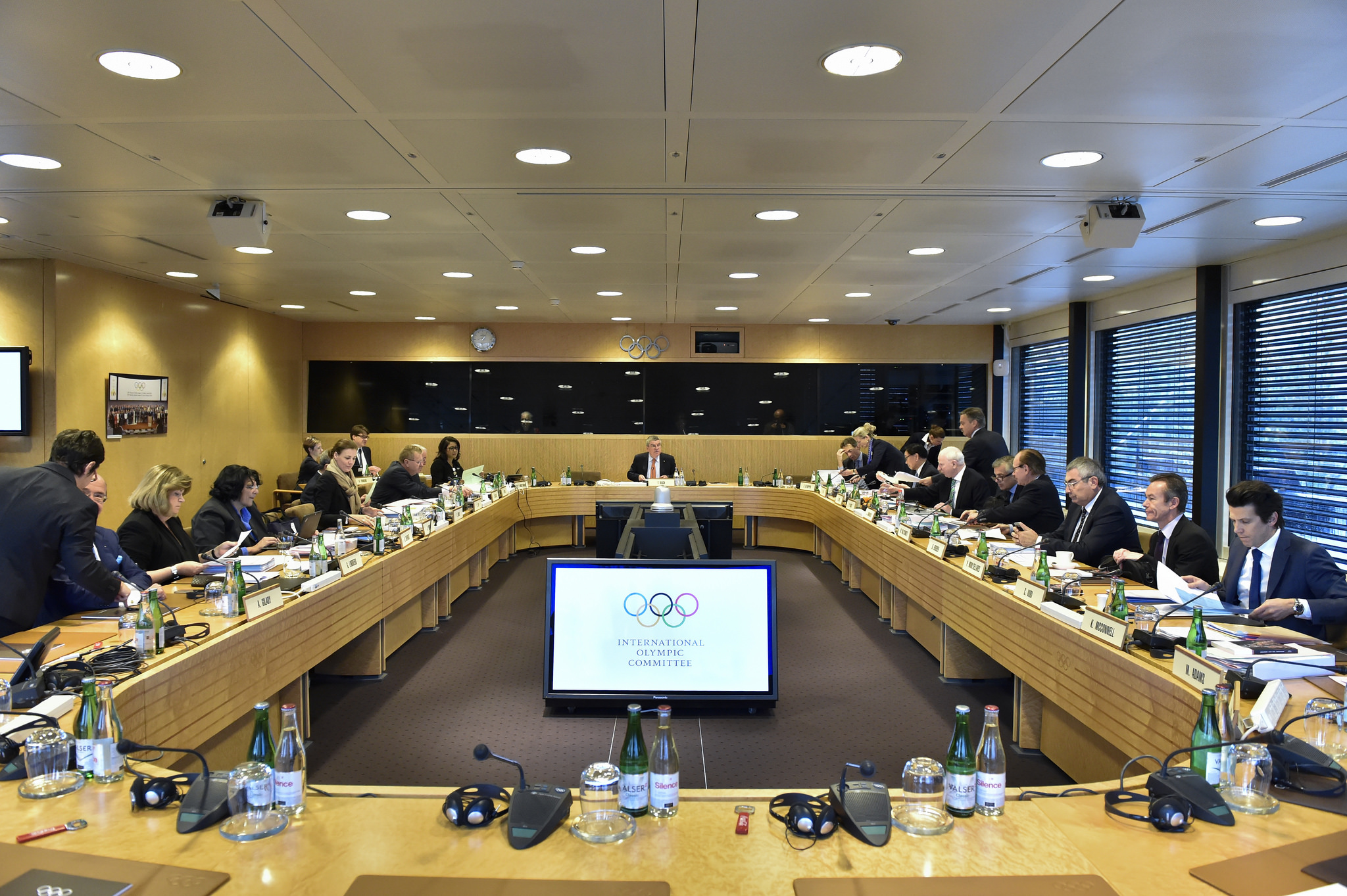
FIFA criminal procedures could affect sport long term, says IOC
The Executive Board of the International Olympic Committee (IOC) on Thursday adopted a declaration on good governance in sport in response to growing concerns of sports organisations.
In the declaration, the IOC singled out criminal investigations into FIFA as an area of particular concern that “could affect all sport organisations” for up to five years.
In a statement, the IOC said the Executive Board welcomed the FIFA Executive Committee’s proposals for major reforms, which include term limits.
However, the IOC said its Executive Board “remains concerned with regard to the ongoing criminal procedures in the United States and Switzerland, which according to these authorities could last for another five years.
“Since this could continue to overshadow the credibility of FIFA and affect all sport organisations for such a long time, the IOC EB encourages FIFA to take all necessary measures to clarify and resolve all the pending issues as soon as possible by further engaging with the relevant authorities.”
At a meeting in Lausanne, the IOC Executive Board addressed requests from “a number of sports organisations which feel affected by incidents in some sports organisations and are concerned their reputation is being tarnished by generalisation.”
The IOC declaration proposes a number of measures to develop good governance in sport. “Recent incidents have shown that, in the interest of the credibility of all sports organisations immediate action to reinforce good governance is necessary,” the IOC statetment said.
According to the declaration, the basic principles of good governance, including transparent and democratic decision making processes, financial reporting and auditing according to international standards, publication of financial reports and ethics and compliance rules, etc. will be applied during 2016.
The IOC will initiate an independent audit system of its major subventions to IFs, NOCs and Organising Committees for the Olympic Games (OCOGs) with regard to the financial as well as the good governance aspects. With regard to all other activities of IFs, NOCs and OCOGs, Recommendation 27 of Olympic Agenda 2020 should be applied as from 2016. The IOC, recognising the independence and autonomy of the IFs, appreciates their support for this initiative as expressed in the IOC EB meeting and by setting up a working group on sports governance by the Association of Summer Olympic International Federations (ASOIF).
The IOC has also has asked the International Institute for Management Development (IMD) in Lausanne and its Global Board Centre to undertake research into good governance at the IOC itself. A first assessment by IMD was presented to the Executive Board.
The IOC Executive Board also confirmed its zero tolerance policy toward doping, expressing support for the authority and autonomy of WADA while putting forward a number of proposals to the WADA working group.
These include establishing an independent testing and results management entity, under the leadership of WADA. “Sports organisations should transfer their doping control operations to this new organisation and make the funding available initially at the level of the present investment in the fight against doping. This organisation should also co-ordinate the work of the national anti-doping agencies to ensure a streamlined, efficient and worldwide harmonised anti-doping system. Governments, which are 50 per cent partners of WADA, should support this reform alongside the sports movement, both logistically and financially,” the IOC said.
This entity should include a “professional intelligence gathering unit” to “address issues that may affect the compliance of anti-doping organisations and anti-doping laboratories accredited by WADA, at the earliest possible stage. This would help to make all such institutions compliant at all times and in such a way as to protect the clean athletes worldwide to the same level.”
The IOC declaration also determined that sanctions should be pronounced by the Court of Arbitration for Sport (CAS) in a centralised way, which would make the system cost-efficient and lead to harmonisation among all sports and all countries. The current right to appeal such sanctions to a different chamber of the CAS would be fully upheld and guaranteed, the IOC said.
The IOC is aiming to have an independent anti-doping system in place from the 2018 Winter Olympic Games in Pyeongchang.